Why Proof of Concept (PoC) is Critical for AI Success
October 17, 2024
4
mins read
Artificial Intelligence (AI) can transform businesses, automate processes, and drive innovation.
Many AI projects fail by skipping feasibility testing before full-scale deployment.
PoC allows businesses to validate AI ideas, identify risks, and ensure seamless integration before full implementation.
Agnotic specializes in AI PoC development, ensuring smooth, cost-effective, and results-driven AI adoption.
The Role of AI PoC in Driving Innovation
Launching an AI project without a PoC is like building a house without a blueprint.
Key Benefits of AI PoC:
Risk Minimization: Identifies potential failures before deployment.
Idea Validation: Tests AI’s ability to solve business problems.
Cost Efficiency: Avoids investments in underperforming models.
Seamless Integration: Ensures compatibility with existing systems.
Stakeholder Confidence: Provides performance insights for decision-makers.
Organizations using PoC see a 60% higher success rate and reduced development costs.
Real-World Case Studies: AI PoC in Action
AI-Driven Customer Support Automation
Challenge: High customer support costs and inefficiencies.
Approach:
Created an AI chatbot prototype using NLP.
Integrated sentiment analysis for tone adjustment.
Tested with a small subset of interactions.
Results:
Reduced resolution time by 50%.
Increased user satisfaction and reduced costs.
Chatbot handled 80% of queries independently post-rollout.
AI-Powered Predictive Maintenance for Operations
Challenge: Manual maintenance caused downtime and high costs.
Approach:
Deployed machine learning to predict failures.
Tested accuracy on select machines.
Recommended optimal maintenance schedules.
Results:
Achieved 95% accuracy in failure prediction.
Reduced downtime by 40%.
Saved millions in maintenance costs after full implementation.
AI-Driven Sales Forecasting
Challenge: Inconsistent sales predictions led to inefficiencies.
Approach:
Used historical sales data and market trends for demand forecasting.
Compared AI predictions with manual forecasts.
Results:
Increased forecast accuracy by 30%.
Optimized inventory and reduced waste.
Boosted revenue by 15%.
How Agnotic Ensures AI PoC Success
Agnotic’s AI PoC Framework:
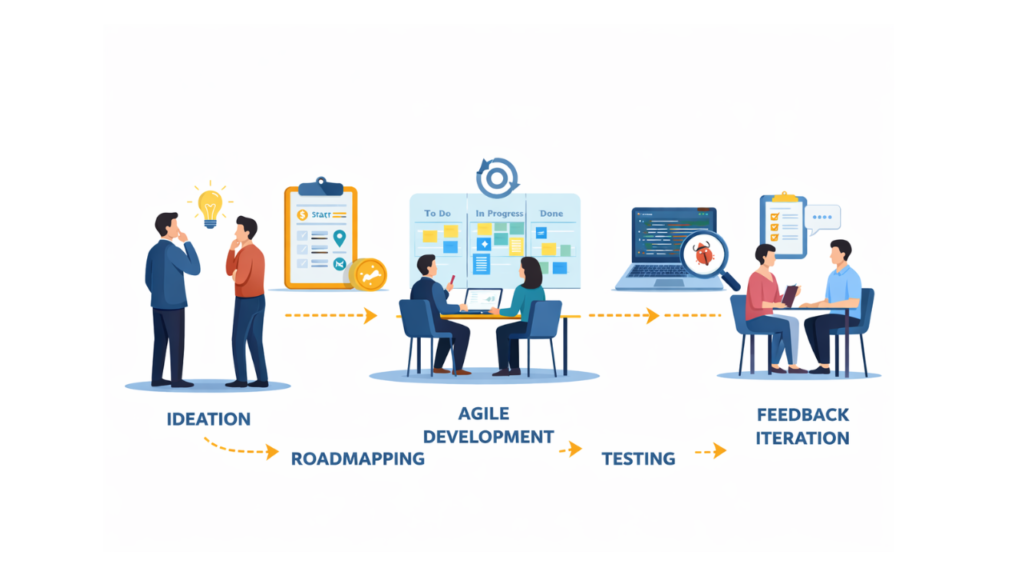
Step 1: Define Goals – Identify business challenges and AI objectives.
Step 2: Build a Prototype – Create a functional AI model for testing.
Step 3: Test & Validate – Evaluate AI in real-world scenarios.
Step 4: Analyze Results – Measure performance and integration success.
Step 5: Scale or Optimize – Proceed with full-scale adoption if PoC succeeds.
Contact Agnotic today to validate your AI ideas with a structured PoC.
Conclusion
A proof of concept is not a shortcut in AI development. It is a safeguard. AI systems behave very differently in real environments compared to controlled demos, and assumptions often break when exposed to real data, workflows, and constraints. A well-executed PoC helps businesses validate feasibility, uncover risks early, and make informed decisions before committing to full-scale implementation.
In 2026, successful AI initiatives are not driven by speed alone, but by clarity. Organizations that treat PoC as a strategic phase gain confidence, reduce wasted investment, and build AI solutions that are practical, scalable, and aligned with real business needs.
If you are exploring AI for your product or operations and want to avoid costly missteps, starting with a focused proof of concept is the smartest path forward. Book a discovery call with Agnotic to discuss how an AI PoC can validate your idea, reduce risk, and set the foundation for successful AI implementation.
Frequently Asked Questions
What is an AI proof of concept (PoC)?
An AI proof of concept is a small, focused implementation used to test whether an AI idea works with real data and real constraints. It helps validate feasibility, performance, and business value before investing in full-scale development.
Why is a PoC important before building an AI product?
AI systems often behave unpredictably when exposed to real-world data. A PoC helps identify technical limitations, data quality issues, and integration challenges early, reducing the risk of failure during full implementation.
What should an AI PoC include?
An effective AI PoC typically includes a clear use case, representative data, basic model or logic implementation, and measurable success criteria. The goal is validation, not feature completeness.
How long does it take to build an AI proof of concept?
Most AI PoCs take between a few weeks to a couple of months, depending on data availability, complexity, and validation requirements. The timeline is intentionally short to support fast decision-making.
Can a PoC be scaled into a full AI solution later?
Yes. A well-designed PoC provides valuable insights that inform architecture, data strategy, and model selection. While not all PoCs are production-ready, they significantly reduce uncertainty when scaling to a full AI solution.