Speed alone no longer defines successful product development. In 2026, teams are expected to deliver value fast, validate assumptions early, and adapt continuously without wasting engineering effort. This shift is why the Agile MVP development process has become the dominant approach for building modern digital products.
Whether you are a startup testing a new idea or an enterprise launching a healthcare or AI platform, Agile MVP development allows teams to reduce risk, control cost, and align product decisions with real user feedback. What Is MVP in Agile Development?
To understand what is MVP in Agile development, it’s important to separate myths from reality. An MVP is not a half-finished product or a quick prototype. In Agile, an MVP is the smallest version of a product that delivers real value and enables validated learning.
Agile focuses on incremental delivery. When combined with an MVP mindset, teams build only what is necessary to test assumptions, solve a specific problem, and learn from users before investing in full-scale development.
Agile and MVP are complementary by design. Agile provides the execution framework through short sprints and continuous feedback, while MVP defines the scope and intent of what is built.
In agile development MVP models, teams avoid large upfront planning and instead prioritize learning through delivery. Each sprint produces a usable increment, allowing stakeholders to validate direction early rather than discovering issues after months of development.
This combination has proven particularly effective in AI-driven products, where uncertainty around data quality, model performance, and user trust is high. We see this clearly in modern approaches like AI Proof of Concept and AI App Development initiatives.
MVP Agile Development in Practice
In MVP agile development, the process begins with identifying a single core problem worth solving. Instead of listing dozens of features, teams define one outcome that determines success.
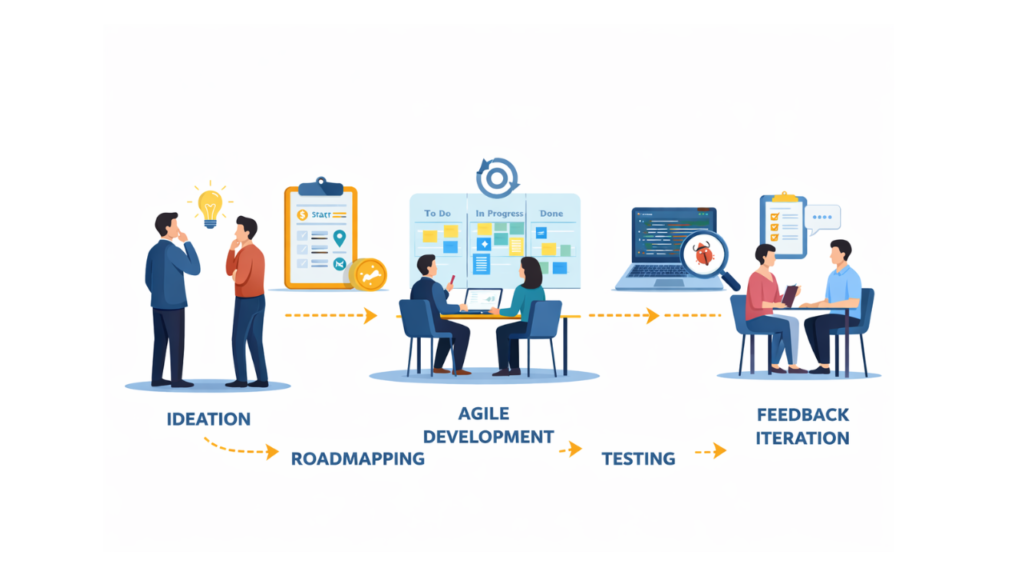
From there, requirements are converted into user stories and prioritized based on value, risk, and effort. Only essential functionality enters the MVP backlog. Development happens in short sprints, with frequent reviews and adjustments based on feedback.
This iterative approach prevents overengineering and keeps teams aligned with real user needs. It also creates natural checkpoints to pivot, refine, or scale the product.
Agile MVP Development Process Step by Step
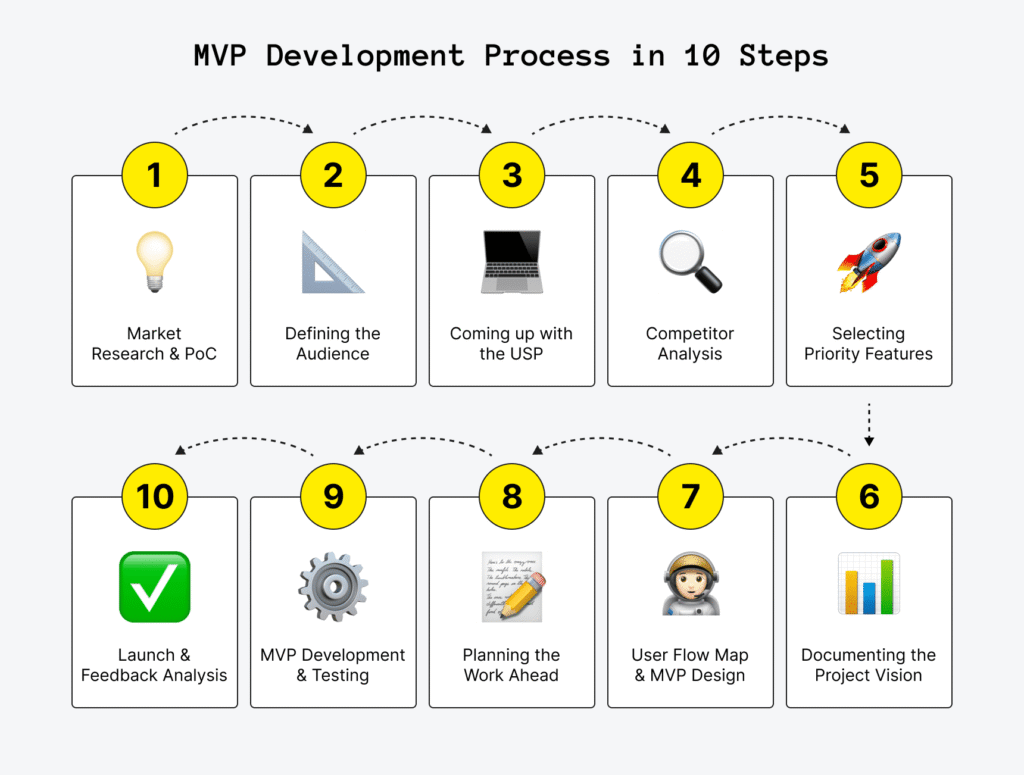
The Agile MVP development process typically starts with discovery and validation. Teams collaborate with stakeholders to understand business goals, user pain points, and technical constraints. This stage defines the MVP scope clearly.
Next comes sprint-based development. Features are built, tested, and reviewed in short cycles. Testing runs continuously, ensuring quality and stability even as the product evolves.
After release, the MVP is exposed to a controlled group of users. Data and feedback collected during this phase guide future iterations. This learn-build-measure loop continues until the product is ready to scale.
This process is widely applied in digital health, as discussed in Fertility Tracking App MVP Development in 2026, where validation, compliance, and user trust are critical from day one.
MVP Development Services Agile Methodology
Many organizations choose MVP development services agile methodology to accelerate delivery while maintaining discipline. Working with experienced Agile teams helps avoid common pitfalls such as unclear scope, feature creep, and delayed feedback loops.
Agile MVP development services typically include product discovery, backlog grooming, sprint planning, development, testing, and iteration support. This structured yet flexible approach allows teams to focus on outcomes rather than rigid plans.
For businesses building scalable platforms, this model aligns well with Software Development, Web App Development, andMobile App Development services where long-term growth depends on early architectural decisions.
Agile MVP Development for Healthcare and AI Products
Agile MVP development has become especially important in healthcare and AI. These domains involve higher risk, regulatory constraints, and complex user workflows.
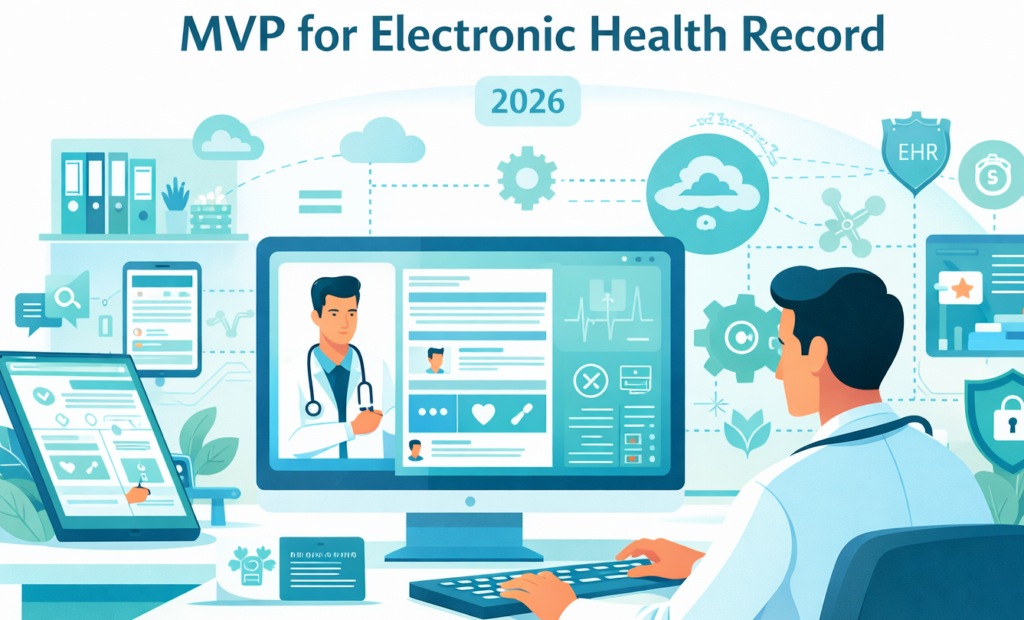
Healthcare MVPs often validate one workflow at a time, such as patient monitoring, clinical documentation, or care coordination. This approach reduces disruption while enabling innovation, as seen in Remote Patient Monitoring MVP Development in 2026.
AI MVPs focus on proving feasibility and value before full deployment. Teams validate data pipelines, model accuracy, and user trust through controlled releases, often starting with an AI Proof of Concept.
Measuring Success in Agile MVP Development
Success in Agile MVP development is not measured by feature count. Instead, teams track engagement, adoption, performance, and feedback. These signals indicate whether the MVP is solving the right problem.
In enterprise and healthcare environments, additional metrics such as workflow efficiency, error reduction, and operational impact are often more important than usage numbers alone.
Agile makes it easier to adjust priorities based on these insights, ensuring development effort remains aligned with business goals.
Scaling Beyond the MVP
Once the MVP is validated, Agile teams can scale confidently. Because the product was built incrementally with real feedback, scaling becomes an extension of the existing system rather than a rewrite.
This is where early decisions around architecture, integrations, and security pay off, particularly for products that evolve into full platforms using DevOps, Backend Development, and Frontend Development practices.
Conclusion
The Agile MVP development process is no longer optional in 2026. It is the most practical way to build products that adapt to uncertainty, reduce risk, and deliver value faster.
By combining Agile execution with an MVP mindset, teams avoid overbuilding, learn from real users, and create a strong foundation for scalable growth. Whether you are launching a healthcare platform, an AI product, or a digital service, Agile MVP development enables smarter decisions at every stage.
Build Your MVP the Agile Way
Validate ideas faster, reduce development risk, and scale with confidence using an Agile MVP approach tailored to your business goals. Book a discovery call with Agnotic to plan your Agile MVP development strategy for 2026
An MVP in Agile development is the smallest functional version of a product that delivers real value and enables learning through user feedback. It focuses on validating assumptions early using short development cycles rather than building a full product upfront.
2: How does Agile MVP development reduce risk?
Agile MVP development reduces risk by delivering features incrementally, validating ideas with real users, and adjusting direction early. This prevents overbuilding, lowers development costs, and avoids late-stage failures.
3: What is the difference between Agile development MVP and traditional MVP?
Traditional MVPs often involve one large release with limited validation. In Agile development MVP models, the product evolves through multiple sprints, with continuous testing and feedback guiding each iteration.
4: When should a business use MVP agile development?
MVP agile development is ideal when requirements are unclear, markets are evolving, or technology risk is high. It is commonly used for healthcare platforms, AI products, SaaS applications, and enterprise systems.
5: How long does Agile MVP development typically take?
Most Agile MVPs are delivered within a few weeks to a few months, depending on scope and complexity. The focus is on rapid validation rather than full feature completion.
6: What services are included in Agile MVP development services?
Agile MVP development services usually include product discovery, backlog creation, sprint-based development, continuous testing, user feedback analysis, and iteration planning for future scaling.
7: Can an Agile MVP scale into a full product late
Yes. Agile MVPs are designed with modular architecture, making it easier to scale features, users, and integrations without rebuilding the system.