Healthcare systems are under increasing pressure to digitize faster while controlling risk, cost, and compliance. By 2026, hospitals and clinics are no longer asking whether digital solutions are necessary, but how to build them responsibly without disrupting care delivery. This is where MVP development has become a critical strategy.
Minimum Viable Product development allows healthcare organizations to test digital solutions in real clinical environments before scaling. For hospitals and clinics, MVPs reduce implementation risk, validate workflows with clinicians, and ensure technology investments deliver measurable outcomes rather than theoretical value.
What MVP Development Means in a Healthcare Context
In healthcare, an MVP is not a stripped-down or experimental system. It is a clinically usable, secure, and compliant digital solution designed to validate one specific problem or workflow. Unlike startups, hospitals and clinics operate in regulated environments where patient safety and data protection are non-negotiable.
An MVP for a hospital or clinic typically focuses on a single use case such as appointment scheduling, clinical documentation, patient engagement, care coordination, diagnostics support, or operational automation. The goal is to prove feasibility, usability, and value before expanding across departments or facilities.
Why MVP Development Matters for Hospitals and Clinics in 2026
By 2026, global healthcare IT spending has crossed $500 billion annually, yet studies consistently show that 30–40% of digital health initiatives fail due to poor adoption, workflow mismatch, or lack of clinician buy-in. MVP development directly addresses these risks.
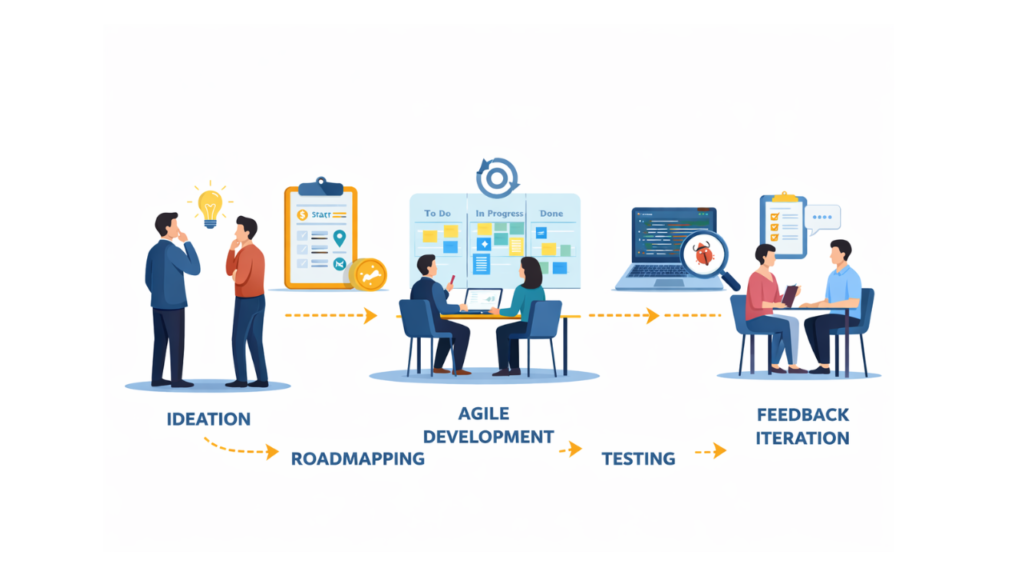
Hospitals that adopt MVP-first strategies are able to pilot solutions with limited users, gather real-world feedback, and iterate quickly. This approach reduces large upfront investments and avoids deploying systems that add operational burden instead of improving care.
Key Problems MVPs Help Solve in Healthcare Organizations
Hospitals and clinics face complex challenges that cannot be solved with generic software. These include fragmented systems, manual processes, staff shortages, and increasing patient expectations.
MVP development helps validate solutions for problems such as reducing patient wait times, improving clinical documentation accuracy, streamlining billing workflows, enabling remote monitoring, and improving data interoperability. By focusing on one problem at a time, organizations gain clarity on what truly works.
Common Types of MVPs Built for Hospitals and Clinics
In 2026, the most common healthcare MVPs fall into several categories. Patient-facing MVPs include appointment booking platforms, patient portals, teleconsultation modules, and digital intake forms. These aim to improve access, engagement, and satisfaction.
Operational MVPs focus on internal efficiency. Examples include staff scheduling tools, inventory tracking systems, document automation, and analytics dashboards. Clinical MVPs often involve decision support systems, diagnostics assistance, and care coordination tools designed to support clinicians without replacing judgment.
The Role of AI and Automation in Healthcare MVPs
Artificial intelligence has become a core component of many healthcare MVPs, but its role is more measured and regulated than in other industries. By 2026, over 60% of hospitals globally are using AI in some form, primarily for operational optimization, imaging analysis, and predictive analytics.
In MVP development, AI is often used to automate repetitive tasks, identify patterns in data, and support decision-making. Importantly, MVPs allow hospitals to validate AI accuracy, bias, and reliability before deploying models at scale.
Data Privacy, Security, and Compliance as MVP Requirements
Healthcare MVPs must comply with strict data protection regulations such as HIPAA, GDPR, and regional health data laws. In 2026, data breaches in healthcare remain among the costliest, with average breach costs exceeding $10 million per incident.
An MVP must include encryption, role-based access control, audit logs, consent management, and secure data storage from day one. Treating compliance as a later phase significantly increases risk and cost. Hospitals increasingly require MVPs to pass security and compliance reviews before pilot deployment.
Designing MVPs for Clinician Adoption
One of the main reasons healthcare software fails is poor clinician adoption. Doctors and nurses already face heavy workloads, and tools that slow them down are quickly abandoned.
Successful healthcare MVPs are designed with clinician workflows at the center. This includes minimizing data entry, integrating with existing systems, and delivering clear value in daily tasks. MVP pilots often include small clinician groups whose feedback directly shapes the next iteration.
Interoperability and Integration Considerations
Hospitals and clinics rarely operate with a single system. Electronic health records, billing platforms, laboratory systems, and imaging tools must work together.
MVP development in 2026 emphasizes interoperability from the start. Standards such as HL7 and FHIR are commonly used to ensure MVPs can integrate with existing infrastructure. MVPs that ignore integration challenges often fail to scale beyond pilots.
Technology Architecture for Healthcare MVPs
Modern healthcare MVPs are built using modular, cloud-native architectures. This allows organizations to scale features, users, and data without system rewrites.
In 2026, hospitals increasingly prefer vendor-neutral and tech-agnostic architectures. This reduces dependency on single vendors and allows flexibility as regulations, technologies, and clinical needs evolve. MVPs serve as a testing ground for architectural decisions that impact long-term digital strategy.
No-Code and Low-Code in Healthcare MVP Development
No-code and low-code platforms are sometimes used in early healthcare MVPs, especially for administrative workflows or internal tools. These platforms help teams prototype quickly and test ideas with minimal development effort.
However, most clinical and patient-facing MVPs eventually require custom development to meet performance, compliance, and integration requirements. Many hospitals use no-code tools for validation, then transition to custom-built systems once feasibility is proven.
Measuring Success of MVPs in Hospitals and Clinics
Healthcare MVP success is not measured by downloads or feature count. Key metrics include clinician adoption rates, reduction in manual work, improvement in patient outcomes, error reduction, and operational efficiency.
Hospitals also track qualitative feedback from staff and patients during MVP pilots. These insights often matter more than metrics alone and guide decisions on scaling or redesigning solutions.
Scaling From MVP to Enterprise Healthcare Systems
A well-executed MVP provides a clear roadmap for scaling. Once validated, features can be expanded to additional departments, locations, or patient populations.
Because the MVP was built with compliance, integration, and scalability in mind, scaling becomes a controlled process rather than a risky transformation. This approach significantly reduces the failure rate of healthcare digital initiatives.
Business Impact of MVP Development in Healthcare
From a financial perspective, MVP-driven healthcare projects reduce waste. Hospitals that adopt phased MVP approaches report 20–35% lower implementation costs compared to full-scale deployments without pilots.
MVPs also shorten time to value. Instead of waiting 12–24 months for full systems, hospitals begin realizing benefits within weeks or months, improving ROI and stakeholder confidence.
The Future of MVP Development for Hospitals and Clinics
By 2026, MVP development has become a standard approach in healthcare innovation. Regulatory complexity, cost pressure, and clinician burnout make large, unvalidated technology rollouts unsustainable.
Hospitals and clinics that succeed in digital transformation are those that test, learn, and scale deliberately. MVPs provide the structure needed to innovate responsibly while maintaining trust, safety, and operational stability.
MVP development for hospitals and clinics in 2026 is not about building less. It is about building smarter. By validating solutions in real clinical environments, healthcare organizations reduce risk, control costs, and improve adoption.
As healthcare continues to digitize, MVP-first strategies offer a practical path to sustainable innovation. Hospitals and clinics that embrace this approach position themselves to deliver better care, operate more efficiently, and adapt to future challenges with confidence.
How Agnotic Helps Hospitals and Clinics Build MVPs That Actually Scale
Building an MVP in a healthcare environment requires more than fast development. Hospitals and clinics need systems that are secure, compliant, interoperable, and aligned with real clinical workflows from day one. This is where Agnotic Technologies brings value beyond basic implementation.
Agnotic works with healthcare organizations to design and deliver MVPs that validate one critical use case at a time, whether it is patient engagement, operational automation, clinical decision support, or data integration. Our approach focuses on reducing implementation risk while ensuring the MVP can evolve into a production-ready system.
At the foundation, our software development services help hospitals and clinics translate operational and clinical requirements into reliable digital solutions. Instead of building large systems upfront, we focus on modular architectures that allow healthcare teams to test, learn, and expand without disruption.
For patient-facing platforms such as portals, scheduling systems, or care coordination tools, Agnotic leverages web development services and web app development services to build secure, scalable applications that integrate with existing hospital systems. These MVPs are designed to handle real patient traffic while maintaining performance and data protection.
When mobility is essential, such as clinician tools or patient companion apps, our mobile app development services support MVPs that work seamlessly across devices and environments. This ensures pilots can be tested in real clinical settings without adding complexity for staff or patients.
Many healthcare MVPs in 2026 also involve intelligence and automation. Agnotic’s AI development services help hospitals validate AI-driven workflows such as document processing, predictive analytics, and decision support while maintaining transparency and control. We focus on responsible AI usage that supports clinicians rather than replacing judgment.
Before scaling AI features across departments, healthcare organizations often validate feasibility through an AI proof of concept. Agnotic helps design PoCs that test real data, real workflows, and real constraints, allowing hospitals to make informed decisions before committing to larger investments.
Strategic clarity is equally important. Through AI consulting services, Agnotic helps hospital leadership and IT teams identify the right MVP scope, choose appropriate technologies, and design architectures that avoid vendor lock-in. This ensures that MVP initiatives align with long-term digital transformation goals rather than becoming isolated pilots.
Across all MVP engagements, Agnotic prioritizes compliance, interoperability, and clinician adoption. Our teams design systems with healthcare regulations, security standards, and integration requirements in mind from the start, ensuring MVPs are ready for both internal review and future scaling.
Frequently Asked Questions
1: How does Agnotic approach MVP development for hospitals and clinics?
Agnotic follows an MVP-first approach that focuses on validating one critical healthcare use case at a time. We work closely with clinical and operational teams to ensure the MVP aligns with real workflows, compliance requirements, and long-term scalability rather than building large systems upfront.
2: Can Agnotic build healthcare MVPs that comply with regulations like HIPAA and GDPR?
Yes. Compliance is built into the MVP from the start. Agnotic designs healthcare MVPs with encryption, role-based access, audit logs, and secure data handling to meet regulations such as HIPAA, GDPR, and regional health data standards.
3: What types of MVPs does Agnotic build for hospitals and clinics?
Agnotic builds MVPs across patient engagement platforms, appointment scheduling systems, clinical documentation tools, operational automation solutions, analytics dashboards, and AI-assisted decision support systems. Each MVP is tailored to a specific hospital or clinic need.
4: How does Agnotic ensure clinician adoption during MVP pilots?
Clinician adoption is a core focus during MVP development. Agnotic involves end users early, designs around existing workflows, minimizes manual data entry, and iterates based on real clinician feedback during pilot deployments.
5: Does Agnotic support AI and automation in healthcare MVPs?
Yes. Agnotic supports responsible AI and automation in healthcare MVPs, including document automation, predictive analytics, and workflow optimization. AI features are validated through focused proof-of-concept work before being scaled across departments.
6: Can MVPs built by Agnotic scale into full hospital systems later?
Absolutely. Agnotic designs MVPs using modular, scalable architectures that allow healthcare organizations to expand features, users, and integrations without rebuilding the system from scratch.
7: How long does it typically take to build a healthcare MVP with Agnotic?
Timelines vary based on scope and complexity, but most healthcare MVPs are delivered within a few months. The goal is rapid validation and early value delivery while maintaining security and compliance.
8: How does Agnotic help hospitals reduce risk during digital transformation?
Agnotic reduces risk by validating ideas early through MVPs and proof-of-concept builds. This approach allows hospitals and clinics to test solutions in real environments, gather feedback, and make data-driven decisions before large-scale investments.
Plan Your Healthcare MVP With Agnotic
Start with a focused MVP designed for compliance, clinician adoption, and scalability.