MVP for Electronic Health Record (EHR) Systems in 2026
blog
MVP for Electronic Health Record (EHR) Systems in 2026
December 29, 2025
7
mins read
MVP for Electronic Health Record (EHR) Systems in 2026: How to Build Smarter, Scalable Healthcare Platforms
Electronic Health Record systems are the backbone of digital healthcare. By 2026, EHR platforms are no longer just repositories of patient data. They are active systems that support clinical decision-making, interoperability, compliance, and patient engagement. Yet despite heavy investment, many EHR initiatives fail to deliver real value due to complexity, poor usability, and lack of clinician adoption.
This is why MVP development has become the preferred approach for building or modernizing EHR systems. An MVP for an EHR allows healthcare organizations to validate workflows, integrations, and compliance requirements before rolling out large-scale platforms.
What an EHR MVP Means in 2026
An MVP for an Electronic Health Record system is not a limited or temporary solution. In 2026, an EHR MVP is a clinically usable, compliant, and secure system focused on solving a specific operational or clinical problem.
Rather than attempting to replace an entire EHR ecosystem, MVPs typically address one focused use case such as patient registration, clinical documentation, appointment management, or interoperability with external systems. The objective is to prove feasibility, adoption, and value before expansion
Why MVP Development Is Critical for EHR Systems
Global healthcare IT spending continues to exceed $500 billion annually, yet studies consistently show that a significant portion of EHR implementations face resistance from clinicians or fail to meet operational expectations. Common reasons include workflow mismatch, excessive documentation burden, and integration challenges.
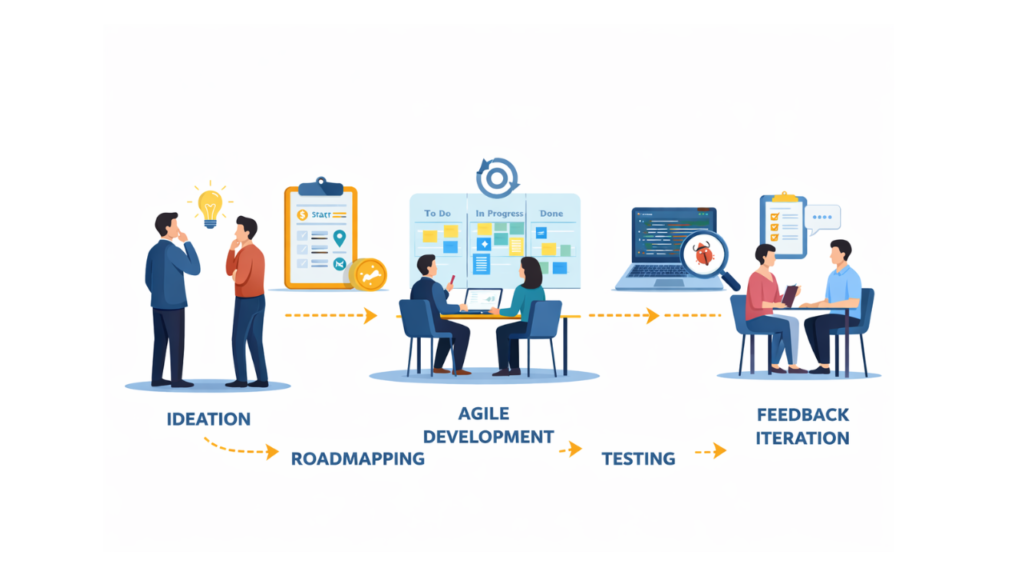
An MVP-first approach allows hospitals, clinics, and health tech companies to test assumptions early. Instead of committing to multi-year rollouts, organizations can pilot EHR functionality with a small group of users, collect real feedback, and refine the system before scaling.
Key Challenges in Traditional EHR Implementations
Traditional EHR systems are often built as monolithic platforms with rigid workflows. This makes them difficult to adapt to different clinical specialties, care models, or regulatory changes.
Clinician burnout is another major concern. Poorly designed EHR interfaces increase administrative workload, reducing time spent on patient care. MVP development helps identify and eliminate friction points early, improving adoption and long-term satisfaction.
Core Features of an EHR MVP
A successful EHR MVP focuses on essential functionality rather than feature overload. Core components typically include secure patient records, role-based access, basic clinical documentation, audit logs, and interoperability with at least one external system.
The MVP should be reliable, fast, and intuitive. Advanced features such as AI-driven decision support, analytics, or population health tools can be added once core workflows are validated.
Interoperability and Standards in 2026
Interoperability is no longer optional for EHR systems. By 2026, standards such as FHIR and HL7 are widely adopted, and regulatory bodies increasingly require seamless data exchange between systems.
An EHR MVP should validate interoperability early. This includes testing data exchange with laboratories, imaging systems, billing platforms, or external providers. MVP pilots help ensure integrations work reliably before scaling.
Data Privacy, Security, and Compliance
EHR systems handle highly sensitive patient data, making privacy and security critical. Healthcare data breaches remain among the most costly globally, with average impacts exceeding $10 million per incident.
An EHR MVP must include encryption, role-based access control, audit trails, consent management, and secure hosting from day one. Treating compliance as a later phase significantly increases risk and cost.
The Role of AI in EHR MVPs
AI is increasingly integrated into EHR platforms, but its role in MVPs is carefully scoped. In 2026, AI is commonly used to support clinical documentation, surface relevant patient history, and reduce administrative burden rather than replace clinical judgment.
MVP development allows healthcare organizations to validate AI accuracy, bias, and explainability using real clinical data before deploying AI features broadly across the system.
Designing EHR MVPs for Clinician Adoption
Clinician adoption is the single most important success factor for EHR systems. Even the most technically advanced platform fails if it disrupts workflows or increases documentation time.
EHR MVPs are designed with direct input from clinicians. By piloting with a small group of users, teams can refine interfaces, reduce unnecessary steps, and ensure the system supports real-world practice rather than theoretical workflows.
Technology Architecture for EHR MVPs
Modern EHR MVPs are built using modular, cloud-native architectures. This approach allows systems to scale gradually, integrate new modules, and adapt to regulatory changes without complete rewrites.
Vendor-neutral and tech-agnostic architectures are increasingly preferred in 2026, reducing lock-in and giving healthcare organizations flexibility as technologies evolve.
No-Code vs Custom Development for EHR MVPs
No-code and low-code tools can support early validation of workflows or administrative processes, but core EHR functionality typically requires custom development to meet performance, security, and compliance standards.
Many organizations use no-code tools to prototype interfaces and flows, then transition to custom engineering once the MVP scope is validated.
Measuring Success of an EHR MVP
Success metrics for an EHR MVP go beyond system uptime. Key indicators include clinician adoption rates, reduction in documentation time, data accuracy, and integration reliability.
Qualitative feedback from clinicians during MVP pilots often provides the most valuable insights, guiding future iterations and feature expansion.
Scaling From EHR MVP to Enterprise Platform
Once validated, an EHR MVP can be expanded across departments, specialties, or facilities. Because the MVP was built with scalability and compliance in mind, scaling becomes controlled rather than disruptive.
Organizations that scale EHR systems incrementally report lower implementation risk and higher user satisfaction compared to large, one-time deployments.
Business Impact of MVP-Driven EHR Development
From a financial perspective, MVP-driven EHR initiatives reduce waste and improve ROI. Healthcare organizations that validate EHR features through MVPs report lower rework costs and faster time to value.
MVPs also improve stakeholder confidence by demonstrating measurable outcomes before large investments are made.
The Future of EHR Systems in 2026 and Beyond
By 2026, EHR systems are evolving into intelligent care platforms that support interoperability, analytics, and patient engagement. Flexibility and usability will define success more than feature count.
MVP development will remain central to this evolution, enabling healthcare organizations to innovate responsibly while maintaining trust, compliance, and clinical effectiveness.
Conclusion
Building an MVP for an Electronic Health Record system in 2026 is about focus, validation, and adaptability. By testing real workflows, integrations, and user behavior early, healthcare organizations reduce risk and build systems that clinicians actually use.
An MVP-first approach allows EHR platforms to evolve with healthcare needs rather than becoming rigid systems that resist change.
Build a Smarter EHR MVP for 2026
Validate clinical workflows, ensure compliance, and reduce implementation risk with a focused EHR MVP designed for real healthcare environments. Book a discovery call with Agnotic to plan and build a scalable, clinician-friendly EHR MVP.
An MVP for an Electronic Health Record system is a focused, production-ready version of an EHR designed to validate specific clinical or operational workflows. It helps hospitals and clinics test usability, compliance, and interoperability before scaling to a full platform.
2: Why should hospitals build an EHR MVP instead of a full system?
Building a full EHR upfront is expensive and risky. An MVP reduces implementation failure by validating clinician adoption, workflow fit, and integration requirements early, saving cost and avoiding large-scale rework.
3: What features should be included in an EHR MVP in 2026?
An EHR MVP should include secure patient records, role-based access, clinical documentation, audit logs, and basic interoperability using standards like FHIR. Advanced analytics and AI features can be added after validation.
4: How does an EHR MVP handle compliance and data security?
EHR MVPs are built with encryption, access controls, audit trails, and consent management from day one. This ensures compliance with regulations such as HIPAA and GDPR and protects sensitive patient data.
5: Can an EHR MVP scale into a full enterprise system?
Yes. When built with modular and cloud-native architecture, an EHR MVP can scale across departments, facilities, and care models without rebuilding the system.
6: How long does it take to build an EHR MVP?
Most EHR MVPs are delivered within a few months, depending on scope, integrations, and regulatory requirements. The focus is validation and usability, not feature completeness.