Healthcare app hardening
Encryption, key management, and access control for a live product.


We secure protected health information end to end — encryption at rest and in transit, KMS-backed key management, and de-identification via Safe Harbor or Expert Determination — designed into your architecture, not retrofitted before an audit.
Trusted by global innovators











Protecting PHI is more than a checkbox for encryption. It means knowing where every piece of protected health information lives, encrypting it at rest and in transit, controlling who can decrypt it, logging every access, and being able to prove all of it during an audit or after an incident. The HIPAA Security Rule frames encryption as addressable — but in practice, unencrypted PHI is how breaches become headlines and OCR settlements.
Generic security guidance stops at 'turn on encryption.' We go further: envelope encryption with managed keys (AWS KMS, GCP Cloud KMS, or Azure Key Vault), least-privilege key policies, automatic rotation, field-level protection for the most sensitive attributes, and de-identification pipelines so analytics and testing never touch live PHI. Security is architected in from the first commit, so it holds up under scrutiny instead of scrambling before launch.
What it is
PHI data security is the set of controls that protect protected health information wherever it lives — encryption at rest and in transit, managed key custody, de-identification for secondary use, access control, and audit logging.
Done right, it satisfies the HIPAA Security Rule, survives a SOC 2 audit, and gives you the evidence trail you need after any incident. We architect it in from the start.
Encryption, key management, de-identification, access control, and audit logging composed into one architecture you can defend to auditors and to your board.

Each control pairs a protection with the standard or mechanism that backs it.
AES-256 encryption at rest and TLS 1.2+ in transit across every service, with envelope encryption so data keys are themselves encrypted by a managed root key — no plaintext PHI on any disk or wire.
Centralized key management via AWS KMS, GCP Cloud KMS, or Azure Key Vault, with least-privilege key policies, automatic rotation, and separation of duties so no single actor can both access data and control its keys.
De-identification pipelines that strip the 18 Safe Harbor identifiers, or an Expert Determination approach with documented statistical risk analysis, so analytics, ML, and lower environments never handle live PHI.
Role-based and attribute-based access control, MFA, and tamper-evident audit logs of every PHI access — the record you need for HIPAA accounting-of-disclosures and incident forensics.
Application-layer encryption and tokenization for the highest-sensitivity fields (SSN, genomic, behavioral health), so a database compromise doesn't hand over the crown jewels.
Managed secrets, encrypted and tested backups, breach-notification runbooks, and BAA governance across every subprocessor — HITECH-aligned readiness before an incident, not after.
Where it applies
Encryption, key management, and access control for a live product.
Control implementation and evidence collection for audit.
Safe Harbor or Expert Determination pipelines for BI and ML.
Meeting the security questionnaires that gate provider deals.
PHI-safe migration to AWS, GCP, or Azure with managed keys.
Runbooks, logging, and forensics readiness before an incident.
Encryption and key management are the controls regulators and enterprise buyers scrutinize first — we build them to be provable.

Health Insurance Portability and Accountability Act
Protect PHI with privacy-first architecture, encrypted storage and transmission, strict access controls, and traceable audit logs.

General Data Protection Regulation
Implement lawful consent flows, data minimization, retention controls, and secure processing for sensitive health data.

Fast Healthcare Interoperability Resources
Enable standardized health data exchange across apps, care teams, and systems through robust FHIR-ready APIs.

Health Level Seven International
Support enterprise-grade interoperability with HL7-based integrations for records, events, and clinical messaging workflows.

Health Information Trust Alliance
Align security programs to healthcare-specific control and risk management practices trusted by providers and ecosystem partners.

Health Information Technology for Economic and Clinical Health Act
Design with breach notification readiness, digital record safeguards, and operational controls that support regulated care programs.

FDA Software as a Medical Device
Plan software quality, traceability, and documentation pathways for products that may require SaMD review and submission.

Medical Device Regulation (European Union)
Prepare EU market-ready processes for risk classification, evidence tracking, and lifecycle governance under MDR expectations.

Substance Abuse and Mental Health Services Administration
Apply confidentiality controls and consent-aware sharing models for behavioral and mental health data experiences.
Standards we build against
We treat PHI security as an auditable engineering program — map the data, protect it in layers, and prove it holds.
We inventory where PHI lives, flows, and rests across your systems and subprocessors — you cannot protect what you haven't mapped.
Encryption at rest and in transit, envelope encryption, and KMS-backed key management with least-privilege policies and rotation.
Safe Harbor or Expert Determination de-identification pipelines, RBAC/ABAC, MFA, and tamper-evident audit logging.
Penetration testing, control validation against HIPAA and SOC 2, continuous monitoring, and incident-response runbooks.
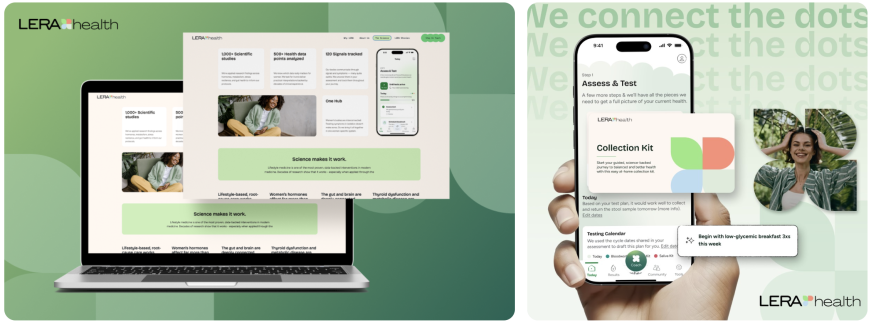
Lera Health handles sensitive biomarker and hormone data on a privacy-first data layer we built end to end — the same encryption, key-management, and access-control discipline that defines our PHI security work.
We build PHI protection as a first-class engineering program, with the evidence trail auditors and enterprise buyers ask for.
HIPAA, HITECH, and SOC 2 controls designed into architecture from sprint one — never bolted on before an audit.
Encryption, key policies, and audit logs configured to produce the evidence you need for OCR, SOC 2, and enterprise security reviews.
Layered protection — encryption, key management, de-identification, and access control — so no single failure exposes PHI.
Experience protecting reproductive, behavioral, and genomic data where the privacy stakes are highest.

Tell us your stack and your audit target. We'll return a phased security plan covering encryption, key management, de-identification, and the evidence trail.
contact@agnotic.com
Partnerships
contact@agnotic.com