
HIPAA compliance has never mattered more. With healthcare breaches at record highs in the United States and parallel pressure from GDPR across the European Union, founders building digital health products in 2026 face a regulatory landscape that is unforgiving — and a patient base that is paying attention. In 2024 alone, more than 276 million U.S. patient records were exposed, and analysts expect that number to climb again before year-end.
For a startup, the stakes are not abstract. A single misstep with Protected Health Information (PHI) can wipe out a funding round, surface civil monetary penalties under 45 CFR §160, and erase the trust that makes healthtech adoption possible. The good news: HIPAA compliance is achievable for early-stage teams. At Agnotic Technologies, we partner with founders across the U.S., U.K., Germany, the Netherlands, and the Nordics to build healthcare products that are compliant from the first commit — not bolted on before launch.
In This Guide
- Why HIPAA Compliance Matters for Startups
- The Most Common HIPAA Compliance Challenges
- Limited Resources & Budget Constraints
- Navigating the Regulatory Landscape
- Technical Complexity & PHI Safeguards
- Vendor Management & BAAs
- Scaling Without Breaking Compliance
- Innovation, AI & New Risk Surfaces
- Technology Adoption on a Budget
- How Agnotic Helps Startups Become HIPAA Compliant
- FAQ
Why HIPAA Compliance Matters for Startups
As healthcare moves to the cloud, telehealth platforms, AI-driven EHRs, remote patient monitoring devices, and third-party vendors create new attack surfaces almost daily. A proactive, security-first posture is no longer optional — it is the price of admission for any startup that wants to win contracts with U.S. hospital systems, European insurers, or Medicare Advantage payers.
HIPAA compliance does more than satisfy auditors. It signals to investors, partners, and patients that your team can be trusted with the most sensitive data in their lives. In a sector where buyers spend twelve to eighteen months evaluating vendors, demonstrable compliance is what shortens the sales cycle and unlocks enterprise revenue.
Beyond commercial upside, HIPAA compliance reduces existential risk: it limits exposure to OCR enforcement, protects you from class-action litigation, and creates the audit trail you will need when a state attorney general asks pointed questions after a breach.
The Most Common HIPAA Compliance Challenges
Most early-stage teams stumble in the same places. HIPAA is a federal law — if you fall under the Privacy Rule, compliance is not optional. The question is how, not whether. Below are the seven challenges we see most often when we kick off a HIPAA Fractional CTO engagement.
Limited Resources and Budget Constraints
Startups run lean. Allocating engineering capacity to risk assessments, security training, and SOC 2 evidence collection feels like a tax on velocity. It is not. Treating compliance as a runway-extending feature — one that lets you sell into hospitals, payers, and European Sickness Funds — reframes the spend as customer acquisition, not overhead.
Practical levers: pick a HIPAA-eligible cloud (AWS, Azure, GCP) with a Business Associate Addendum baked in, lean on managed services that ship with HIPAA controls (Auth0, Segment, Snowflake Healthcare Data Cloud), and outsource the parts of the stack that do not differentiate you. Our Healthcare Cloud & DevOps team helps founders stand up HIPAA-ready infrastructure in weeks, not quarters.
Navigating the Regulatory Landscape
The Privacy Rule, Security Rule, Breach Notification Rule, and HITECH amendments interact in ways that surprise even experienced operators. Layer in state laws like California's CMIA, Texas HB 300, New York SHIELD, and cross-border obligations under GDPR Article 9, and the matrix can paralyze a small team.
Engage counsel and a compliance partner early. We pair clients with healthcare attorneys we trust and use shared playbooks for risk analysis, sanction policies, and workforce training so that the legal review does not become a bottleneck.
Technical Complexity and PHI Safeguards
Encryption at rest (AES-256) and in transit (TLS 1.3), role-based access control, MFA on every administrative path, audit logs that survive operator tampering — none of this is exotic, but missing one detail can sink an audit. The proposed 2025 HIPAA Security Rule update tightens requirements around encryption, MFA, and asset inventories; the Office for Civil Rights expects organizations to be ready when the final rule lands.
Invest in a small set of internal champions. Our Fractional CTO engagements typically pair a part-time HIPAA security officer with a senior platform engineer who owns the secure baseline (Terraform modules, golden images, secret rotation, key management) for the life of the product.
Vendor Management and Business Associate Agreements
Every external service that touches PHI — cloud, email, SMS, analytics, AI inference, billing — must be governed by a Business Associate Agreement. Skipping a BAA on a single subprocessor is one of the most common audit findings.
Stand up a living vendor inventory from day one. Tag each vendor with the PHI categories it processes, the legal basis under HIPAA (and GDPR if you sell into the EU), the BAA execution date, and the renewal cadence. Re-review whenever the subprocessor list changes.
Scaling Without Breaking Compliance
What works for a five-person team often collapses at fifty. New engineers join, new microservices spin up, new data flows emerge — and yesterday's threat model is no longer accurate. Build compliance into your delivery pipeline so that every pull request enforces secret scanning, dependency review, SBOM generation, and policy-as-code checks.
Innovation, AI, and New Risk Surfaces
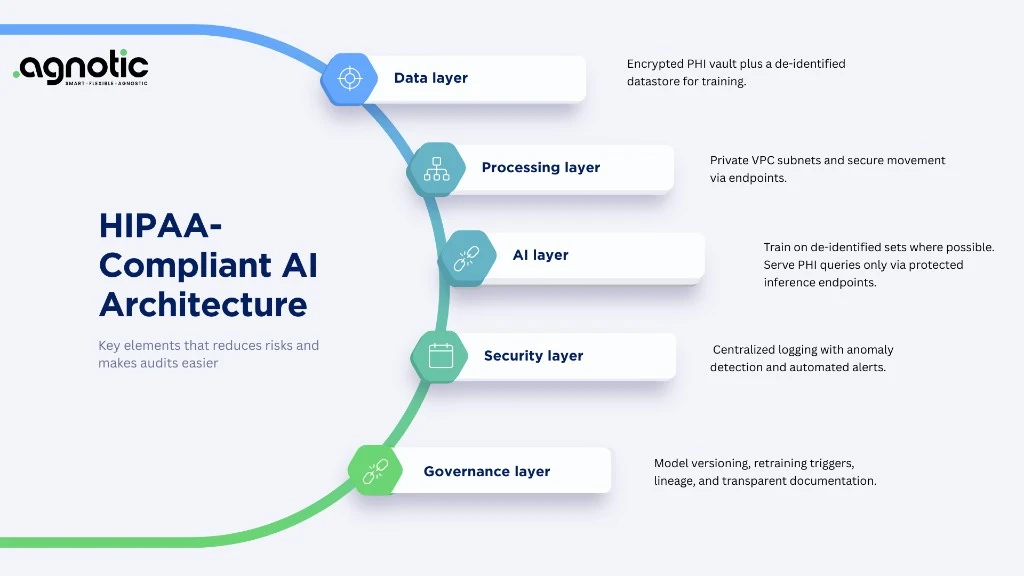
Generative AI introduces risks HIPAA was not written for: model memorization of PHI, prompt injection, vector store leakage, and inference-time re-identification. The U.S. Department of Health and Human Services has signaled that AI-specific guidance is coming, and the EU AI Act now classifies most clinical AI as high-risk under Annex III.
Bake privacy-preserving techniques into every AI workflow: synthetic data for training, differential privacy on aggregate outputs, federated learning across hospital sites, and tenant-isolated vector stores. Our HIPAA-Compliant AI App playbook walks founders through each of these controls.
Technology Adoption on a Budget
Best-in-class security tooling can feel out of reach. The fix is opinionated infrastructure: start with a HIPAA-ready landing zone, use managed identity, push observability into a single SIEM, and standardize on a single secret store. Replace pricey enterprise tools with open-source equivalents until revenue justifies the upgrade.
HIPAA Penalties: What Non-Compliance Actually Costs
The U.S. Department of Health and Human Services Office for Civil Rights (OCR) enforces HIPAA, and the financial exposure is real. Civil monetary penalties are tiered by culpability and adjusted annually for inflation under the HITECH Act. As of 2026, the published maximums per violation are roughly USD 137 for unknowing violations, USD 1,379 for reasonable cause, USD 13,785 for willful neglect that is corrected, and USD 68,928 for willful neglect that is not corrected — with an annual cap that can exceed USD 2 million per identical provision violated.
Those numbers are only the floor. Class-action lawsuits, state attorneys general investigations, breach-notification costs, forensic engagements, credit-monitoring services for affected patients, regulatory consent orders, and customer churn routinely dwarf the OCR fine itself. IBM's 2025 Cost of a Data Breach report put the average healthcare breach cost at USD 10.93 million — the highest of any industry for the 14th consecutive year.
For founders, the most underestimated cost is reputational. Hospitals that have escalated a vendor through their procurement office will not re-engage after a publicized breach. That blocks the very revenue you need to recoup the regulatory hit.
Real-World Breach Case Studies in 2024-2026
Change Healthcare (2024)
The ransomware attack on Change Healthcare disrupted prescription processing for tens of thousands of U.S. pharmacies and exposed PHI for an estimated 100 million-plus people. UnitedHealth Group disclosed costs north of USD 3 billion and the OCR launched an investigation focused on risk analysis, MFA gaps on legacy infrastructure, and incident-response timelines. The lesson for startups: legacy infrastructure inherited through acquisitions is the single largest unmanaged HIPAA risk in U.S. healthtech.
Welltok (2023-2024)
A managed file transfer vulnerability exposed roughly 8.5 million patient records across multiple health-system clients. Welltok's customers learned the hard way that subprocessor risk is their risk; OCR explicitly emphasized that Covered Entities cannot delegate accountability through a Business Associate Agreement.
23andMe (2023)
Although primarily a consumer genomics service, the credential-stuffing attack on 23andMe affected an estimated 6.9 million accounts and triggered investigations in the U.S., U.K., and Canada. It illustrates that 'we are not technically HIPAA-covered' rarely shields a healthtech brand from regulator scrutiny under GDPR, the U.K. Data Protection Act, or U.S. state privacy laws.
A 90-Day HIPAA Compliance Roadmap for Founders
Compliance can be sequenced. The roadmap below is the same one we run with seed and Series A digital health startups when we begin a HIPAA Fractional CTO engagement.
Days 1-30: Inventory and Risk Analysis
- Map every system, vendor, and data flow that touches PHI. Tag each one with the categories of data, the legal basis under HIPAA (and GDPR if applicable), and the storage location.
- Run a formal HIPAA Security Risk Analysis aligned with NIST SP 800-66r2. Capture threats, vulnerabilities, likelihood, and impact in a living register.
- Designate a HIPAA Security Officer and a HIPAA Privacy Officer (the same person is permissible early on).
- Stand up baseline policies: information security, acceptable use, access control, incident response, breach notification, sanction, and training.
- Schedule annual HIPAA training for the whole workforce and require role-based training for engineers, customer success, and clinical staff.
Days 31-60: Controls and Subprocessors
- Enforce MFA across every administrative path and high-privilege workflow — including engineering tooling, infrastructure consoles, and break-glass accounts.
- Encrypt PHI at rest (AES-256) and in transit (TLS 1.3); document the algorithms, key-management, and rotation schedule.
- Centralize logging in a tamper-evident SIEM with at least six years of immutable retention.
- Execute Business Associate Agreements (or Business Associate Addenda) with every vendor that touches PHI. Document the BAA execution date, scope, and renewal cadence in a vendor inventory.
- Configure backup, disaster-recovery, and runbook drills. Tabletop a ransomware scenario and a vendor compromise scenario.
Days 61-90: Audit Readiness and Continuous Compliance
- Adopt a continuous compliance platform such as Vanta, Drata, Secureframe, or Sprinto to track evidence collection against your control set.
- Schedule a third-party HIPAA assessment or readiness review. Even an informal review surfaces the issues an OCR investigator would find.
- Wire policy-as-code checks (e.g., OPA, Checkov, tfsec) into your CI pipeline so configuration drift is caught at the pull request, not in post-mortem.
- Publish a customer-facing trust center summarizing your HIPAA posture, sub-processor list, and security FAQs. It shortens enterprise sales cycles dramatically.
- Establish a quarterly compliance review with leadership and an annual external audit cadence.
Mapping HIPAA to GDPR, UK DPA 2018, and SOC 2
Most startups we work with sell into both the U.S. and the European Union, so we recommend building a unified control matrix rather than maintaining parallel programs. The good news: roughly 70-80% of the underlying engineering work is shared across frameworks. The discipline lies in mapping the same evidence to each requirement.
- Lawful basis & purpose: HIPAA implicitly assumes treatment, payment, and healthcare operations purposes; GDPR Article 6 and Article 9 require explicit lawful basis and additional safeguards for health data.
- Data subject rights: HIPAA grants patients access, amendment, and accounting of disclosures; GDPR adds erasure, portability, restriction, and the right to object. Build a unified data-subject request workflow that satisfies both.
- Breach notification: HIPAA requires notification within 60 days of discovery; GDPR Article 33 requires notification to the supervisory authority within 72 hours. Engineer for the faster clock.
- Cross-border transfers: GDPR Chapter V and the EU-U.S. Data Privacy Framework govern transfers out of the EU. If you process EU PHI on U.S. cloud regions, document your DPF certification or Standard Contractual Clauses.
- Audit & evidence: SOC 2 Type II and ISO 27001 share control objectives with HIPAA. A single evidence catalog can support all three when scoped intentionally.
Tools and Platforms We Recommend
These are the tools most often deployed in HIPAA-aligned startups we partner with. None are endorsements — choose what fits your stack, budget, and customer expectations.
- Compliance automation: Vanta, Drata, Secureframe, Sprinto, Thoropass.
- HIPAA-eligible cloud baselines: AWS HealthLake & Landing Zone, Azure for Health, Google Cloud Healthcare API, Oracle Cloud for Healthcare.
- Identity & access: Okta, Auth0, Microsoft Entra ID, AWS IAM Identity Center.
- Secrets & key management: AWS KMS + Secrets Manager, HashiCorp Vault, Doppler.
- SIEM & detection: Datadog Cloud SIEM, Sumo Logic Cloud SIEM, Panther, Wazuh.
- Vulnerability & posture management: Wiz, Lacework, Snyk, Aqua Trivy, GitHub Advanced Security.
- Patient-facing identity & consent: Stytch, OneSignal Healthcare, Persona, Onfido.
- BAA-ready LLMs: Anthropic Claude on Amazon Bedrock, OpenAI on Azure OpenAI Service, Google Gemini via Vertex AI.
Audit Prep Checklist: 12 Things to Have in Place
- Current HIPAA Security Risk Analysis with documented remediation plans.
- Executed BAAs with every PHI-touching vendor, indexed in a single registry.
- Workforce training completion records covering the last 12 months.
- Documented access-control policy with periodic access reviews logged.
- Encryption inventory: data at rest, in transit, key custodianship, rotation cadence.
- Tamper-evident audit logs covering PHI access for at least six years.
- Incident-response runbook with documented tabletop exercises in the last 12 months.
- Disaster-recovery plan with annual restore tests and RTO/RPO targets.
- Sanction policy for workforce violations and at least one documented enforcement event.
- Patient rights workflow covering access, amendment, accounting, and restriction requests.
- Breach-notification template, communications plan, and OCR contact path pre-staged.
- Trust center or security white paper, current as of the last quarter.
Mistakes That Kill Investor Due Diligence
We have sat in on dozens of healthtech diligence calls. The same gaps surface repeatedly and they all undermine a term sheet faster than missed revenue numbers.
- No documented Security Risk Analysis. Investors interpret this as 'we have not actually looked.'
- Production PHI on a founder's personal laptop or in a shared Google Drive folder.
- Reliance on a single subprocessor with no BAA and no contingency plan.
- Customer-facing AI features that pipe PHI through model APIs without a BAA.
- No designated security officer, or a security officer who has also been juggling DevOps for nine months.
- Logs that are mutable, missing, or retained for less than six years.
- Open-ended access for ex-employees because de-provisioning is manual.
How Agnotic Helps Startups Become HIPAA Compliant
Compliance is a marathon, but you do not have to run it alone. Agnotic Technologies brings senior product, engineering, and security leaders who have shipped HIPAA-compliant products into U.S. health systems and EU healthcare integrators. Our HIPAA Fractional CTO service combines architecture review, gap analysis, policy authoring, and shoulder-to-shoulder engineering so that founders can keep building while we close the audit trail.
We also offer a free AI Proof of Concept for digital health startups — a focused two-week sprint where our team validates a high-impact AI use case against your data, your compliance constraints, and your roadmap. Many of our long-term clients started with one of these POCs.
Authoritative Resources
- HHS HIPAA Compliance Hub
- NIST SP 800-66r2 — Implementing the HIPAA Security Rule
- OCR Cybersecurity Newsletter
- EU GDPR — Article 9 (Special Categories of Data)
- ENISA — Cybersecurity for Healthcare
Conclusion
HIPAA compliance for startups is a discipline, not a destination. Teams that bake compliance into engineering, product, and go-to-market motions outpace competitors that treat it as a checklist. With the right partner, you can ship faster, sell into regulated markets sooner, and protect the patients whose trust your product depends on.