Health systems & clinics
Reducing after-hours charting and burnout across many clinicians.

We build ambient AI scribes that listen to the visit, draft a structured clinical note, and write it back to the EHR — so clinicians talk to patients instead of typing, with every note reviewed before it's signed.
Trusted by global innovators







Ambient clinical documentation captures the natural conversation between clinician and patient and turns it into a structured note — history, exam, assessment, and plan — without the clinician typing during the visit. The best implementations do voice-to-note in near real time, draft coded orders and diagnoses, and route everything back into the chart for review, so documentation stops stealing attention from the patient.
The hard parts are accuracy, safety, and the EHR write-back. A scribe that hallucinates findings or drops a medication is dangerous, and a note that can't flow into the record just moves the burden elsewhere. We build ambient scribes with medical-grade speech recognition, retrieval-grounded generation, explicit clinician sign-off, and FHIR-based write-back — so the note is accurate, auditable, and lands in the right place in the EHR.
What it is
Ambient clinical documentation — an AI scribe — listens to the clinician-patient conversation and drafts a structured note, coded diagnoses, and orders, then routes them into the EHR for review. It replaces typing during the visit with talking to the patient.
We build scribes with medical-grade speech recognition, grounded generation, enforced clinician sign-off, and FHIR-based EHR write-back — so the note is accurate, safe, and lands where it belongs.
An ambient documentation pipeline — capture, transcription, structured note generation, and FHIR write-back — with PHI handling and clinician review at every stage.
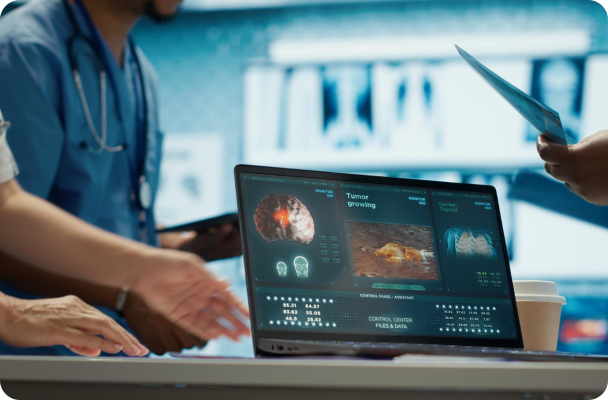
Accurate voice-to-note, safe generation, and real EHR write-back — the three things a scribe has to nail.
Medical-grade speech recognition with speaker diarization captures the clinician-patient conversation and produces a structured SOAP or specialty note in near real time, even in noisy exam rooms.
Retrieval-grounded generation tied to the transcript and chart context reduces hallucination, flags uncertainty, and never fabricates findings — with the clinician's explicit sign-off required before anything is final.
The signed note, plus suggested problems, orders, and ICD-10/CPT codes, writes back to the EHR via FHIR R4 (DocumentReference, Condition, ServiceRequest) or SMART on FHIR — landing in the chart, not a separate silo.
Draft diagnosis and procedure codes and orderable items surfaced for review, coded with ICD-10-CM, CPT, SNOMED CT, and RxNorm to speed billing and closeout.
Audio and transcripts handled under a signed BAA with encryption, configurable retention, and de-identification options — so ambient capture meets HIPAA rather than creating new exposure.
Note formats and vocabulary tuned per specialty and per clinician's style, so the drafted note matches how each provider actually documents.
Where it fits
Providers and vendors fighting documentation burden and clinician burnout.
Reducing after-hours charting and burnout across many clinicians.
Note formats tuned to specialty-specific documentation needs.
Ambient documentation of virtual visits with write-back to the EHR.
Embedding an ambient scribe into their platform via FHIR and SMART on FHIR.
High-volume settings where per-visit time savings compound fast.
Differentiating a clinical product with built-in ambient documentation.
An ambient scribe earns its place by cutting documentation time without cutting corners on accuracy. We build for both.
Health Insurance Portability and Accountability Act
Protect PHI with privacy-first architecture, encrypted storage and transmission, strict access controls, and traceable audit logs.

General Data Protection Regulation
Implement lawful consent flows, data minimization, retention controls, and secure processing for sensitive health data.

Fast Healthcare Interoperability Resources
Enable standardized health data exchange across apps, care teams, and systems through robust FHIR-ready APIs.

Health Level Seven International
Support enterprise-grade interoperability with HL7-based integrations for records, events, and clinical messaging workflows.

Health Information Trust Alliance
Align security programs to healthcare-specific control and risk management practices trusted by providers and ecosystem partners.

Health Information Technology for Economic and Clinical Health Act
Design with breach notification readiness, digital record safeguards, and operational controls that support regulated care programs.

FDA Software as a Medical Device
Plan software quality, traceability, and documentation pathways for products that may require SaMD review and submission.

Medical Device Regulation (European Union)
Prepare EU market-ready processes for risk classification, evidence tracking, and lifecycle governance under MDR expectations.

Substance Abuse and Mental Health Services Administration
Apply confidentiality controls and consent-aware sharing models for behavioral and mental health data experiences.
Standards and compliance
We prove accuracy and safety before scale — because a documentation tool clinicians can't trust won't get used.
We define target specialties, note formats, and EHR write-back targets, then design the capture-to-chart pipeline and safety guardrails.
We build speech recognition, diarization, and grounded note generation, tuned on representative encounters with accuracy benchmarking.
We implement FHIR write-back, coding suggestions, and the clinician review-and-sign workflow, validated against sandbox EHRs.
Phased pilot with a small clinician cohort, measuring documentation-time savings and note quality before broader rollout.
Related proof of compliant AI-on-PHI delivery: for Lera Health we built data-to-insight workflows on a privacy-first layer with clinician oversight. It shows the safety and PHI discipline an ambient scribe requires, though it is a different product.
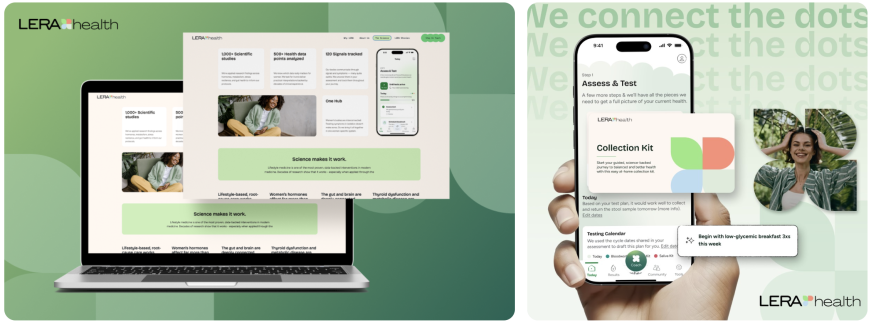
We build ambient documentation that is accurate, safe, and actually lands in the EHR — the parts that make or break adoption.
Grounded generation, clinician sign-off, and BAA-covered PHI handling so the scribe reduces risk instead of adding it.
FHIR-based write-back into the chart, not a disconnected transcript — so the time saved isn't lost to copy-paste.
Note formats tuned per specialty and provider, with a review flow that fits how clinicians actually close a visit.
Experience with medical speech, retrieval grounding, and healthcare NLP so accuracy and coding hold up in practice.

Documentation that gives clinicians their time back
Tell us your specialties and EHR. We'll return a plan for an ambient scribe with accurate voice-to-note, safe generation, and real FHIR write-back.
contact@agnotic.com
Partnerships
contact@agnotic.com