Computer-assisted coding
ICD-10-CM and CPT suggestion for coders, with confidence-based routing.


We build clinical NLP pipelines that extract problems, medications, and findings from free-text notes and autocode them to SNOMED CT, ICD-10-CM, and LOINC — with PHI-safe processing and human-in-the-loop review, not black-box guesses.
Trusted by global innovators




Most clinical value is locked in free text — progress notes, discharge summaries, pathology and radiology reports. Clinical text extraction reads that narrative and pulls out structured entities: problems, medications, procedures, labs, and social determinants, each linked to a standard code so downstream systems can act on it. Done well, it feeds analytics, quality measures, and coding workflows without asking clinicians to re-enter anything.
Generic, consumer-grade NLP fails here. Clinical language is dense with abbreviations, negation ('no evidence of pneumonia'), family history, and hedging. We build with clinical models (cTAKES-style pipelines, transformer NER, and LLM extraction with guardrails), map to SNOMED CT / ICD-10-CM / LOINC / RxNorm, and keep a human-in-the-loop review step for anything that drives billing or care — so accuracy is measured, not assumed.
What it is
Healthcare NLP is the discipline of extracting structured, coded meaning from unstructured clinical text — notes, reports, and summaries — so that data can feed analytics, coding, quality measures, and decision support.
It only works in production when negation and uncertainty are handled, terminology mapping is explicit, and a human reviews anything with real consequences. We build all three in.
De-identification, entity extraction, terminology mapping, and confidence-scored review — engineered as one auditable pipeline you can defend to compliance and to your coders.
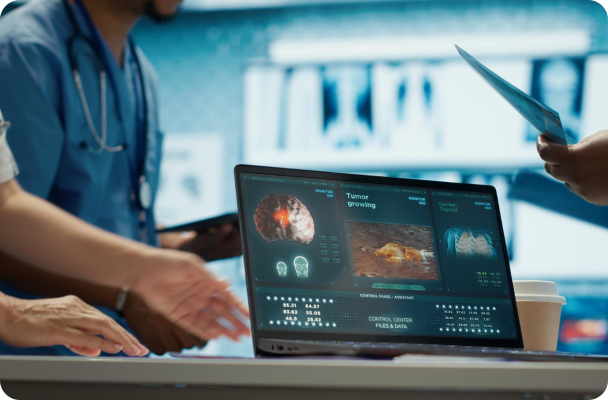
Each capability pairs an extraction task with the terminology and controls it needs.
Transformer and cTAKES-style models extract problems, medications, procedures, and findings from clinical text, with explicit negation, uncertainty, and family-history detection so 'ruled out MI' never becomes an active diagnosis.
Extracted entities are normalized and mapped to SNOMED CT, ICD-10-CM, LOINC, RxNorm, and CPT, with confidence scores that route low-certainty codes to a coder queue instead of straight to a claim.
Text is de-identified (Safe Harbor rules or NER-based redaction) before it touches any general-purpose model, with BAA-covered infrastructure and full audit logging of every extraction and edit.
Results are written as FHIR R4 resources — Condition, MedicationStatement, Observation, Procedure — so the structured data flows straight into your EHR, analytics store, or registry.
Section-aware summarization of long notes and chart abstraction for registries and quality measures, with citations back to the source span so reviewers can verify every claim.
Precision, recall, and inter-annotator agreement tracked per entity type against a gold-standard set, with coder corrections fed back to improve the models over time.
Where it runs
ICD-10-CM and CPT suggestion for coders, with confidence-based routing.
Automated chart abstraction for HEDIS, eCQM, and registry reporting.
Find patients matching complex clinical criteria across free-text notes.
Structured extraction into disease and outcomes registries.
HCC capture from documented conditions with audit-ready evidence.
De-identified structured datasets from clinical corpora for research.
Structured, coded data lifts analytics, quality reporting, and coding throughput — when accuracy is measured and reviewed, not assumed.
Health Insurance Portability and Accountability Act
Protect PHI with privacy-first architecture, encrypted storage and transmission, strict access controls, and traceable audit logs.

General Data Protection Regulation
Implement lawful consent flows, data minimization, retention controls, and secure processing for sensitive health data.

Fast Healthcare Interoperability Resources
Enable standardized health data exchange across apps, care teams, and systems through robust FHIR-ready APIs.

Health Level Seven International
Support enterprise-grade interoperability with HL7-based integrations for records, events, and clinical messaging workflows.

Health Information Trust Alliance
Align security programs to healthcare-specific control and risk management practices trusted by providers and ecosystem partners.

Health Information Technology for Economic and Clinical Health Act
Design with breach notification readiness, digital record safeguards, and operational controls that support regulated care programs.

FDA Software as a Medical Device
Plan software quality, traceability, and documentation pathways for products that may require SaMD review and submission.
Medical Device Regulation (European Union)
Prepare EU market-ready processes for risk classification, evidence tracking, and lifecycle governance under MDR expectations.

Substance Abuse and Mental Health Services Administration
Apply confidentiality controls and consent-aware sharing models for behavioral and mental health data experiences.
Standards we build against
We treat clinical NLP as a measured engineering problem — annotation, evaluation, and human review are first-class workstreams, not afterthoughts.
We define the entities and codes that matter for your use case, assemble a representative note sample, and agree on the gold-standard annotation guidelines up front.
De-identification, entity extraction, and terminology mapping to SNOMED CT / ICD-10-CM / LOINC are built as composable, versioned stages with confidence scoring throughout.
We benchmark precision and recall against the gold set, build the reviewer UI for low-confidence output, and tune thresholds to your risk tolerance.
FHIR-native output wired into your systems, with drift monitoring, audit trails, and a correction feedback loop that improves the model with real use.
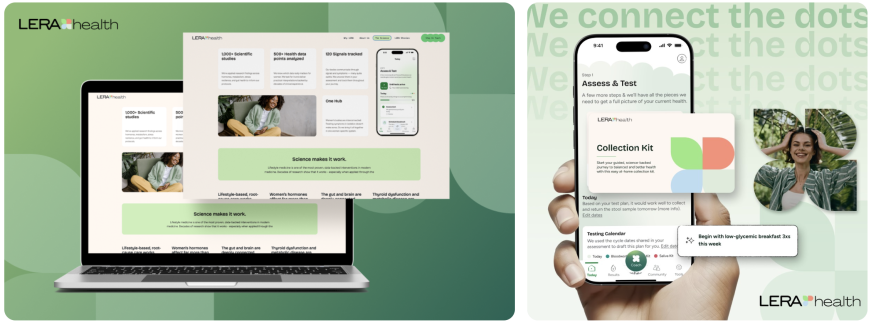
Lera Health shows how we build privacy-first data layers that turn clinical inputs into structured, personalized insight. The same discipline — PHI-safe pipelines, auditable processing, and clean structured output — underpins the NLP work we deliver.
We pair NLP engineering with clinical-domain depth and a compliance-first default, so the output is safe to act on.
De-identification, BAA-covered infrastructure, and audit logging are designed in from the first extraction — never bolted on.
We build the reviewer workflow and measure accuracy, so nothing that touches billing or care ships on model confidence alone.
SNOMED CT, ICD-10-CM, LOINC, and FHIR R4 out of the box — the extraction lands where your systems can use it.
Negation, hedging, and section structure are handled by people who understand how clinicians actually write notes.

Clinical NLP that clinicians and coders trust
Share a sample of your notes and the codes you need. We'll return a scoped NLP plan with an evaluation approach and a human-in-the-loop design.
contact@agnotic.com
Partnerships
contact@agnotic.com