

01
Direct-to-Consumer Teletherapy
On-demand and scheduled sessions with licensed therapists and psychiatrists.



We build HIPAA-ready mental health and behavioral health apps that pair licensed-clinician teletherapy with evidence-based CBT, DBT and ACT programs: measurement-based care, crisis escalation, 42 CFR Part 2 aware data handling and a patient experience people return to.
Trusted by global innovators











Mental health app development is the engineering of teletherapy, measurement-based care and self-guided therapy apps for behavioral health providers, payers and digital health founders. Agnotic Technologies builds them as a services engagement, with crisis escalation, PHQ-9 and GAD-7 scoring, 42 CFR Part 2 aware consent and HIPAA safeguards designed in from the first sprint.
Friction points behavioral health teams raise when they scope a mental health app.
Clinical Validity Gap: Many consumer wellness apps lack validated instruments, which makes payers and health systems reluctant to reimburse or adopt them.
Crisis Handling: Safety planning, suicidality screening (C-SSRS), and escalation paths are too often bolted on after launch, or missing.
42 CFR Part 2 Complexity: Substance-use disclosures demand stricter consent and redisclosure controls than standard HIPAA.
Therapist Drop-Off: Clinicians abandon tools that add documentation overhead instead of reducing it.
A consumer mood tracking app has no clinician reading the entries, so it needs private check-ins and journaling, passive sleep and activity data only with permission, insights worded as wellness rather than diagnosis, crisis resources one tap away and consumer health data rules. Agnotic Technologies designs those differences in when it builds mood tracking apps.
| Need | Consumer self-tracking app | Clinician-linked tracking in a therapy app |
|---|---|---|
| Who sees the entries | Only the user, unless they choose to share an export with someone | The treating clinician, inside the care record |
| Check-ins and journal | Quick mood check-ins, tags and a private journal the user controls and can delete | Validated measures such as PHQ-9 and GAD-7 on a schedule the clinician sets |
| Passive sleep and activity data | Read from Apple Health or Health Connect only after the user grants each data type, and easy to switch off | Used only where the care plan calls for it, with the clinician seeing the trend |
| How insights are worded | Patterns such as lower mood after short sleep, worded as wellness information and never as a diagnosis, in line with FDA's general wellness policy for low risk products | Scores and trends shown to the clinician, who interprets them with the client |
| Crisis resources | The 988 Suicide and Crisis Lifeline and local emergency numbers one tap away on every screen, with no promise that anyone is watching | Escalation to the care team under the practice's safety plan |
| Privacy rules | Often outside HIPAA; a vendor of personal health records falls under the Health Breach Notification Rule at 16 CFR Part 318 | HIPAA, plus 42 CFR Part 2 where substance use disorder records are involved |
We engineer for the clinical reality of therapy and crisis care, not the demo.
PHQ-9, GAD-7, WHODAS, AUDIT, and C-SSRS instruments embedded directly into patient and clinician workflows.
AI-assisted SOAP notes, caseload triage, and collaborative care-team messaging designed to reduce per-visit documentation work.
Risk stratification, safety plans, 988 warm handoff, and configurable escalation, built into the platform, not the backlog.
Capabilities we build into teletherapy and behavioral health platforms.
WebRTC video on BAA-covered infrastructure, with asynchronous secure messaging and voice-note support.
Structured, evidence-based programs with homework, thought records, and behavior experiments.
Daily mood, sleep, and behavior diaries that auto-feed clinician dashboards and measurement-based care.
PHQ-9, GAD-7, ACE, AUDIT, WHODAS, and C-SSRS with longitudinal scoring and trend views.
DrFirst / Surescripts EPCS-ready flows for controlled substances and med reconciliation.
Stanley-Brown safety plans, 988 warm handoff, and configurable clinician escalation rules.
Moderated group sessions and peer-support rooms with abuse controls and clinician oversight.
Ambient session transcription that drafts SOAP notes, CPT suggestions, and outcome summaries.
Eligibility checks, CPT 90834/90837/90791 billing, and superbill exports for self-pay patients.
How data and decisions flow, from consent capture to clinician dashboards.
OIDC sign-in with granular 42 CFR Part 2 consent capture, minor/guardian flows, and BAA-gated partners.
Session, instrument, care-plan, and outcome services backed by a FHIR R4 data model.
WebRTC SFU for video, WebSocket messaging fabric, and push notifications over APNs/FCM.
Risk-scoring models, measurement-based-care engines, and LLM-assisted clinician documentation.
React Native patient app and a Next.js clinician workspace that share a single GraphQL contract.
A pragmatic stack chosen for reliability, speed, and ease of operation.
A multi-state therapist network matches each client with a therapist licensed in the state where the client is at the time of the session, and checks it again before every visit. In virtual therapy platform development we build that rule into booking, the therapist's credential record and the session start, so it never depends on memory.
| Check | When it runs | What the platform does | What goes wrong without it |
|---|---|---|---|
| Client location | At sign-up, at booking and when each session starts | Asks the client to confirm the state they are in now and stores it with the session record | A client who has moved or is travelling is seen by a therapist with no license in that state |
| License-state match | At booking | Shows only therapists with an active license for the client's current state and the right license type | Schedulers book by availability and find license problems after the visit |
| Credential record | When a therapist joins and at each renewal | Holds each license with its state, number, type, expiry date and the date your credentialing team verified it | Licenses live in a spreadsheet that nobody owns |
| Expiry alerts | Ahead of each expiry date | Alerts the therapist and the credentialing team, then stops new bookings in that state if the license lapses | Sessions are booked past the expiry date |
| Other practice authority | When your compliance team approves it | Stores any extra authority, such as a compact authorization your team has confirmed, as its own credential with its own states and expiry | Exceptions are applied by hand and differ between schedulers |
| Audit trail | On every check | Logs which rule allowed each booking and session | A license question cannot be answered from the record |
The clinical and safety signals we wire in from the first release.
A HIPAA-ready maternal health platform enabling remote patient monitoring, care coordination, and personalized engagement from pre-pregnancy through postpartum.
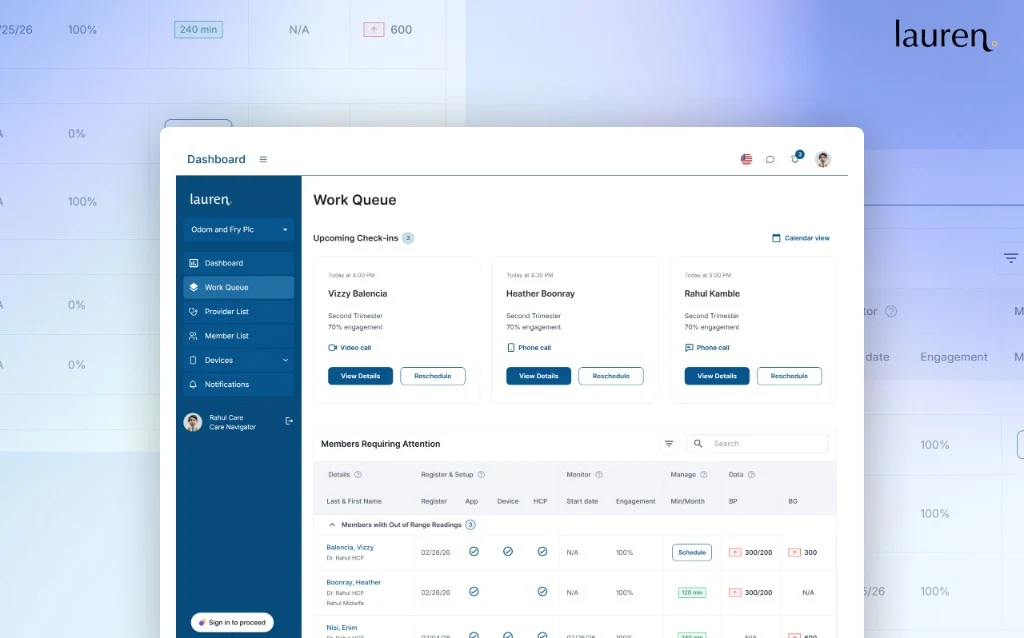
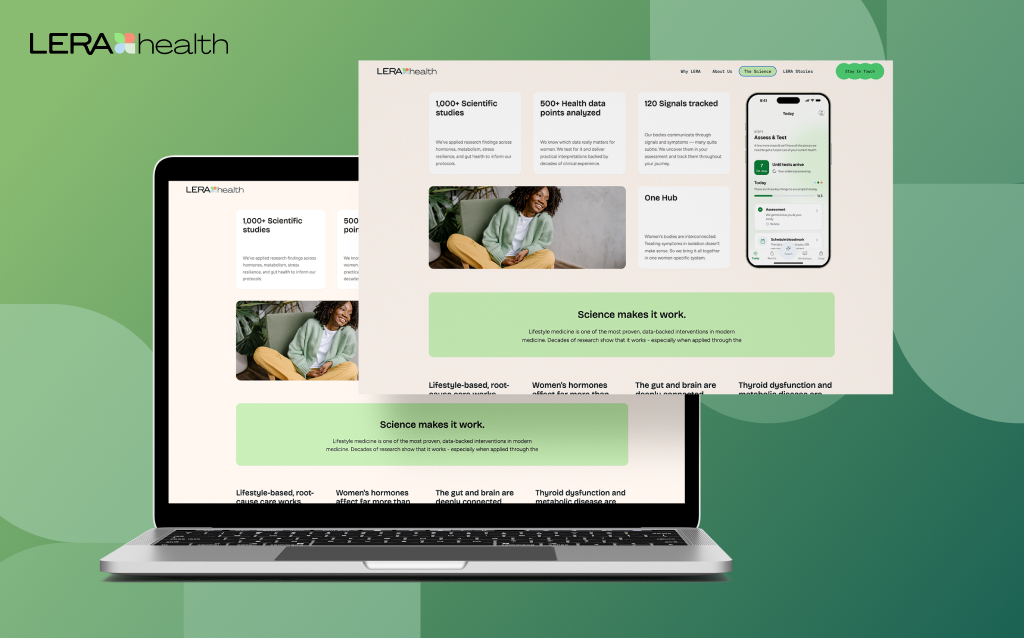
A women’s health product experience focused on guided care journeys, education, and compliance-aware workflows to support long-term engagement.
Common care models we design mental health apps around.
On-demand and scheduled sessions with licensed therapists and psychiatrists.
Sponsored behavioral health benefits with eligibility file ingestion and reporting.
PCP-led CoCM workflows with psychiatric consultation and registry tracking for CPT 99492-99494.
42 CFR Part 2-compliant outpatient SUD journeys with contingency-management support.
Minor consent flows, guardian access controls, and family session scheduling.
Prescription digital therapeutics pipelines for FDA De Novo / 510(k) programs.
We connect to the systems your teams already know.
We build secure, scalable products designed for privacy, interoperability, and regulatory readiness from day one across every sector we serve.

Protect PHI with privacy-first architecture, encrypted storage and transmission, and strict access controls.

Implement lawful consent flows, data minimization, and secure processing for global data privacy.

Enabling standardized health data exchange through standards-based API mappings.
We combine deep technical expertise with industry-specific knowledge to deliver solutions that aren't just functional, but transformational.
We implement rigorous security protocols and compliance standards (HIPAA, GDPR, SOC2) across all industrial solutions to protect sensitive data.
Our architectures are built to handle massive data loads and user bases, keeping performance steady whether you're serving ten or ten million.
Using our suite of internal tools and proven frameworks, we cut setup work so your first release reaches users sooner.
Beyond simple wrappers, we build deep-learning integrations and predictive analytics directly into the core of your industry-specific workflows.
A scoping call, a fixed-scope first release, then scale and support.
We map your care model, clinical measures, crisis pathway and the systems the app must connect to.
One patient journey and the clinician workspace behind it, with consent, measures and escalation working end to end.
Access controls, audit logging, Part 2 segmentation and monitoring go live behind your identity provider.
We stay on as the engineering team, adding programs, payers and integrations as the service grows.
Short facts we design around, each linked to its primary source.
42 CFR Part 2 restricts the use and disclosure of substance use disorder patient records maintained by federally assisted Part 2 programs, separately from the HIPAA Privacy Rule.
Source: 42 CFR Part 2 (eCFR)The HIPAA Security Rule requires administrative, physical and technical safeguards for electronic protected health information.
Source: 45 CFR Part 164 Subpart C (eCFR)The FTC Health Breach Notification Rule requires vendors of personal health records and related entities, including many health apps outside HIPAA, to notify consumers after a breach of unsecured health information.
Source: 16 CFR Part 318 (eCFR)WCAG 2.2 is the W3C Recommendation commonly used as the technical benchmark for accessible web and mobile interfaces.
Source: W3CWe don't just build products; we forge lasting partnerships. See how we've helped industry leaders transform their vision into technical reality.
“I can clearly see how Agnotic has a unique way of handling end-to-end development. They are always active on quick chat and provide support quickly.”

Aaron Phelan
Founder, Benchmark
“Agnotic combines deep technical expertise with strong domain knowledge. They understand the business context, anticipate challenges, and make collaboration smooth and effective.”

John Pasmore
Founder, Latimer
“Agnotic is the best technical team we evaluated. Their engineering excellence made our work dramatically easier and allowed us to stay focused on what matters most for maternal care outcomes. They took full ownership of the technical execution, and we are always happy to continue working together.”

Kim Smith
Founder, My Lauren
This page covers clinical mental health apps. These pages cover the consumer, data and service sides of the same product.
The consumer wellness app build: programs, reminders and the rules that apply outside HIPAA.
How passive sleep and activity data reaches an iOS or Android mood app.
Where conversational AI fits beside check-ins, and where it must hand off to people.
Screening, Part 2 consent and billing for behavioral health providers.
The video visit, scheduling and EHR layer behind teletherapy sessions.
Device and wearable data, alerts and review queues between sessions.
Custom clinical records for practices whose EHR does not fit therapy workflows.
The safeguards we build into every mental health product that handles PHI.
Explore other production-grade engineering platforms we deliver across healthcare.
The technical patterns behind this platform translate naturally into adjacent verticals.
Tell us about your care model, and we will scope a focused first release with you on a scoping call.
contact@agnotic.com
Partnerships
contact@agnotic.com