

HIPAA requirements for software teams
The safeguards every EHR integration has to meet.


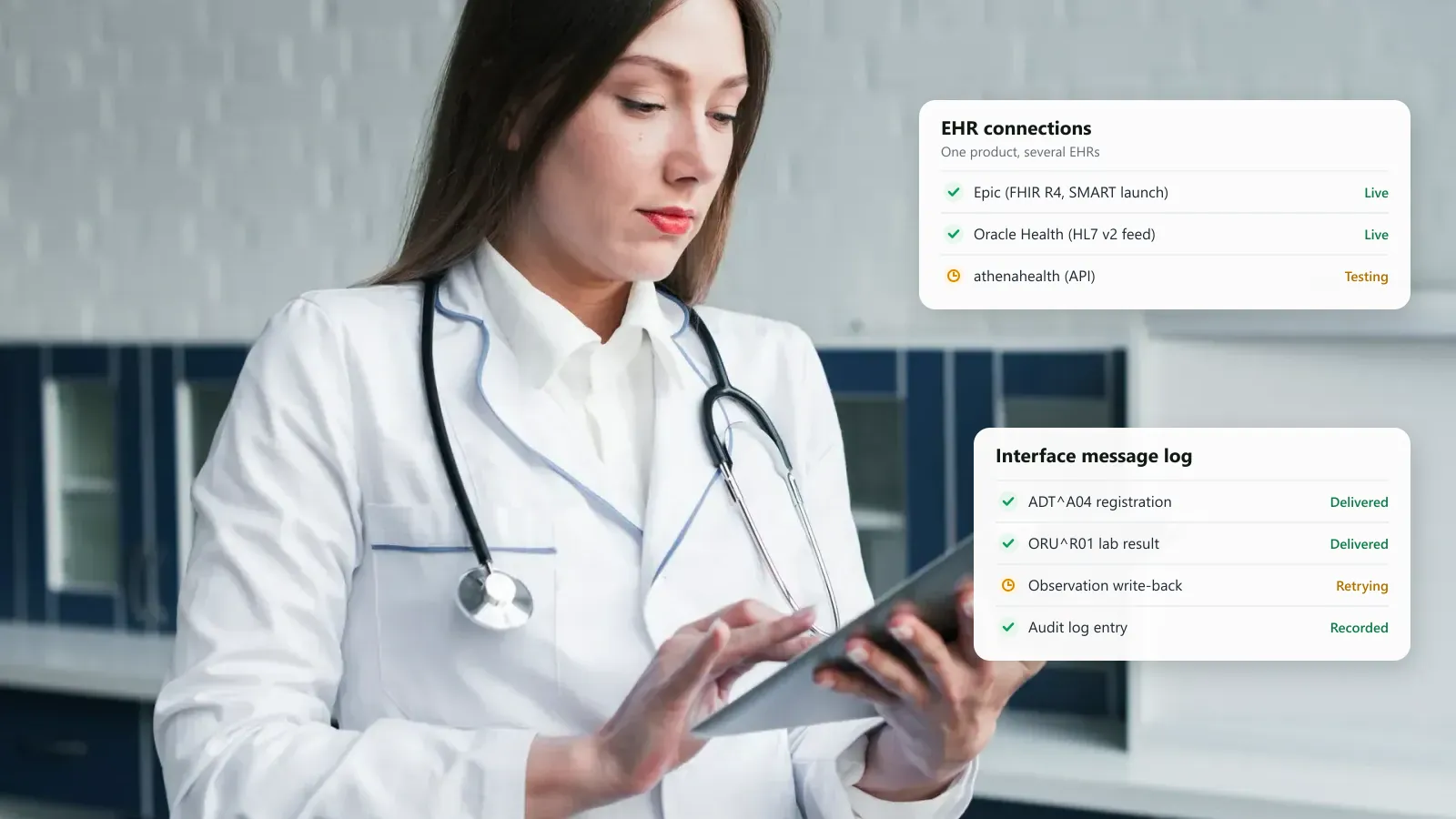
Your product is only as useful as its connection to the EHR, and every EHR vendor does it differently. Agnotic Technologies builds EHR and EMR integrations with Epic, Oracle Health, athenahealth and others, using FHIR, HL7 v2 and vendor APIs, with audit logging and PHI controls from the first interface.
Trusted by global innovators











EHR integration services connect an application, device or data platform to an electronic health record so patient data moves between them without manual entry. Agnotic Technologies builds these integrations for Epic, Oracle Health (Cerner), athenahealth and other EHRs, choosing FHIR, HL7 v2, C-CDA or X12 for each data flow and adding audit logging and access controls.
EHR integration rarely stands alone. These are the areas it most often touches.
The safeguards every EHR integration has to meet.
HIPAA, ONC and other frameworks as engineering work.
Women's health products that need EHR data and results.
Claims, eligibility and payments connected to the EHR.
We do not quote before we understand these. The code is rarely the slow part; access, sites and testing usually are.
Number of EHRs, sites and data flows: each one adds mapping, testing and go-live work.
Read-only or write-back: writing data into the chart needs more vendor approval and more testing than reading it.
Vendor access: app registration, sandbox access and production approval follow the vendor's process and calendar.
A client sponsor is needed: many EHRs only open production access through a hospital or practice that runs them.
Each site is different: the same EHR is configured differently at every organization, so mappings change per site.
Testing needs real workflows: an interface that passes sandbox tests can still fail on live data and edge cases.
Most projects use more than one. We pick per data flow, based on what the EHR supports and what the data is for.
| Standard | Best for | How it works | Watch out for |
|---|---|---|---|
| HL7 FHIR R4 (HL7 International) | Apps that read and write patient data on demand | REST APIs over standard resources such as Patient, Observation and MedicationRequest | Write access and some resources vary by EHR vendor |
| SMART on FHIR | Apps that open inside the EHR with the patient in context | OAuth 2.0 launch from the chart on top of FHIR APIs | App registration and review with each vendor |
| HL7 v2 | Real-time event feeds: admissions, orders, results | Messages such as ADT, ORM and ORU sent through an interface engine | Each site's message variations need mapping and testing |
| C-CDA | Exchanging summary documents between organizations | Structured XML documents such as the Continuity of Care Document | Large documents; useful data must be parsed out |
| X12 | Claims, eligibility and prior authorization with payers | HIPAA standard transactions such as 837, 835, 270/271 and 278 | Usually runs through a clearinghouse, not the EHR |
Access is a project in its own right. We run it in parallel with the build so it does not hold up go-live.
Register with the vendor's developer program, for example Epic's at open.epic.com, and choose the APIs and scopes you need.
Develop and test against the vendor sandbox with test patients before any real data is involved.
Agree production access with the hospital or practice that runs the EHR; they approve and activate the app.
Configure, test and launch at each site, with monitoring from the first message.
The integration work we take on, from a single interface to a full integration layer.
Apps that launch from the patient chart with user and patient context, for Epic, Oracle Health and other EHRs.
Reading and writing patients, encounters, results and medications through each EHR's FHIR APIs.
ADT, orders and results feeds through your interface engine, with mapping and error handling.
Decision support that appears in the clinician's workflow at the moment of ordering or signing.
FHIR bulk export and scheduled extracts for population health and analytics.
Message tracking, alerting on failures and replay, so problems are found before clinicians notice.
Three patterns cover most projects. Many products combine them.
Your app calls the EHR's FHIR APIs directly. Simple for one EHR, harder to maintain across many.
HL7 v2 and FHIR traffic routes through an engine such as Mirth Connect, which handles mapping, retries and monitoring.
Your own service normalizes data from several EHRs into one model, so the product does not depend on any single vendor.
Every pattern logs each PHI read and write, encrypts data in transit and at rest, and limits access by role.
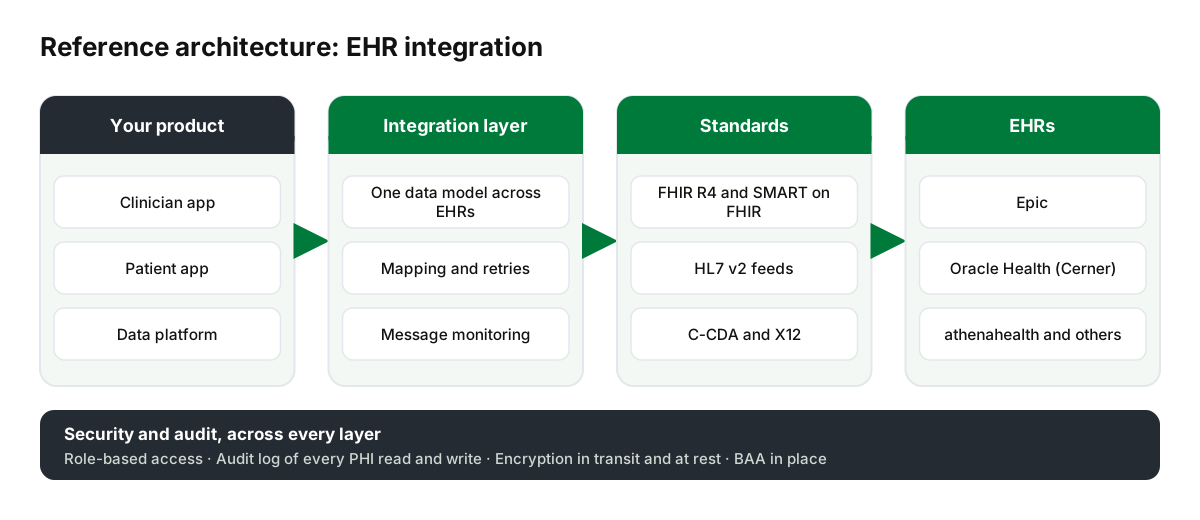
The EHRs, standards and tools that come up most in our integration work.
Each control is an engineering decision we make with your security team, not a checkbox at the end.
| Control | What it answers | How we build it |
|---|---|---|
| Business associate agreement | Who is allowed to handle PHI | A BAA in place before any PHI moves, for us and for every vendor in the data path |
| Minimum necessary | Which data the integration really needs | Only the FHIR scopes and message types the use case requires |
| Access control | Who can see what | Role-based access, with user context passed from the EHR launch |
| Audit logging | Who read or changed which record, and when | A log of every read and write, exportable to your security tools |
| Encryption | How data is protected | TLS in transit and encryption at rest with managed keys |
| HIPAA Security Rule (HHS) | Which safeguards apply | Administrative, physical and technical safeguards documented for your security review |
| Information blocking (21st Century Cures Act) | Whether access can be restricted | Access and exchange designed to the ONC (ASTP) rules in 45 CFR Part 171 |
| ONC Health IT Certification and CMS rules | Which APIs EHRs and payers must offer | We build on the FHIR APIs that ONC certification and CMS interoperability rules require |
We agree these measures at kickoff and track them against your own baseline.
Share of messages and API calls that complete without manual fixes.
Time from an event in one system to the data appearing in the other.
How quickly failed messages are detected, fixed and replayed.
Effort to bring the integration live at each additional organization.
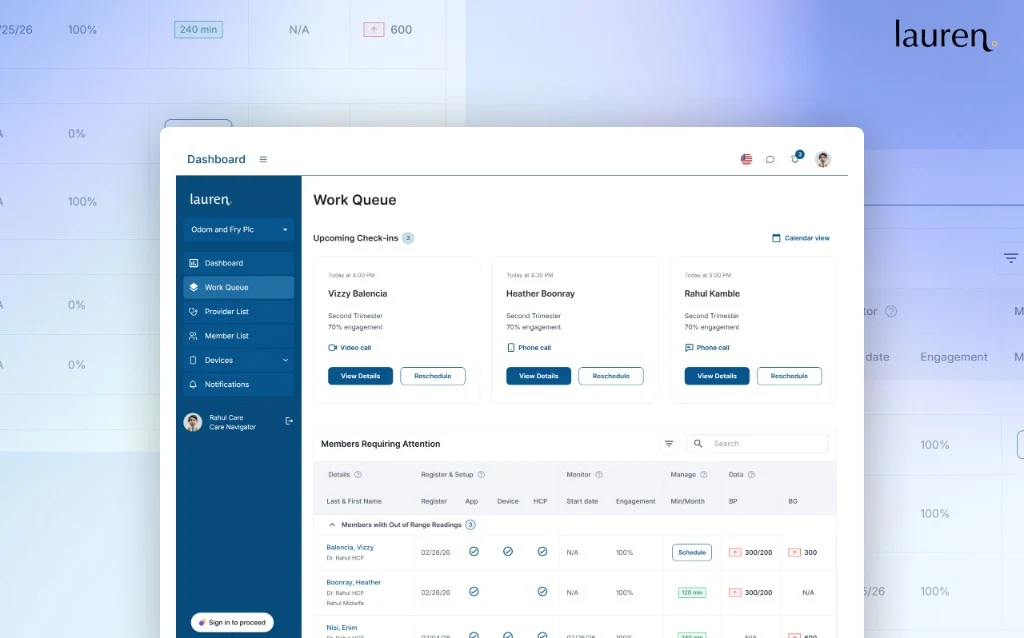
A HIPAA-ready maternal health platform enabling remote patient monitoring, care coordination, and personalized engagement from pre-pregnancy through postpartum.
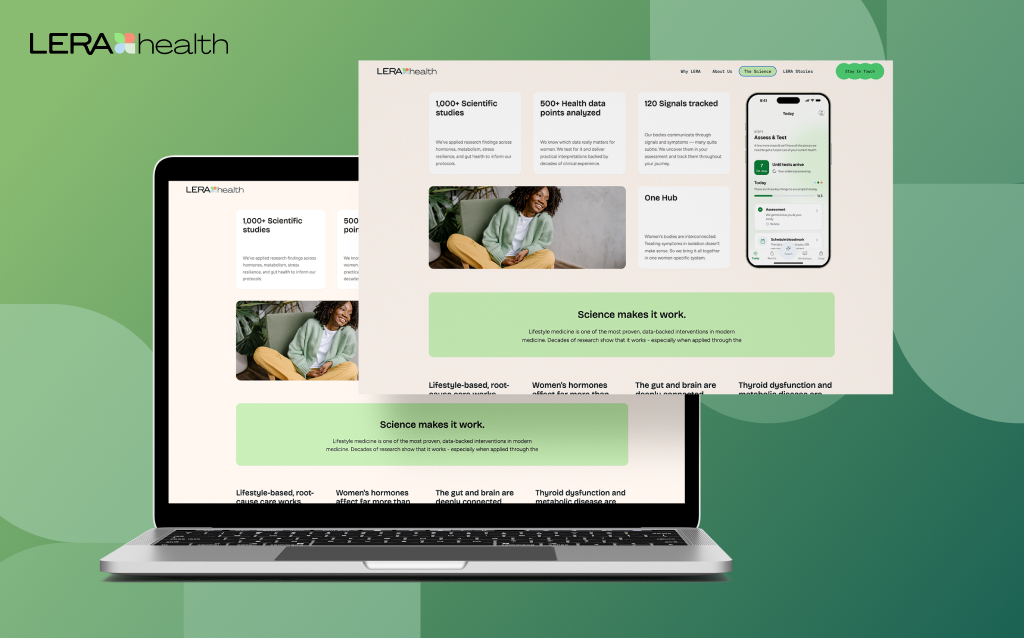
A women’s health product experience focused on guided care journeys, education, and compliance-aware workflows to support long-term engagement.
The integrations we are asked to build most often.
Startups whose product needs patient data from, and results back into, the EHR.
Apps and AI tools that open inside the chart through SMART on FHIR.
Orders and results exchanged with lab and imaging systems over HL7 v2.
Device readings written to the chart as FHIR Observations.
Bulk data feeds into a warehouse for reporting and quality measures.
Moving data from a retiring EHR or EMR into a new one.
Common systems on the other side of an EHR integration.
You keep an EHR integration from disrupting clinical work by planning the cutover as carefully as the build: named owners, tests on the site's own configuration, a quiet go-live window, queued messages and an agreed rollback rule. Agnotic Technologies runs this cutover checklist with your clinical and IT leads.
We build secure, scalable products designed for privacy, interoperability, and regulatory readiness from day one across every sector we serve.

Protect PHI with privacy-first architecture, encrypted storage and transmission, and strict access controls.

Enabling standardized health data exchange through standards-based API mappings.

Supporting enterprise-grade interoperability for clinical messaging and record workflows.
We combine deep technical expertise with industry-specific knowledge to deliver solutions that aren't just functional, but transformational.
We implement rigorous security protocols and compliance standards (HIPAA, GDPR, SOC2) across all industrial solutions to protect sensitive data.
Our architectures are built to handle massive data loads and user bases, keeping performance steady whether you're serving ten or ten million.
Using our suite of internal tools and proven frameworks, we cut setup work so your first release reaches users sooner.
Beyond simple wrappers, we build deep-learning integrations and predictive analytics directly into the core of your industry-specific workflows.
Three stages, each with a clear output.
We agree the EHRs, data flows, standards and sites in scope, and start vendor access early.
One data flow with one EHR, working end to end in the sandbox, then live at the first site.
More data flows, vendors and sites, with monitoring and support under agreed terms.
Short facts we design around, each linked to its primary source.
ONC certification criterion 170.315(g)(10) requires certified EHRs to offer a standardized API for patient and population services based on HL7 FHIR.
Source: 45 CFR 170.315 (eCFR)HHS adopts the United States Core Data for Interoperability (USCDI) as the standard set of health data classes and data elements for certified health IT.
Source: 45 CFR 170.213 (eCFR)The information blocking regulations restrict practices by health care providers, certified health IT developers and health information networks that interfere with access, exchange or use of electronic health information.
Source: 45 CFR Part 171 (eCFR)The HIPAA Security Rule requires administrative, physical and technical safeguards for electronic protected health information.
Source: 45 CFR Part 164 Subpart C (eCFR)Epic publishes its FHIR API documentation and developer resources for third-party applications on open.epic.com.
Source: Epic (open.epic.com)We don't just build products; we forge lasting partnerships. See how we've helped industry leaders transform their vision into technical reality.
“I can clearly see how Agnotic has a unique way of handling end-to-end development. They are always active on quick chat and provide support quickly.”

Aaron Phelan
Founder, Benchmark
“Agnotic combines deep technical expertise with strong domain knowledge. They understand the business context, anticipate challenges, and make collaboration smooth and effective.”

John Pasmore
Founder, Latimer
“Agnotic is the best technical team we evaluated. Their engineering excellence made our work dramatically easier and allowed us to stay focused on what matters most for maternal care outcomes. They took full ownership of the technical execution, and we are always happy to continue working together.”

Kim Smith
Founder, My Lauren
Each EHR has its own APIs, app programs and approval steps. These pages cover what an integration with each one involves.
FHIR APIs, SMART on FHIR apps, CDS Hooks and Epic's developer programs.
Millennium FHIR APIs, SMART apps and HL7 v2 interfaces.
athenahealth's APIs and marketplace for ambulatory practices.
Expanse APIs and interfaces for community hospitals.
APIs and interfaces for eClinicalWorks practices.
APIs and interfaces for NextGen ambulatory practices.
FHIR R4 patient access and SMART launch for independent practices.
Virtual visit notes, orders and encounters written back to the EHR.
Explore other production-grade engineering platforms we deliver across healthcare.
Multi-party exchange through HIEs, QHINs and TEFCA.
Claims, eligibility and payments connected to the EHR.
Products that need EHR data from their first release.
AI features that read from and write back to the EHR, with human review.
The technical patterns behind this platform translate naturally into adjacent verticals.