


AI in healthcare, built to run inside real clinical workflows
Most healthcare AI pilots stall between the demo and the clinic: no EHR connection, no review step, no answer for the security team. Agnotic Technologies builds AI that clinicians and staff can use every day, with human review and an audit trail.
15-Minute Scoping Call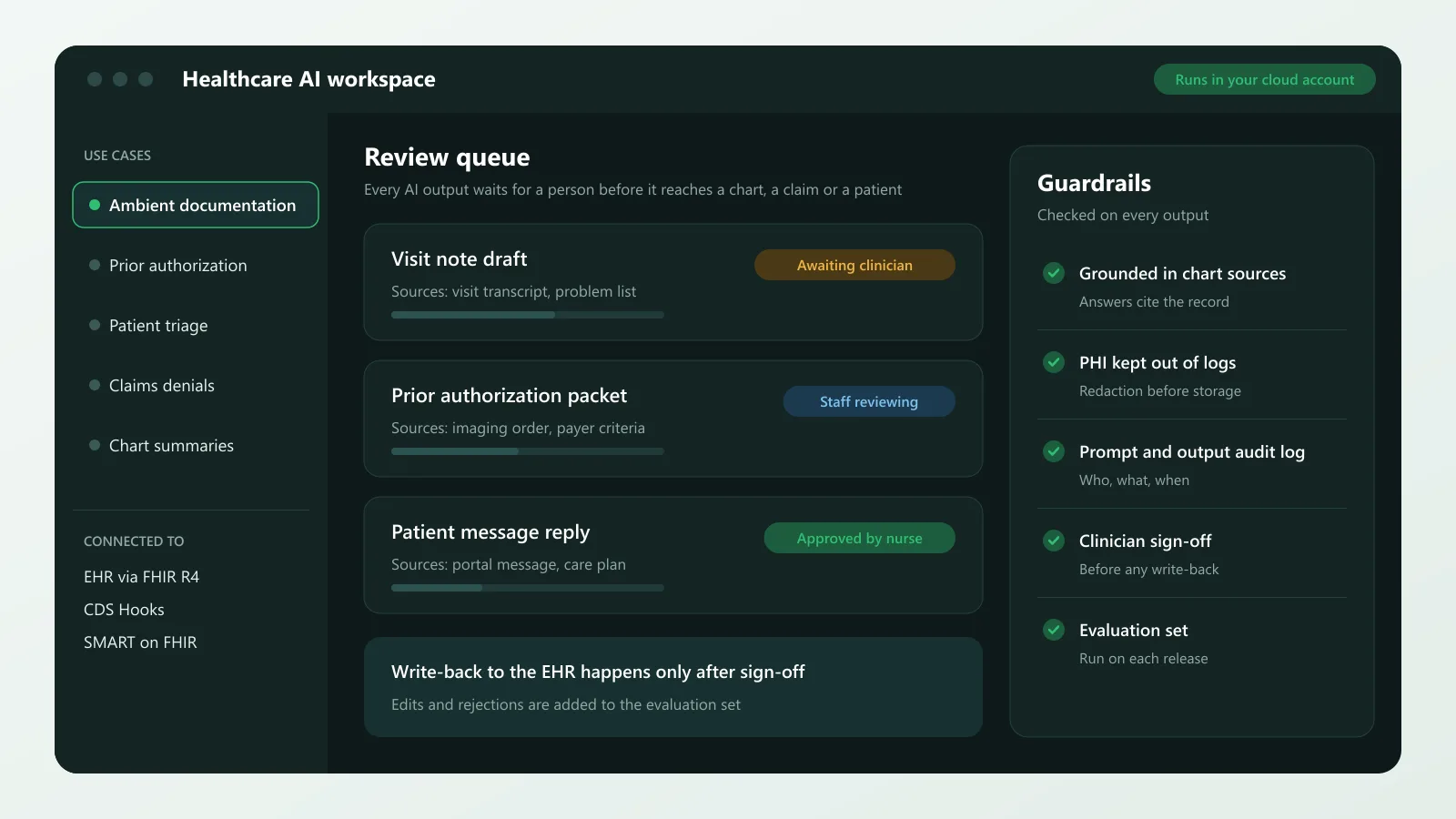
Trusted by global innovators











What is AI in healthcare software development?
AI in healthcare software development is building AI features into clinical and administrative workflows so their output can be trusted and used. Agnotic Technologies connects models to the EHR through HL7 FHIR, grounds them in the patient's record, adds automated checks and a human review step, and keeps an audit log of every prompt and output.
Which healthcare AI use cases do we build?
Each page covers the workflow, the integration and the review step for that use case.
Clinical documentation and decisions
- AI medical scribe and ambient documentationVisit notes drafted from the conversation for clinician sign-off.
- Clinical decision support AI agentRecommendations inside the EHR at the point of care.
- Chat with medical recordsRecord summaries and answers that cite the chart.
- Patient triage AI agentSymptom intake and routing to the right care team.
Revenue cycle and payer work
- Prior authorization automationDocumentation gathered against payer criteria, with FHIR ePA.
- Claims denial managementDenials sorted, root causes found and appeals drafted.
- Eligibility verificationCoverage checks before the visit.
- Document processingFaxes, referrals and forms extracted for staff to confirm.
Patient access and voice
- Voice AI schedulingPhone booking and rescheduling connected to the schedule.
- Patient communication AIMessage drafting and inbox routing for staff review.
- Virtual nursing assistantRoutine follow-up and check-ins with escalation to nurses.
- Healthcare AI agent developmentCustom agents for workflows not listed here.
How do guardrails, evaluation and human review work?
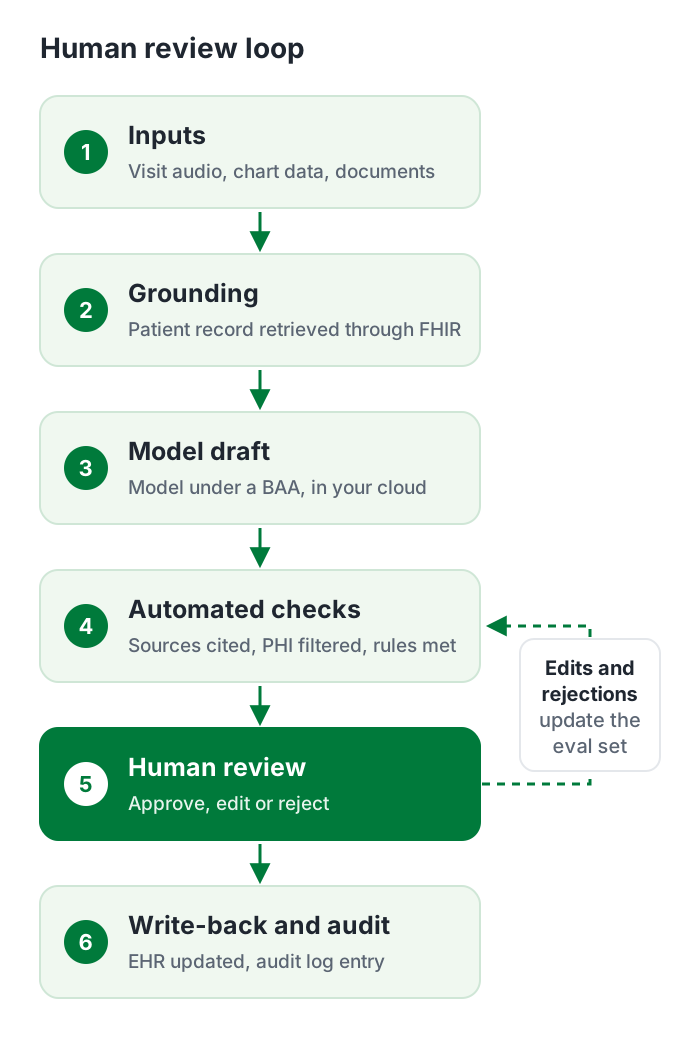
Every output goes through the same loop before it reaches a chart, a claim or a patient.
- Grounding
- The model works from the patient's record and your documents, retrieved at request time, so answers can cite their source.
- Automated checks
- Each output is checked for missing sources, PHI in places it should not be and your own rules before anyone sees it.
- Human review
- A clinician or staff member approves, edits or rejects the output. Nothing is written to the EHR without that step.
- Evaluation set
- Edits and rejections become test cases, and the full set runs before each release to catch regressions and drift.
- Audit trail
- Prompts, sources, outputs and reviewer decisions are logged, so you can answer what the AI did and who approved it.
Where does FDA clinical decision support guidance apply?
The answer depends on what the software does and who relies on it. These are the common patterns we see in healthcare AI projects.
| What the AI does | Likely status | What we do in the build |
|---|---|---|
| Drafts notes, letters or messages that a person reviews | Usually not a device function | Human review, audit logging and a documented intended use |
| Summarizes the record and shows its sources to a clinician | Often non-device CDS, if the clinician can review the basis | Show sources and reasoning so the clinician can check them |
| Flags patients for follow-up based on a risk model | Depends on intended use and how output is presented | Regulatory assessment before build, validation on your data |
| Diagnoses, or drives treatment without clinician review | Likely a device software function | Plan for FDA requirements and a documented software lifecycle |
This table is a planning guide, not a regulatory determination. Your regulatory counsel decides the status of each function.
Should you build or buy healthcare AI?
Buy where a product already fits the workflow. Build where your workflow, data or integration is what makes the AI useful.
Workflow
- Usually buy
- A standard workflow that a product already covers
- Usually build
- A workflow specific to your organization or specialty
EHR fit
- Usually buy
- The vendor already works inside your EHR
- Usually build
- You need write-back, CDS Hooks or a SMART on FHIR app
Data
- Usually buy
- General documents or public knowledge
- Usually build
- Your own records, policies or payer rules
Control
- Usually buy
- Vendor review steps and logs meet your needs
- Usually build
- You need your own review rules, audit trail and evaluation
Contracts
- Usually buy
- The vendor signs a BAA for the exact service
- Usually build
- You want models hosted in your own cloud account
Which systems does healthcare AI need to connect to?
AI is only useful where people already work. These are the integration points we build most often.
- EHR data through HL7 FHIRRead the record through FHIR R4 and US Core, and write approved results back.
- In-workflow cards with CDS HooksShow a recommendation when the clinician opens a chart or signs an order.
- EHR integrationEpic, Oracle Health (Cerner) and athenahealth connections tested in the customer's environment.
Which healthcare standards does our AI work follow?
HIPAA
Health Insurance Portability and Accountability Act
Protect PHI with privacy-first architecture, encrypted storage and transmission, strict access controls, and traceable audit logs.

GDPR
General Data Protection Regulation
Implement lawful consent flows, data minimization, retention controls, and secure processing for sensitive health data.

FHIR
Fast Healthcare Interoperability Resources
Enable standardized health data exchange across apps, care teams, and systems through standards-based FHIR APIs.

HL7
Health Level Seven International
Support enterprise-grade interoperability with HL7-based integrations for records, events, and clinical messaging workflows.

HITRUST
Health Information Trust Alliance
Align security programs to healthcare-specific control and risk management practices trusted by providers and ecosystem partners.

HITECH
Health Information Technology for Economic and Clinical Health Act
Design with breach notification readiness, digital record safeguards, and operational controls that support regulated care programs.

SaMD
FDA Software as a Medical Device
Plan software quality, traceability, and documentation pathways for products that may require SaMD review and submission.

MDR (EU)
Medical Device Regulation (European Union)
Prepare EU market-ready processes for risk classification, evidence tracking, and lifecycle governance under MDR expectations.

SAMHSA
Substance Abuse and Mental Health Services Administration
Apply confidentiality controls and consent-aware sharing models for behavioral and mental health data experiences.
What compliance work does healthcare AI need?
- A business associate agreement with every model or AI vendor that processes PHI
- Prompts, outputs and retrieval logs kept out of analytics and protected like the record
- De-identified or synthetic data for development and evaluation
- Role-based access to the AI features, with an audit log of every use
- A documented intended use and review step for each AI function
Which frameworks and rules shape healthcare AI?
The NIST AI Risk Management Framework is a voluntary framework that organizes AI risk work into four functions: Govern, Map, Measure and Manage.
Source: NIST AI 100-1FDA's Clinical Decision Support Software guidance explains which decision support functions meet the non-device criteria in section 520(o)(1)(E) of the FD&C Act and which remain device software functions.
Source: FDA guidance, Clinical Decision Support SoftwareA HIPAA covered entity may share protected health information with a business associate, such as a software vendor, only under a business associate agreement that commits the vendor to safeguard it.
Source: 45 CFR 164.502(e) and 164.504(e) (eCFR)HIPAA allows two ways to de-identify health data: expert determination, or the safe harbor method, which removes 18 categories of identifiers.
Source: 45 CFR 164.514(b) (eCFR)
Where should you go next?
- Healthcare software developmentEverything we build for providers, payers and digital health teams.
- EHR integration servicesThe integration most AI features depend on.
- HIPAA compliant AI agent developmentHow PHI, vendor agreements and access are handled with AI in the loop.
- Femtech app developmentAI features in women's health products.