

Integration leads
Health system teams adding apps and data feeds to the EHR.



Every EHR exposes FHIR a little differently, and an app that works in one sandbox can fail at the next site. Agnotic Technologies builds FHIR APIs, FHIR servers and SMART on FHIR apps, tested against Epic and Oracle Health sandboxes before they reach a clinician.
Trusted by global innovators









FHIR development services are the engineering work of building software that exchanges health data through HL7 FHIR APIs: modeling resources and profiles, building or connecting FHIR servers, and creating SMART on FHIR apps that launch inside an EHR. Agnotic Technologies designs, builds and tests this work, with OAuth scopes and audit logging from the first release.
FHIR R4 is the version most EHRs and US regulations use today. Most projects combine three things: the FHIR data model, a server or API layer, and the apps that read and write through it.
The app opens from the patient chart, receives the patient and user context, requests only the scopes it needs and reads and writes FHIR resources through the EHR's API.
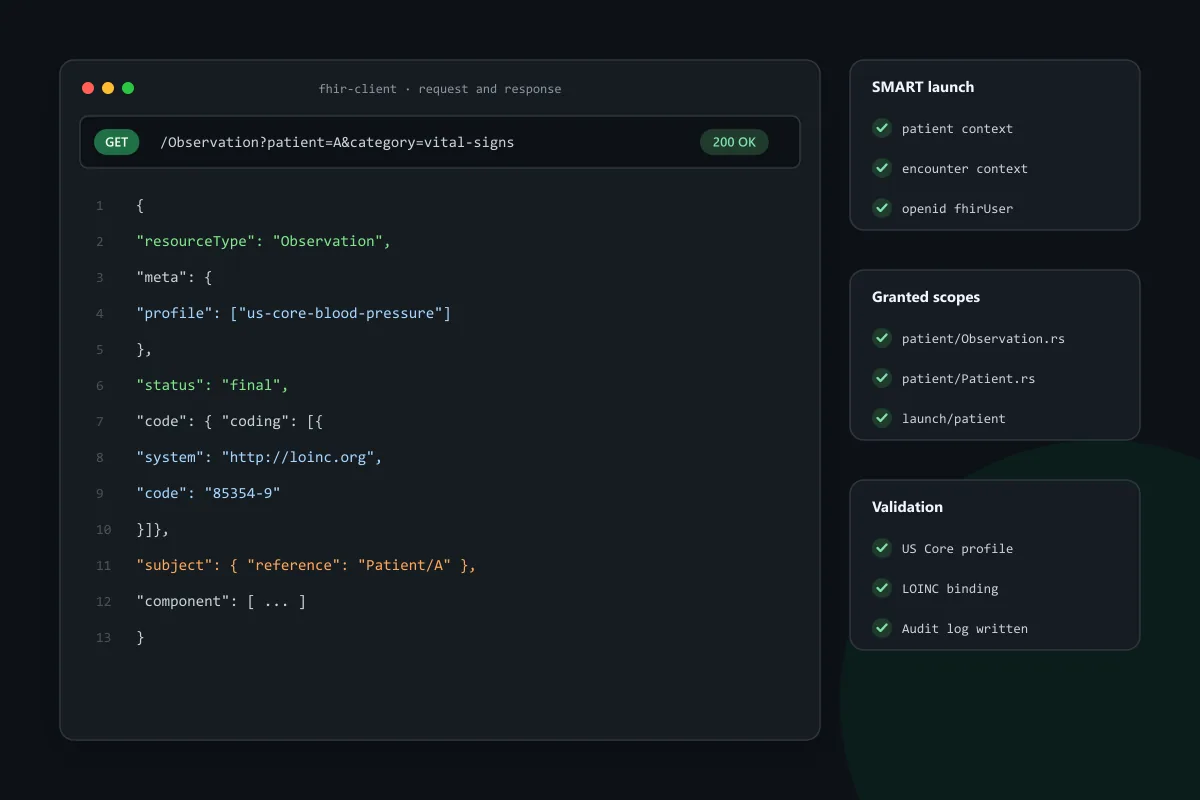
We model to published profiles first, so your data is exchangeable without custom mapping at every partner.
Patient, Encounter, Condition, Observation, MedicationRequest and the other US Core profiles that cover the USCDI data classes.
Patient summaries for cross-border or multi-country products that follow the IPS implementation guide.
Extensions and profiles only where published ones do not fit, documented in an implementation guide your partners can read.
SNOMED CT, LOINC, RxNorm and ICD-10-CM bindings, with a terminology service for validation and lookup.
FHIR Bulk Data export for population health, analytics and data warehouse feeds.
A FHIR API in front of an existing database or HL7 v2 feed, so new apps can use FHIR without replacing the old system.
Who it is for
Most of our FHIR work is for one of these teams.
Health system teams adding apps and data feeds to the EHR.
Product teams whose app has to launch inside Epic or Oracle Health.
Payers building the FHIR APIs CMS rules require.
Analytics teams pulling FHIR bulk data into a warehouse.
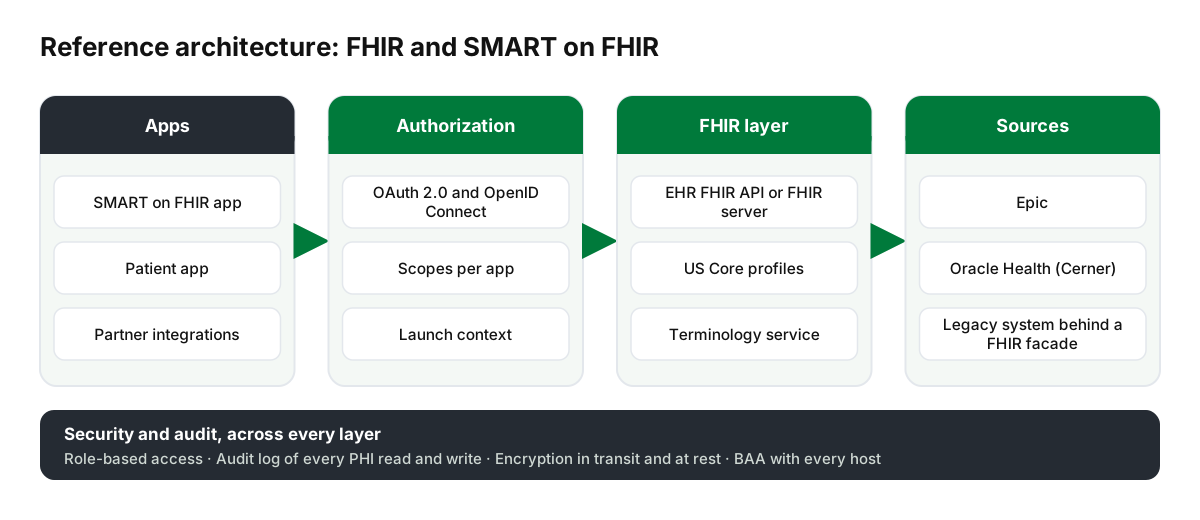
Reference architecture
The layout we start from and adjust to your EHRs and hosting.

Health Insurance Portability and Accountability Act
Protect PHI with privacy-first architecture, encrypted storage and transmission, strict access controls, and traceable audit logs.

General Data Protection Regulation
Implement lawful consent flows, data minimization, retention controls, and secure processing for sensitive health data.

Fast Healthcare Interoperability Resources
Enable standardized health data exchange across apps, care teams, and systems through standards-based FHIR APIs.

Health Level Seven International
Support enterprise-grade interoperability with HL7-based integrations for records, events, and clinical messaging workflows.

Health Information Trust Alliance
Align security programs to healthcare-specific control and risk management practices trusted by providers and ecosystem partners.

Health Information Technology for Economic and Clinical Health Act
Design with breach notification readiness, digital record safeguards, and operational controls that support regulated care programs.

FDA Software as a Medical Device
Plan software quality, traceability, and documentation pathways for products that may require SaMD review and submission.

Medical Device Regulation (European Union)
Prepare EU market-ready processes for risk classification, evidence tracking, and lifecycle governance under MDR expectations.

Substance Abuse and Mental Health Services Administration
Apply confidentiality controls and consent-aware sharing models for behavioral and mental health data experiences.
Compliance and security
Each requirement is an engineering decision. Agnotic claims no certification; we build so your product can pass your partners' reviews.
| Requirement | Who sets it | What it means for the build |
|---|---|---|
| HIPAA Security Rule | HHS | Access control, audit logs and encryption for every FHIR call and stored resource |
| Standardized FHIR API for certified EHRs | ONC (ASTP) | Certified EHRs must offer a FHIR API under 170.315(g)(10), which apps can build on |
| FHIR, SMART and US Core specifications | HL7 International | Resources, launch and profiles built to the published specifications |
| Payer FHIR APIs | CMS | Patient Access, Provider Access and Payer-to-Payer APIs for payers under CMS interoperability rules |
| Vendor app programs | EHR vendors such as Epic | App registration, review and production approval before go-live |
These are the pieces that put your app inside the clinician's workflow.
The clinician opens the app from the chart. The EHR passes a launch context with the patient, encounter and user.
From the chartThe app requests only the scopes it needs, such as reading a patient's observations, and the EHR authorizes them.
Least accessThe app reads and writes FHIR resources through the EHR's API, with every call logged.
Read and writeWhere needed, the EHR calls your service at moments like opening a chart or signing an order, and shows your cards in its own screen.
In the workflowScope and effort
We do not quote before we understand these.
Writing data back to the EHR needs more approval and testing than reading it.
Each EHR and each organization adds configuration, testing and go-live work.
Running your own FHIR server adds hosting, scaling and operations.
Published profiles are faster than custom ones that partners must learn.
App review and client sponsorship follow the vendor's and the client's calendar.
FHIR servers
Many products do not need their own FHIR server. When they do, these are the usual choices.
| Option | Choose it when | Watch out for |
|---|---|---|
| Open source (HAPI FHIR) | You need full control, custom operations or on-premises hosting | You run, scale, patch and back it up yourself |
| Cloud FHIR stores | You already run on AWS, Google Cloud or Azure and want a hosted store under your cloud BAA | Each cloud supports a different set of FHIR features and search parameters |
| Managed FHIR platforms | You want a hosted FHIR platform with extra tooling and do not want to run the server | Vendor lock-in, pricing at scale and data residency |
| No server: use the EHR's API | Your app only reads and writes data that lives in the EHR | Each EHR's API differs, and write access needs vendor approval |
We recommend the simplest option that meets your data, hosting and partner needs.
Short facts we design around, each linked to its primary source.
HL7 FHIR is a standard published by HL7 International for exchanging health data through RESTful APIs built on defined resources such as Patient, Observation and MedicationRequest.
Source: HL7 International (hl7.org/fhir)The SMART App Launch implementation guide uses OAuth 2.0 and OpenID Connect so that apps can launch from an EHR with the user's and patient's context and only the access scopes they were granted.
Source: HL7 International (SMART App Launch)US Core is the HL7 FHIR implementation guide that profiles FHIR resources for the USCDI data classes used in the United States.
Source: HL7 International (US Core)ONC certification criterion 170.315(g)(10) requires certified EHRs to offer a standardized API for patient and population services based on HL7 FHIR.
Source: 45 CFR 170.315 (eCFR)