

Challenge
The visit is not written back to the EHR
Agnotic approach
We agree the EHR, the data to write back and sandbox access in the first weeks, because vendor access can take longer than the build.



A video call is not a virtual care service. Clinicians also need intake, notes, prescriptions, labs and a record in the EHR. Agnotic Technologies builds telemedicine platforms that handle the whole visit, built for your care model, your payers and the systems you already run.
Trusted by global innovators









Telemedicine platform development is building the software a care team uses to see, treat and follow up with patients remotely: scheduling and intake, video or asynchronous visits, clinical notes, e-prescribing, labs and EHR sync. Agnotic Technologies builds these platforms as a services engagement, with HIPAA safeguards designed in from the first release.
Telehealth is the wider term for remote health services, including education and monitoring. Telemedicine is the clinical part: a clinician diagnosing and treating a patient at a distance. The platforms we build usually cover both.
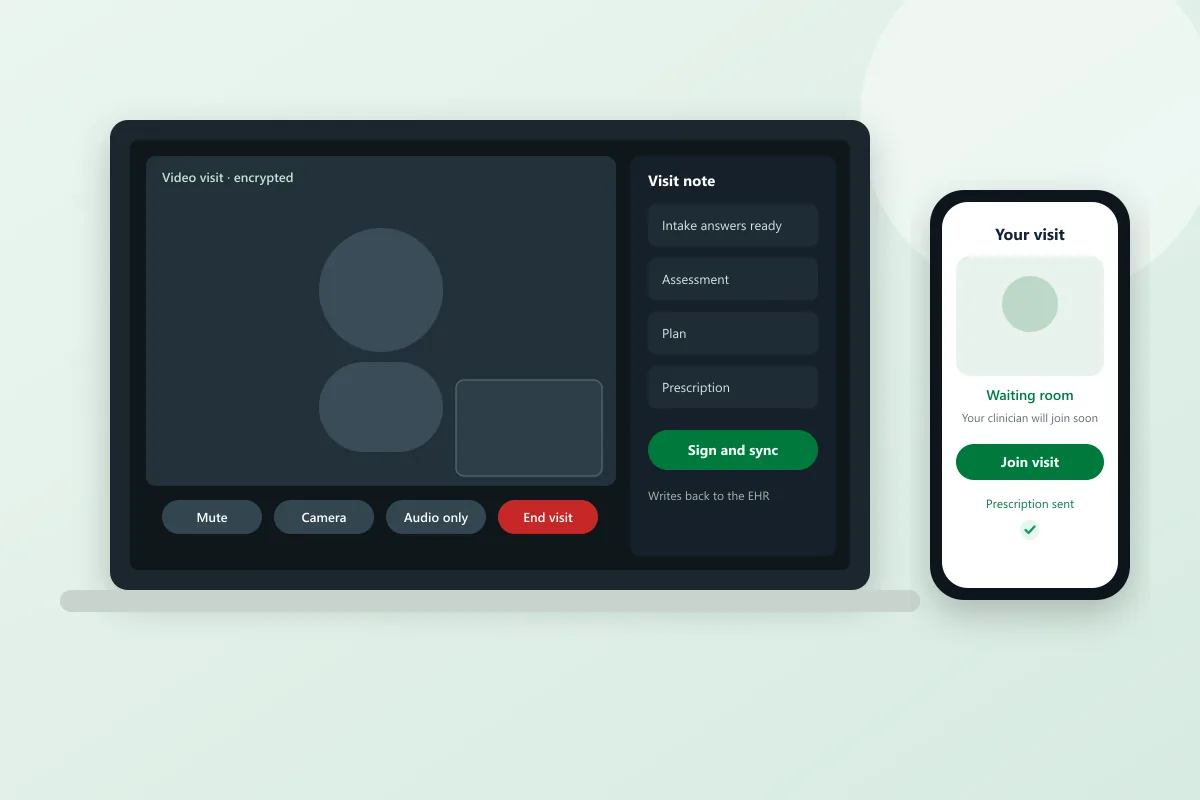
The clinician sees the patient queue, the video visit, the note and the prescription in one place, and the visit is written back to the EHR when it ends.
Failure points
The problems we see most often, and how we plan around them from the start.
Challenge
The visit is not written back to the EHR
Agnotic approach
We agree the EHR, the data to write back and sandbox access in the first weeks, because vendor access can take longer than the build.
Challenge
Video works in testing but fails at home
Agnotic approach
We test on poor networks and older phones, and design an audio-only fallback and a clear way to rejoin.
Challenge
Prescribing rules are an afterthought
Agnotic approach
We plan state licensing checks, controlled substance rules and EPCS before the prescribing screens are built.
Challenge
No-shows and drop-offs
Agnotic approach
Reminders, simple rejoin links and a waiting room that tells patients what is happening.
Challenge
Compliance drifts after launch
Agnotic approach
A BAA inventory for every vendor that touches PHI, audit log reviews and access reviews built into operations.
The modules most platforms need. We build the ones your care model uses.
Appointment booking, eligibility checks and digital intake forms, with the answers ready for the clinician before the visit.
Browser and mobile video through a vendor that signs a business associate agreement, with a waiting room and an audio-only fallback.
Visit notes and templates for each care model, signed by the clinician and stored as part of the patient record.
Prescriptions routed through Surescripts, with EPCS and identity proofing for controlled substances where your program prescribes them.
Lab orders and results exchanged with lab partners over HL7 v2 or FHIR, filed to the chart and shown to the patient.
Cash-pay checkout or insurance claims, with eligibility, coding and claim submission connected to your billing system.
Launch scope by role
A telemedicine software features checklist sorted by role shows what each person must be able to do on the first day of visits. Most features depend on an outside system: the video vendor, the EHR, e-prescribing, payments or identity proofing.
Patients need identity-checked sign-up, state-aware booking, a device test and payment capture. Clinicians need a license-filtered queue, an audio-only fallback, e-prescribing with EPCS (Surescripts) and EHR note write-back. Front desk and admins need reminders, eligibility checks, license and DEA records, and audit logs.
Who it is for
Most of the teams we build virtual care for fall into one of these groups.
New virtual care services that need a platform built around their care model.
Health systems and practices adding virtual visits connected to their EHR.
Programs with their own visit formats, consent steps and follow-up.
Organizations that have outgrown a packaged telehealth product.
Telemedicine specialties
Telemedicine works across many specialties, but each needs different visit data: dermatology runs on photos, behavioral health on questionnaires such as the PHQ-9, pulmonology on home spirometry and cardiology on blood pressure and ECG readings. Agnotic Technologies builds the visit around that data.
Store-and-forward visits built on photos the patient takes, with image quality checks before a dermatologist reviews them.
Video therapy and medication follow-up, with PHQ-9 and GAD-7 scores collected before each session and consent steps for sensitive records.
Asthma and COPD follow-up that reviews home spirometry and pulse oximetry readings sent from the patient's devices.
Remote follow-up and heart failure check-ins using home blood pressure, weight and ECG readings from connected devices.
Diabetes visits built around continuous glucose monitor data, insulin logs and lab results reviewed with the patient.
Video sessions where the therapist watches exercises and range of motion, with a home exercise program between visits.
Video visits a parent or guardian joins and consents to, sharing photos or temperature readings for the child.
Short video or message visits for minor illness, refills and chronic care check-ins, with vitals the patient enters.
Video vendors
Most HIPAA problems in telemedicine start with the video and messaging vendors. These are the checks we run with you.
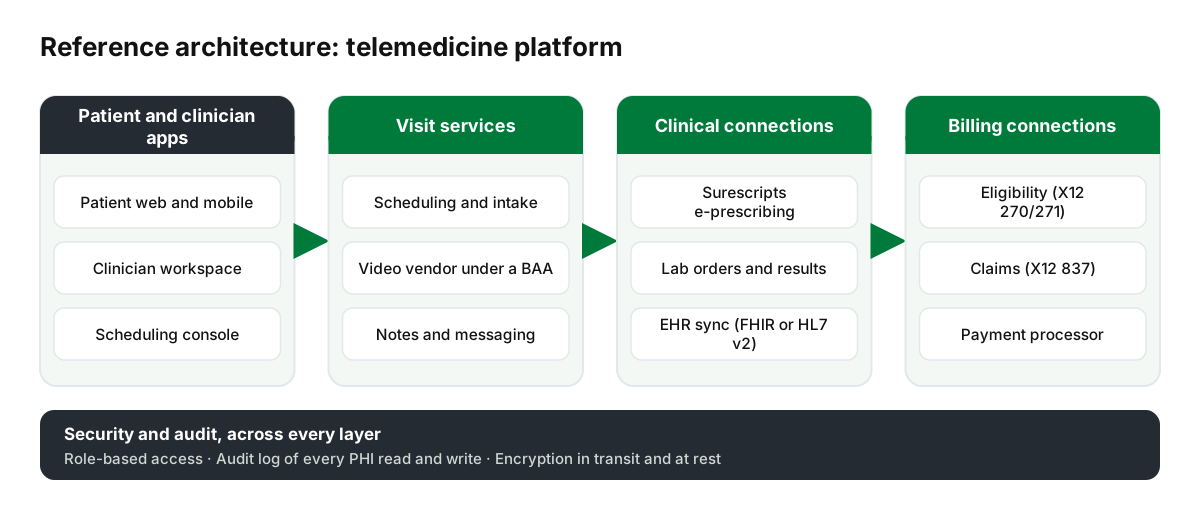
Reference architecture
Every visit touches several outside systems. This is the layout we start from and adjust to your stack.
Outside the US
One platform can serve several markets, but privacy law and registration rules differ. These are the starting points we plan for.

Health Insurance Portability and Accountability Act
Protect PHI with privacy-first architecture, encrypted storage and transmission, strict access controls, and traceable audit logs.

General Data Protection Regulation
Implement lawful consent flows, data minimization, retention controls, and secure processing for sensitive health data.

Fast Healthcare Interoperability Resources
Enable standardized health data exchange across apps, care teams, and systems through standards-based FHIR APIs.

Health Level Seven International
Support enterprise-grade interoperability with HL7-based integrations for records, events, and clinical messaging workflows.

Health Information Trust Alliance
Align security programs to healthcare-specific control and risk management practices trusted by providers and ecosystem partners.

Health Information Technology for Economic and Clinical Health Act
Design with breach notification readiness, digital record safeguards, and operational controls that support regulated care programs.

FDA Software as a Medical Device
Plan software quality, traceability, and documentation pathways for products that may require SaMD review and submission.

Medical Device Regulation (European Union)
Prepare EU market-ready processes for risk classification, evidence tracking, and lifecycle governance under MDR expectations.

Substance Abuse and Mental Health Services Administration
Apply confidentiality controls and consent-aware sharing models for behavioral and mental health data experiences.
Compliance and security
Each requirement becomes an engineering decision: which vendors touch PHI, what is recorded and logged, and who can prescribe what. Agnotic claims no certification; we build so your platform can pass the reviews you face.
| Requirement | Who sets it | What it means for the build |
|---|---|---|
| HIPAA Security Rule | HHS | Access control, audit logs and encryption for video, chat, recordings, notes and messages |
| Business associate agreements | HHS (HIPAA) | A signed BAA with every video, messaging, hosting and analytics vendor that handles PHI |
| Controlled substance prescribing | DEA, with HHS | EPCS, identity proofing and checks against the current DEA telemedicine rules |
| Clinician licensure | State medical boards | Patients matched only with clinicians licensed where the patient is located |
| Medicare telehealth billing | CMS | Visit types, places of service and modifiers recorded so claims follow current CMS rules |
| EHR data exchange | HL7 International and ONC (ASTP) | Visits written back over HL7 FHIR or HL7 v2, using the APIs certified EHRs must offer |
Three stages, each with a clear output.
We agree the care model, the markets, the EHR and payers you need to connect, and what the first release must do.
Care model firstA working platform for real patients and clinicians, usually one care model and one EHR connection, delivered with weekly demos.
Weekly demosMore care models, markets, integrations and mobile apps, then ongoing releases and support under agreed terms.
Ongoing releasesBuild or buy
There are three realistic options. We help you choose before any build starts.
Fastest to launch when a standard video visit fits your care model and you can accept the vendor's workflow, data model and per-visit or per-seat fees.
Use a video vendor, e-prescribing network and EHR APIs under BAAs, and build your own workflow, apps and data model on top. This is what most of our clients choose.
Only when the platform is your product and you need control over every part, including video. It is the largest scope.
Telehealth platforms vs custom builds is mostly a question of what you can take with you. Before signing a white-label contract, test eight terms: BAA scope, visit history, patient accounts, export, EHR interface, prescriber credentials, licensing data and exit.
Ask for the list of subprocessors that touch PHI, such as video, messaging, hosting and transcription, and confirm the BAA makes each one accept the same terms.
The contract should say that visit notes, messages, recordings and intake answers belong to you, not to the platform.
Patients sign up in the vendor's app. Check whether their logins and contact details can move with you, or whether every patient must register again.
Get the format in writing, such as FHIR, CSV or a database copy, how often you can run it and whether attachments are included. Test one export before signing.
If the vendor built the EHR connection, find out whether the interface, its credentials and its mapping move with you or stay with the vendor.
Each prescriber's two-factor EPCS credential comes from an approved credential service provider after identity proofing. Ask whose account the credential sits under and whether it survives a move.
License states, DEA registrations and credentialing files entered in the platform should be exportable, so nobody types them in again.
Look for a notice period, transition help, a final full export and written confirmation that PHI is returned or destroyed, which the BAA must require at termination where feasible.
Scope and effort
We do not quote before we understand these. They are what a scoping call works through.
One synchronous video model is a smaller build than video, async and RPM-led care together.
Each EHR, lab, pharmacy and payer connection adds interface work, vendor access and testing.
Web only, or native iOS and Android apps for patients and clinicians.
Whether you prescribe, and whether controlled substances are in scope.
Each country or state adds privacy, licensing and billing rules to support.
The depth of your customers' or partners' security reviews and the evidence they ask for.
Care models
The care model decides most of the platform. We settle it in the first scoping call.
| Care model | How the visit works | What the platform needs |
|---|---|---|
| Synchronous video | Patient and clinician meet live on video | Scheduling, waiting room, HIPAA-ready video, visit notes and e-prescribing |
| Asynchronous (store and forward) | Patient sends a questionnaire, photos or messages; the clinician reviews later | Structured intake, secure messaging, review queues and response time tracking |
| Hybrid | Async intake first, then a live visit when the clinician needs one | Both of the above, plus rules for when a case moves to a live visit |
| RPM-led | Device readings drive check-ins between visits | Device integration, alerts, care team queues and billing time capture |
Pediatric, behavioral health and specialty programs add their own steps, such as guardian consent or longer session formats.
Short facts we design around, each linked to its primary source.
HHS ended its COVID-19 enforcement discretion for telehealth in August 2023, so covered health care providers must now use remote communication technologies in line with the HIPAA Rules.
Source: Federal Register, April 13, 2023 (HHS Office for Civil Rights notice)A HIPAA covered entity may share protected health information with a business associate, such as a software vendor, only under a business associate agreement that commits the vendor to safeguard it.
Source: 45 CFR 164.502(e) and 164.504(e) (eCFR)DEA and HHS have extended the telemedicine flexibilities that let DEA-registered practitioners prescribe Schedule II to V controlled medications without a prior in-person visit through December 31, 2026.
Source: Federal Register, December 31, 2025A practitioner who signs controlled substance prescriptions electronically must obtain a two-factor authentication credential from an approved credential service provider or a cross-certified certification authority, after submitting identity proofing information.
Source: 21 CFR 1311.105 (eCFR)