

01
Group Practice Booking
Multi-provider, multi-location practices with mixed specialty needs.



Booking apps that don't write to the EHR calendar double-book slots and push work back to the front desk. Agnotic Technologies builds doctor appointment apps that book into the EHR schedule, check insurance eligibility before the visit, collect intake online and send reminders before each visit.
Trusted by global innovators











A doctor appointment app lets patients find a provider, see open times and book, change or cancel a visit from their phone or browser, with the booking written straight into the practice's EHR schedule. Agnotic builds doctor appointment apps for practices, health systems and digital health startups, connected to eligibility checks, intake and reminders.
Problems practices and product teams raise when they scope a doctor appointment app.
Calendar Drift: Apps that mirror availability instead of writing into the EHR end up double-booking or leaving slots stale.
Eligibility Surprises: Patients book in, then discover at check-in that the practice doesn't take their plan, everyone loses.
Intake Rework: Paper intake forms get keyed in by front-desk staff, introducing errors and slowing every visit.
No-Show Pain: Missed appointments leave empty slots when reminders, co-pay capture and waitlists are missing.
We treat the EHR schedule as the source of truth, not a copy.
Live write-backs into Epic, Oracle Health (Cerner), athenahealth, eClinicalWorks and NextGen, not a shadow calendar.
270/271 eligibility checks with Availity, Change Healthcare, and Waystar before booking is confirmed.
Dynamic intake forms keyed directly to the EHR's discrete fields, including photo-ID and insurance-card capture.
Capabilities we build into doctor appointment apps.
EHR-synced availability across providers, locations, and visit types.
Specialty, insurance, language, location, and availability-aware provider search.
Live 270/271 checks before booking confirmation, with cost-estimate pre-disclosure.
Dynamic, EHR-discrete intake with photo-ID, insurance-card, and ROI capture.
SMS, email, push reminders and pre-visit co-pay capture via Stripe / Elavon.
Smart waitlist dynamics that fill cancellations automatically, recovering lost revenue.
Multi-provider, multi-location, multi-specialty scheduling with resource constraints.
Hybrid scheduling for in-person, virtual, and follow-up visit types with rules.
Household / dependent profiles, guardian scheduling, and proxy access controls.
From slot search to eligibility, intake, reminders and the EHR schedule.
Bidirectional scheduling APIs with Epic, Oracle Health (Cerner), athenahealth, eClinicalWorks and NextGen.
Real-time 270/271 and cost-estimate integrations with Availity, Change, and Waystar.
Dynamic forms, photo-ID OCR, and insurance-card parsing into discrete EHR fields.
Reminders, waitlist dynamics, and Stripe / Elavon co-pay capture.
React Native patient app and Next.js front-desk workspace sharing one API.
A pragmatic stack chosen for reliability, speed, and ease of operation.
Measures we build reporting around, agreed with you before launch.
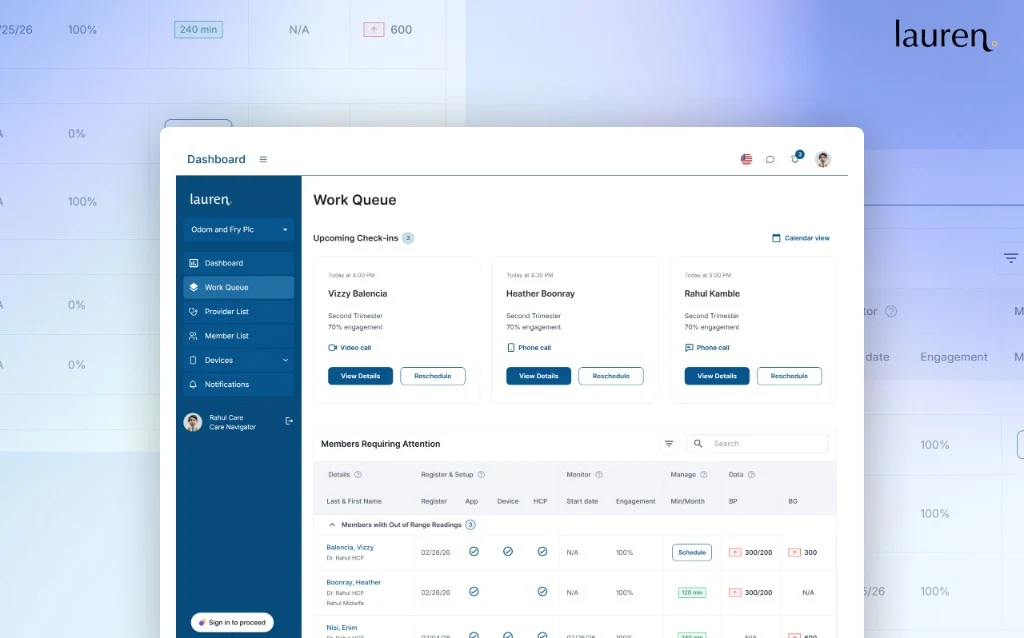
A HIPAA-ready maternal health platform enabling remote patient monitoring, care coordination, and personalized engagement from pre-pregnancy through postpartum.
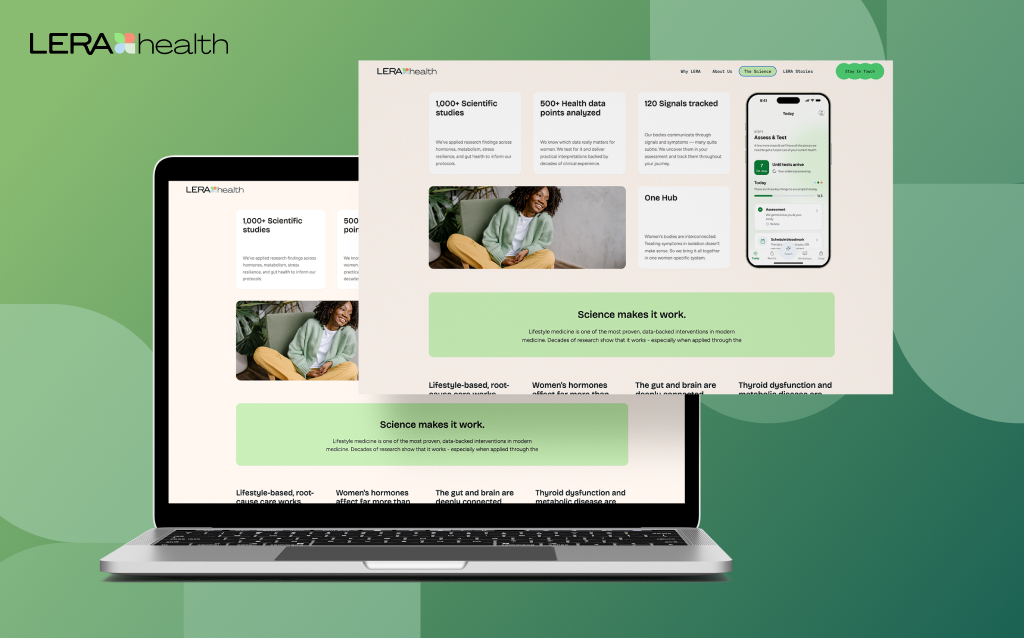
A women’s health product experience focused on guided care journeys, education, and compliance-aware workflows to support long-term engagement.
Common booking setups we design doctor appointment apps around.
Multi-provider, multi-location practices with mixed specialty needs.
Branded booking across hospitals, ambulatory networks, and urgent care.
Same-day booking with queue-aware estimated wait times and walk-in hold slots.
Cardiology, dermatology, and ortho clinics with resource-constrained slot logic.
Hybrid booking with video-visit slot types and cross-state licensing rules.
Practice-management-integrated booking for dental and optometry networks.
We connect to the systems your teams already know.
We build secure, scalable products designed for privacy, interoperability, and regulatory readiness from day one across every sector we serve.

Protect PHI with privacy-first architecture, encrypted storage and transmission, and strict access controls.

Enabling standardized health data exchange through standards-based API mappings.

Supporting enterprise-grade interoperability for clinical messaging and record workflows.
We combine deep technical expertise with industry-specific knowledge to deliver solutions that aren't just functional, but transformational.
We implement rigorous security protocols and compliance standards (HIPAA, GDPR, SOC2) across all industrial solutions to protect sensitive data.
Our architectures are built to handle massive data loads and user bases, keeping performance steady whether you're serving ten or ten million.
Using our suite of internal tools and proven frameworks, we cut setup work so your first release reaches users sooner.
Beyond simple wrappers, we build deep-learning integrations and predictive analytics directly into the core of your industry-specific workflows.
A scoping call, a fixed-scope first release, then scale and support.
We map your EHRs, locations, visit types, booking rules and payer mix.
One visit type at one location, booked into the EHR schedule with reminders, working end to end.
Eligibility checks, digital intake and co-pay capture added before more locations go live.
More locations, EHRs and visit types, with our team supporting the app.
Short facts we design around, each linked to its primary source.
In HL7 FHIR R4, a Schedule resource is a container for time slots that can be booked using an appointment, and it carries no information about the actual appointments.
Source: HL7 FHIR R4, ScheduleAn HL7 FHIR R4 Slot resource provides a block of time that can be booked using an appointment, marked as free or busy, and a scheduling system may allow more than one appointment in a single slot.
Source: HL7 FHIR R4, SlotAn HL7 FHIR R4 Appointment resource describes a single planned meeting, in person or remote, so a series of repeating visits needs one Appointment resource for each visit.
Source: HL7 FHIR R4, AppointmentHIPAA adopts ASC X12 standards for electronic transactions, including health care claims (837), payment and remittance advice (835), eligibility inquiries (270/271) and prior authorization requests (278).
Source: 45 CFR Part 162 (eCFR)The HIPAA Security Rule requires administrative, physical and technical safeguards for electronic protected health information.
Source: 45 CFR Part 164 Subpart C (eCFR)We don't just build products; we forge lasting partnerships. See how we've helped industry leaders transform their vision into technical reality.
“I can clearly see how Agnotic has a unique way of handling end-to-end development. They are always active on quick chat and provide support quickly.”

Aaron Phelan
Founder, Benchmark
“Agnotic combines deep technical expertise with strong domain knowledge. They understand the business context, anticipate challenges, and make collaboration smooth and effective.”

John Pasmore
Founder, Latimer
“Agnotic is the best technical team we evaluated. Their engineering excellence made our work dramatically easier and allowed us to stay focused on what matters most for maternal care outcomes. They took full ownership of the technical execution, and we are always happy to continue working together.”

Kim Smith
Founder, My Lauren
Detailed pages for the healthcare services that sit next to this app.
All the healthcare products and integrations we build.
Video visit slot types that this booking flow can schedule.
Follow-up between visits for patients on monitoring programs.
Custom scheduling and records when an off-the-shelf EHR does not fit.
Explore other production-grade engineering platforms we deliver across healthcare.
The technical patterns behind this platform translate naturally into adjacent verticals.