Challenge
Chemotherapy regimen and dosing logic is complex and safety-critical.
Agnotic approach
We build protocol-driven regimen support with dosing checks and human-in-the-loop review.



Cancer care runs on regimens, staging and genomic results that general EHR screens handle poorly. Agnotic builds oncology software that keeps them structured, checked and connected.
Trusted by global innovators









Oncology software development is building the systems a cancer practice relies on: regimen ordering with dose checks, structured staging and biomarkers, infusion scheduling, tumor board preparation and trial matching. Agnotic Technologies builds them for oncology practices, cancer centers and precision oncology startups, connected to your oncology EHR through HL7 FHIR.
Oncology software has to model complex, protocol-driven care (chemotherapy regimens, TNM staging, molecular markers, and clinical-trial eligibility), where a small error carries real clinical weight.
We build the regimen logic, structured staging, and trial-matching oncology needs, integrated with the EHR and genomics data, with safety and PHI handling engineered in.
A oncology platform (clinical workflow, icd-o / tnm cancer staging, and connected integrations) with PHI handled to HIPAA standards at every layer.
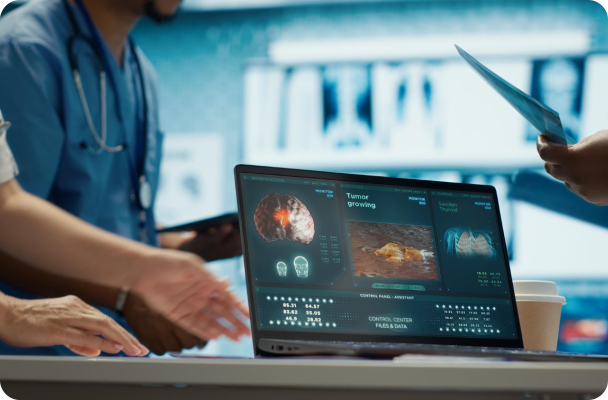
The problem
Off-the-shelf products rarely fit oncology. Here is where they fall short, and how we build around it.
Challenge
Chemotherapy regimen and dosing logic is complex and safety-critical.
Agnotic approach
We build protocol-driven regimen support with dosing checks and human-in-the-loop review.
Challenge
Trial eligibility and molecular data are scattered across systems.
Agnotic approach
We build trial-matching against structured staging and genomic markers pulled from the EHR and lab feeds.
Challenge
Staging and outcomes data are unstructured and hard to report.
Agnotic approach
We capture TNM/ICD-O staging as structured data so reporting and analytics are possible.
A oncology capability set engineered for its real workflows, codes, and devices.
Protocol-driven chemotherapy regimen logic with dosing checks and safety guardrails.
TNM and ICD-O staging captured as structured, reportable data.
Eligibility matching against staging and molecular markers from the EHR and labs.
Molecular and lab result ingestion tied to the patient record.
Infusion-chair scheduling and care-plan orchestration across the cancer center.
Integration with oncology EHRs and the enterprise record via FHIR/HL7.
Where it fits
Oncology practices, cancer centers, and precision-oncology startups.
Oncology groups modernizing clinical and administrative workflows.
Oncology-focused products going to market.
Oncology device companions, data pipelines, and companion apps.
Oncology programs, care management, and value-based initiatives.
Oncology practices, cancer centers, and precision-oncology startups choose us because we build oncology software that fits the workflow, not the other way round.

Health Insurance Portability and Accountability Act
Protect PHI with privacy-first architecture, encrypted storage and transmission, strict access controls, and traceable audit logs.

General Data Protection Regulation
Implement lawful consent flows, data minimization, retention controls, and secure processing for sensitive health data.

Fast Healthcare Interoperability Resources
Enable standardized health data exchange across apps, care teams, and systems through standards-based FHIR APIs.

Health Level Seven International
Support enterprise-grade interoperability with HL7-based integrations for records, events, and clinical messaging workflows.

Health Information Trust Alliance
Align security programs to healthcare-specific control and risk management practices trusted by providers and ecosystem partners.

Health Information Technology for Economic and Clinical Health Act
Design with breach notification readiness, digital record safeguards, and operational controls that support regulated care programs.

FDA Software as a Medical Device
Plan software quality, traceability, and documentation pathways for products that may require SaMD review and submission.
Medical Device Regulation (European Union)
Prepare EU market-ready processes for risk classification, evidence tracking, and lifecycle governance under MDR expectations.

Substance Abuse and Mental Health Services Administration
Apply confidentiality controls and consent-aware sharing models for behavioral and mental health data experiences.
Codes, standards & devices
We prove the core workflow with real users before scaling: clinical fit and adoption decide the outcome.
We map the oncology workflow, the codes and devices involved, and the core job to be done.
We build the core workflow with interoperability and PHI handling engineered in from the start.
EHR, device, and standards integration so the product connects to the systems already in use.
A measured launch tracking adoption and outcomes, then iteration.
Short facts we design oncology data, EHR access and security around, each linked to its primary source.
mCODE (minimal Common Oncology Data Elements) is an HL7 FHIR R4 implementation guide that assembles a core set of structured data elements for oncology EHRs, in about 40 profiles grouped into patient information, disease characterization, health assessment, genomics, cancer treatments and outcomes.
Source: HL7 FHIR mCODE Implementation Guide (HL7)HHS adopts the United States Core Data for Interoperability (USCDI) as the standard set of health data classes and data elements for certified health IT.
Source: 45 CFR 170.213 (eCFR)ONC certification criterion 170.315(g)(10) requires certified EHRs to offer a standardized API for patient and population services based on HL7 FHIR.
Source: 45 CFR 170.315 (eCFR)The HIPAA Security Rule requires administrative, physical and technical safeguards for electronic protected health information.
Source: 45 CFR Part 164 Subpart C (eCFR)Healthcare-only focus, standards-based engineering, and delivery you can hold to account.
We understand the oncology workflow, the codes and devices, and the clinical realities that decide adoption.
HIPAA safeguards and role-based access designed in from the first commit, not retrofitted before launch.
FHIR R4, HL7 v2, DICOM, and SMART on FHIR so what we build connects to your existing systems.
Clear scope, working software early, and accountability throughout the engagement.
Tell us your oncology workflow and goals. We'll return a plan that's clinically credible, interoperable, and built to ship.
contact@agnotic.com
Partnerships
contact@agnotic.com