
Privacy-Enhancing Technologies (PETs) used to live in academic papers. In 2026 they are mainstream — embedded in cloud platforms, regulated by the GDPR and the EU AI Act, encouraged by the U.K. ICO, and increasingly required by U.S. state privacy laws from California's CPRA to Colorado's CPA. Pair PETs with modern AI and you can extract real value from sensitive data without exposing it.
Misconceptions, however, still shape buying decisions. This guide explains the five major PET categories, busts the most common myths, and shows how Agnotic Technologies helps U.S. and European teams choose the right PET stack for the data and use cases at hand.
Understanding the Five Major PETs
Almost every PET in production falls into one of five categories: homomorphic encryption, secure multi-party computation, federated learning, differential privacy, and trusted execution environments. Each has its own sweet spot, performance profile, and regulatory fit.
1. Homomorphic Encryption (HE)
HE allows computation directly on encrypted data. The decrypted result equals what you would have obtained from running the same computation on the plaintext. That property unlocks cloud analytics, secure data sharing, and outsourced machine learning without ever decrypting the source data.
HE shines in scenarios where data leaves your trust boundary but you still need answers — multi-tenant analytics, MLaaS, and regulated cross-border data sharing under GDPR adequacy decisions.
2. Secure Multi-Party Computation (SMPC)
SMPC lets multiple parties jointly compute a function over their private inputs without revealing those inputs to one another. Hospitals can compute combined fraud-detection statistics, banks can run cross-institution AML analytics, and research consortia can pool epidemiological data — none of them giving up raw records.
3. Federated Learning (FL)
FL trains machine learning models across decentralized devices without moving raw data. Local devices train on their own slices of data and only aggregate model updates leave the perimeter. FL is the backbone of on-device personalization in mobile apps, hospital-network diagnostics, and edge-IoT analytics.
4. Differential Privacy (DP)
Differential privacy is less a technology than a mathematical definition of privacy. By injecting calibrated noise into outputs, DP quantifies the maximum information leakage a single record can produce. The epsilon parameter (ε) controls the trade-off: smaller ε means stronger privacy but more noise.
DP rarely stands alone. The most effective deployments combine DP with federated learning, synthetic data, or trusted execution environments. The U.S. Census Bureau, Apple, Google, and the U.K. Office for National Statistics all use DP in production today.
5. Trusted Execution Environment (TEE)
A TEE is a hardware-enforced enclave inside a processor that isolates sensitive code and data from the rest of the system. Intel SGX, AMD SEV-SNP, ARM CCA, and AWS Nitro Enclaves all provide TEEs that let teams run privileged code, manage keys, and process regulated data inside a verified boundary.
TEEs pair naturally with confidential computing platforms (Azure Confidential Computing, GCP Confidential VMs, AWS Nitro) and are increasingly relied on for healthcare, financial services, and defense workloads in the U.S. and EU.
Leveraging PETs for Privacy and Data Utility
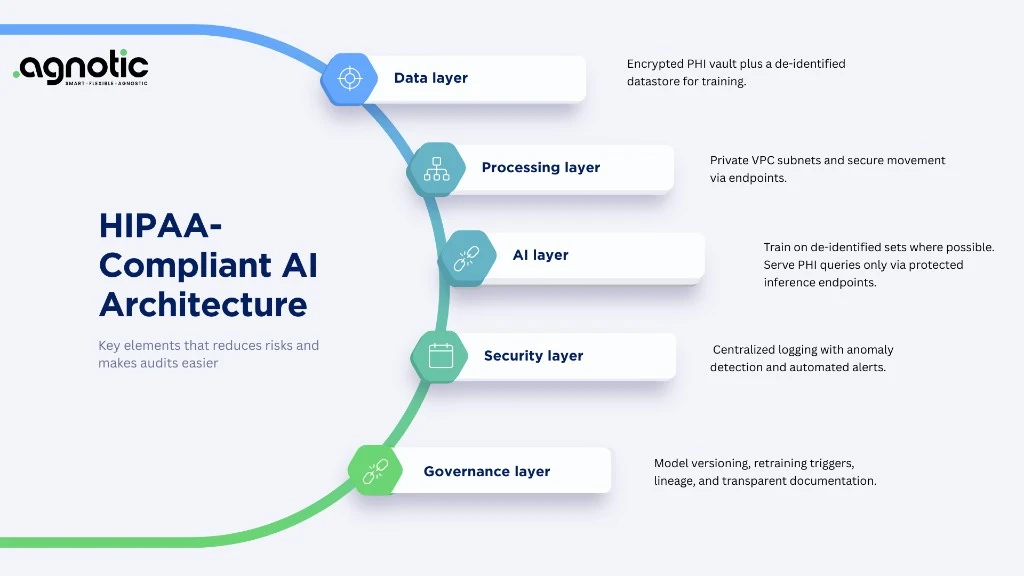
PETs unlock data use while honoring privacy obligations. Retailers analyze purchasing patterns without exposing customer identities. Banks run fraud detection on encrypted transaction flows. Hospitals collaborate on research while complying with HIPAA, GDPR, and the upcoming European Health Data Space regulation.
Most teams adopt more than one PET. A common combination pairs federated learning with differential privacy on aggregated updates and runs the aggregation server inside a TEE. The result is a system that protects raw data, the learned model, and the operating environment all at once.
Choosing the Right PET: The Tree Approach
The U.K. Centre for Data Ethics and Innovation popularized a four-level decision tree that helps teams match PETs to use cases. We use a similar structure with our clients.
- Data: what type of data are you protecting (PHI, financial, identity, behavioral) and what level of privacy is required by law and brand promise?
- Scenario: what is the workload (training, inference, analytics, sharing) and what utility must survive?
- Context: which regulations apply (HIPAA, GDPR, CPRA, EU AI Act, EHDS, NHS DSPT) and which stakeholders demand demonstrable controls?
- Solution: which PETs, individually or combined, deliver the required privacy while preserving the utility the business needs?
Most production stacks blend two or three PETs. Resist the temptation to standardize on a single technology — the right choice is always a function of data, scenario, and context.
Misconceptions About Modern Privacy Tech
Misconception 1: PETs Are Just for Compliance
Reality: PETs unlock new business models — secure data monetization, multi-party analytics, federated AI training, and cross-border collaboration. They satisfy compliance, but the bigger value is what they make possible commercially.
Misconception 2: Security Matters More Than Privacy Tech
Reality: privacy, security, and governance are siblings, not substitutes. PETs close a specific gap — protecting data while it is being used — that traditional security tooling cannot reach. They replace the legal fiction that a partner with access will not snoop with technical guarantees that they cannot.
Misconception 3: PETs Are Too Slow
Reality: modern PETs are dramatically faster than the early prototypes that gave them a reputation for being slow. Hardware acceleration, optimized libraries, and smarter scheme selection have made PET-based workflows competitive with — and often faster than — manual de-identification pipelines.
Misconception 4: Privacy Compromises Data Quality
Reality: tuned correctly, PETs preserve analytic accuracy while removing privacy risk. Multiple peer-reviewed evaluations in healthcare and finance have shown PET-protected analyses matching or exceeding clear-data baselines for the metrics that matter.
Misconception 5: PETs Are Just Tokenization
Reality: tokenization swaps sensitive values for surrogate identifiers; PETs eliminate the need for de-identification in the first place. They use encryption, secure computation, and privacy mathematics to keep data usable while keeping it confidential.
Where PETs Are Heading Next
Expect three trends to accelerate through 2026: (1) PETs natively embedded in cloud data platforms (Snowflake Clean Rooms, BigQuery Confidential, Databricks Confidential Compute); (2) regulatory recognition of PET-based safeguards under GDPR, EU AI Act, and U.S. state laws; and (3) PETs becoming a procurement requirement for healthcare, financial services, and public-sector contracts.
Decision Matrix: Which PET for Which Use Case
Use cases drive technology selection. The combinations below are the patterns that show up most often in production deployments we have built or audited.
- Cross-institution model training (rare-disease research, fraud rings, supply-chain risk): Federated Learning + Differential Privacy on updates + TEE-based aggregator.
- Privacy-preserving analytics on third-party data (marketing measurement, ad attribution, public health surveillance): Secure Multi-Party Computation or HE-protected joins inside clean rooms.
- AI inference on sensitive data (clinical decision support, financial scoring, eGovernment): Homomorphic Encryption on the most sensitive features + TEE for the rest of the inference pipeline.
- Synthetic data generation for development and testing: Differential Privacy + Generative Adversarial Networks, with downstream utility tests to confirm fidelity.
- Confidential identity verification (KYC, AML, age verification): SMPC for cross-bank checks + TEE for biometrics.
- Cross-border data collaboration (multinational research consortia): FL + PQC transport + selective HE for the most sensitive sub-computations.
Performance and Cost Snapshot
PET performance depends on the underlying primitive, the hardware available, and the workload. The ranges below summarise what we typically observe in production deployments.
- Homomorphic Encryption (CKKS): inference latency 10-100x baseline; 15-40% cost premium with GPU acceleration; supports addition and multiplication on real numbers.
- Secure Multi-Party Computation: latency depends on network round trips; suited to lower-frequency, higher-value computations like cross-bank fraud joins.
- Federated Learning: training time 1.5-3x centralized baseline; communication overhead 20-200 MB per round depending on model size.
- Differential Privacy: utility loss of 1-5% for typical epsilon values (1-3); minimal compute overhead.
- Trusted Execution Environments: near-native performance for code that fits in the enclave; remote attestation adds milliseconds per session.
- Synthetic Data: generation cost varies widely; utility loss depends on data type — usually 0-10% on common ML tasks.
Vendor and Open-Source Landscape
PET tooling has matured significantly. The following vendors and projects are widely cited and worth evaluating against your specific workload.
- Homomorphic Encryption: OpenFHE, Microsoft SEAL, IBM HElib, Zama Concrete, Duality SecurePlus, Inpher XOR Platform.
- Secure Multi-Party Computation: Sharemind, Cybernetica, Galois, Decentriq, Enveil ZeroReveal, TripleBlind.
- Federated Learning: Flower, NVIDIA FLARE, OpenFL, PySyft, Owkin Substra, FATE, OpenMined.
- Differential Privacy: Google DP Library, OpenDP, Microsoft SmartNoise, Tumult Analytics, Privitar.
- Trusted Execution: Intel SGX, AMD SEV-SNP, ARM CCA, AWS Nitro Enclaves, Azure Confidential Computing, GCP Confidential Compute.
- Synthetic Data: MOSTLY AI, Gretel, Hazy, Syntegra, Statice, Synthesized.
- Confidential Clean Rooms: Snowflake Clean Rooms, AWS Clean Rooms, Google Ads Data Hub, Databricks Confidential Computing, Habu.
Regulatory Recognition of PETs
PETs are no longer a fringe interest of academic conferences — they are referenced by regulators around the world as a state-of-the-art safeguard.
- U.K. ICO: PETs guidance published in 2023, regularly updated, explicitly recognises PETs as a route to GDPR Article 25 (privacy by design) and Article 32 (security) compliance.
- EU EDPB and EDPS: joint opinions describe PETs as enabling lawful processing under GDPR for high-risk use cases.
- European Commission: PETs feature prominently in the European Data Strategy and the upcoming European Health Data Space.
- U.S. White House and NIST: the 2022 PETs Prize Challenge and subsequent NIST guidance positioned PETs as critical infrastructure for trustworthy AI.
- OECD: 2023 report on PETs called for international coordination on standards and adoption incentives.
- Singapore PDPC: PET Sandbox provides regulatory experimentation space for organisations piloting PETs.
Common Implementation Pitfalls
- Picking the wrong PET for the workload. Trying to do everything with FHE will tank performance; trying to do everything with FL will leak information without DP.
- Misconfigured epsilon in differential privacy. Choose epsilon based on the data and use case, not on what other teams happen to publish.
- Skipping a threat model. PETs reduce specific risks; without a threat model you cannot tell which risks remain.
- Forgetting key management. Cryptographic safeguards are only as strong as the key custody around them.
- Underestimating operational cost. PETs introduce latency, monitoring complexity, and incident-response edge cases. Plan for them.
- Ignoring downstream utility. A privacy-preserving pipeline that produces unusable outputs is not a win. Validate utility before scaling.
How to Pilot a PET in 90 Days
Most clients we work with prove out PETs through a focused 90-day pilot. The cadence below has produced reliable results across healthcare, financial services, and public-sector engagements.
- Weeks 1-2: identify the use case, document the threat model, and select PETs against the tree approach.
- Weeks 3-4: stand up a reference architecture, secure the data partners, and complete legal review (DPIA, BAA, vendor risk).
- Weeks 5-8: implement the PET-protected pipeline end-to-end, including monitoring, telemetry, and incident-response runbooks.
- Weeks 9-10: validate privacy guarantees (epsilon, secure aggregation, attestation logs) and utility (model accuracy, query fidelity).
- Weeks 11-12: present findings, package learnings into reusable patterns, and plan production rollout with clear KPIs.
Authoritative Resources
- U.K. ICO — Anonymisation, Pseudonymisation and PETs
- U.K. CDEI PETs Adoption Guide
- OECD PETs Report
- NIST SP 800-188 — De-Identifying Government Datasets
- EU AI Act — Official Text
Conclusion
PETs are not a luxury. They are the toolkit that lets organizations honor privacy promises, satisfy regulators, and still extract competitive value from data. Pair AI with PETs intentionally — choose the right technology for the right data and scenario, layer multiple PETs where the stakes demand it, and treat privacy as a design discipline rather than an afterthought. Agnotic Technologies helps clients across the U.S. and EU build that practice into their roadmaps.