Enterprise DevOps is the practice of building, testing, releasing and operating software through shared, automated pipelines across a large organization, with the controls that regulated industries require built into the pipeline rather than added at the end. In healthcare that means audit trails, change control and security evidence are produced by the same automation that ships the code.
This enterprise DevOps guide is for healthcare organizations and health tech companies. It covers what enterprise DevOps is, why it matters now, what the platform looks like, how to roll it out, how to measure it, best practices, common mistakes and your build plan.
What is enterprise DevOps?
Running clinical and billing systems with manual releases?
Agnotic builds DevOps platforms for healthcare teams: pipelines, infrastructure as code, monitoring and the compliance evidence that comes with them.
Enterprise DevOps is DevOps at the scale of a whole organization: shared platforms, standard pipelines and common controls that many teams use to deliver many systems. It adds governance to the team-level practice, so releases are frequent and small while every change remains traceable, reviewed, tested and reversible. DevOps for enterprise healthcare adds HIPAA, patient safety and vendor obligations to that list.
How it differs from team DevOps
- Platform, not projects: A central platform team provides pipelines, environments and tooling that product teams consume.
- Policy as code: Security, compliance and architecture rules enforced automatically in the pipeline.
- Evidence by default: Every deployment produces the approvals, test results and change records an auditor asks for.
- Many systems: EHR integrations, portals, data platforms and vendor systems with different release cadences on one set of standards.
- Shared on-call and incident practice: One way to detect, respond and learn, across teams.
Why does enterprise DevOps matter now?
- Secure development has a reference: NIST SP 800-218, the Secure Software Development Framework version 1.1 (February 2022), defines outcome-based practices in four groups: prepare the organization, protect the software, produce well-secured software and respond to vulnerabilities.
- Delivery is measurable: DORA, the research program run by Google Cloud, measures software delivery with change lead time, deployment frequency, failed deployment recovery time, change fail rate and deployment rework rate.
- Audit controls are law: The HIPAA Security Rule requires audit controls at 45 CFR 164.312(b) and a risk analysis and risk management process at 45 CFR 164.308(a)(1), both of which a pipeline can evidence.
- Sector goals name the basics: HHS published Healthcare and Public Health Cybersecurity Performance Goals in January 2024, ten essential and ten enhanced, covering practices such as vulnerability mitigation, multi-factor authentication and incident planning.
- Device software needs an SBOM: Under section 524B of the FD&C Act, manufacturers of cyber devices must provide a software bill of materials and maintain a plan for monitoring and addressing postmarket vulnerabilities.
- Supply chain is a top risk: The OWASP Top 10:2025 adds Software Supply Chain Failures as a category, which pipeline controls such as dependency scanning and signed artifacts address.
What does an enterprise DevOps platform look like?
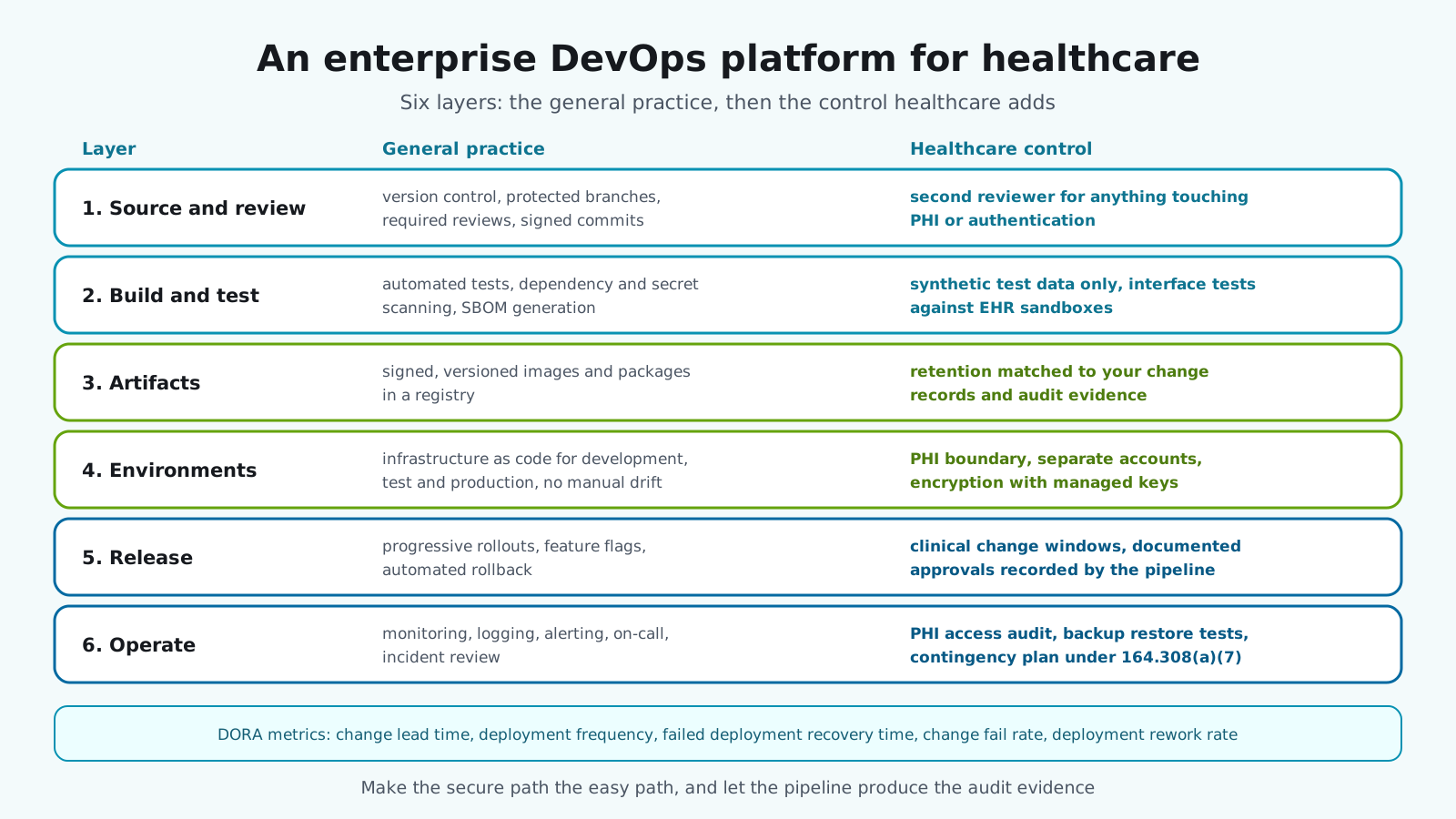
DevOps in enterprise healthcare is a platform with six layers. The diagram shows them, and the controls that healthcare adds at each one.
- Source and review: Version control, protected branches, required reviews and signed commits. Healthcare adds a second reviewer for anything touching PHI or authentication.
- Build and test: Automated builds, unit and integration tests, dependency and secret scanning, SBOM generation. Healthcare adds synthetic test data and interface tests against EHR sandboxes.
- Artifacts: Signed, versioned images and packages in a registry. Healthcare adds retention that matches your change records.
- Environments: Infrastructure as code for development, test and production, with no manual drift. Healthcare adds a PHI boundary and separate accounts.
- Release: Progressive rollouts, feature flags and automated rollback. Healthcare adds clinical change windows and documented approvals.
- Operate: Monitoring, logging, alerting, on-call and incident review. Healthcare adds PHI access audit, backup tests and the contingency plan.
Evidence as a pipeline output
Auditors ask the same questions every year: who approved this change, what tests ran, which components are in the build and when was the last restore test. A pipeline can answer all of them by emitting signed records at each stage and storing them with the artifact. Teams that do this stop preparing for audits, because the evidence already exists.
Test data without PHI
Realistic tests need realistic data, and realistic data in healthcare is PHI. Synthetic patient generators, de-identified extracts prepared under the HIPAA de-identification standard and vendor sandboxes cover most needs. Production data belongs in production, and the pipeline should block anything else.
How do teams roll out enterprise DevOps step by step?
- 1. Baseline the pain: Measure lead time, release frequency, failure rate and recovery time for two or three systems.
- 2. Form the platform team: A small group that owns pipelines, environments and standards, serving product teams.
- 3. Write the controls as policy: Security, compliance and architecture rules the pipeline will enforce.
- 4. Build the golden path: One standard pipeline and environment template that a new service gets in a day.
- 5. Migrate one critical system: Prove the path on something that matters, with a parallel run and a rollback.
- 6. Automate the evidence: Approvals, test results, SBOMs and deployment records collected automatically.
- 7. Add observability and on-call: Shared dashboards, alert standards and an incident process with reviews.
- 8. Scale and retire the old way: Move the remaining systems, then shut down manual release procedures.
How do you measure enterprise DevOps?
Measure throughput and stability together, or teams will trade one for the other. The DORA metrics are the common language, and healthcare adds compliance measures beside them.
- Change lead time: From commit to production, per system.
- Deployment frequency: How often production changes, and whether it is during approved windows.
- Change fail rate and recovery time: How often a release needs intervention, and how fast it is fixed or rolled back.
- Deployment rework rate: Unplanned deployments caused by incidents.
- Compliance measures: Percentage of changes with complete evidence, time to patch a critical vulnerability, backup restore test results and audit findings per quarter.
What are enterprise DevOps best practices?
- Make the secure path the easy path: The standard pipeline should be faster than any workaround.
- Everything as code: Infrastructure, policies, pipelines and dashboards versioned and reviewed.
- Shift security left and keep it right: Scan in the pipeline and monitor in production.
- Separate duties with automation: The person who writes the change does not deploy it alone, and the pipeline records both.
- Rehearse recovery: Restore backups and roll back releases on a schedule, not only in a crisis.
- Respect clinical time: Release windows and freeze periods agreed with clinical operations.
- Keep the platform team small and service-minded: Their customers are the product teams.
The practices above are what the platform team enforces and the product teams rely on. The mistakes below are what happens when either side skips its part.
What are the common mistakes with enterprise DevOps?
- Tools before practices: Buying a platform and keeping the manual approval chain around it.
- One pipeline for every case: Forcing a data platform and a mobile app through identical steps.
- Evidence by hand: Screenshots and spreadsheets assembled before every audit.
- Production data in test: PHI copied into lower environments to make tests realistic.
- No ownership of dependencies: Vulnerable libraries with nobody assigned and no SBOM.
- Measuring speed only: Faster releases with rising incident counts, and nobody watching the second number.
What does enterprise DevOps mean for your build plan?
- Platform scope: Which systems, clouds and teams the platform serves first.
- Controls to encode: The security, compliance and architecture rules the pipeline will enforce.
- Golden path: Pipeline and environment templates, and the migration of the first system.
- Evidence automation: Approvals, SBOMs, test results and deployment records.
- Observability and on-call: Dashboards, alerting standards and the incident process.
- Operations: Platform maintenance, dependency updates and the quarterly measurement review.
For the engineering culture behind the pipeline, our guide on how to build quality software covers the practices, and our cloud computing in healthcare guide covers the platform underneath.
How Agnotic can help
Agnotic Technologies is a software development services company. We build enterprise DevOps platforms for healthcare organizations and health tech companies: standard pipelines with security and compliance gates, infrastructure as code, environments with a PHI boundary, observability and on-call practice, and the automated evidence that satisfies auditors. We leave your teams with a platform they run themselves.
Build your DevOps platform with Agnotic
Explore our healthcare cloud and DevOps services or browse more articles in our Software Engineering hub.
Related reading on Agnotic
Go deeper on the engineering, cloud and security topics covered in this guide.
Sources
- NIST: Secure Software Development Framework (SP 800-218)
- DORA: Software delivery performance metrics
- 45 CFR 164.312: HIPAA Security Rule technical safeguards
- 45 CFR 164.308: HIPAA Security Rule administrative safeguards
- HHS: Healthcare and Public Health Cybersecurity Performance Goals
- FDA: Cybersecurity in medical devices
- OWASP Top 10:2025
- AWS: Shared responsibility model