athenahealth integration is connecting outside software to athenaOne, athenahealth's cloud-based EHR, practice management and revenue cycle platform used mainly by ambulatory practices and medical groups. Because the platform is cloud hosted and multi-tenant, integration runs through athenahealth's APIs and partner program rather than through on-premises interfaces, which changes how you plan the work.
This athenahealth integration guide covers what the platform is, why it matters now, the integration surfaces, the benefits and considerations, how an integration proceeds step by step, best practices, common mistakes and what it means for your build plan.
What is athenahealth integration?
Connecting your product to athenaOne?
Agnotic builds athenahealth integrations for digital health companies and practice groups: FHIR and API connections, SMART on FHIR apps and the data pipelines behind them.
athenahealth integration is the connection of third-party software to athenaOne, the cloud-based electronic health record, practice management and billing platform from athenahealth, so that schedules, patients, encounters, orders, results, documents and claims data flow between the practice and your product. It uses athenahealth's developer APIs, including the certified FHIR API, under the practice's authorization and athenahealth's partner review.
What makes athenahealth different
- Cloud and multi-tenant: One platform athenahealth operates for all customers, so there is no on-premises interface engine to configure per site.
- Practice focus: Ambulatory practices, medical groups and some hospitals, with practice management and billing in the same product.
- API-first integration: Access through athenahealth's Developer Portal and APIs, with practice-level authorization.
- Partner program: Third-party products are reviewed and listed through athenahealth's Marketplace.
- Shared services: Clearinghouse, patient communications and portal functions run by athenahealth, which your product may complement rather than replace.
Why does athenahealth integration matter now?
- Certification requires a standard API: Under ONC criterion 170.315(g)(10) and the HTI-1 rule, certified EHRs expose a FHIR API supporting USCDI v3, US Core 6.1.0, SMART App Launch 2.0 and Bulk Data Access from January 1, 2026, and certification status for athenahealth products is public on the Certified Health IT Product List.
- Developer access is documented: athenahealth publishes a Developer Portal with API documentation and sandbox access for registered developers, and a Marketplace where practices find partner products.
- Data must flow: The information blocking rules at 45 CFR Part 171 restrict practices that interfere with access, exchange or use of electronic health information, which applies to EHR developers and the practices that use them.
- Patients can connect apps: The same (g)(10) criterion lets patient-chosen apps read a patient's record with the patient's permission through SMART App Launch.
- Vendors are business associates: Under 45 CFR 164.502(e), a vendor that creates, receives, maintains or transmits PHI for a practice needs a Business Associate Agreement before practice data flows to it.
- Payer data is coming by API: Under CMS-0057-F, impacted payers must offer Prior Authorization and Payer-to-Payer FHIR APIs by January 1, 2027, which practice-side products can consume alongside EHR data.
Which surfaces does athenahealth expose?
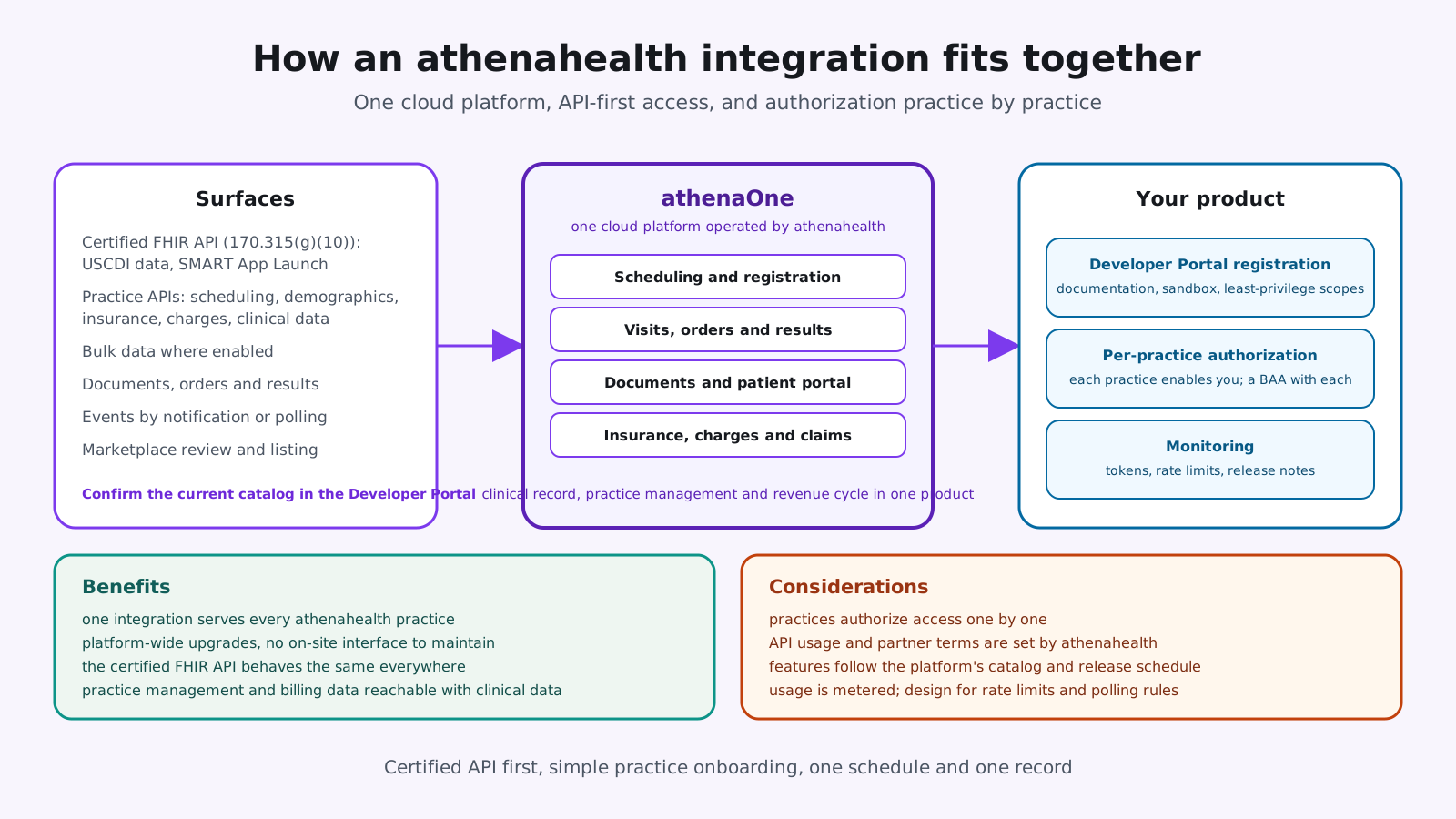
The diagram maps the parts of a practice workflow to the surfaces an athenahealth integration uses. Confirm the current API catalog and access process in athenahealth's Developer Portal, because the platform is cloud hosted and the catalog changes with releases.
- Certified FHIR API: USCDI data for patients, conditions, medications, allergies, results, documents and encounters, with SMART App Launch for patient and provider apps.
- Practice APIs: athenahealth's broader API catalog for scheduling, demographics, insurance, charges and clinical data, where the practice authorizes it.
- Bulk data: Population exports through the FHIR Bulk Data Access standard, where enabled.
- Documents: Clinical documents, orders and results exchanged as structured data or attachments.
- Events: Change notifications or polling patterns for appointments, encounters and results, depending on what the platform offers.
- Marketplace: Review and listing so practices can enable your product from inside their athenahealth account.
Benefits and considerations
The athenahealth integration benefits and considerations come from the same fact: one cloud platform. Benefits: one integration serves every athenahealth practice, upgrades are platform-wide, there is no on-site interface to maintain and the certified FHIR API behaves the same everywhere. Considerations: practices authorize access individually, API usage and partner terms are set by athenahealth, and features depend on the platform's catalog and release schedule rather than on a local build you can change.
Practice management and billing data
Because athenaOne combines the clinical record with practice management and revenue cycle, integrations often touch both. Scheduling, insurance, charges and claim status are as reachable as clinical data, and a product that helps a practice's front desk or billing team can be as valuable as one for clinicians. Treat billing data with the same care as clinical PHI, and keep X12 transactions with the clearinghouse where they belong.
Onboarding practice by practice
Because each practice authorizes your product separately, onboarding is a product feature, not a one-time setup. Document the steps a practice administrator follows, test them with a pilot practice, and build the authorization flow so a new practice is live in a short, repeatable sequence rather than a support ticket.
Working inside a metered platform
A cloud platform meters API usage and sets polling rules. Design to read what you need when you need it, cache sensibly, batch where the API allows and back off on errors. Polling every patient every minute to detect a change is the quickest way to be throttled, and the most common reason an integration is switched off by the practice.
How does an athenahealth integration proceed step by step?
- 1. Write the practice scenario: Which role, which step of the day, what your product reads and writes.
- 2. Register as a developer: Developer Portal account, documentation and sandbox access.
- 3. Map to surfaces: The certified FHIR API first, practice APIs where the scenario needs more, with least-privilege scopes.
- 4. Build against the sandbox: Prove the flows with test data before any PHI.
- 5. Engage a pilot practice: Their authorization, a Business Associate Agreement and a real-practice test.
- 6. Validate workflows: Patient matching, scheduling sync, document handling and any write-back with practice staff.
- 7. Complete partner review: Marketplace requirements and listing where appropriate.
- 8. Monitor and track releases: Token health, API errors, rate limits and platform release notes.
What are athenahealth integration best practices?
- Certified API first: FHIR R4 and SMART App Launch before product-specific APIs, because they survive releases.
- Design for practice-level authorization: Every practice enables your product separately; make onboarding simple and documented.
- Respect rate limits and polling rules: Cloud platforms meter usage; design for it.
- Keep one schedule and one record: Read and sync; do not maintain copies.
- Write structured data: Questionnaire responses and documents as coded data where the API allows.
- Minimize PHI: Request the resources the scenario needs, under a BAA.
- Follow the release notes: Platform-wide changes arrive on athenahealth's schedule, not yours.
The practices above are what keeps an integration stable on a platform you do not control. The mistakes below are what breaks it.
What are the common mistakes with athenahealth integration?
- Assuming on-premises patterns: Looking for an interface engine where the integration is API-based.
- Sandbox as proof: A working sandbox integration that fails on a real practice's authorization and data.
- Over-requesting scopes: Asking for everything and stalling in review.
- Ignoring billing data rules: Treating practice management data as less sensitive than clinical data.
- Hard-coded assumptions: Practice-specific configuration baked into the product.
- No BAA before data: Practice data flowing before the agreement is signed.
What does athenahealth integration mean for your build plan?
- Scenario and roles: Clinical, front desk or billing, and what is read and written.
- Surfaces: Certified FHIR API, practice APIs, bulk data and documents.
- Program steps: Developer registration, sandbox, pilot practice and Marketplace review.
- Practice onboarding: Authorization and setup per practice, made simple.
- Compliance: BAAs, scope minimization and audit logging.
- Operations: Monitoring, rate limits and release tracking.
For comparison with other vendors, our EHR integrations guide covers how Epic, Oracle Health and athenahealth integrations differ, and our FHIR integration guide covers the standard they share.
How Agnotic can help
Agnotic Technologies is a software development services company. We build athenahealth integrations for digital health companies and practice groups: certified FHIR and SMART on FHIR connections, practice API integrations for scheduling and billing workflows, structured document handling and the onboarding, monitoring and compliance work that a cloud platform demands, with HIPAA safeguards designed in. Your product reaches every athenahealth practice through one well-built connection.
Build your athenahealth integration with Agnotic
Explore our EHR integration services or browse more articles in our EHR integration hub.
Related reading on Agnotic
Go deeper on the EHR, FHIR and practice topics covered in this guide.
Sources
- athenahealth: Developer Portal
- athenahealth: Marketplace
- ASTP/ONC: Certified Health IT Product List
- ASTP/ONC: Standardized API for patient and population services, 170.315(g)(10)
- ASTP/ONC: HTI-1 final rule
- HL7: SMART App Launch
- 45 CFR Part 171: Information blocking
- 45 CFR 164.502: Uses and disclosures of PHI, including business associates