The future of telemedicine in the United States is being written in dated rules rather than predictions: Medicare coverage fixed through 2027, a mental health in-person requirement delayed to 2028, hospital at home extended to 2030, a prescribing rule still unpublished and a payment system that made virtual supervision permanent. Builders who plan to those dates will be ready. Those who plan to trends will not.
This future of telemedicine guide covers where telemedicine stands, why the next two years matter, the dates that shape the roadmap, what will drive adoption, how to plan a platform, best practices, common mistakes and your build plan.
What is the future of telemedicine?
Planning a telemedicine roadmap past 2027?
Agnotic builds telemedicine platforms designed around the federal dates: coverage, prescribing, supervision and interoperability built into the plan.
The future of telemedicine is a shift from emergency flexibilities to settled policy: Medicare telehealth coverage extended through December 31, 2027, permanent changes to the telehealth services list and supervision rules in the CY 2026 Physician Fee Schedule, hospital at home authorized through 2030, and a permanent controlled substance prescribing framework still being finalized. Adoption will follow payment, licensure and integration rather than technology alone.
Where telemedicine stands
- Routine for some care: Behavioral health, follow-ups and chronic care management are often remote first.
- Hybrid for most: Virtual visits mixed with in-person tests, procedures and exams.
- Specialty services growing: Telestroke, tele-ICU, teledermatology and e-consults extend specialists across networks.
- Home as a care site: Remote monitoring and hospital at home move acute and chronic care into the home.
- Integration catching up: Video platforms connected to the EHR, scheduling and billing instead of standing alone.
Why do the next two years matter for telemedicine?
- Coverage has an end date: The Consolidated Appropriations Act, 2026, signed February 3, 2026, extended most Medicare telehealth flexibilities, including home as an originating site and audio-only services, through December 31, 2027, and delayed the in-person requirement for mental health telehealth to January 1, 2028.
- Hospital at home is extended: Section 6210 of the same law extended the Acute Hospital Care at Home program through September 30, 2030, with a study of quality and cost.
- Payment rules went permanent: In the CY 2026 Physician Fee Schedule final rule, CMS moved provisional telehealth codes to the permanent list, removed frequency limits for subsequent inpatient and nursing facility visits and critical care consultations, and permanently allowed direct supervision through real-time audio and video.
- Prescribing is unsettled: The DEA and HHS fourth temporary rule allows telemedicine prescribing of controlled medications without a prior in-person visit through December 31, 2026. The permanent special registration rule was under White House review as of October 2026 and had not been published.
- Exchange is maturing: HHS announced in June 2026 that more than one billion health records had been exchanged through the TEFCA network, which gives telemedicine platforms a national path to records.
- Payer APIs arrive: Under CMS-0057-F, impacted payers must offer Prior Authorization and Payer-to-Payer FHIR APIs by January 1, 2027.
Which dates shape a telemedicine roadmap?
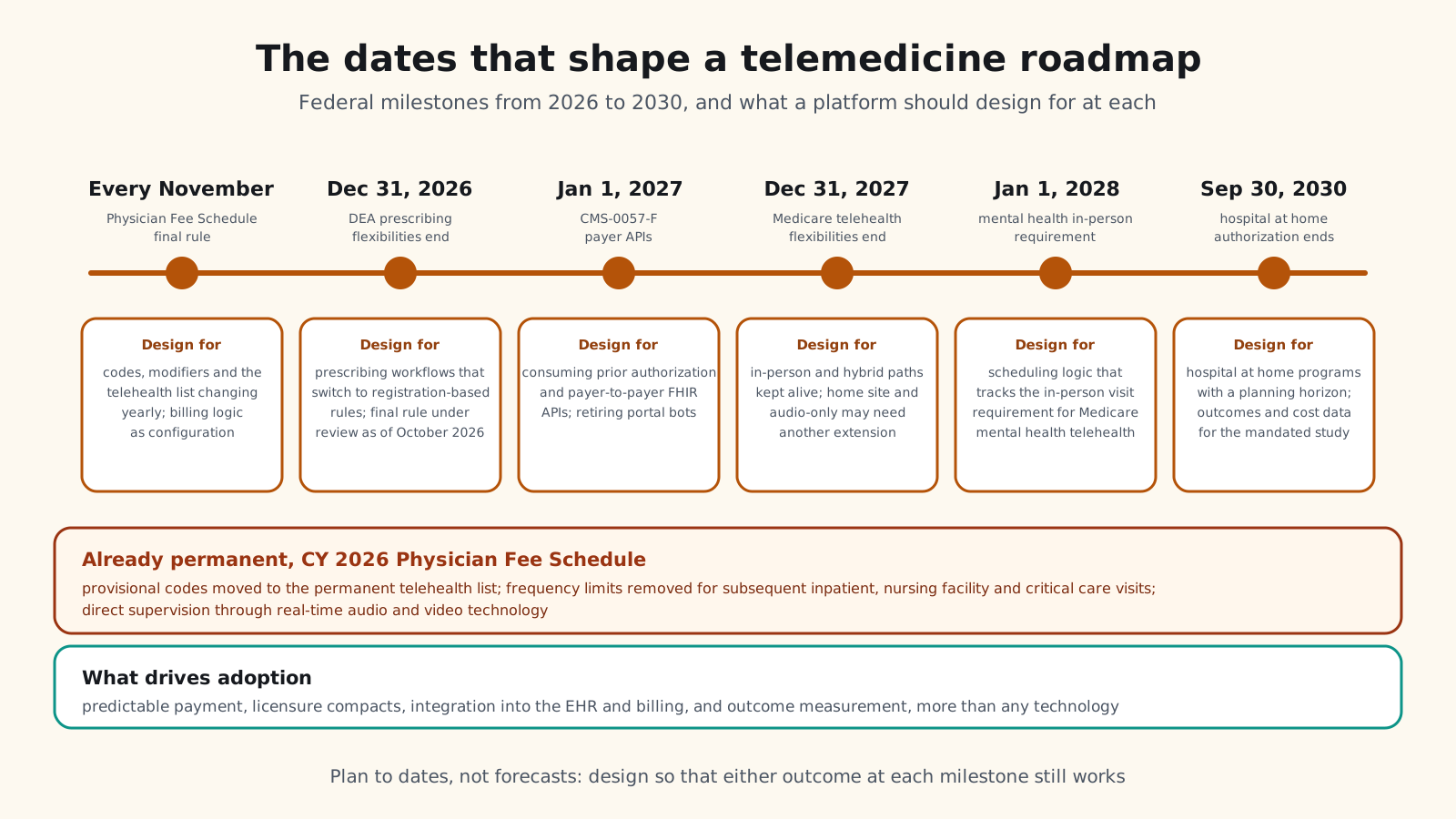
The diagram lays the federal dates on one timeline from 2026 to 2030. Each one is a decision point for a platform: what must be ready, what might change and what to design so that either outcome works.
- December 31, 2026: DEA telemedicine prescribing flexibilities end unless extended or replaced by the special registration rule. Design prescribing workflows that can switch to registration-based rules.
- January 1, 2027: CMS-0057-F payer APIs for prior authorization and payer-to-payer exchange take effect. Plan to consume them.
- December 31, 2027: Medicare telehealth flexibilities end unless Congress acts again. Keep in-person and hybrid paths in the product.
- January 1, 2028: The in-person requirement for Medicare mental health telehealth takes effect unless delayed again. Build the scheduling logic now.
- September 30, 2030: Acute Hospital Care at Home authorization ends. Programs have a planning horizon for the first time.
- Every November: The Physician Fee Schedule final rule changes codes, modifiers and the telehealth services list for the following year.
What will drive future telemedicine adoption
The future of telemedicine adoption depends on four things more than on technology: payment that is predictable past the next cliff, licensure that lets clinicians serve patients across state lines through compacts such as the Interstate Medical Licensure Compact and PSYPACT, integration that puts the visit in the EHR and the claim in billing without re-keying, and measurement that shows outcomes and cost, not just visit counts.
Where the technology is going
On the technology side, expect ambient documentation and structured intake to become standard, device data to flow into visits by default, asynchronous and e-consult models to grow where payment allows, and FHIR to replace custom integrations as certified EHRs expose standard APIs under ONC criterion 170.315(g)(10). None of these matter if the visit cannot be paid for, which is why the dates come first.
State rules move too
Federal dates set the floor for Medicare. State law decides licensure, consent to telehealth, prescribing limits and payer parity for commercial plans, and states change those rules every session. Platforms serving several states need a rules table maintained per state, with the patient's location captured at every visit to pick the right row.
Designing for either outcome
The flexibilities that end in 2026 and 2027 may be extended, replaced or allowed to lapse. A platform designed for either outcome keeps in-person booking, audio-only visits and prescribing paths switchable by configuration rather than by release, so a December extension or expiry is a settings change, not a project.
How do teams plan a telemedicine platform for the future step by step?
- 1. Put the dates on the roadmap: Prescribing, coverage, in-person requirements and payer APIs as milestones with owners.
- 2. Design for both outcomes: Workflows that work if a flexibility is extended and if it expires.
- 3. Integrate first: Schedule, note and claim in the systems of record through FHIR, so visits are paid and documented.
- 4. Build the hybrid path: In-person and virtual visits in one schedule, with referrals to local tests and exams.
- 5. Add licensure logic: Patient location captured at every visit, matched to clinician licenses and compact privileges.
- 6. Instrument outcomes: Completed visits, follow-up rates, avoided visits and cost per episode.
- 7. Add AI with review: Intake, documentation and monitoring alerts, with clinicians signing off.
- 8. Review each November: The fee schedule changes codes and lists every year.
What are future of telemedicine best practices?
- Plan to dates, not forecasts: Federal milestones are known; use them.
- Keep audio-only and in-person paths alive: Flexibilities can expire; patients still need care.
- One schedule and one record: Telehealth is a visit type, not a separate system.
- Capture location and consent every time: For licensure, emergencies and billing.
- Design prescribing to switch: Between flexibility rules and registration-based rules.
- Measure outcomes: Payers and Congress will ask what telehealth achieved.
- Follow the fee schedule: Codes, modifiers and lists change yearly.
The practices above make a platform resilient to policy. The mistakes below are what happened to platforms built for the emergency rules alone.
What are the common mistakes when planning for the future of telemedicine?
- Betting on permanence: Products that assume every flexibility becomes permanent, with no fallback.
- Ignoring the fee schedule: Billing logic frozen while codes and modifiers change.
- Standalone platforms: Video tools that never reached the EHR or billing, and were abandoned when staff tired of double entry.
- No location logic: Clinicians seeing patients in states where they hold no license.
- Prescribing without a plan B: Controlled substance workflows that break on January 1, 2027 if the flexibility lapses.
- Measuring visits: Volume reported while nobody can show outcomes or savings.
What does the future of telemedicine mean for your build plan?
- Roadmap milestones: The federal dates as planning items with owners.
- Dual-path design: Workflows for extended and expired flexibilities.
- Integration: FHIR connections for schedule, documentation and claims.
- Licensure and location: Capture, matching and compact rules.
- Measurement: Outcomes and cost instrumentation from launch.
- Annual updates: Fee schedule, payer API and rule changes every year.
For the platform itself, our telemedicine software guide covers choosing and integrating products, and our mental health telehealth guide covers the specialty where the dates bite hardest.
How Agnotic can help
Agnotic Technologies is a software development services company. We build telemedicine platforms designed around the policy calendar: dual-path workflows for coverage and prescribing changes, location and licensure logic, FHIR integration with the EHR and billing, outcome measurement from day one and AI features with clinician review. Your strategy sets the direction. We build a platform that survives the next rule change.
Build a telemedicine platform for 2027 and beyond with Agnotic
Explore our telemedicine platform development services or browse more articles in our HL7 hub.
Related reading on Agnotic
Go deeper on the telemedicine, remote care and policy topics covered in this guide.
Sources
- Congress.gov: Consolidated Appropriations Act, 2026 (H.R. 7148)
- CMS: CY 2026 Medicare Physician Fee Schedule final rule (CMS-1832-F) fact sheet
- Federal Register: Fourth temporary extension of telemedicine flexibilities for prescription of controlled medications
- CMS: Acute Hospital Care at Home
- HHS: TEFCA network passes one billion health records exchanged
- CMS: Interoperability and Prior Authorization final rule (CMS-0057-F)
- Interstate Medical Licensure Compact
- ASTP/ONC: Standardized API for patient and population services, 170.315(g)(10)