Specialty telehealth services bring a specialist to a patient or a referring clinician remotely: teledermatology, telepsychiatry, telecardiology, telestroke, tele-ICU, tele-oncology and more. Each specialty needs different data, devices and workflows, and the general-purpose video visit covers only a part of it.
This specialty telehealth services guide covers the types of telemedicine services, why they are growing now, what each specialty needs from software, how to launch a service step by step, best practices, common mistakes and what it means for your build plan.
What are specialty telehealth services?
Launching a specialty telehealth line?
Agnotic builds telemedicine platforms for specialty care: imaging and device data, e-consult workflows, scheduling and EHR integration for the specialty's own needs.
Specialty telehealth services are remote clinical services delivered by or with a specialist, as opposed to general primary or urgent care visits. They include direct-to-patient specialist visits, clinician-to-clinician e-consults, hospital-to-hospital coverage such as telestroke and tele-ICU, and asynchronous review of images and data. Each depends on the specialty's data, from skin photos to ECG traces to tumor board documents.
Types of telemedicine services
- Synchronous visits: Live video or audio between a specialist and a patient, with or without a presenter at the patient's site.
- Asynchronous review: Store-and-forward of images, readings or records for a specialist to review later.
- E-consults: A referring clinician asks a specialist a question with the chart attached, and gets a documented answer.
- Remote monitoring: Device data reviewed by a specialty team, such as cardiac rhythm or glucose.
- Hospital coverage: Remote specialists covering emergency departments and ICUs across a network.
- Hybrid programs: Remote visits combined with local labs, imaging or infusion.
Why are specialty telehealth services growing now?
- Medicare coverage is set to 2027: The Consolidated Appropriations Act, 2026 extended most Medicare telehealth flexibilities, including home as an originating site, through December 31, 2027.
- The services list was simplified: In the CY 2026 Physician Fee Schedule final rule, CMS removed the provisional category and moved those codes to the permanent Medicare Telehealth Services List, and it permanently removed frequency limits for subsequent inpatient visits, subsequent nursing facility visits and critical care consultations furnished by telehealth.
- Supervision can be virtual: The same rule permanently allows direct supervision through real-time audio and video technology, excluding audio-only.
- Licensure is easier across states: The Interstate Medical Licensure Compact offers an expedited path to licenses in member states, PSYPACT covers psychologists and the Nurse Licensure Compact covers nurses, though the patient's location still sets the rules.
- Images have a standard: DICOM is the international standard for medical images and related information, so teleradiology and image-based specialties exchange studies without custom formats.
- Software may be a device: FDA's Policy for Device Software Functions and Mobile Medical Applications explains when software that analyzes images or signals is a medical device, which affects remote diagnostic tools.
What does each specialty need from telehealth software?
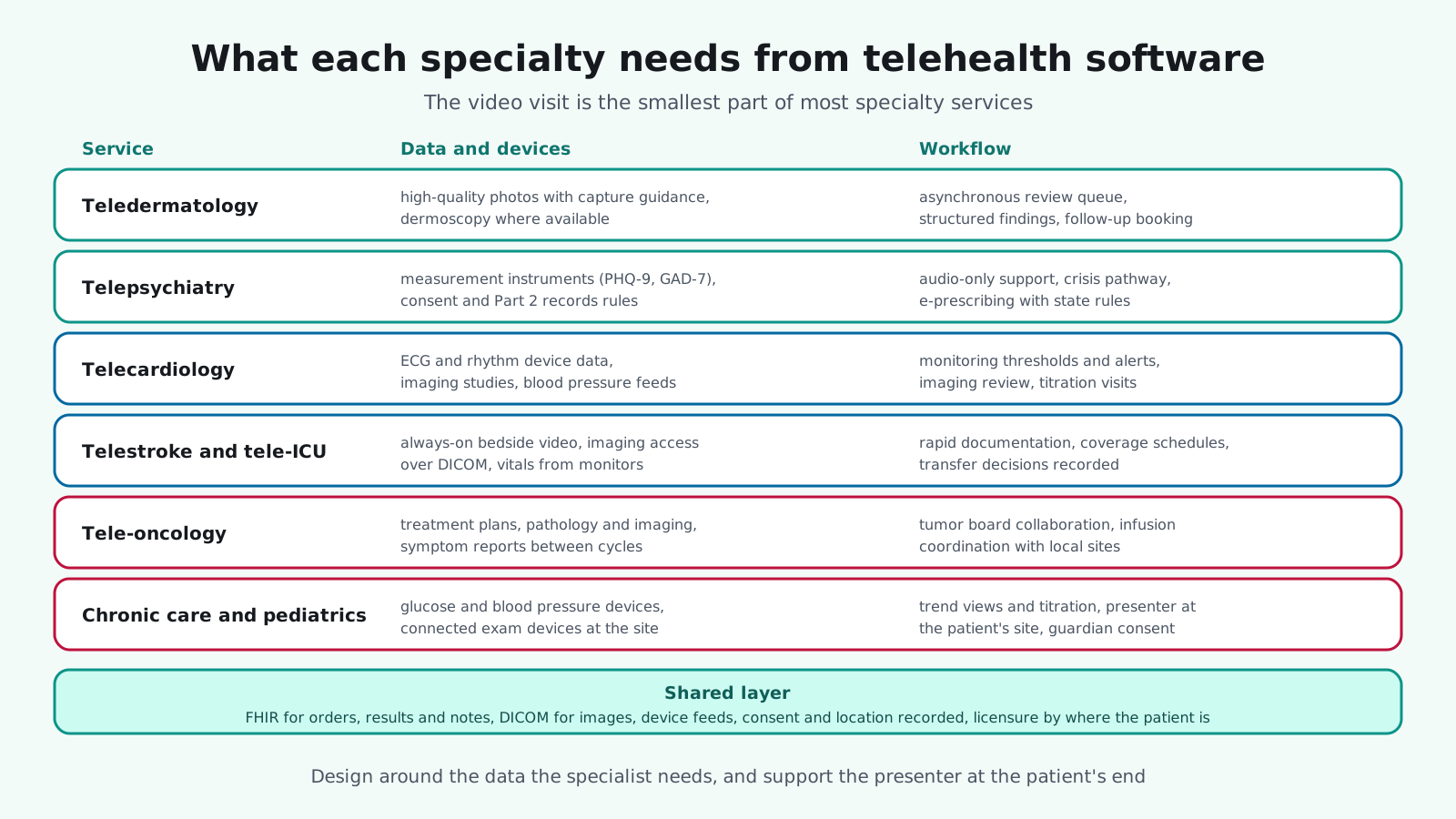
The diagram matches common specialty telehealth services to the data, devices and workflow each one needs. The general video visit is the smallest part of most of them.
- Teledermatology: High-quality photo capture with guidance, asynchronous review queues and structured findings.
- Telepsychiatry: Measurement instruments, consent and records rules, crisis pathways and audio-only support.
- Telecardiology: ECG and rhythm device data, remote monitoring thresholds and imaging review.
- Telestroke and tele-ICU: Always-on video into the bedside, imaging access, rapid documentation and coverage schedules.
- Tele-oncology: Tumor board collaboration, treatment plan review, infusion coordination with local sites and symptom monitoring between cycles.
- Tele-endocrinology and chronic care: Glucose and blood pressure data from home devices, trend views and titration workflows.
- Pediatrics and school-based care: Presenters at the patient's site, guardian consent and connected exam devices.
Presenters and the patient's site
Many specialty services depend on someone at the patient's end: a nurse in a rural clinic with a connected otoscope, a school nurse, or a bedside team in an emergency department. The software has to support that presenter with device pairing, capture guidance and a clear handoff, and it has to record who was present, for billing and for the clinical note.
E-consults and payment
Clinician-to-clinician e-consults save patients a visit but need their own payment path, through interprofessional consultation codes, contracts or value based arrangements. Design the e-consult workflow so the question, the chart attachments, the specialist's answer and the time spent are all captured, because that is what the payment path requires.
Coverage across sites
A specialty service that depends on one enthusiastic specialist is a pilot, not a service. Plan coverage like a clinical department: a schedule with backups, response-time targets for e-consults and urgent reviews, credentialing at every site served, and reporting per site so a hospital that joins the network can see what it is getting. The software should make the schedule and the targets visible to the referring sites.
How do teams launch a specialty telehealth service step by step?
- 1. Pick the specialty and the service type: Direct visits, e-consults, asynchronous review or hospital coverage.
- 2. Define the data: Which images, readings, documents and measures the specialist needs before, during and after.
- 3. Map the rules: Coverage and codes, licensure in each state served, consent and any device classification.
- 4. Design the workflow: Referral or booking, data capture at the patient's site, specialist review, documentation and follow-up.
- 5. Choose the tools: Video, image capture, device integration and e-consult platforms, each with a BAA.
- 6. Integrate the EHR: Orders, results, notes and images through FHIR and DICOM, into the record both sides use.
- 7. Pilot with one site and one specialist: Measure time to specialist response, completed visits and rework.
- 8. Scale across sites: Coverage schedules, credentialing by proxy where allowed, and reporting per site.
What are specialty telehealth services best practices?
- Design around the data, not the video: The specialist's decision depends on images, readings and records.
- Capture well at the source: Guided photo and device capture at the patient's site saves repeat visits.
- Document once: Specialist notes land in the shared record, not in a separate platform.
- Match the service to the payment path: Visit, e-consult and monitoring codes have different rules.
- Confirm location and consent: Every encounter, for licensure and for emergencies.
- Plan coverage like a clinical service: Schedules, backups and response-time targets.
- Measure outcomes by specialty: Time to diagnosis, avoided transfers and follow-up completion.
The practices above come from services where the video call was the easy part. The mistakes below are where the hard parts were skipped.
What are the common mistakes with specialty telehealth services?
- Generic video for everything: A dermatologist squinting at a webcam instead of reviewing a guided photo.
- Data left at the site: Readings and images that never reach the specialist's record.
- Licensing by assumption: Specialists seeing patients in states where they hold no license or privilege.
- Device status ignored: Remote diagnostic software deployed without checking whether it is a regulated device.
- Unbilled e-consults: Specialist time spent without the codes or contracts to pay for it.
- No coverage plan: A service that works when one enthusiastic specialist is available.
What do specialty telehealth services mean for your build plan?
- Specialties and service types: Each adds data, devices and workflow.
- Capture tools: Photo, device and document capture at the patient's site.
- Integration: FHIR for orders, results and notes, DICOM for images, device feeds for monitoring.
- Licensure and credentialing: States served and sites covered.
- Payment paths: Visit, e-consult and monitoring codes, with the modifiers and places of service for each.
- Operations: Coverage schedules, device support and annual rule updates.
For the platform itself, our telemedicine software guide covers choosing and integrating products, and our telemedicine apps guide covers building the patient and clinician apps.
How Agnotic can help
Agnotic Technologies is a software development services company. We build the software behind specialty telehealth services: guided image and device capture, e-consult and review queues, specialist workspaces, FHIR and DICOM integration with the EHR and imaging systems, and the scheduling and billing connections each specialty needs. Your specialists define the service. We build the system that carries it across sites.
Build your specialty telehealth service with Agnotic
Explore our telemedicine platform development services or browse more articles in our HL7 hub.
Related reading on Agnotic
Go deeper on the telemedicine, specialty and device topics covered in this guide.
Sources
- Congress.gov: Consolidated Appropriations Act, 2026 (H.R. 7148)
- CMS: CY 2026 Medicare Physician Fee Schedule final rule (CMS-1832-F) fact sheet
- CMS: List of Telehealth Services
- Interstate Medical Licensure Compact
- PSYPACT: Psychology Interjurisdictional Compact
- NCSBN: Nurse Licensure Compact
- DICOM Standard
- FDA: Policy for Device Software Functions and Mobile Medical Applications