Telemedicine software is the set of systems that let clinicians see, message, monitor and treat patients remotely and get paid for it: video platforms, asynchronous care tools, remote monitoring, e-consult systems and the scheduling, EHR and billing connections around them. Buyers face dozens of products that look alike on a feature list and behave very differently in a clinic.
This telemedicine software guide covers the categories, why the market is changing now, the features that matter, build, buy or white-label, how to evaluate products step by step, best practices, common mistakes and what it means for your build plan.
What is telemedicine software?
Choosing between buying, white-labeling and building telemedicine software?
Agnotic builds telemedicine platforms and integrates purchased ones with your EHR, scheduling and billing systems.
Telemedicine software is any application used to deliver clinical care at a distance: synchronous video and audio visits, asynchronous messaging and store-and-forward review, remote patient monitoring, clinician-to-clinician e-consults and the platforms that combine them. It is distinct from the EHR, but it must connect to it, to scheduling, to e-prescribing and to billing, or staff end up working in two systems.
The categories
- Video visit platforms: Scheduled or on-demand audio and video consultations with waiting rooms and intake.
- Asynchronous care: Questionnaires, photos and messages reviewed by a clinician later, common in dermatology and urgent care.
- Remote patient monitoring: Device readings flowing to a care team with thresholds and alerts.
- E-consult and tele-specialty: Primary care asks a specialist, or a hospital connects to a remote stroke or ICU team.
- Virtual-first care: A complete remote practice with its own scheduling, records and billing.
- Embedded telehealth: Video and messaging inside an EHR or patient portal rather than a separate product.
Why is telemedicine software changing now?
- Medicare coverage is set to 2027: The Consolidated Appropriations Act, 2026 extended most Medicare telehealth flexibilities, including home as an originating site and audio-only services, through December 31, 2027.
- Payment depends on codes: Medicare pays telehealth to a patient at home (place of service 10) at the non-facility rate, and claims carry modifier 95 for audio and video or modifier 93 for audio-only, per the Medicare Claims Processing Manual.
- Supervision went virtual: In the CY 2026 Physician Fee Schedule final rule, CMS permanently allowed direct supervision through real-time audio and video technology and moved provisional telehealth codes to the permanent list.
- Controlled substances have a deadline: The DEA and HHS fourth temporary rule allows telemedicine prescribing of controlled medications without a prior in-person visit through December 31, 2026.
- HIPAA applies in full: HHS OCR's enforcement discretion for telehealth video tools ended on August 9, 2023, so every video, messaging and transcription vendor handling PHI needs a Business Associate Agreement.
- The EHR must open up: Under ONC certification criterion 170.315(g)(10), certified EHRs expose a FHIR API with SMART App Launch, which is how telemedicine software reads the schedule and writes the note.
Which telemedicine software features matter?
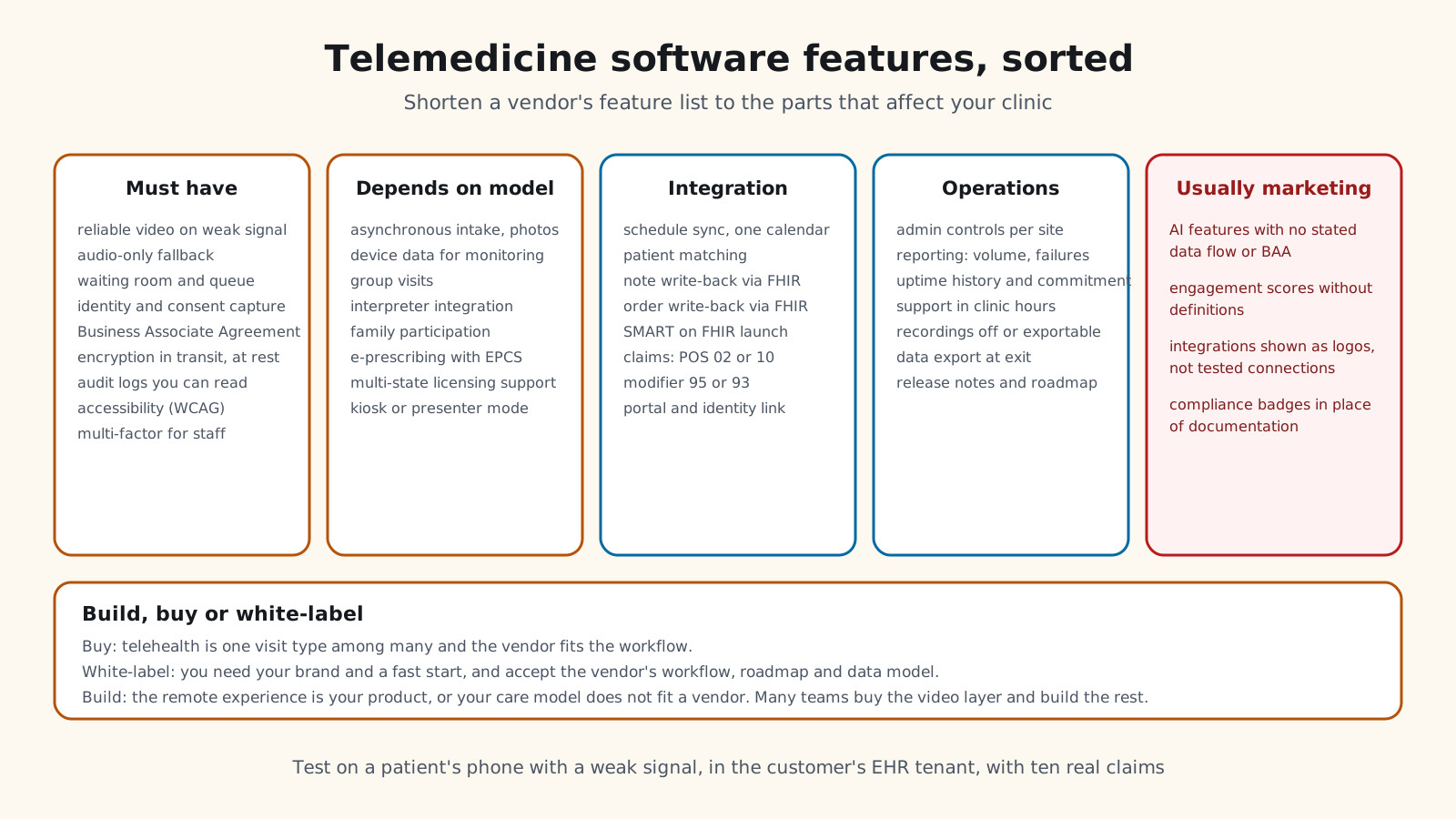
The diagram sorts telemedicine software features into what every product must have, what depends on your care model, and what is usually marketing. Use it to shorten a vendor's feature list to the parts that affect your clinic.
- Must have: Reliable audio and video on weak connections, audio-only fallback, waiting room and queue, identity and consent capture, BAA, encryption, audit logs and accessibility.
- Depends on the model: Asynchronous intake and photos, device data, group visits, interpreter integration, family participation, e-prescribing with EPCS and multi-state licensing support.
- Integration: Schedule sync, patient matching, note and order write-back through FHIR, and claims with the right place of service and modifiers.
- Operations: Admin controls, reporting on visit volume and failures, uptime commitments and support hours that match clinic hours.
- Usually marketing: AI features without a stated data flow, engagement scores without definitions, and integrations listed as logos rather than tested connections.
Should you build, buy or white-label telemedicine software?
- Buy when telehealth is one visit type among many and the EHR vendor's module or an established platform fits the workflow.
- White-label when you need your brand and a faster start, but can accept the vendor's workflow, roadmap and data model.
- Build when the remote experience is your product, your care model does not fit a vendor workflow, or you need control over data, integrations and cost at scale.
- Mix: Many teams buy the video layer and build the intake, triage, monitoring and integration around it. Our telemedicine apps guide covers choosing the video service.
What to build around a purchased core
When the video layer is bought, the telemedicine software development work that remains is the part patients and staff notice: intake tuned to your visit types, triage rules, waiting room messaging, device data for monitoring programs and the integration that writes the visit into the EHR and the claim into billing. Build those as services around the vendor, so the vendor can be replaced without rebuilding the clinic's workflow.
Security and privacy checks
Ask for the Business Associate Agreement before the demo, read what the vendor logs and for how long, and confirm that recordings and chat transcripts can be disabled or exported on your terms. Encryption in transit and at rest, access logs you can read and multi-factor authentication for staff accounts are the minimum under the HIPAA Security Rule.
How do you evaluate telemedicine software step by step?
- 1. Write the visit types: Which services, which patients, which devices and which states.
- 2. List the systems it must talk to: EHR, scheduling, e-prescribing, billing, identity and the patient portal.
- 3. Check the paper: BAA terms, security documentation, uptime history and breach history.
- 4. Test on bad networks: A real visit on a phone with a weak signal, and the audio-only path.
- 5. Test the integration: Schedule sync, patient match and note write-back in a test tenant, not a demo.
- 6. Run a billing trial: Ten claims with the right place of service and modifiers through to payment.
- 7. Pilot with one clinic: Measure completed visits, failures, time per visit and staff rework.
- 8. Decide with the numbers: Cost per visit, integration gaps and the exit plan if you leave.
What are telemedicine software best practices?
- One schedule: Telehealth slots live in the same scheduling system as in-person visits.
- Consent and location every time: Recorded at the start of each visit, for licensure and emergencies.
- Audio-only as a designed path: Not a fallback nobody tested.
- Write the note where care is documented: In the EHR, through the API, not in a separate record.
- Bill from the visit record: Place of service and modifier derived from where the patient was and how the visit ran.
- Measure failure: Dropped visits, late joins and reconnects, by site and device.
- Plan for the dates: The 2026 prescribing and 2027 coverage dates belong on the roadmap.
The practices above turn a product choice into a service that runs well. The mistakes below are the ones we are most often asked to undo.
What are the common mistakes with telemedicine software?
- Buying from the demo: A smooth video call on office Wi-Fi tells you nothing about a patient's phone.
- Two schedules: Staff double-booking because telehealth slots live in the vendor's calendar.
- Notes in the vendor: Clinical documentation trapped in the telemedicine product instead of the EHR.
- No BAA for the add-ons: Transcription, translation or analytics services added without agreements.
- Codes by habit: Wrong place of service or missing modifiers, and denials nobody traces.
- No exit plan: Data and recordings that cannot be exported when the contract ends.
What does telemedicine software mean for your build plan?
- Visit types and states: Each adds workflow, consent and licensing requirements.
- Build, buy or white-label: The split decides whether you pay licenses, engineering or both.
- Integrations: EHR, scheduling, e-prescribing and billing, each tested in a real tenant.
- Vendors with BAAs: Video, messaging, transcription and translation.
- Compliance work: HIPAA safeguards, state rules and the federal dates.
- Operations: Support during clinic hours, monitoring, annual code updates and vendor management.
For the clinical record behind the visit, our custom EHR software development guide covers building or extending the EHR, and our medical lab billing software guide covers the claims side for diagnostics.
How Agnotic can help
Agnotic Technologies is a software development services company. We help healthcare organizations choose, integrate and build telemedicine software: evaluation against your visit types, integration of purchased platforms with the EHR, scheduling and billing, and custom telemedicine platforms when the remote experience is your product. You get one workflow for staff and one record for patients.
Choose or build your telemedicine software with Agnotic
Explore our telemedicine platform development services or browse more articles in our HL7 hub.
Related reading on Agnotic
Go deeper on the telemedicine, EHR and billing topics covered in this guide.
Sources
- Congress.gov: Consolidated Appropriations Act, 2026 (H.R. 7148)
- CMS: Telehealth
- CMS: CY 2026 Medicare Physician Fee Schedule final rule (CMS-1832-F) fact sheet
- Federal Register: Fourth temporary extension of telemedicine flexibilities for prescription of controlled medications
- HHS OCR: HIPAA and telehealth
- ASTP/ONC: Standardized API for patient and population services, 170.315(g)(10)
- HL7: SMART App Launch
- 45 CFR Part 164, Subpart C: HIPAA Security Rule