Telemedicine apps let patients and clinicians hold visits by video, phone or secure messaging, then document, prescribe and bill as they would in person. A working app needs scheduling, intake, a video service covered by a Business Associate Agreement, EHR integration, e-prescribing and billing that follows Medicare and payer telehealth rules.
This telemedicine apps guide covers the main types and features, the rules that apply in 2026, a step by step approach to telemedicine app development, monetization models, best practices and what drives cost.
What are telemedicine apps?
Building a telemedicine app?
We design and build telemedicine platforms, from video visits and scheduling to EHR integration and billing.
What are telemedicine apps, in practice? They are the software behind remote care: a patient books a visit, completes intake, joins a video call, gets a prescription or an order, and receives a bill or a claim goes to their insurer. The clinician sees the schedule, the intake answers and the patient's history, documents the visit and closes it out, ideally all in one place.
Types of telemedicine apps
- Live video and phone visits: Real time consultations, the most common model.
- Asynchronous care: Patients submit forms, photos or messages that clinicians review later.
- Remote monitoring: Device data reviewed between visits.
- Direct to consumer: Patients pay or use their insurance for on demand care.
- Provider led: A practice or hospital offers virtual visits to its own patients.
- Business to business: Employers or health plans offer virtual care to members.
Core features
- Scheduling and reminders: Booking, waiting rooms and notifications.
- Intake: Forms, consent, insurance details and identity checks.
- Video and messaging: Reliable calls on poor connections, with secure chat.
- Clinical documentation: Notes, orders and prescriptions linked to the visit.
- Payments and billing: Card payments, claims and receipts.
- Accessibility: Captions, screen reader support and large text, designed to WCAG 2.2.
Why do telemedicine apps matter now?
Telehealth rules changed several times in 2025 and 2026, and apps must keep up:
- Medicare flexibilities: The Consolidated Appropriations Act, 2026, signed in February 2026, extended Medicare's telehealth flexibilities, including coverage when the patient is at home and anywhere in the United States, through December 31, 2027. The flexibilities had lapsed briefly in late 2025 and early 2026 before being restored.
- Behavioral health: Medicare permanently allows behavioral and mental health telehealth in the patient's home, and the in-person visit requirement for these services is delayed until January 1, 2028.
- Controlled substances: DEA and HHS have extended the telemedicine flexibilities for prescribing controlled substances through December 31, 2026, and DEA's proposed special registration rule, published in January 2025, has not been finalized.
- HIPAA: HHS's COVID-19 telehealth enforcement discretion ended with a transition period on August 9, 2023, so video tools must be fully HIPAA compliant, including a BAA with the video vendor.
- Licensure: The Interstate Medical Licensure Compact offers qualifying physicians an expedited pathway to licenses in more than 40 participating states, plus the District of Columbia and Guam.
Because these rules change, keep billing, prescribing and licensing rules in configuration, and record the dates they apply from, so the app can follow the next change without a rebuild.
How do teams approach telemedicine app development step by step?
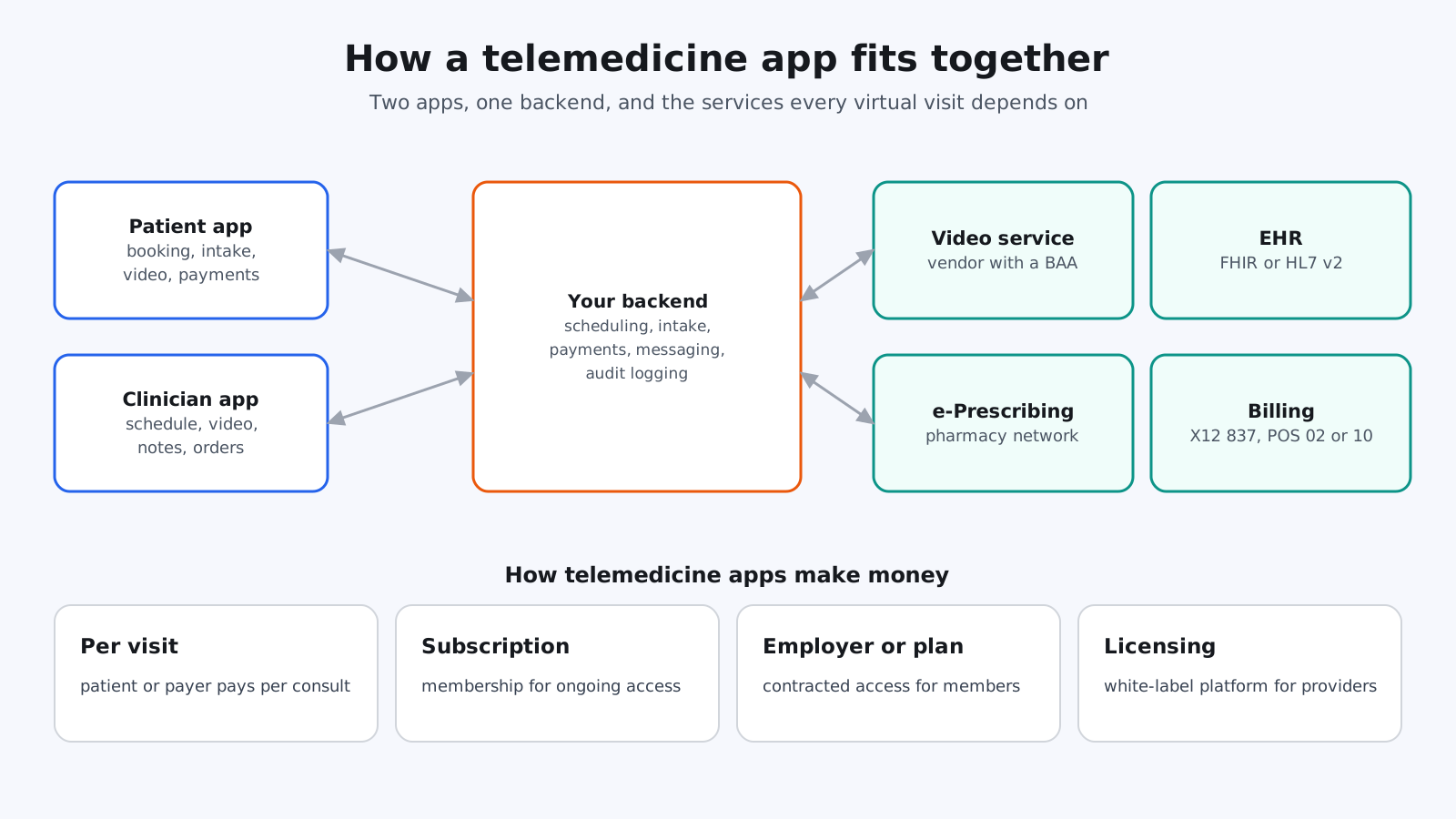
- 1. Define the care model: Who the patients are, which services you offer, who pays and in which states.
- 2. Map the visit journey: From booking and intake to the visit, prescription, follow-up and billing.
- 3. Choose the video service: A vendor that signs a BAA and handles poor networks, with recording turned off unless needed.
- 4. Build the patient and clinician apps: Web and mobile, designed for accessibility and low bandwidth.
- 5. Build the backend: Scheduling, intake, payments, messaging and audit logging.
- 6. Integrate: EHR through FHIR or HL7 v2, both standards from HL7 International (certified EHRs offer FHIR APIs under ASTP/ONC rules), plus e-prescribing networks, labs and billing.
- 7. Add compliance checks: Clinician licensing by patient state, consent capture and prescribing rules.
- 8. Test and pilot: Security, accessibility and real visits with a small group of clinicians.
- 9. Launch and monitor: Call quality, no-show rates, visit times and patient feedback.
Billing telehealth visits
Medicare telehealth claims use place of service 10 when the patient is at home and place of service 02 when the patient is somewhere else, and practitioners add modifier 95 for audio and video visits or modifier 93 for audio-only visits. Claims go to payers as HIPAA standard X12 837 transactions, so the app should capture these details at the visit, not after it.
Licensing and state rules
Clinicians generally need to be licensed in the state where the patient is during the visit. Capture the patient's location at each visit, match it against clinician licenses, and route visits only to clinicians who can see that patient.
Security for video visits
Encrypt calls and messages, use waiting rooms so patients cannot join the wrong visit, verify identity at intake, and keep recording off unless there is a clear reason and consent. Log who joined each visit and when, and make sure the video vendor's BAA covers every feature you use, including chat and file sharing.
Asynchronous visits and e-visits
Not every visit needs video. Asynchronous care, where a patient submits a form, photos or a message and a clinician responds later, suits many routine problems and follow-ups. Build structured forms for each condition, a review queue for clinicians and clear rules for when a case needs a live visit instead.
Prescribing in virtual visits
Connect the app to an e-prescribing network so prescriptions go straight to the patient's pharmacy, with drug interaction and allergy checks. For controlled substances, follow the DEA telemedicine rules in force on the date of the visit, and use an e-prescribing application that meets DEA requirements for controlled substances, including two-factor authentication for prescribers.
How do you choose a video service for telemedicine?
- Business Associate Agreement: The vendor must sign one that covers the features you use.
- Call quality: Adaptive video that falls back to audio on weak connections.
- Platforms: Software development kits for web, iOS and Android.
- Controls: Waiting rooms, recording settings and multi-party calls for interpreters or family members.
- Data handling: Where call data is processed and how long logs are kept.
- Support: Status reporting and help when calls fail during clinic hours.
How do telemedicine apps make money?
Telemedicine app monetization usually follows one of four models, and many products combine them:
- Per visit: The patient or their insurer pays for each consultation.
- Subscription: A membership fee for ongoing access to care.
- Employer or health plan contracts: Organizations pay for access for their members.
- Platform licensing: Providers pay to run the platform under their own brand.
Choose the model early, because it shapes the build: insurance billing needs eligibility checks and claims, subscriptions need membership management, and employer contracts need eligibility files and reporting.
Measuring a telemedicine program
Track the numbers that show whether virtual care works for patients and staff: time to first available visit, no-show rate, share of calls that fail or drop to audio, visit length, follow-up in-person visits within a few days, and patient and clinician satisfaction. Review them monthly with clinical leaders.
What are telemedicine apps best practices?
- One patient record: Virtual visits belong in the same chart as in-person care.
- Design for weak connections: Fall back to audio and keep the visit going.
- Keep PHI out of notifications: Reminders should not reveal clinical details.
- Make rules configurable: Billing, prescribing and licensing rules change often.
- Test with real patients: Older adults and people using assistive technology find problems teams miss.
- Support interpreters: Let a third participant join for language or accessibility support.
- Plan the hand off: Make it easy to convert a virtual visit into an in-person appointment or an order.
What are the common mistakes with telemedicine apps?
- Consumer video tools without a BAA: Using video services that do not sign a Business Associate Agreement.
- Hard coded telehealth rules: Building on flexibilities without tracking when they end.
- Ignoring licensing: Letting clinicians see patients in states where they are not licensed.
- No EHR integration: Notes and prescriptions that never reach the main record.
- Weak intake: Missing insurance, consent or location details that block billing later.
- No measures: Launching without tracking no-shows, call failures, visit length and patient satisfaction.
- Ignoring the clinician experience: Extra clicks and separate logins push clinicians back to the phone.
What does telemedicine app development mean for your build plan?
- Care model: Services, patient types, states and payers.
- Platforms: Web, iOS and Android apps for patients and clinicians.
- Integrations: Video, EHR, e-prescribing, labs, payments and billing.
- Compliance: HIPAA safeguards, BAAs, licensing checks, prescribing rules and accessibility.
- Monetization: Payments, subscriptions, claims or employer reporting.
- Operations: Support, monitoring and updates as telehealth rules change.
How Agnotic can help
Agnotic Technologies is a software development services company. We design and build telemedicine apps and platforms: patient and clinician apps, video visits with BAA covered vendors, scheduling and intake, EHR and e-prescribing integration, and billing, with HIPAA safeguards built in. You own the code.
Build your telemedicine app with Agnotic
Explore our telemedicine platform development service or browse more articles in our HL7 integration hub.
Related reading on Agnotic
Go deeper on the platforms, records and billing topics covered in this guide.
Sources
- CMS: Medicare telehealth FAQ (updated October 2026)
- Congress.gov: H.R. 7148, Consolidated Appropriations Act, 2026
- Federal Register: Fourth temporary extension of telemedicine flexibilities for controlled substances
- Federal Register: Special registrations for telemedicine (proposed rule)
- HHS: Billing and coding Medicare fee-for-service telehealth claims
- Interstate Medical Licensure Compact
- Federal Register: Expiration of COVID-19 HIPAA enforcement discretion
- 45 CFR Part 164, Subpart C: HIPAA Security Rule