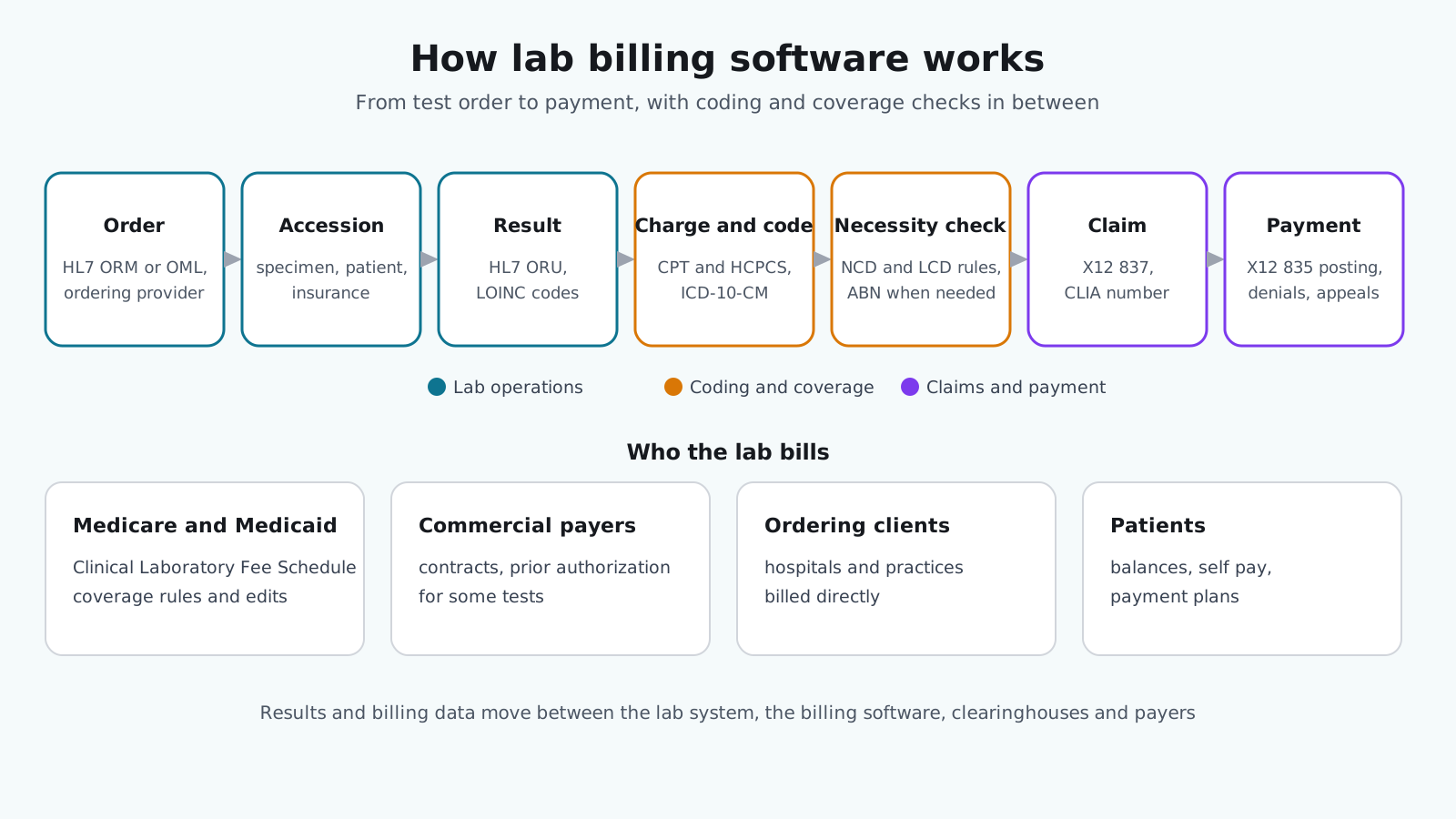
Medical lab billing software turns laboratory test orders and results into clean claims and collected payments. It captures order, patient and insurance data, assigns CPT, HCPCS and ICD-10-CM codes, checks medical necessity rules, submits X12 837 claims with the lab's CLIA number, posts X12 835 payments, and manages denials and patient balances.
This medical lab billing software guide explains what makes lab billing different, the Medicare rules your software must handle, how to build it step by step, recent innovations, best practices, common mistakes and what drives cost.
What is medical lab billing software?
Building billing software for a lab?
We design and build custom medical billing software, including lab-specific coding, coverage checks and claims.
What is medical lab billing software in practice? Lab billing is different from physician billing. The lab rarely sees the patient. The order, the diagnosis codes and often the insurance details come from another provider. Claims are high in volume and low in value, so small error rates add up quickly, and the same test can be billed to Medicare, a commercial plan, an ordering hospital or the patient.
Who a lab bills
- Medicare and Medicaid: Paid under fee schedules, with national and local coverage rules for many tests.
- Commercial payers: Paid under contracts, sometimes with prior authorization for genetic and molecular tests.
- Ordering clients: Hospitals, practices and other labs billed directly under client agreements.
- Patients: Deductibles, coinsurance and self pay balances, with statements and payment options.
Why does lab billing need specialized software?
Lab claims follow rules that general billing tools often handle poorly:
- CLIA certification: A laboratory that tests human specimens to report patient results must hold a CLIA certificate that fits the complexity of its testing (42 CFR Part 493). Medicare requires the lab's 10 digit CLIA number on claims for CLIA covered tests, which on the electronic 837P goes in loop 2300 in a REF segment with the X4 qualifier.
- National coverage rules: Medicare has national coverage determinations for 23 common clinical lab tests. Each lists the ICD-10-CM codes that support coverage, and CMS updates the claim edits that apply these lists every quarter.
- Advance notices: When a lab expects Medicare may deny a test as not reasonable and necessary, the patient should receive an Advance Beneficiary Notice of Noncoverage (form CMS-R-131) before the service. A valid signed ABN lets the provider bill the patient if Medicare denies the claim.
- Molecular tests: Palmetto GBA runs the MolDX program for Medicare. In participating jurisdictions, labs register each molecular test in the DEX Diagnostics Exchange to get a Z-Code that must appear on claims with the CPT or HCPCS code.
- Fee schedule changes: Under the Consolidated Appropriations Act, 2026, labs reported private payer rates to CMS from May 1 to July 31, 2026, using data from January 1 to June 30, 2025. Medicare applied no Clinical Laboratory Fee Schedule reduction in 2026, and cuts from 2027 through 2029 are capped at 15 percent a year.
- Standard transactions: HIPAA requires X12 standards for electronic claims (837), payment and remittance advice (835) and eligibility (270/271) under 45 CFR Part 162.
How lab data standards connect to billing
Lab orders and results usually move as HL7 Version 2.5.1 messages: orders as OML^O21 (some older interfaces use ORM) and results as ORU^R01, following HL7 International's US Realm Laboratory Orders Interface and Laboratory Results Interface guides, which ASTP/ONC lists on its Interoperability Standards Platform. Results identify each test with LOINC, the code system maintained by the Regenstrief Institute for lab tests and clinical observations. Billing uses CPT and HCPCS instead, so a central table that links each orderable test to its LOINC codes, CPT or HCPCS codes and prices is the core of any lab billing system.
How do teams approach medical lab billing software step by step?
- 1. Map the current workflow: Follow a test from order to payment for each payer type, and note where claims stall or get denied.
- 2. Build order intake: Connect to ordering systems through HL7 interfaces or a portal, and catch missing diagnosis codes, insurance details or signatures at the start.
- 3. Build the test compendium: Link every orderable test to its LOINC codes, CPT or HCPCS codes, modifiers and prices, with effective dates.
- 4. Add coverage checks: Apply NCD and local coverage rules and frequency limits, and trigger the ABN workflow before the test when coverage is in doubt.
- 5. Build and scrub claims: Include the CLIA number, and for tests sent to a reference lab, modifier 90 and that lab's CLIA number. Catch errors before submission.
- 6. Submit and track: Send claims through a clearinghouse, and track acknowledgments and claim status.
- 7. Post payments and work denials: Post X12 835 remittances automatically, group denials by reason code, and route them to the right team.
- 8. Bill clients and patients: Produce client invoices and clear patient statements, with online payment and payment plans.
Reports a lab billing team needs
- Clean claim rate: The share of claims accepted on first submission, by payer.
- Denials by reason: Denial counts and amounts grouped by reason code, payer and test.
- Missing information: Orders held for missing diagnosis codes, insurance or signatures, by ordering client.
- Days to payment: Time from date of service to payment, by payer.
- Write-offs: Amounts written off and why, so fixable causes are found.
Medical billing software development for labs versus practices
Medical billing software development for a physician practice centers on the visit: documentation, evaluation and management coding and the encounter. For a lab, it centers on the order and the result. That changes the data model, the interfaces and the checks. A lab system must handle requisitions from many ordering providers, missing information that arrives later, panels that expand into several billable tests, and reflex tests ordered automatically from a first result.
What are the new innovations in medical billing software development?
- Earlier eligibility checks: Running coverage checks when the order arrives, not after the test, so problems are fixed while the patient can still be reached.
- AI assisted coding and denial prediction: Suggesting codes and flagging claims likely to be denied, with a person reviewing the result.
- Rules engines that change without releases: Payer and coverage rules stored as configuration, so billing staff can update them when policies change.
- Payer APIs: The CMS Interoperability and Prior Authorization Final Rule requires many payers to offer FHIR based Prior Authorization APIs, generally by January 1, 2027, which may help labs that need approval for genetic and molecular tests.
- Better patient payment tools: Clear statements, text reminders and online payment plans.
What are medical lab billing software best practices?
- Fix data at intake: Most lab denials trace back to missing or wrong order information.
- Keep the compendium current: Review code, price and coverage changes on a fixed schedule.
- Automate the routine: Post remittances and route denials automatically, so staff work only the exceptions.
- Measure by payer and test: Track denial rates, days to payment and write-offs for each payer and test.
- Protect PHI: Apply the administrative, physical and technical safeguards of the HIPAA Security Rule, enforced by HHS, and sign Business Associate Agreements with clearinghouses and other vendors.
What are the common mistakes with medical lab billing software?
- Treating labs like practices: Generic practice billing tools miss CLIA numbers, panels, reflex testing and client billing.
- Late medical necessity checks: Checking coverage after the test means the ABN chance has passed.
- Hard coded rules: Coverage and payer rules buried in code fall behind every quarterly update.
- No link between results and billing: When the result system and the billing system disagree on what was performed, claims go out wrong.
- Ignoring client billing: Invoicing hospitals and practices by hand causes delays and disputes.
- No denial analytics: Without reasons grouped by payer and test, the same denials repeat.
What does medical billing software development cost?
Medical billing software development cost depends on scope more than on any single feature. These drivers set cost and timeline:
- Test menu: The number of tests, panels and reflex rules in the compendium.
- Payer mix: Medicare, Medicaid, commercial and client billing each add rules and reports.
- Interfaces: HL7 order and result interfaces, clearinghouse connections and any payer APIs.
- Coverage logic: NCD and local coverage edits, frequency limits, MolDX and ABN workflows.
- Patient billing: Statements, portals, payment plans and collections.
- Compliance: HIPAA safeguards, audit logging and BAAs.
- Support: Quarterly code and coverage updates and payer rule changes.
A sensible first release covers one payer group and the highest volume tests end to end, with clean intake and automatic payment posting. Add payers, molecular test workflows and patient billing features in later releases.
How Agnotic can help
Agnotic Technologies is a software development services company. We design and build medical billing software for laboratories and health tech companies: order intake and HL7 interfaces, test compendiums, coverage checks, claims, payment posting and reporting, with HIPAA safeguards built in. We build software; we do not provide billing services. You own the code.
Build your lab billing software with Agnotic
Explore our medical billing software service or browse more articles in our HL7 integration hub.
Related reading on Agnotic
Go deeper on the billing, coding and interfaces covered in this guide.
Sources
- 42 CFR Part 493: Laboratory requirements (CLIA)
- CMS Medicare Claims Processing Manual, Chapter 16: Laboratory services
- CMS: Lab NCDs and ICD-10 code lists
- CMS: Advance Beneficiary Notice of Noncoverage (CMS-R-131)
- Palmetto GBA: MolDX program
- CMS: Clinical Laboratory Fee Schedule PAMA reporting resources
- LOINC: Introduction (Regenstrief Institute)
- 45 CFR Part 162: HIPAA Administrative Requirements (transactions and code sets)