Revenue cycle management (RCM) is the process a healthcare organization uses to get paid correctly for care, from scheduling and eligibility checks through coding, claims, payment posting and patient billing. In software terms, it is a chain of systems connected by HIPAA standard transactions, such as X12 eligibility, claim and remittance messages.
This guide to healthcare revenue cycle management explains the key steps, why the rules are changing, where AI and automation help, and how to plan RCM software.
What is revenue cycle management?
Building revenue cycle software?
Our team designs and builds custom RCM software around your workflows, payers and EHR.
Revenue cycle management covers every administrative and clinical step that turns a patient visit into payment. It starts before the visit, when the patient is registered and coverage is checked, and ends when the claim is paid, the patient balance is collected, and the account is closed. Weak points anywhere in the chain show up later as denials, delays or write-offs.
Front, middle and back of the cycle
Teams often split the work into three parts. The front end covers scheduling, registration, eligibility and authorization. The middle covers documentation, charge capture and coding. The back end covers claims, payment posting, denials and patient collections. Software usually has to connect all three, because an error at the front end often becomes a denial at the back end.
Key steps of revenue cycle management
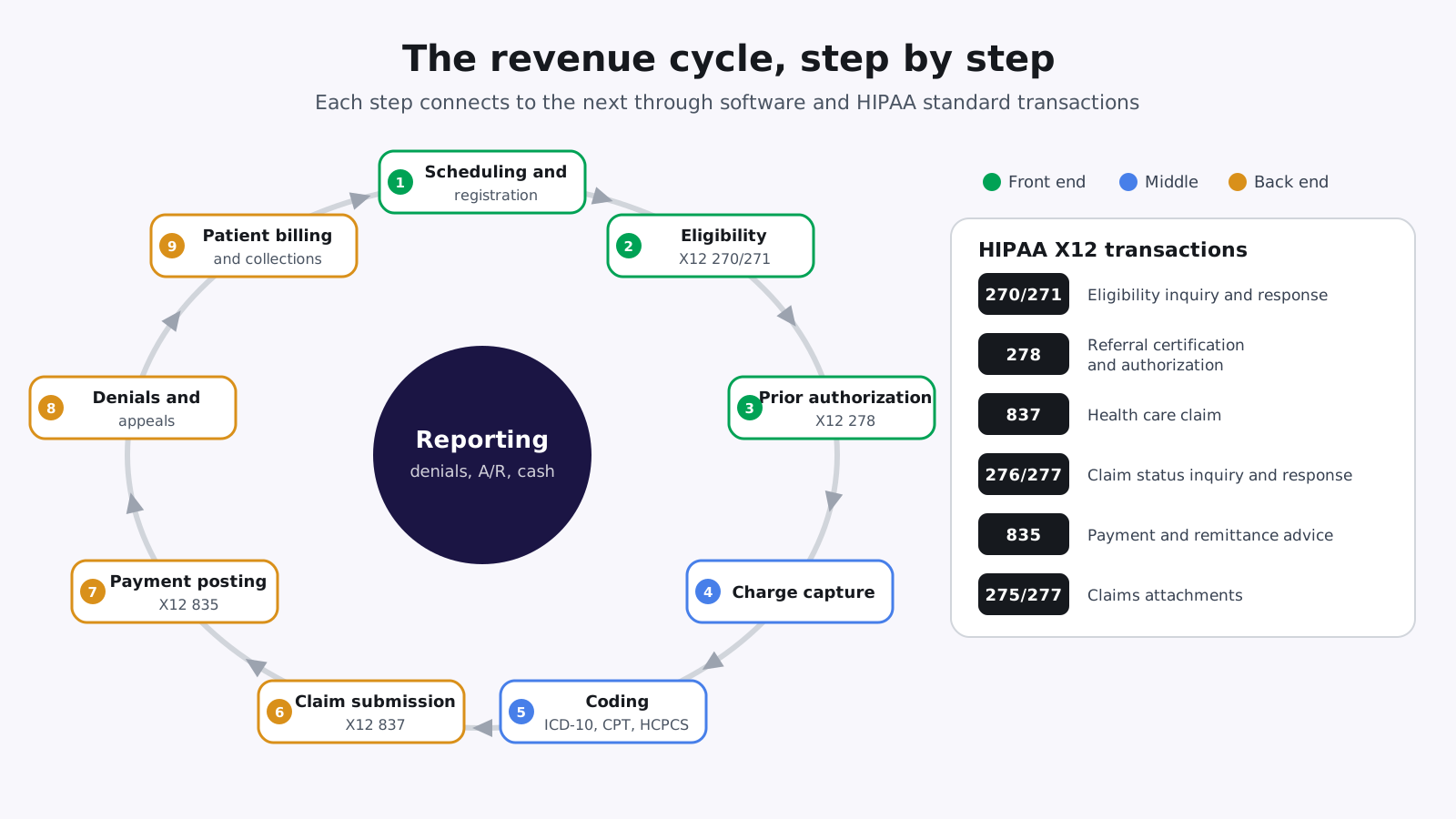
- 1. Scheduling and registration: Capture accurate demographics and insurance details at the first contact.
- 2. Eligibility and benefits verification: Confirm coverage before the visit, typically with the X12 270 inquiry and 271 response.
- 3. Prior authorization: Get payer approval for services that require it, using the X12 278 transaction or payer portals and APIs.
- 4. Charge capture: Record every billable service from the clinical documentation.
- 5. Coding: Assign diagnosis codes (ICD-10-CM) and procedure codes (CPT and HCPCS) that match the documentation.
- 6. Claim submission: Send the claim to the payer as an X12 837 transaction, after checking it for errors.
- 7. Claim status: Track claims with the X12 276 inquiry and 277 response.
- 8. Payment posting: Post payments and adjustments from the X12 835 remittance advice.
- 9. Denial management: Find the reason for each denial, correct it, and appeal where appropriate.
- 10. Patient billing and collections: Send clear statements and offer easy ways to pay.
- 11. Reporting: Track denial rates, days in accounts receivable and other measures to find problems early.
Why does revenue cycle management matter now?
Several rules shape how revenue cycle software must work today, and some of them are changing.
- HIPAA standard transactions: Under HIPAA Administrative Simplification, HHS requires claims, eligibility, claim status, referral certification and authorization, and remittance advice transactions to use adopted X12 standards (45 CFR Part 162). The claim standards are the X12 837 version 5010 transactions for professional, institutional and dental claims.
- Standard code sets: HIPAA also adopts the code sets used in billing, including ICD-10-CM for diagnoses, ICD-10-PCS for inpatient procedures, and HCPCS with CPT for physician and other services (45 CFR 162.1002).
- Prior authorization changes: The CMS Interoperability and Prior Authorization Final Rule (CMS-0057-F) requires impacted payers, such as Medicare Advantage organizations and Medicaid and CHIP programs, to decide standard prior authorization requests within 7 calendar days and expedited requests within 72 hours starting in 2026, and to build FHIR-based APIs, including a Prior Authorization API, from January 2027.
- Electronic claims attachments: A CMS final rule adopted the X12 275 and 277 version 006020 standards for health care claims attachments, effective May 26, 2026, so supporting documentation can move electronically with claims.
- Filing deadlines: Medicare generally requires claims to be filed within one calendar year of the date of service (42 CFR 424.44). Late or rejected claims that are not corrected in time become lost revenue.
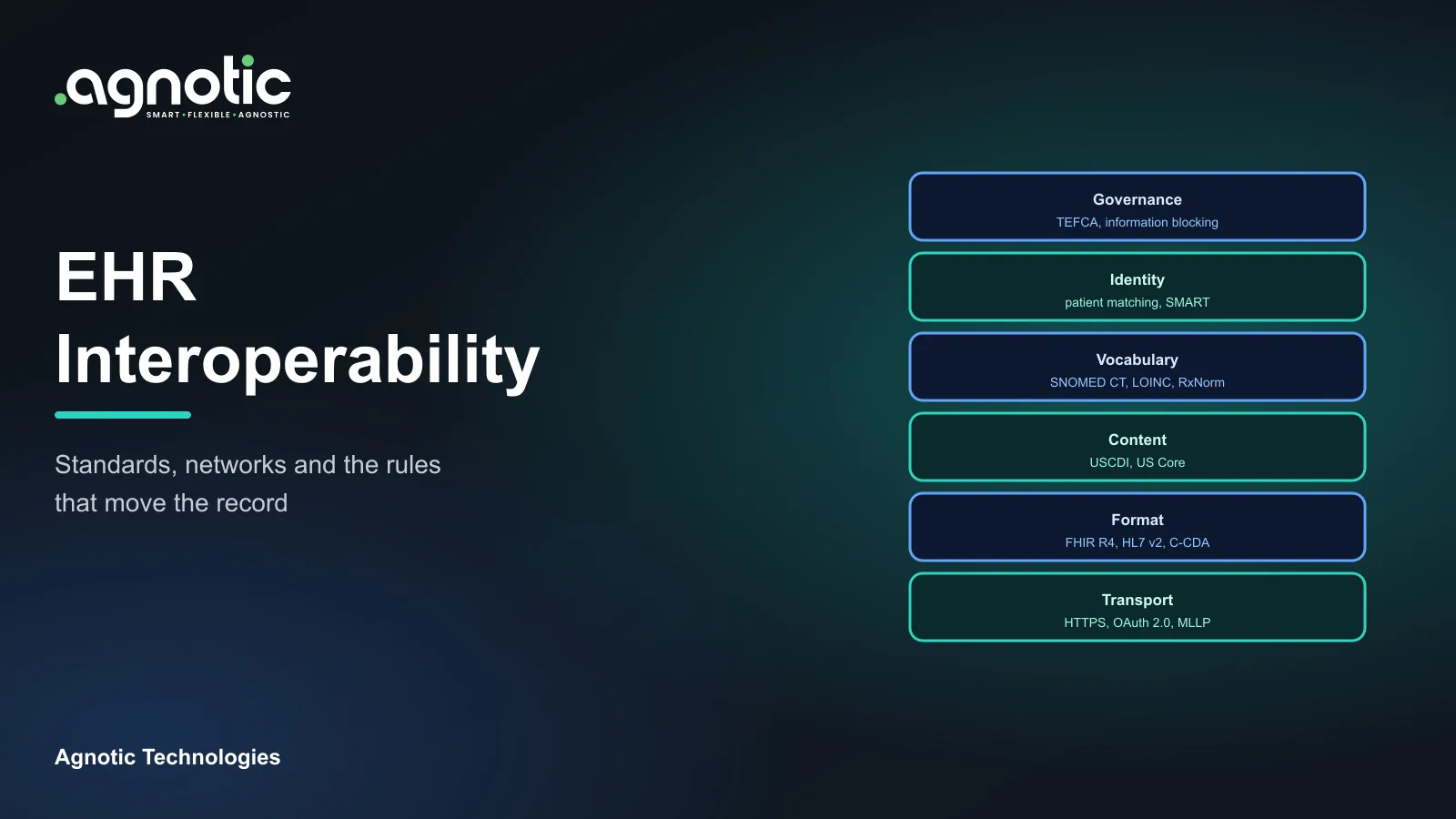
Clinical data matters too. Coding and attachments depend on documentation in the EHR, and certified EHRs expose that data through standardized APIs built on the USCDI data set under the ASTP/ONC Health IT Certification Program, using HL7 International's FHIR standard.
How does AI change revenue cycle management?
AI in revenue cycle management is most useful on high-volume, rules-heavy work where a person can check the result. Common uses of AI revenue cycle management tools include:
- Eligibility checks: Running coverage checks in batches before appointments and flagging problems.
- Coding support: Suggesting codes from clinical notes for a certified coder to review.
- Claim scrubbing: Catching missing or inconsistent data before a claim is sent.
- Denial prediction and appeals: Flagging claims likely to be denied and drafting appeal letters from the record.
- Prior authorization: Assembling the documentation a payer asks for.
Revenue cycle management automation does not remove the need for people. Keep a human review step for coding and appeals, log what the system did, and protect the data: the HIPAA Security Rule requires administrative, physical and technical safeguards for electronic protected health information (45 CFR Part 164, Subpart C).
How does revenue cycle management differ by specialty?
The steps are the same, but each specialty has its own billing pressure points. Your software should handle these without workarounds.
- Cardiology revenue cycle management: Prior authorization for advanced imaging and procedures, and billing for device and remote monitoring services delivered over time.
- Gastroenterology revenue cycle management: Correctly separating screening and diagnostic procedures, which changes coding and what the patient owes.
- Orthopedic revenue cycle management: Surgical global periods, durable medical equipment, and authorizations for imaging and surgery.
- Oncology revenue cycle management: Drug administration and drug units billed with HCPCS codes, and frequent prior authorization for treatment plans.
- Dermatology revenue cycle management: Billing an evaluation and a procedure on the same day with the right modifiers, and separating cosmetic from medically necessary services.
Specialty software we build
Explore the specialty software we design and build.
Should you build, buy or outsource revenue cycle management?
There are three common models, and many organizations combine them.
- In-house team with off-the-shelf software: Full control of the process, but the software sets the limits on workflow and integration.
- Outsourced billing company: The benefits of outsourcing revenue cycle management are access to trained staff and less hiring, but you depend on the vendor's processes, reporting and data access.
- Custom software around your workflows: Fits specialty rules, payer mix and EHR integration, but needs a clear scope and a team to build and maintain it.
Agnotic Technologies builds software. We do not provide billing services, so this guide treats outsourcing as one option to weigh, not a recommendation.
How do teams approach an RCM software project step by step?
- 1. Map the current cycle: Document each step, who owns it, and where claims stall or get denied.
- 2. Pick the first problem to solve: For example, eligibility errors or slow denial follow-up, and agree on how success is measured.
- 3. Confirm integrations: List the EHR, practice management system, clearinghouse and payer connections, and the X12 transactions each one uses.
- 4. Agree on security and contracts: Sign Business Associate Agreements where protected health information is involved, and plan access control and audit logging.
- 5. Build in small releases: Ship one step of the cycle at a time and compare results with the baseline.
- 6. Test with real payer behavior: Validate claims and remittances against test files and a limited live rollout before scaling.
- 7. Monitor and adjust: Track rejections, denials and payment timing, and update rules as payer policies change.
What are the common mistakes with revenue cycle management?
These mistakes also point to how to improve revenue cycle management:
- Fixing the back end only: Many denials start with registration and eligibility errors. Check data at the front of the cycle.
- Treating denials one by one: Group denials by reason and fix the upstream cause.
- Poor integration with the EHR: Manual re-entry of charges and documentation causes coding errors and delays.
- No visibility: Without reporting on denials and accounts receivable, problems surface months later.
- Ignoring patient billing: Confusing statements and few payment options slow collections.
- Automating without review: AI and rules engines need human checks, audit logs and regular tuning.
What does revenue cycle management mean for your build plan?
Use this checklist when you scope RCM software. It also lists the main drivers of cost and timeline:
- Scope: Which steps of the cycle the first release covers.
- Integrations: The EHR, practice management system, clearinghouse and payers involved.
- Transactions: Which X12 transactions you send and receive, and any payer APIs.
- Specialty rules: Coding, modifiers and authorization rules for the specialties you serve.
- Compliance: BAAs, HIPAA safeguards and audit logging from day one.
- Reporting: The measures you will track and who uses them.
- Support: Ongoing updates for code set changes, payer rules and new regulations.
Plan the reporting early. Common measures include denial rate by reason, first-pass claim acceptance, days in accounts receivable and time from service to claim. Agree on definitions with the finance team before launch, so the numbers in the new system can be compared with the old process.
How Agnotic can help
Agnotic Technologies is a software development services company. We design and build revenue cycle software for healthcare organizations and health tech companies: mapping the cycle, integrating with EHRs and clearinghouses, handling X12 transactions, adding AI where it helps, and putting HIPAA safeguards in place. You own the software; we build it to fit how your team works.
Build your revenue cycle software with Agnotic
Explore our custom RCM software service or browse more articles in our revenue cycle hub.
Related reading on Agnotic
Go deeper on the workflows, standards and safeguards covered in this guide.
Sources
- 45 CFR Part 162: HIPAA Administrative Requirements (transactions and code sets)
- 45 CFR 162.1002: Medical data code sets
- CMS Interoperability and Prior Authorization Final Rule (CMS-0057-F)
- X12: Final rule on health care claims attachments
- 42 CFR 424.44: Time limits for filing claims
- 45 CFR Part 164, Subpart C: HIPAA Security Rule
- ASTP/ONC Standards Version Advancement Process (USCDI)