Mental health telehealth is the delivery of psychiatric, psychological and counseling care through video, audio and messaging instead of an in-person visit. It is the largest and most durable use of telehealth in the United States, and the rules that govern it, from Medicare coverage to controlled substance prescribing and substance use disorder records, changed again in 2026.
This mental health telehealth guide covers what the service includes, why it matters now, the benefits and the challenges, how a program is built step by step, the architecture behind it, best practices, common mistakes and what it means for your build plan.
What is mental health telehealth?
Building a behavioral health telehealth platform?
Agnotic builds telemedicine platforms for behavioral health providers: video and messaging, intake and measurement, e-prescribing and EHR integration, with consent rules built in.
Mental health telehealth is care for mental health and substance use conditions delivered remotely: therapy and psychiatry visits by video or audio, asynchronous messaging between visits, digital intake and symptom measurement, and remote prescribing. It serves patients at home or in a clinic that lacks a specialist, and it is covered by Medicare, Medicaid and most commercial plans under rules that keep changing.
What a program usually includes
- Visits: Scheduled video and audio-only sessions for therapy, medication management and psychiatric evaluation.
- Between visits: Secure messaging, homework, symptom check-ins and crisis resources.
- Measurement: Standard instruments such as PHQ-9 and GAD-7 collected before visits and trended over time.
- Prescribing: Electronic prescribing, including controlled medications where federal and state rules allow.
- Coordination: Notes, referrals and results shared with primary care and, with consent, with other providers.
- Safety: A crisis pathway with escalation steps and the 988 Suicide and Crisis Lifeline in every patient surface.
Why does mental health telehealth matter now?
- Medicare coverage runs to 2027: The Consolidated Appropriations Act, 2026 extended most Medicare telehealth flexibilities, including home as an originating site and audio-only services, through December 31, 2027. The in-person visit requirement for mental health telehealth is delayed until January 1, 2028.
- Controlled substances by telemedicine: The DEA and HHS fourth temporary rule lets practitioners prescribe Schedule II to V controlled medications by telemedicine without a prior in-person visit through December 31, 2026, under the existing conditions. No permanent rule had been published as of October 2026.
- Substance use records changed: The 42 CFR Part 2 final rule of February 2024 aligned Part 2 with HIPAA, allowing a single patient consent for treatment, payment and operations, with a compliance date of February 16, 2026. Counseling notes still need separate consent.
- HIPAA is fully back: HHS OCR's COVID-era enforcement discretion for telehealth video tools ended on August 9, 2023, so every video and messaging vendor that handles PHI needs a Business Associate Agreement.
- Interstate practice: Compacts such as PSYPACT for psychologists and the Interstate Medical Licensure Compact let clinicians practice across member states, but the patient's location still decides which law applies.
- Billing codes: Medicare pays telehealth to a patient at home (place of service 10) at the non-facility rate, with modifier 95 for audio and video and modifier 93 for audio-only, per the Medicare Claims Processing Manual.
What are the opportunities and challenges of telemedicine in mental health?
The benefits of telehealth technology for mental health services are real: no travel, shorter waits, privacy for patients who avoid a waiting room, and continuity when a patient moves or a clinician is scarce. The challenges are equally real and mostly about rules and data.
Opportunities
- Access: Patients in rural areas and shortage specialties reach a clinician in days, not months.
- Adherence: Shorter, more frequent check-ins and measurement-based care improve follow-through.
- Collaborative care: Primary care teams add a psychiatric consultant remotely.
- Audio-only: Patients without broadband or a camera still get care through 2027 under Medicare.
Challenges
- Licensure: Clinicians need a license, or a compact privilege, where the patient is located at the time of the visit.
- Prescribing: Controlled substance rules differ by state and the federal flexibilities have end dates.
- Consent and records: Part 2 records, state mental health privacy laws and minors' consent rules all shape what can be shared and with whom.
- Safety at a distance: Crisis protocols need the patient's location, a local emergency contact and an escalation path that works without a front desk.
- Reimbursement drift: Codes, modifiers and payer policies change every year.
What does a mental health telehealth platform look like?
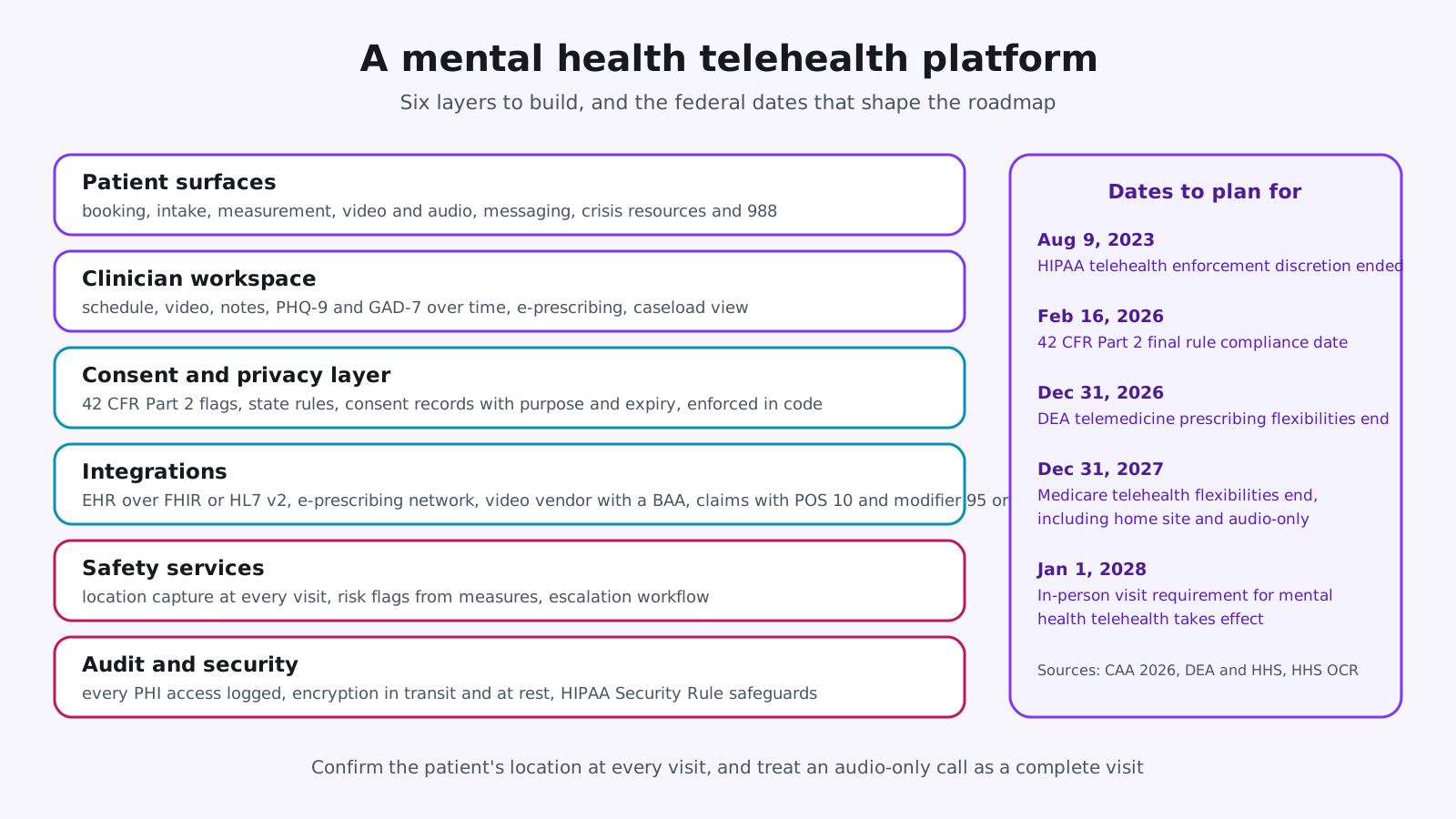
- Patient surfaces: Web and mobile apps for booking, intake, measurement, video, messaging and crisis resources.
- Clinician workspace: Schedule, video, notes, measures over time, e-prescribing and a caseload view.
- Consent and privacy layer: Part 2 flags, state rules and consent records enforced in software, not by memory.
- Integrations: EHR through FHIR or HL7 v2, e-prescribing network, video vendor with a BAA, claims with the right place of service and modifiers.
- Safety services: Location capture at the start of each visit, risk flags from measures, and an escalation workflow.
- Audit and security: Every PHI access logged, encryption in transit and at rest, and the HIPAA Security Rule safeguards.
Audio-only and low bandwidth
Audio-only is not a fallback in mental health care. Many patients, especially older adults and people in rural areas, have a phone but no reliable video. Medicare covers audio-only mental health services through 2027, so the platform should treat a phone call as a complete visit: identity confirmed, consent recorded, note written and the claim coded with modifier 93.
Consent and Part 2 segmentation
Substance use disorder records under 42 CFR Part 2 can now move under a single consent for treatment, payment and operations, but counseling notes still need separate consent and redisclosure rules still apply. Tag Part 2 data at the source, store consent as structured records with a purpose and an expiry, and enforce the rules in every export and integration rather than relying on staff to remember them.
How do teams build a mental health telehealth program step by step?
- 1. Define the populations and states: Who you serve, where they live, and which licenses and compacts you hold.
- 2. Map the rules: Medicare and Medicaid coverage, state telehealth and consent laws, Part 2 status, and controlled substance rules per state.
- 3. Choose the vendors: A video service and an e-prescribing network that sign BAAs and support audio-only and EPCS.
- 4. Design the clinical flow: Intake, measurement, visit, note, prescription, follow-up, and the crisis path at every step.
- 5. Integrate the EHR: Scheduling, notes, medications and measures through FHIR, with Part 2 segmentation where required.
- 6. Build consent into the data model: Who consented to what, for which purpose, and until when.
- 7. Test with clinicians and patients: Include low bandwidth, audio-only and phone-only users.
- 8. Launch, bill and measure: Clean claims with the right codes, and outcomes tracked with the measures you collect.
What are mental health telehealth best practices?
- Start every visit with location: Confirm where the patient is, for licensure and for emergencies.
- Measure routinely: Standard instruments before visits, trended, and visible to the clinician.
- Keep audio-only first class: Design flows that work on a phone call, not only on video.
- Separate Part 2 data: Mark substance use records and apply the consent rules automatically.
- Plan for the end dates: Treat the 2026 and 2027 federal dates as milestones in your roadmap, not surprises.
- Train for crisis: Scripts, contacts and system support for a patient in danger during a remote visit.
- Make 988 visible: The Suicide and Crisis Lifeline in the app, the portal and the after-visit summary.
Most of these practices cost little when they are designed in and a great deal when they are retrofitted after an audit or an incident.
What are the common mistakes with mental health telehealth?
- Consumer video tools: Free conferencing without a BAA, which has not been acceptable since August 2023.
- Ignoring the patient's location: Visits delivered to patients in states where the clinician is not licensed.
- One consent form for everything: Part 2 and state rules need specific, recorded consent.
- No crisis plan: Nobody knows what to do when a patient discloses intent to self-harm on video.
- Measures in PDFs: Instruments collected but not structured, so nothing can be trended or reported.
- Billing by habit: Wrong place of service or modifier, and denials that nobody traces back.
What does mental health telehealth mean for your build plan?
- States and licenses: Each state adds rules for consent, prescribing and practice.
- Vendors with BAAs: Video, e-prescribing, messaging and transcription vendors, each under contract.
- Consent model: Part 2 and state privacy rules enforced by the data platform.
- EHR integration: Scheduling, notes, medications and measures through FHIR.
- Safety workflow: Location capture, risk flags and escalation, tested before launch.
- Operations: Annual code and policy updates, payer enrollment and outcome reporting.
For the general telemedicine build, our telemedicine apps guide covers video selection and revenue models, and our custom EHR software development guide covers the record behind the visit.
How Agnotic can help
Agnotic Technologies is a software development services company. We build mental health telehealth platforms for behavioral health providers and digital health companies: patient and clinician apps, video and messaging with BAA covered vendors, measurement-based care, e-prescribing, consent rules for Part 2 and state law, and EHR integration over FHIR. Your clinicians set the model of care. We build the system that delivers it safely.
Build your mental health telehealth platform with Agnotic
Explore our telemedicine platform development services or browse more articles in our HL7 hub.
Related reading on Agnotic
Go deeper on the telemedicine, behavioral health and EHR topics covered in this guide.
Sources
- Congress.gov: Consolidated Appropriations Act, 2026 (H.R. 7148)
- CMS: Telehealth
- Federal Register: Fourth temporary extension of telemedicine flexibilities for prescription of controlled medications
- HHS: Fact sheet, 42 CFR Part 2 final rule
- HHS OCR: HIPAA and telehealth
- PSYPACT: Psychology Interjurisdictional Compact
- SAMHSA: 988 Suicide and Crisis Lifeline
- 45 CFR Part 164, Subpart C: HIPAA Security Rule