Remote patient monitoring MVP development is building the smallest version of an RPM product that works end to end: one or two connected devices, a patient app or hub, a clinician dashboard with alerts, and the data and time tracking needed for Medicare billing. It proves clinical and operational value before you add more conditions, devices and integrations.
This guide covers what remote patient monitoring involves, the billing rules for 2026, device choices, EHR integration, a step by step build plan, common mistakes and what drives cost.
What is remote patient monitoring MVP development?
Planning an RPM product?
We design and build remote patient monitoring software, from device integration to clinician dashboards.
Remote patient monitoring collects physiologic data, such as blood pressure, weight, blood glucose and oxygen saturation, from patients at home and sends it to a care team that reviews it and acts on it. Medicare calls this remote physiologic monitoring. A related service, remote therapeutic monitoring, covers data such as musculoskeletal and respiratory status and has its own billing codes.
What the first release must include
- Devices: One or two devices that fit the condition you start with.
- Data path: A reliable way to get readings from the device to your platform without manual entry.
- Clinician workflow: Thresholds, alerts, a review queue and a place to document actions.
- Patient experience: Simple setup, reminders, a way to reach the care team, and screens that meet WCAG 2.2 accessibility guidelines.
- Billing data: Days with readings and minutes of management time, tracked automatically.
- Security: HIPAA safeguards and Business Associate Agreements with every vendor that handles PHI.
Benefits of remote patient monitoring
For care teams, RPM gives a view of the patient between visits, so changes can be caught earlier and acted on. For patients, it replaces paper logs with automatic readings. For the organization, it is a billable service when the program meets payer rules. An MVP lets you test these benefits with a small group before investing in scale.
Why does remote patient monitoring MVP development matter now?
Medicare billing rules for remote monitoring changed in 2026, and more changes have been proposed for 2027.
- New 2026 codes: Starting January 1, 2026, Medicare added CPT 99445 for device supply when data covers 2 to 15 days in a 30 day period, and CPT 99470 for the first 10 minutes of monthly treatment management. These sit alongside the existing 99453, 99454 (16 or more days), 99457 and 99458.
- Device rules: Medicare requires an RPM device to meet the definition of a medical device in section 201(h) of the Federal Food, Drug, and Cosmetic Act, though it does not have to be FDA cleared. Data must be collected and transmitted automatically, not self-reported.
- Remote therapeutic monitoring: RTM uses CPT 98975 to 98978 for setup and device supply and 98980 and 98981 for treatment management. For 2026, Medicare added shorter period codes, including 98984 and 98985 for 2 to 15 days of data and 98979 for the first 10 minutes of management.
- Proposed 2027 changes: CMS's proposed rule for calendar year 2027 would, if finalized, require RPM and RTM services to be furnished by staff employed by the billing practice and to begin with an initiating visit. The final rule had not been released as of mid October 2026.
These rules shape the software. Your platform has to count days with readings per 30 day period, track minutes and interactive communication per month, and show which code each patient qualifies for. If those numbers come from spreadsheets, billing becomes the bottleneck.
Cardiac, COPD and diabetes remote patient monitoring
- Cardiac remote patient monitoring: Programs commonly track blood pressure and weight, for example weight gain in heart failure, with alerts tuned to each patient's targets.
- COPD remote patient monitoring: Pulse oximetry and symptom check-ins are common. Some respiratory data may fall under remote therapeutic monitoring instead of RPM.
- Diabetes remote patient monitoring: Connected glucose meters and continuous glucose monitors are the main sources, and CGM data often arrives through the manufacturer's platform rather than directly from the device.
How do teams approach remote patient monitoring MVP development step by step?
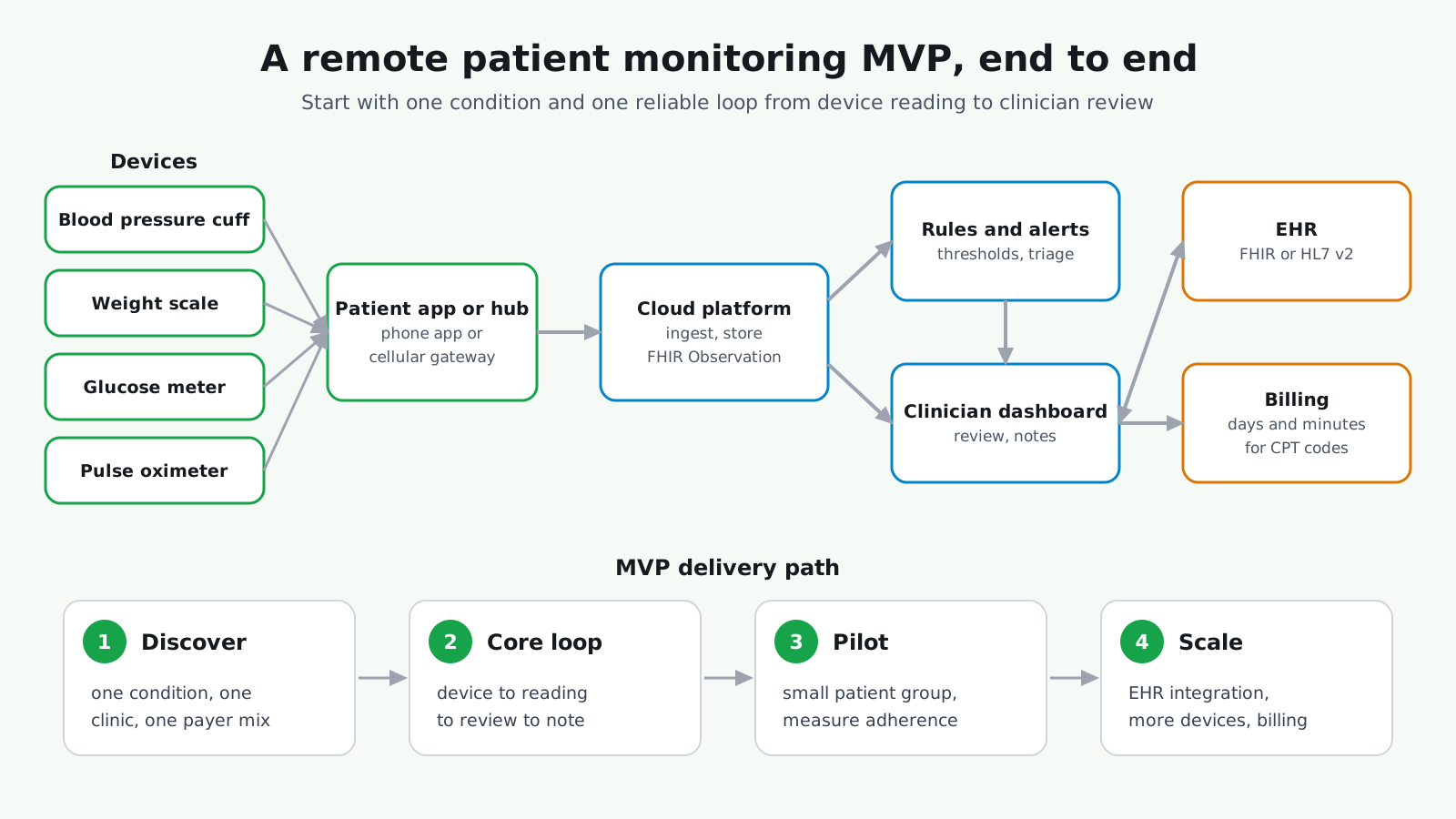
- 1. Pick one condition and one care team: A narrow start keeps alert rules, devices and training manageable.
- 2. Choose the devices: A typical remote patient monitoring devices list starts with blood pressure cuffs, weight scales, glucose meters and pulse oximeters. Decide between Bluetooth devices that pair with a phone and cellular devices that send data on their own, and confirm each device's regulatory status.
- 3. Design the data path: Receive readings, handle duplicates, units and time zones, and store them in a standard shape such as a FHIR Observation.
- 4. Build the clinician workflow: Set thresholds, route alerts to the right person, give staff a review queue, and record notes and time in one place.
- 5. Track billing data automatically: Count days with readings, minutes of management time and interactive communication, and flag patients approaching each threshold.
- 6. Integrate with the EHR: Send summaries, results or notes back to the record. Start with what the clinical team needs most.
- 7. Secure the platform: Sign BAAs, apply the HIPAA safeguards HHS requires, and keep PHI out of logs and notifications.
- 8. Pilot, measure and scale: Run a small pilot, track adherence, alert volume and review time, and fix the workflow before adding patients.
Remote patient monitoring deployment
Deployment is as much logistics as software. Plan how devices are shipped, set up, replaced and returned, who answers patient calls, and how a patient is enrolled and discharged from the program. Build these steps into the platform so staff are not tracking them by hand.
EHR integration for remote patient monitoring
Most EHR integration for remote patient monitoring uses HL7 v2 messages or FHIR APIs, both standards from HL7 International, depending on what the EHR and the health system support. Certified EHRs must offer FHIR APIs under the ASTP/ONC Health IT Certification Program. For Epic remote patient monitoring integration, Epic publishes its FHIR API documentation and a sandbox at fhir.epic.com, and each health system decides whether to activate an app. Plan for that approval time in the schedule.
Does RPM software need FDA clearance?
It depends on what the software is intended to do. The FDA uses the IMDRF definition of Software as a Medical Device (SaMD): software intended for one or more medical purposes that performs those purposes without being part of a hardware medical device. In January 2026 the FDA revised its General Wellness guidance to clarify that some non-invasive wearables that estimate physiologic values can be treated as low risk wellness products, as long as they make no claims about diagnosing, screening for or monitoring a disease.
If your product is a device, the quality system rules apply. Since February 2, 2026, the FDA's Quality Management System Regulation incorporates ISO 13485:2016 by reference, and many medical software teams follow IEC 62304 for software life cycle processes. Confirm your product's status with regulatory counsel early, because it changes the build process.
What are the common mistakes with remote patient monitoring MVP development?
- Too many conditions at once: Each condition adds devices, thresholds and training.
- Devices patients cannot set up: Hard pairing and unclear instructions lead to missing days and lost billing.
- Alert floods: Thresholds that are too tight bury real problems under noise.
- Manual billing tracking: Counting days and minutes in spreadsheets causes errors and missed claims.
- Self-reported data treated as RPM data: Medicare requires readings to be collected and sent automatically.
- No logistics plan: Device shipping, replacement and returns become a full time job.
- Ignoring rule changes: Billing rules changed in 2026 and more changes are proposed, so keep rules configurable.
What does remote patient monitoring MVP development mean for your build plan?
The cost of remote patient monitoring software depends on these drivers:
- Devices: How many device types and vendors you support, and whether they connect by Bluetooth or cellular.
- Apps: Whether patients need a mobile app, or a cellular hub is enough.
- Clinical workflow: The number of alert rules, roles and documentation steps.
- Remote patient monitoring billing: Tracking for RPM and RTM codes, reporting your billing team can use, and, if you submit claims, the HIPAA standard X12 transactions such as the 837 claim and 835 remittance.
- Integrations: EHR connections, device vendor APIs and any video visit tools.
- Compliance: HIPAA safeguards, BAAs and, if the software is a device, FDA quality system work.
- Support: Device logistics, patient support and updates as payer rules change.
As a remote patient monitoring telemedicine guide in one line: many programs pair RPM with video visits for review conversations, so build video on a vendor that signs a BAA and keep the visit record and the monitoring data in the same patient view.
Keep the first release narrow: one condition, one or two devices, one care team and the billing data your team needs to submit claims. Make thresholds, billing rules and device types configurable, so the next condition is a setup task rather than a rebuild.
How Agnotic can help
Agnotic Technologies is a software development services company. We design and build remote patient monitoring software for digital health companies and provider groups: device integration, data pipelines, clinician dashboards, billing data tracking and EHR integration, with HIPAA safeguards from the first release. You own the software; we build it around your program.
Build your RPM MVP with Agnotic
Explore our remote patient monitoring software service or browse more articles in our remote care hub.
Related reading on Agnotic
Go deeper on the devices, platforms and integrations covered in this guide.
Sources
- CMS: CY 2026 Medicare Physician Fee Schedule final rule (CMS-1832-F) fact sheet
- CMS MLN: Telehealth and remote patient monitoring
- CMS: Therapy code list, 2026 annual update (remote therapeutic monitoring)
- Federal Register: CY 2027 Physician Fee Schedule proposed rule
- 21 U.S.C. 321: Definitions, including device (FD&C Act section 201(h))
- FDA: Software as a Medical Device (SaMD)
- FDA: General Wellness: Policy for Low Risk Devices
- FDA: Quality Management System Regulation (QMSR)