EHR data analytics is the practice of extracting clinical and operational data from electronic health records, cleaning and standardizing it, and analyzing it to answer questions about care quality, operations and cost. It depends on reliable data access, such as FHIR APIs and bulk export, plus HIPAA safeguards and clear governance over who sees what.
This EHR data analytics guide explains the four types of data analytics, why EHR data is easier to reach than it used to be, how to run a data analytics project step by step, who belongs on the team, and what drives cost.
What is EHR data analytics?
Need reliable EHR data for analytics?
We build the EHR integrations and data pipelines that feed your dashboards and models.
What is EHR data analytics in practice? An EHR holds diagnoses, medications, lab results, vital signs, orders, notes and encounters, along with scheduling and billing data. Analytics turns that data into answers: which patients are overdue for screening, where appointments are lost, which units have the longest waits, or which patients are most likely to be readmitted.
The hard part is rarely the chart. It is getting complete, correct data out of the EHR, making codes and units consistent, and controlling access so the right people see the right level of detail.
The four types of data analytics
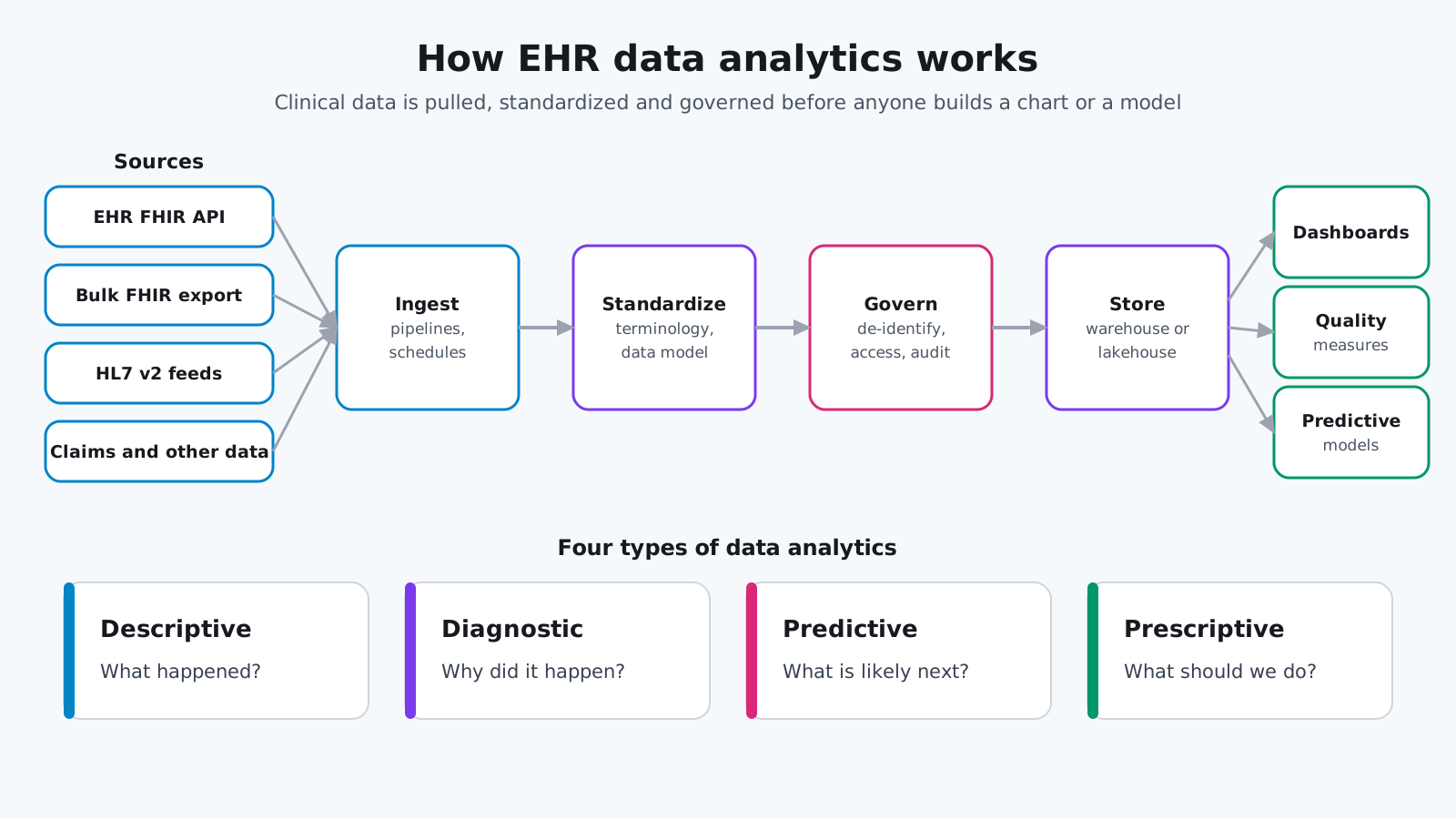
- Descriptive analytics: What happened? For example, the number of diabetic patients with an HbA1c result in the last year.
- Diagnostic analytics: Why did it happen? For example, which clinics or referral paths account for missed follow-ups.
- Predictive analytics: What is likely to happen next? For example, a model that flags patients at higher risk of readmission.
- Prescriptive analytics: What should we do? For example, recommending outreach lists or staffing changes based on the predictions.
Where EHR data comes from
- FHIR APIs: Standard and current, but designed for one patient at a time and subject to rate limits.
- Bulk FHIR export: Built for groups of patients and scheduled loads, which suits population analytics.
- HL7 v2 feeds: Real time events such as admissions and results, usually routed through an interface engine.
- EHR reporting databases: Rich and detailed, but each vendor's schema is different and needs specialist knowledge.
- Claims data: Shows care across providers, but arrives later than clinical data.
Common EHR data analytics use cases
- Population health: Finding patients with care gaps, such as missed screenings or uncontrolled chronic conditions.
- Quality reporting: Calculating quality measures, such as those used in CMS quality programs, from structured EHR data instead of manual chart review.
- Operations: Tracking no-shows, wait times, bed use and clinic throughput.
- Revenue cycle: Linking clinical documentation to coding and denial patterns.
- Research: Finding patient cohorts for studies, usually with de-identified or limited data.
- AI features: Preparing clean, labeled data for predictive models and testing them.
Why does EHR data analytics matter now?
The importance of data analytics in healthcare has grown as EHR data has become easier to reach in standard formats:
- Population level APIs: Certified EHRs must offer standardized FHIR APIs under ASTP/ONC Health IT Certification Program criterion 170.315(g)(10), including HL7 International's FHIR Bulk Data Access standard, which exports data for groups of patients as NDJSON files.
- Full data export: ONC criterion 170.315(b)(10) requires certified health IT that stores electronic health information to support both single patient and whole population export in a computable, documented format. The compliance deadline was December 31, 2023.
- Information blocking rules: The HHS rules at 45 CFR Part 171 limit practices that interfere with access, exchange or use of electronic health information.
- Shared data models: The OMOP Common Data Model, maintained by the OHDSI community, maps health data into common tables and standard vocabularies so the same analysis can run across sources.
Among current data analytics trends in healthcare, we see teams moving from custom extracts to FHIR based pipelines, adopting common data models, adding AI on top of clinical data, and asking for fresher data than a monthly report can give.
AI raises the bar for data quality. A predictive model trained on EHR data reflects how that data was recorded at the sites it came from, so test it on data from each new site, monitor its performance after launch, and keep a person in the loop for clinical decisions.
How do teams approach an EHR data analytics project step by step?
- 1. Start with questions and owners: Write down the decisions the data should support and who owns each one.
- 2. Inventory the sources: List EHR FHIR APIs, bulk export, HL7 v2 feeds, EHR reporting databases, claims and other systems.
- 3. Agree on access: Confirm what the EHR vendor and the health system allow, and put Business Associate Agreements and data use agreements in place.
- 4. Ingest: Build pipelines that load data on a schedule or in near real time, and record where every row came from.
- 5. Standardize: Map codes to standard terminologies such as LOINC, SNOMED CT and RxNorm, align units, and load a consistent data model.
- 6. Govern: Apply role based access, audit logging and, where possible, de-identified data.
- 7. Validate with clinicians: Check results against charts and known counts before anyone relies on them.
- 8. Deliver and monitor: Publish dashboards or models, and monitor data freshness and quality over time.
Measuring data quality
Check four things on every load: completeness (are expected records and fields present), timeliness (how old is the newest data), consistency (do codes and units follow the model), and accuracy (do sample results match the chart). Show these checks next to the dashboards, so users know when the numbers can be trusted.
HIPAA options for analytics data
- Minimum necessary: HIPAA requires reasonable efforts to limit uses, disclosures and requests of PHI to the minimum needed for the purpose (45 CFR 164.502(b)).
- De-identified data: HIPAA allows de-identification by Safe Harbor, which removes 18 listed identifiers, or by Expert Determination, where a qualified expert finds the re-identification risk very small (45 CFR 164.514(b)).
- Limited data set: A limited data set removes direct identifiers but may keep items such as dates and ZIP codes, and it can be used for research, public health or health care operations only under a data use agreement (45 CFR 164.514(e)).
- Security safeguards: Analytics stores that hold PHI need the same administrative, physical and technical safeguards as any other system (45 CFR Part 164, Subpart C).
Who do you need on a data analytics team?
- Integration engineer: Connects to EHR APIs, bulk export and HL7 feeds.
- Data engineer: Builds pipelines, the data model and quality checks.
- Clinical informaticist: Explains how data is entered in the EHR and validates results.
- Analyst: Builds reports and dashboards and works with the people who use them.
- Privacy and security lead: Owns access rules, de-identification and audits.
- Machine learning engineer: Needed only if you build predictive models.
What does a data analytics consultant do?
A data analytics consultant helps an organization decide what to measure, assesses its data sources, designs the data architecture and governance, and often builds the first pipelines and dashboards. A good data analytics consultancy leaves behind documentation and a team that can run the system without them.
Data analytics outsourcing overview
There are three common models. An in-house team keeps knowledge inside but takes time to hire. A consultancy brings experience quickly but can leave gaps when it leaves. An outsourced build with a planned handover combines the two: an external team builds the platform while your staff learn to run it. Whichever model you choose, keep ownership of the code, the data model and the documentation.
What are the common mistakes with EHR data analytics?
- Starting with tools: Choosing a dashboard tool before agreeing on the questions and the data.
- Trusting raw EHR data: The same fact can be recorded in different places and codes. Without standardization, counts disagree.
- Ignoring how data is entered: Workflow changes in the clinic change the data. Involve clinicians in validation.
- Copying more PHI than needed: Full identifiable records in an analytics store add risk without adding insight.
- One-off extracts: Manual exports cannot be repeated or audited. Build pipelines instead.
- No data quality monitoring: Feeds break quietly, and dashboards keep showing old numbers.
What does EHR data analytics mean for your build plan?
These EHR data analytics best practices also act as the main drivers of cost and timeline:
- Sources: The number of EHRs and other systems, and how each one exposes data.
- Freshness: Daily batches are simpler than near real time feeds.
- Data model: Whether you adopt a common model such as OMOP or a FHIR based model, and how much mapping it needs.
- Governance: Access rules, de-identification, audit logging and agreements.
- Outputs: The number of dashboards, measures and models, and who maintains them.
- Team model: In-house, consultancy or outsourced build with a handover.
Start small: one question, one or two sources and one dashboard that people use every week. Once the pipeline, data model and governance work for that case, adding the next question is mostly mapping and reporting work, not a new platform.
How Agnotic can help
Agnotic Technologies is a software development services company with an engineering hub in Pune, India. We build the EHR integrations and data pipelines behind healthcare analytics: connecting to EHR APIs and feeds, standardizing the data, applying HIPAA safeguards and delivering dashboards and models your team can run. You own the code and the data.
Build your EHR data platform with Agnotic
Explore our EHR integration services or browse more articles in our EHR integration hub.
Related reading on Agnotic
Go deeper on the data platforms, integrations and apps covered in this guide.
Sources
- ASTP/ONC: Electronic health information export, 170.315(b)(10)
- ASTP/ONC: Standardized API for patient and population services, 170.315(g)(10)
- HL7 FHIR Bulk Data Access implementation guide
- 45 CFR 164.502: Uses and disclosures of PHI, including minimum necessary
- 45 CFR 164.514: De-identification and limited data sets
- 45 CFR Part 164, Subpart C: HIPAA Security Rule
- 45 CFR Part 171: Information blocking
- OHDSI: OMOP Common Data Model