

Cloud and DevOps services
Landing zones, CI/CD and infrastructure as code for new healthcare platforms.



Running PHI on AWS, Azure or Google Cloud means someone has to own patching, backups, access, cost and the alert at three in the morning. Agnotic Technologies operates your cloud environment under a BAA, with the HIPAA Security Rule safeguards written as runbooks your auditors can read.
Trusted by global innovators











Cloud managed services for healthcare are the ongoing operation of the AWS, Azure or Google Cloud environment that hosts health applications and PHI: monitoring, patching, backups, access control, cost management and incident response. Agnotic Technologies delivers them as an operations service under a business associate agreement, with each HIPAA Security Rule safeguard mapped to a runbook, an owner and evidence.
Managed operations start once an environment exists. These pages cover the build and migration work that leads into it.
Landing zones, CI/CD and infrastructure as code for new healthcare platforms.
Moving existing health systems to the cloud with a cutover plan and a rollback.
Pipelines, environments and release automation built for PHI workloads.
The safeguards the runbooks on this page implement.
The environment was built well and then left to run itself. The same findings come up in most reviews we do.
A BAA was accepted, but PHI sits in services the BAA does not cover.
Application servers are patched; databases, agents and base images are not.
Backups run every night and nobody has ever restored one.
Spend grows month on month because no one owns rightsizing and clean-up.
Logs are collected and never reviewed, so the activity review the Security Rule requires does not happen.
Cloud providers secure the cloud itself; everything built on it is the customer's responsibility. This is how we split that customer side with you.
| Area | Cloud provider | Agnotic (managed operations) | Your organisation |
|---|---|---|---|
| Physical data centres and hypervisors | Owns | Verifies the BAA and eligible services | Approves the provider |
| Operating systems, containers and dependencies | Patches managed services | Patches and rebuilds images | Approves maintenance windows |
| Identity and access | Provides IAM | Runs least privilege, reviews and break-glass | Approves who needs access |
| Backups and restore tests | Provides storage and snapshots | Schedules, tests and documents restores | Sets recovery objectives |
| Monitoring and incident response | Reports provider incidents | Monitors, pages and runs the incident runbook | Named contact and decisions |
| Cost management | Bills | Rightsizes, tags and reports | Sets the budget |
| Risk analysis and policies | Publishes compliance reports | Supplies evidence and findings | Owns the HIPAA risk analysis |
| Breach notification | Notifies the customer | Reports incidents to you under the BAA | Decides and notifies as the covered entity |
Three principles make the operations auditable rather than heroic.
Infrastructure, alert rules and access policies live in version control, so every change has an author, a review and a rollback.
Engineers hold no standing access to PHI data stores. Elevated access is time-boxed, approved and logged.
Patch records, restore tests, access reviews and incident reports are produced by the runbooks, not assembled before an audit.
The operations work a healthcare cloud environment needs every month.
Infrastructure, database and security monitoring with paging for the severities in your SLA.
Scheduled patch windows for operating systems, containers and managed services, with scan results tracked to closure.
Backup schedules, retention, cross-region copies and restore tests against your recovery objectives.
Role design, joiner and leaver processes, MFA enforcement and periodic access reviews with records.
Tagging, rightsizing, reserved capacity decisions and a monthly spend report against budget.
A written incident runbook, severity triage, communication to your named contact and a post-incident report.
We run the services your environment already uses and standardise the operations around them.
Each safeguard that touches cloud operations is written as a runbook with an owner and the evidence it produces. This is the core of how we work.
| Safeguard (45 CFR 164) | Runbook | Evidence we keep |
|---|---|---|
| 164.308(a)(1)(ii)(D) Information system activity review | Weekly review of audit logs, access reports and security alerts | Review tickets with findings and sign-off |
| 164.308(a)(5)(ii)(B) Protection from malicious software | Patch and vulnerability runbook with scan, fix and verify steps | Scan reports and patch records per system |
| 164.308(a)(6) Security incident procedures | Incident response runbook with triage, containment and reporting steps | Incident timeline and post-incident report |
| 164.308(a)(7)(ii)(A) Data backup plan | Backup schedule and restore test runbook | Restore test results and retention settings |
| 164.312(a)(2)(iv) Encryption and decryption | Key management runbook: KMS keys, rotation and encryption at rest | Key rotation records and encryption configuration |
| 164.312(b) Audit controls | Logging runbook: what is logged, where it is kept and for how long | Log retention configuration and access to log stores |
The measures in the report we send every month, agreed at handover.
Which systems are current and which are waiting for a window.
Backups proven by restoring them, with the time each took.
Monthly spend, trend and the rightsizing actions taken.
What happened, how long it took to restore and what changed afterwards.
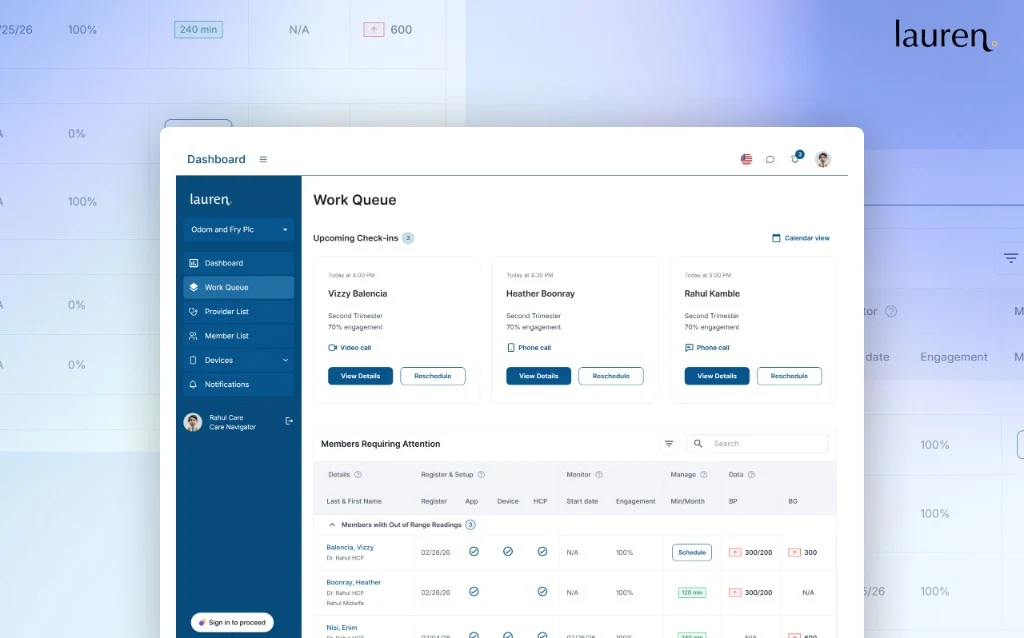
A HIPAA-ready maternal health platform enabling remote patient monitoring, care coordination, and personalized engagement from pre-pregnancy through postpartum.
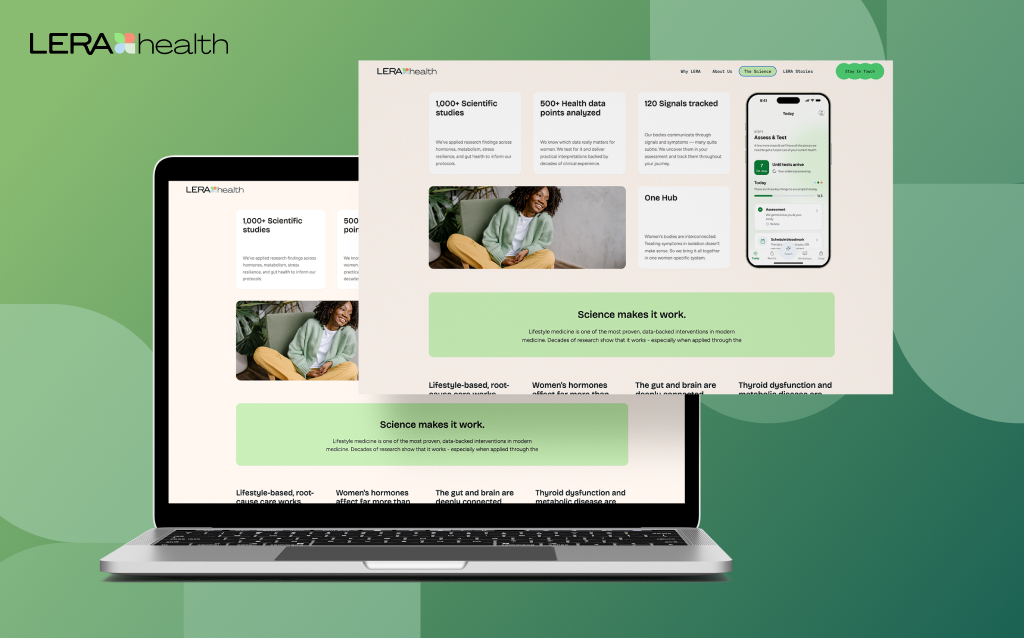
A women’s health product experience focused on guided care journeys, education, and compliance-aware workflows to support long-term engagement.
Teams that have PHI in the cloud and no operations team to run it.
After the first release, when the founders no longer want to carry the pager.
Patient and provider portals that IT wants operated under written procedures.
Device data pipelines and video services that must stay available.
Member-facing applications with strict access and logging needs.
Software vendors that need HIPAA-ready operations without building the team.
Data environments with de-identified and identified zones kept separate.
The systems a healthcare cloud environment depends on, inside and outside the account.
We build secure, scalable products designed for privacy, interoperability, and regulatory readiness from day one across every sector we serve.

Protect PHI with privacy-first architecture, encrypted storage and transmission, and strict access controls.
We combine deep technical expertise with industry-specific knowledge to deliver solutions that aren't just functional, but transformational.
We implement rigorous security protocols and compliance standards (HIPAA, GDPR, SOC2) across all industrial solutions to protect sensitive data.
Our architectures are built to handle massive data loads and user bases, keeping performance steady whether you're serving ten or ten million.
Using our suite of internal tools and proven frameworks, we reduce development cycles and get your product to market 40% faster.
Beyond simple wrappers, we build deep-learning integrations and predictive analytics directly into the core of your industry-specific workflows.
Timing depends on the size of the environment; we agree the review scope on the scoping call.
Which clouds, accounts and workloads hold PHI, who runs them today and what the SLA must cover.
BAA scope, eligible services, identity, patching, backups, logging and cost, written up as findings.
The findings that block safe operation are fixed first, as code, with evidence.
Runbooks, dashboards, on-call rota and the monthly report are set up and we take the pager.
Patch status, restores, spend and incidents each month; scope and roadmap each quarter.
Short facts we operate against, each linked to its primary source.
HIPAA defines a business associate as a vendor that creates, receives, maintains or transmits protected health information for a covered entity, so a cloud service that maintains ePHI falls inside the definition.
Source: 45 CFR 160.103 (eCFR)The HIPAA Security Rule contingency plan standard requires a data backup plan that creates and maintains retrievable exact copies of ePHI and a disaster recovery plan to restore any loss of data.
Source: 45 CFR 164.308(a)(7) (eCFR)AWS states that there is no HIPAA certification for a cloud service provider; customers accept the AWS Business Associate Addendum through AWS Artifact and should process PHI only in HIPAA Eligible Services.
Source: AWS, HIPAA compliance documentationMicrosoft offers its HIPAA Business Associate Agreement as part of the Microsoft Product Terms to customers that are covered entities or business associates, for in-scope Azure services.
Source: Microsoft Learn, Azure HIPAA compliance offeringNIST SP 800-61 Rev. 3, published in April 2025, gives incident response recommendations as a Cybersecurity Framework 2.0 Community Profile and supersedes Rev. 2 from 2012.
Source: NIST SP 800-61 Rev. 3We don't just build products; we forge lasting partnerships. See how we've helped industry leaders transform their vision into technical reality.
“I can clearly see how Agnotic has a unique way of handling end-to-end development. They are always active on quick chat and provide support quickly.”

Aaron Phelan
Founder, Benchmark
“Agnotic combines deep technical expertise with strong domain knowledge. They understand the business context, anticipate challenges, and make collaboration smooth and effective.”

John Pasmore
Founder, Latimer
“Agnotic is the best technical team we evaluated. Their engineering excellence made our work dramatically easier and allowed us to stay focused on what matters most for maternal care outcomes. They took full ownership of the technical execution, and we are always happy to continue working together.”

Kim Smith
Founder, My Lauren
Explore other production-grade engineering platforms we deliver across healthcare.
The technical patterns behind this platform translate naturally into adjacent verticals.