










Dental practice receptionist checking the schedule on a front desk monitor, with a dental operatory in soft focus behind
    Open Dental integration

    Open Dental Integration

    Your product needs the patients, appointments, treatment plans and claims that live inside Open Dental, and the practice cannot re-key them. Agnotic Technologies builds the Open Dental API integration for you: scoped on a call, shipped as a fixed first release, and run with HIPAA safeguards and audit logging from the first sprint.

    Open Dental REST APIX12 837D claimsHIPAA-readyAudit logged

    Trusted by global innovators

    Benchmark
    Chibasco
    Fundency
    Lantimer
    Lauren
    Lera
    One Minute
    Pento Pix
    TAP
    Xtrium
    Healthevolve
    Benchmark
    Chibasco
    Fundency
    Lantimer
    Lauren
    Lera
    One Minute
    Pento Pix
    TAP
    Xtrium
    Healthevolve
    Benchmark
    Chibasco
    Fundency
    Lantimer
    Lauren
    Lera
    One Minute
    Pento Pix
    TAP
    Xtrium
    Healthevolve
    Benchmark
    Chibasco
    Fundency
    Lantimer
    Lauren
    Lera
    One Minute
    Pento Pix
    TAP
    Xtrium
    Healthevolve

    What is Open Dental integration?

    Open Dental integration connects your software to the Open Dental practice management system so patient, appointment, treatment plan, procedure and claims data move between the two without re-keying. Agnotic Technologies builds it as a services engagement, using the Open Dental REST API first and the documented MySQL database where reporting needs it, with HIPAA safeguards designed in.

    Open Dental is used by solo practices, group practices and DSOs, and its API and database tables are documented publicly. That makes it one of the more open dental platforms to integrate with, but the practice still owns the data and the API permissions.

    The work that decides success is not the HTTP calls. It is mapping Open Dental's procedure codes, insurance plans and appointment statuses onto your product's model, and keeping the two in step when the practice edits a record.

    What does an Open Dental integration look like in use?

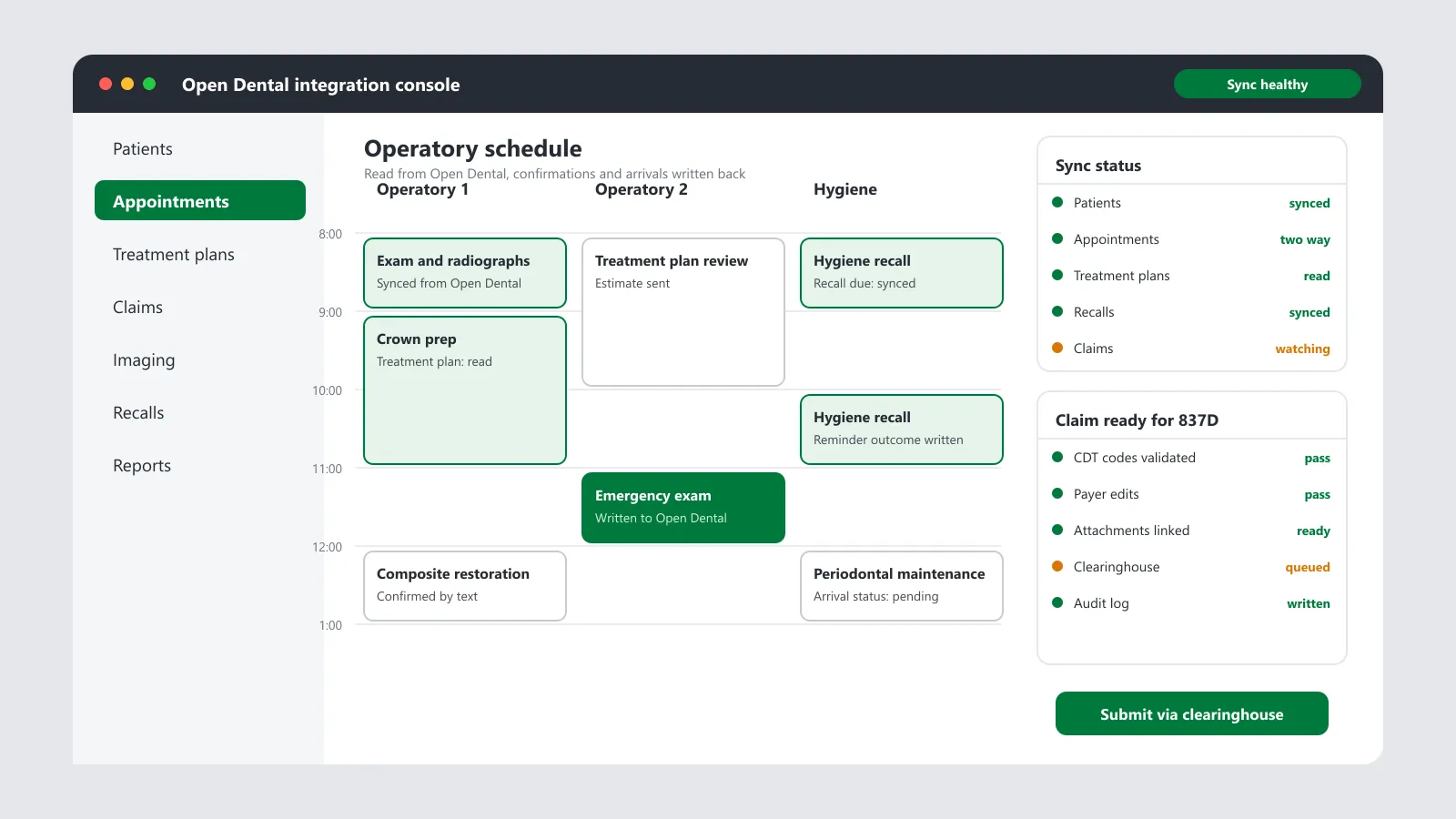
    From the practice side: the schedule and treatment plan stay in Open Dental, while your product reads appointments, writes recall and reminder outcomes, and watches each dental claim from treatment plan to 837D submission.

    Open Dental integration mockup by Agnotic: an integration console with a sidebar for patients, appointments, treatment plans, claims and imaging, an operatory schedule, a sync status panel and a dental claim ready for 837D submission

    Open Dental API

    Which Open Dental API resources carry the data?

    The Open Dental REST API exposes the practice database as named resources. These are the ones most integrations read or write.

    CodeNameTypical use
    PatientsPatient demographics and statusMatch and create patient records, keep contact details in step with your product.
    AppointmentsScheduled, broken and completed visitsRead the schedule by operatory and provider, write confirmations and arrival status.
    ProcedureLogsTreatment planned and completed proceduresPull treatment plans and completed work by CDT code for estimates, reminders and reporting.
    ClaimsDental insurance claims and their statusTrack each claim from created to sent to received, and reconcile against the 837D and ERA.
    InsPlans / InsSubsInsurance plans and subscribersRead coverage for eligibility checks and treatment estimates.
    RecallsHygiene and exam recall due datesDrive recall and reminder outreach from the practice's own recall rules.
    DocumentsAttached images and filesLink radiographs and intraoral photos to the right patient and visit.
    Providers / OperatoriesProviders, schedules and roomsBuild availability for online scheduling without double-booking a chair.

    Reference architecture

    How does the integration reach Open Dental: API, database or both?

    Most Open Dental integrations use two paths. The API for anything that writes or runs in real time, and a read-only database path for reporting that the API does not cover well.

    01

    Open Dental REST API (default path)

    • API keys issued through Open Dental's developer setup, one set per practice
    • Per-customer API permissions limited to the resources your product needs
    • GET, POST and PUT against Patients, Appointments, ProcedureLogs and Claims
    • Polling or change detection to pick up edits since the last sync

    02

    Read-only database path (reporting)

    • Read access to a MySQL or MariaDB replica, never the live production database
    • Documented tables for procedures, fees, insurance and payments
    • Nightly extracts into your warehouse for production and collections reporting
    • No writes: every change goes through the API so Open Dental's own rules apply
    03

    Your integration layer

    • Mapping between CDT procedure codes, your product's model and claim lines
    • Idempotent sync jobs with retries, dead-letter queues and reconciliation reports
    • Audit log of every read and write with user, patient, time and purpose
    • Secrets, encryption in transit and at rest, and per-practice key rotation

    Decision table

    Should you use the Open Dental API or the database?

    The right path depends on what your product does with the data. This is how we decide on a scoping call.

    Your needOpen Dental APIDirect database readOur default
    Create or update patients and appointmentsSupported, with Open Dental's validationNot safe: bypasses business rulesAPI
    Show today's schedule in your appAppointments and Operatories resourcesPossible, but duplicates API workAPI
    Treatment plan estimates and remindersProcedureLogs and InsPlansPossible for batch reportsAPI, database for history
    Practice production and collections reportingPartial, many calls per reportDocumented tables, one queryRead replica
    Multi-location DSO analyticsPer-practice keys and rate limitsReplica per database, central warehouseRead replica
    Claim status and ERA reconciliationClaims resource plus your clearinghouse 835Claim tables for historyAPI plus X12 835

    Practices hosted on Open Dental Cloud may not be able to give you database access, so cloud practices usually run API only. We confirm hosting per practice before scoping.

    Modules we build on Open Dental

    Each module is scoped on its own, so a first release can be one of them and still be useful to the practice.

    Patient and appointment sync

    Two-way sync of demographics, appointments and confirmations, with matching rules so a patient edited in Open Dental is the same patient in your product.

    Treatment plan and procedure data

    Planned and completed procedures by CDT code, fee schedule and insurance estimate, for case acceptance tools, patient financing and recall logic.

    Dental claims (X12 837D) and ERA

    Claim creation and status from Open Dental, submission through your clearinghouse as an 837D, and 835 remittance posted back against the claim.

    Scheduling, recalls and reminders

    Online scheduling built on provider and operatory availability, recall outreach from Open Dental's recall rules, and reminder outcomes written back.

    Imaging and document links

    Radiographs, intraoral photos and signed forms attached to the right patient and visit through the Documents resource, with DICOM where your imaging source supports it.

    Reporting and analytics feeds

    Read-only extracts from a database replica into your warehouse for production, collections and hygiene reporting across one practice or a DSO.

    Failure points

    Where do Open Dental integrations break?

    These are the points we design for, because they fail quietly and show up as wrong data at the front desk.

    Challenge

    Duplicate patients after a two-way sync

    Agnotic approach

    Deterministic matching on Open Dental's patient number first, then a review queue for near matches instead of silent merges.

    Challenge

    Writing to the database directly and breaking Open Dental's rules

    Agnotic approach

    All writes go through the API so Open Dental validates them. Database access is read only, on a replica.

    Challenge

    Appointment status drift between systems

    Agnotic approach

    One system owns each status, status changes are events with timestamps, and a nightly reconciliation report lists mismatches.

    Challenge

    CDT and fee schedule changes each year

    Agnotic approach

    Procedure codes are versioned in the mapping layer and fee schedules are read from Open Dental, never copied into your product.

    Challenge

    API keys shared across practices in a DSO

    Agnotic approach

    One customer key per practice, least-privilege permissions per key, and rotation handled in a secrets manager.

    Challenge

    Claims rejected at the clearinghouse

    Agnotic approach

    837D validation before submission, payer-specific edits kept in configuration, and rejection reasons written back to the claim for staff.

    Compliance as engineering

    How do we keep PHI safe in an Open Dental integration?

    HIPAA applies to the practice, to Open Dental and to your product. We make the safeguards concrete decisions rather than a policy document.

    Business associate agreements

    Agnotic signs a BAA with you before any PHI is shared, and Open Dental expects API developers to hold a BAA with each practice they serve.

    Least-privilege access

    API permissions are scoped to the resources each module uses, database access is read only, and every practice has its own credentials.

    Encryption and key handling

    TLS for every API call, encryption at rest for synced data, and keys kept in a secrets manager with rotation, never in configuration files.

    Audit logging

    Every read and write records who, which patient, when and why, so the practice can answer an access request or investigate an incident.

    Compliance-First Healthcare App Development Services Backed by Global Standards

    01HIPAA logo

    HIPAA

    Health Insurance Portability and Accountability Act

    Protect PHI with privacy-first architecture, encrypted storage and transmission, strict access controls, and traceable audit logs.

    02GDPR logo

    GDPR

    General Data Protection Regulation

    Implement lawful consent flows, data minimization, retention controls, and secure processing for sensitive health data.

    03FHIR logo

    FHIR

    Fast Healthcare Interoperability Resources

    Enable standardized health data exchange across apps, care teams, and systems through standards-based FHIR APIs.

    04HL7 logo

    HL7

    Health Level Seven International

    Support enterprise-grade interoperability with HL7-based integrations for records, events, and clinical messaging workflows.

    05HITRUST logo

    HITRUST

    Health Information Trust Alliance

    Align security programs to healthcare-specific control and risk management practices trusted by providers and ecosystem partners.

    06HITECH logo

    HITECH

    Health Information Technology for Economic and Clinical Health Act

    Design with breach notification readiness, digital record safeguards, and operational controls that support regulated care programs.

    07SaMD logo

    SaMD

    FDA Software as a Medical Device

    Plan software quality, traceability, and documentation pathways for products that may require SaMD review and submission.

    08MDR (EU) logo

    MDR (EU)

    Medical Device Regulation (European Union)

    Prepare EU market-ready processes for risk classification, evidence tracking, and lifecycle governance under MDR expectations.

    09SAMHSA logo

    SAMHSA

    Substance Abuse and Mental Health Services Administration

    Apply confidentiality controls and consent-aware sharing models for behavioral and mental health data experiences.

    Scope drivers

    What drives Open Dental integration cost?

    There is no fixed price for an integration. These are the factors that move the effort, and we size each one on the scoping call.

    Read only or two-way

    Reading the schedule is a small scope. Writing appointments, patients and claim updates adds matching rules, conflict handling and testing against a practice.

    Number of practices and hosting

    One practice with a local server differs from a DSO with dozens of databases or Open Dental Cloud. Each adds credentials, replicas and rollout steps.

    Claims and clearinghouse work

    837D submission, payer edits and 835 posting bring a clearinghouse into scope and need end-to-end testing with real payers.

    Imaging and documents

    Linking radiographs and forms means handling large files, retention rules and sometimes DICOM, which is its own workstream.

    Reporting depth

    A handful of production metrics is quick. A full warehouse model of procedures, fees, adjustments and payments is a data project.

    Your product's maturity

    Startups integrating a first product need the data model designed alongside the integration. Established products mostly need mapping.

    Who builds on Open Dental

    Who needs Open Dental integration?

    The same integration surface, used by very different products.

    Dental startups

    Patient engagement, financing and case-acceptance products that need live schedule and treatment plan data from day one.

    DSOs and group practices

    Central reporting and patient communication across many Open Dental databases.

    Dental AI and imaging vendors

    Radiograph analysis and charting tools that need the procedure and imaging context from the practice record.

    Dental RCM and billing companies

    Claim status, 837D submission and remittance posting across client practices.

    Online scheduling and reminders

    Availability by provider and operatory, confirmations and recalls written back to the chart.

    Analytics platforms

    Production, collections and hygiene metrics from a read-only replica into a warehouse.

    How we work

    How do you build an Open Dental integration?

    Four steps, with a fixed first release agreed before any code is written.

    1.

    Scoping call

    We list the data you need, which direction it moves, how your practices host Open Dental and which modules make a useful first release.

    Scope first
    2.

    Developer setup and sandbox

    We complete Open Dental's API developer setup, request permissions, and build against a test database with synthetic patients, never live PHI.

    Synthetic data
    3.

    Fixed-scope first release

    Mapping, sync jobs, audit logging and reconciliation reports for the agreed modules, tested with a pilot practice before wider rollout.

    Pilot practice
    4.

    Rollout and support

    Per-practice onboarding, monitoring of failed syncs and claim rejections, and a plan for Open Dental version and CDT updates.

    Monitored

    Standards in scope

    Standards an Open Dental integration touches

    RESTX12 837DX12 835CDTHIPAADICOM
    Facts and sources

    Which facts shape Open Dental integration work?

    Short facts we design around, each linked to its primary source.

    • The Open Dental API is a RESTful service for reading and writing an Open Dental database, and Open Dental states that API developers should have a Business Associate Agreement in place with their clients.

      Source: Open Dental, API Specification
    • Open Dental stores its data in a MySQL or MariaDB database; the Open Dental installer supports MySQL 5.5 or MariaDB, and other versions are not supported.

      Source: Open Dental manual, MySQL
    • In version 24.4 the Open Dental licence changed from open source GPL to proprietary; Open Dental says the change did not affect customers' database access or how the software is used.

      Source: Open Dental manual, License
    • HIPAA adopts the ASC X12N 837 Health Care Claim: Dental (version 005010X224) as the standard transaction for dental health care claims.

      Source: 45 CFR 162.1102 (eCFR)
    • HIPAA adopts the Code on Dental Procedures and Nomenclature (CDT), maintained and distributed by the American Dental Association, as the standard code set for dental services.

      Source: 45 CFR 162.1002 (eCFR)

    Frequently Asked Questions

    It depends on scope: read-only schedule access is a small project, two-way sync with claims and imaging is larger. We agree a fixed first release on the scoping call and give you a dated plan for it.