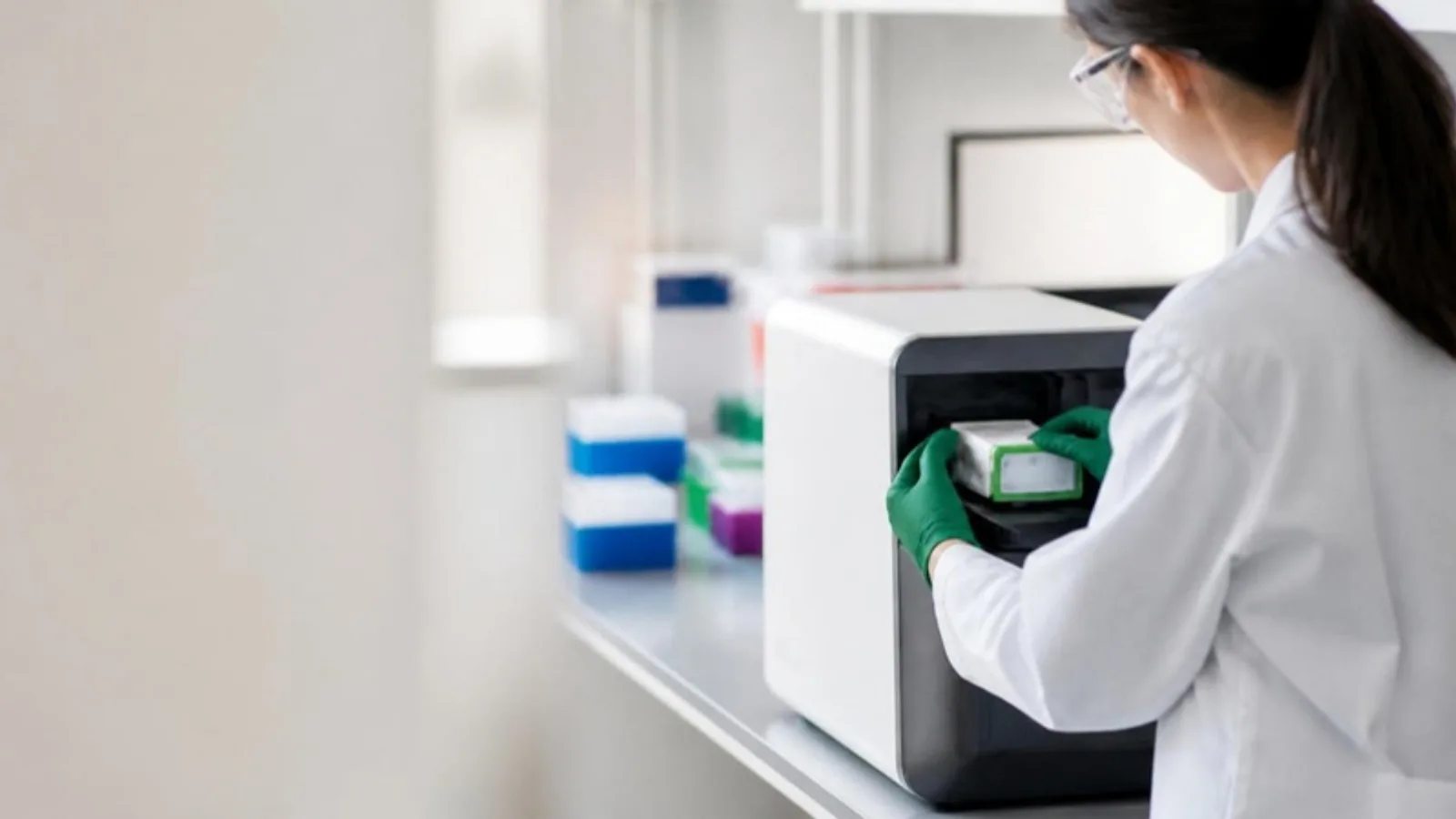
Genomics lab scientist in green gloves loading a cartridge into a benchtop sequencer, with sample racks softly blurred on the bench
    Precision medicine integration

    Precision Medicine Data Integration

    Genomic results often reach clinicians as reports that decision support cannot read. Agnotic Technologies builds the integration that brings structured variant and pharmacogenomic results from your lab partners into the EHR, with consent, access controls and audit logging designed in from the first sprint.

    FHIR Genomics ReportingPharmacogenomics CDSHL7 v2 and FHIRHIPAA-ready

    Trusted by global innovators

    Benchmark
    Chibasco
    Fundency
    Lantimer
    Lauren
    Lera
    One Minute
    Pento Pix
    TAP
    Xtrium
    Healthevolve
    Benchmark
    Chibasco
    Fundency
    Lantimer
    Lauren
    Lera
    One Minute
    Pento Pix
    TAP
    Xtrium
    Healthevolve
    Benchmark
    Chibasco
    Fundency
    Lantimer
    Lauren
    Lera
    One Minute
    Pento Pix
    TAP
    Xtrium
    Healthevolve
    Benchmark
    Chibasco
    Fundency
    Lantimer
    Lauren
    Lera
    One Minute
    Pento Pix
    TAP
    Xtrium
    Healthevolve

    What is precision medicine data integration?

    Precision medicine data integration moves genomic test results, from variants to pharmacogenomic findings, out of lab systems and into the EHR as structured data that clinicians and decision support can use. Agnotic Technologies builds it for you on the HL7 FHIR Genomics Reporting implementation guide, with consent and access rules for sensitive genetic data.

    The hard part is not the transport. It is keeping each variant, its interpretation and its link to the signed report intact as data moves between lab partners, your platform and the EHR.

    This page covers the data integration. Sequencing, variant calling and diagnostic models stay with your lab partners and data science teams.

    Data path

    How does a genomic result travel from the lab to the clinician?

    Three layers. We build the middle one and the connections on each side.

    01

    Lab partner

    • Order received with patient, specimen and test codes
    • Sequencing, variant calling and annotation in the lab's own pipeline
    • Signed report released as a PDF, an HL7 v2 result, a FHIR Genomics bundle or a mix
    • Raw files such as VCF kept at the lab unless your contract says otherwise
    02

    Integration layer we build

    • Inbound HL7 v2 and FHIR endpoints for each lab partner
    • Mapping of variants, genotypes and interpretations to Genomics Reporting profiles
    • Patient matching against the EHR before anything is filed
    • Consent and sensitivity labels applied before data reaches downstream systems
    03

    EHR and decision support

    • Genomic report and discrete results filed to the chart
    • Pharmacogenomic findings available to CDS Hooks services at prescribing
    • A SMART on FHIR app for the full genomic view where EHR screens are too narrow
    • Audit log of who viewed which genetic result and when

    FHIR Genomics Reporting

    Which FHIR Genomics Reporting profiles carry the data?

    The HL7 FHIR Genomics Reporting guide (v3.0.0, STU 3, on FHIR R4) defines these profiles. They build on DiagnosticReport and Observation, so systems without genomics support still keep the data.

    CodeNameTypical use
    Genomic ReportDerived from DiagnosticReportThe container clinicians open, linked to the signed report and each finding.
    VariantA genomic findingA detected variant, described with standard notation such as HGVS.
    GenotypeA genomic findingA genotype call, often the input to pharmacogenomic rules.
    HaplotypeA genomic findingA set of variants reported together.
    Diagnostic ImplicationA genomic implicationThe lab's interpretation of a finding for a condition.
    Therapeutic ImplicationA genomic implicationMedication relevance of a finding, which decision support acts on.
    Molecular ConsequenceA genomic implicationThe predicted effect of a variant on the gene product.
    Genomic StudyDerived from ProcedureWhat was tested and how, so results can be read in context.

    Decision table

    How should genomic results reach the EHR?

    Most programs use more than one format. This is how we decide which carries what.

    Delivery formatWhat the clinician getsWhat decision support can useWhen we choose it
    Signed PDF reportThe full narrative report attached to the chartNothing discrete; rules cannot read a PDFAlways, as the signed record, but never as the only feed
    HL7 v2 result messageThe report plus discrete results the lab codesCoded values the lab sends as discrete resultsWhen the lab and EHR already run HL7 v2 result interfaces
    FHIR Genomics Reporting bundleA genomic report with each variant and interpretation as its own ObservationEvery variant, genotype and implication can be queriedWhen the lab can produce it, or we convert to it in the integration layer
    SMART on FHIR genomics appA dedicated genomic view launched from the chartWhatever the app reads from the genomic repositoryWhen the detail is too much for the EHR's own result screens

    What we build for precision medicine programs

    Each module is scoped on its own, so a first release can be one of them.

    Lab partner interfaces

    Orders out and results in for each genomic lab, over HL7 v2, FHIR or both, with one internal model behind them.

    Genomic data model

    Variants, genotypes and implications stored to the Genomics Reporting profiles, linked to the signed report.

    Pharmacogenomic decision support

    CDS Hooks services that check genotype results when a clinician orders a drug and return a card in the workflow.

    Clinician genomics app

    A SMART on FHIR app that shows the full genomic picture, launched from the patient's chart.

    Consent and access controls

    Consent capture, sensitivity labels and role-based access applied to genetic results before they are shown.

    Research and registry feeds

    De-identified or consented extracts for research programs, kept separate from clinical data paths.

    Failure points

    Where do genomic data integrations break?

    These fail quietly, and a quiet failure in genomics can mean a wrong prescription.

    Challenge

    Variants lose their interpretation in transit

    Agnotic approach

    Each variant and implication is its own Observation linked to the report, as the Genomics Reporting guide recommends.

    Challenge

    A variant is reclassified after the report

    Agnotic approach

    The guide leaves amendment workflow to implementers, so we keep versioned interpretations and a notification path to the ordering clinician.

    Challenge

    Results filed to the wrong patient

    Agnotic approach

    Patient matching runs before anything is filed, with a review queue for uncertain matches and no silent merges.

    Challenge

    Pharmacogenomic alerts nobody acts on

    Agnotic approach

    Alerts fire at ordering through CDS Hooks for the drug and gene pairs your clinicians agree, not on every chart open.

    Challenge

    Genetic data shared beyond its purpose

    Agnotic approach

    Sensitivity labels and purpose checks travel with the data, and payer-facing feeds exclude genetic results unless a lawful purpose is documented.

    Challenge

    Every lab sends a different format

    Agnotic approach

    A per-lab adapter maps each partner's format to one internal model, so a new lab does not change the EHR side.

    Consent and sensitivity

    How do we handle consent and genetic data sensitivity?

    Genetic results are protected health information under HIPAA. We treat that as design input, not a policy note.

    Business associate agreements

    Agnotic signs a BAA before any PHI is shared. Development uses synthetic genomic data, never real patients.

    Consent and purpose

    Consent is captured and stored with the data it covers, and each downstream use is checked against its purpose.

    Access by role

    Genetic results are visible only to roles that need them, with stricter rules for research and payer-facing feeds.

    Audit logging

    Every view and export of a genetic result is logged with user, patient, purpose and time.

    Who needs it

    Who needs precision medicine data integration?

    Programs where genomic results have to reach clinicians as data, not documents.

    Health system genomics programs

    Germline and somatic results from several labs, filed consistently to one EHR.

    Oncology programs

    Tumor profiling results with therapeutic implications for treatment planning.

    Pharmacogenomics services

    Genotype results that drive prescribing alerts at the point of ordering.

    Genomic testing labs

    Labs that need to deliver structured results into client EHRs.

    Precision medicine startups

    Products that interpret or act on genomic data and need it from labs and EHRs.

    Research programs

    Consented or de-identified genomic data kept apart from clinical feeds.

    Scope drivers

    What drives the cost of precision medicine data integration?

    We do not quote a price before scoping. These factors move the effort most.

    Number of lab partners

    Each lab brings its own formats, codes and testing, so effort grows with every partner.

    Structured or document results

    Labs that already send structured results need mapping. PDF-only labs need a conversion plan or a different contract.

    Decision support scope

    A few agreed drug and gene pairs is a contained build. A broad pharmacogenomics program needs clinical governance alongside.

    EHR filing and display

    Filing discrete results to the chart and building a SMART app are separate pieces of work.

    Consent model

    Simple clinical consent is quick to support. Research consent and data sharing agreements add rules and review.

    Startup or established program

    New programs need the genomic data model designed with the integration. Established programs mostly need connections.

    How we work

    How do you build a precision medicine data integration?

    Four steps, with a fixed first release agreed before build starts.

    1.

    Scoping call

    We list your lab partners, their formats, the EHR you file to and the clinical decisions the data must support.

    Scope first
    2.

    Model and map

    We design the genomic data model on the Genomics Reporting profiles and map one lab partner's results to it with synthetic data.

    Synthetic data
    3.

    Fixed-scope first release

    One lab, results filed to the chart, consent and audit in place, tested with your clinical and lab teams.

    One lab first
    4.

    Add labs and decision support

    More lab partners, pharmacogenomic CDS and the clinician app follow, each as its own release.

    Iterate

    Compliance-First Healthcare App Development Services Backed by Global Standards

    01HIPAA logo

    HIPAA

    Health Insurance Portability and Accountability Act

    Protect PHI with privacy-first architecture, encrypted storage and transmission, strict access controls, and traceable audit logs.

    02GDPR logo

    GDPR

    General Data Protection Regulation

    Implement lawful consent flows, data minimization, retention controls, and secure processing for sensitive health data.

    03FHIR logo

    FHIR

    Fast Healthcare Interoperability Resources

    Enable standardized health data exchange across apps, care teams, and systems through standards-based FHIR APIs.

    04HL7 logo

    HL7

    Health Level Seven International

    Support enterprise-grade interoperability with HL7-based integrations for records, events, and clinical messaging workflows.

    05HITRUST logo

    HITRUST

    Health Information Trust Alliance

    Align security programs to healthcare-specific control and risk management practices trusted by providers and ecosystem partners.

    06HITECH logo

    HITECH

    Health Information Technology for Economic and Clinical Health Act

    Design with breach notification readiness, digital record safeguards, and operational controls that support regulated care programs.

    07SaMD logo

    SaMD

    FDA Software as a Medical Device

    Plan software quality, traceability, and documentation pathways for products that may require SaMD review and submission.

    08MDR (EU) logo

    MDR (EU)

    Medical Device Regulation (European Union)

    Prepare EU market-ready processes for risk classification, evidence tracking, and lifecycle governance under MDR expectations.

    09SAMHSA logo

    SAMHSA

    Substance Abuse and Mental Health Services Administration

    Apply confidentiality controls and consent-aware sharing models for behavioral and mental health data experiences.

    Standards in scope

    Standards used in genomic data integration

    FHIR GenomicsHL7 v2CDS HooksSMARTHGVSCLIA
    Facts and sources

    Which facts shape precision medicine data integration?

    Short facts we design around, each linked to its primary source.

    • The HL7 FHIR Genomics Reporting implementation guide (v3.0.0, STU 3, based on FHIR R4) defines how to structure genomic reports and variants. It covers data structures only, not how reports are ordered, routed, delivered or amended.

      Source: HL7 International, Genomics Reporting Implementation Guide
    • Under HIPAA, health information includes genetic information, so individually identifiable genetic test results held by a covered entity or business associate are protected health information.

      Source: 45 CFR 160.103 (eCFR)
    • The HIPAA Privacy Rule prohibits health plans, other than issuers of certain long-term care policies, from using or disclosing protected health information that is genetic information for underwriting.

      Source: 45 CFR 164.502(a)(5)(i) (eCFR)
    • CLIA requires a laboratory to have systems that send test results accurately and reliably from data entry to the final report destination, including results reported electronically to interfaced systems.

      Source: 42 CFR 493.1291 (eCFR)
    • CDS Hooks is an HL7 specification that lets an EHR call an external decision support service at points in the clinician's workflow, such as opening a chart or signing an order.

      Source: HL7 International (CDS Hooks)

    Frequently Asked Questions

    No. Sequencing, variant calling and interpretation stay with your lab partners. We build the integration that takes their results into your platform and the EHR as structured, usable data.