Value based care pays providers for outcomes and total cost rather than for each service. In the United States it runs through programs such as the Medicare Shared Savings Program, CMS Innovation Center models, Medicare Advantage and commercial contracts, and every one of them depends on data moving between payers, providers and patients.
This value based care guide explains the payment models, why the shift is accelerating, how attribution works, why interoperability decides the results, how social determinants of health fit, the data challenges, a step by step approach and what it all means for your build plan.
What is value based care?
Need the data plumbing for a value based contract?
Agnotic builds the interoperability layer behind value based care: attribution feeds, clinical data for quality measures, event notifications and payer connections.
Value based care is a payment and delivery model in which providers are paid for the quality and total cost of care for a defined population rather than for the volume of services. Payers attribute patients to a provider organization, measure quality and spending against a benchmark, and share savings or losses based on the results.
Fee for service or value based payment?
- Fee for service: Paid per visit, test or procedure. Revenue grows with volume. Data needs are claims and coding.
- Shared savings: Fee for service continues, plus a share of savings against a benchmark if quality targets are met. Data needs add attribution, quality measures and cost tracking.
- Two-sided risk: Shared savings and shared losses. Data needs add risk adjustment accuracy and near real-time utilization.
- Capitation: A fixed payment per attributed patient per month. Data needs add full population management and care coordination.
- Bundles: One payment for an episode such as a joint replacement. Data needs add episode tracking across settings.
Programs you will meet
- Medicare Shared Savings Program: The permanent Medicare ACO program, with tracks from one-sided to two-sided risk.
- ACO REACH and LEAD: The CMS Innovation Center's ACO REACH model ends on December 31, 2026. Its successor, the Long-term Enhanced ACO Design (LEAD) model announced in December 2025, runs for ten years from 2027.
- Medicare Advantage: Plans contract with providers on quality and cost, with Star Ratings and risk adjustment driving the data needs.
- Medicaid and commercial: State programs and employer plans with their own measures, attribution rules and file formats.
Why is value based care rising now?
- Scale: CMS reported that about 14.3 million people with Medicare were receiving care from providers in ACOs in January 2026, up from 13.7 million in 2025.
- Digital quality reporting: From the 2025 performance year, Shared Savings Program ACOs must report quality measures through the eCQM or MIPS CQM collection types. The CMS Web Interface ended after 2024.
- Payer APIs: Under CMS-0057-F, impacted payers must offer Payer-to-Payer and Prior Authorization FHIR APIs by January 1, 2027, which standardizes data that value based contracts rely on.
- Information blocking: 45 CFR Part 171 restricts practices that interfere with access, exchange or use of electronic health information, which removes a common excuse for not sharing data with an ACO.
- Standard social data: USCDI v2 (July 2021) added SDOH Assessment, Goals, Interventions and Problems/Health Concerns, so social needs data has a standard home.
How does attribution work in value based care?
Attribution in value based care is the method a payer uses to decide which patients a provider organization is accountable for. In the Shared Savings Program, assignment is based on where a beneficiary receives most primary care services, and ACOs choose prospective assignment or preliminary prospective assignment with retrospective reconciliation, under 42 CFR Part 425.
- Prospective: The list is fixed at the start of the year. You know who to manage, but patients who move are still yours.
- Retrospective: The list is finalized after the year from actual claims. It matches real care patterns but makes outreach harder.
- Why it matters for software: Care management, outreach and quality tools must load attribution lists from every payer, track changes monthly and reconcile them with your own patient index.
- The standard: The HL7 Da Vinci Member Attribution (ATR) List implementation guide defines a FHIR Group based exchange of attribution lists between payers and providers.
Why does interoperability decide value based care results?
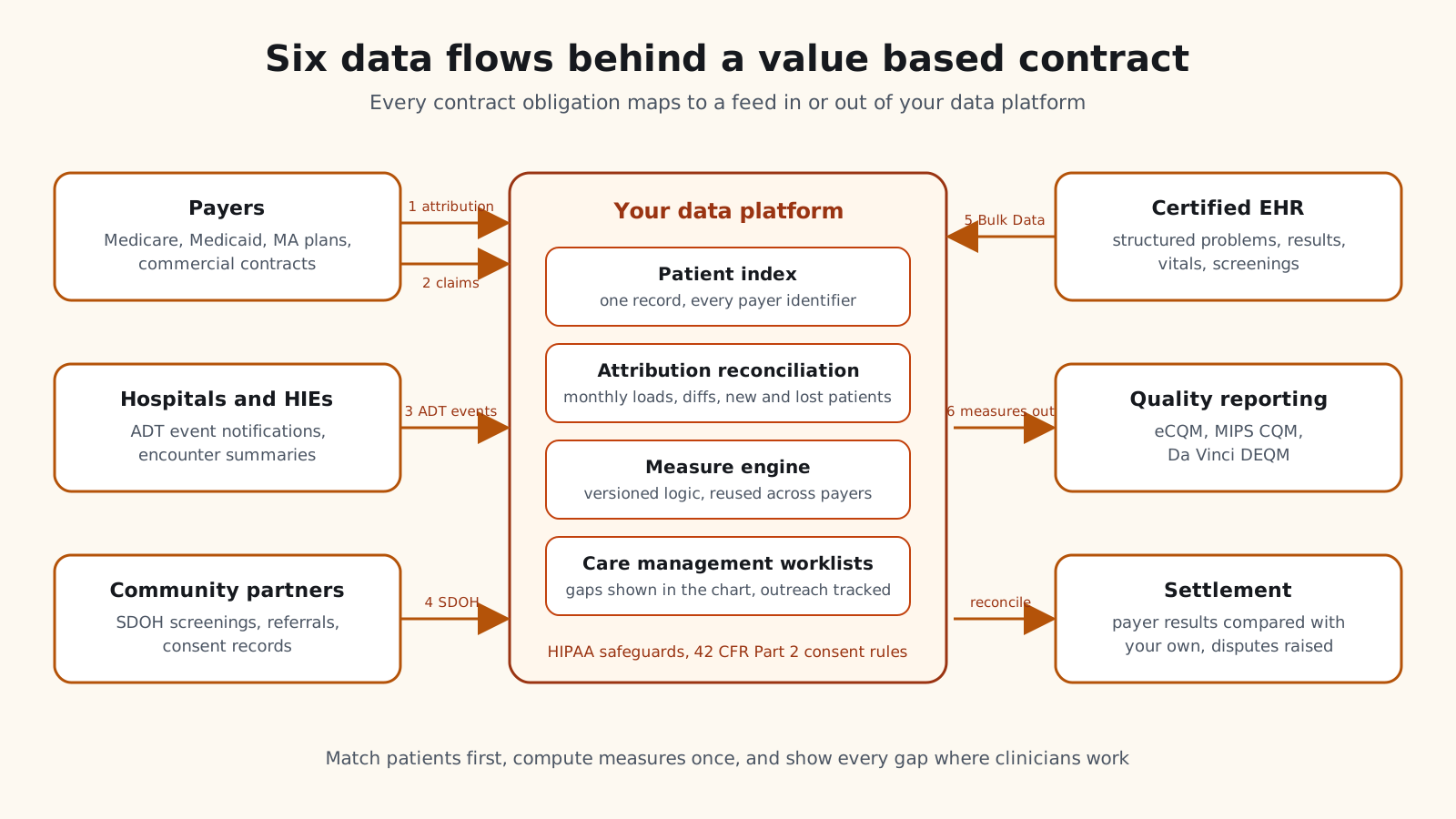
Value based care with interoperability means every contract obligation maps to a data flow. The diagram shows the six flows we build or repair in most programs.
- Attribution lists in: From each payer, monthly, matched to your patients.
- Clinical data out for measures: Structured problems, results, vitals and screenings sent as eCQM data or FHIR resources. The HL7 Da Vinci Data Exchange for Quality Measures (DEQM) guide covers this exchange.
- Event notifications: Admission, discharge and transfer messages from hospitals, so care managers act within days rather than months.
- Claims and cost: Payer claims feeds, to see utilization you did not deliver yourself.
- Population extracts: FHIR Bulk Data Access for pulling whole populations from the EHR into analytics.
- Social needs and consent: SDOH screenings, referrals and the consent that governs sharing them.
How do SDOH fit into value based care?
SDOH in value based care are the social factors, such as food, housing, transportation and social isolation, that drive outcomes and cost. Programs now expect screening, documentation and referral, and some quality measures count them.
- Capture: Standard screening instruments coded with LOINC, stored as structured assessments, not notes.
- Code: ICD-10-CM Z codes Z55 to Z65 record social determinants on claims, and CMS publishes guidance on using them.
- Act: Referrals to community organizations, tracked to closure, with consent recorded.
- Exchange: USCDI SDOH elements and the Gravity Project's HL7 FHIR guides give the data a standard shape.
What are the value based care data challenges?
- Patient matching: Payer and EHR identifiers rarely line up, and a wrong match corrupts attribution and measures.
- Measure logic drift: Each payer uses different measure versions and value sets, so one calculation never fits all.
- Latency: Claims arrive months late and clinical data arrives in real time. Dashboards mix both without saying so.
- Unstructured data: Screenings and care plans buried in notes cannot be counted.
- Risk adjustment accuracy: Diagnoses documented but not coded, or coded but not supported.
- Too many portals: Staff re-key data into a payer portal for every contract.
How do teams approach value based care step by step?
- 1. Read the contracts: List every measure, attribution rule, file format and deadline per payer.
- 2. Build the patient index: One master patient record with payer identifiers mapped to it.
- 3. Automate attribution: Load, diff and reconcile lists monthly, and surface new and lost patients to care teams.
- 4. Standardize clinical capture: Templates and codes for screenings, vitals and care gaps inside the EHR workflow.
- 5. Connect the feeds: ADT notifications, claims, FHIR extracts and payer APIs into one data platform.
- 6. Compute measures once: A measure engine with versioned logic, reused across payers.
- 7. Close the loop: Worklists and outreach tools that act on gaps and record the outcome.
- 8. Report and reconcile: Submit on time, then compare payer results with your own and dispute differences.
Should you build a custom EHR for value based care?
Usually not. A custom EHR for value based care makes sense only when no certified EHR fits the care model, such as a new kind of community-based program. Most organizations keep their certified EHR and build around it: a data platform, a measure engine, care management tools and the interoperability layer that feeds them.
That keeps certification and the clinical workflow where they are, and puts engineering effort where contracts are won or lost.
What are value based care best practices?
Value based care best practices come down to treating the contract as a data specification and building once for every payer.
- One patient index: Every payer identifier mapped to one master record before anything else is built.
- Attribution as a monthly job: Automated loads, diffs and reconciliation, with new and lost patients pushed to care teams.
- Structured capture at the point of care: Screenings, vitals and care gaps as coded data inside the EHR workflow.
- Measures computed once: Versioned measure logic shared across payers, with payer variants handled as configuration.
- Gaps shown in the chart: Findings delivered where clinicians work, through CDS cards or worklists, not only in dashboards.
- Consent handled in software: 42 CFR Part 2 and state rules enforced by the data platform, not by memory.
What are the common mistakes with value based care programs?
- Starting with dashboards: Reports built before the data underneath is matched and complete.
- Manual attribution: Spreadsheets per payer that nobody reconciles.
- Measures from the EHR only: Missing care delivered elsewhere because claims and notifications were never connected.
- Ignoring consent and 42 CFR Part 2: Sharing substance use disorder records without the required consent.
- No feedback to clinicians: Gaps found in analytics but never shown inside the chart.
- One payer at a time: Point solutions per contract instead of a platform that handles all of them.
What does value based care mean for your build plan?
- Contracts and payers: Each adds attribution rules, measure sets and file formats.
- Data sources: EHRs, hospital ADT feeds, labs, claims and HIEs, each a connection to build and monitor.
- Patient matching and consent: A master index and consent management are the foundation.
- Measure engine: Buy or build, with versioning and payer-specific variants.
- Care management tools: Worklists, outreach and referral tracking inside or beside the EHR.
- Operations: Monthly loads, submissions, reconciliations and audits.
For the payment side of the same contracts, our revenue cycle management guide covers claims and denials, and our EHR data analytics guide covers the pipelines that feed the measures.
How Agnotic can help
Agnotic Technologies is a software development services company. For value based care programs we build the interoperability layer: attribution ingestion and reconciliation, FHIR and HL7 v2 feeds, bulk data pipelines, measure calculation services and the care management tools that act on the results, with HIPAA safeguards designed in. Your contracts set the requirements. We build the systems that meet them.
Build your value based care data layer with Agnotic
Explore our healthcare interoperability solutions or browse more articles in our Interoperability and Regulation hub.
Related reading on Agnotic
Go deeper on the platforms, payments and data exchange covered in this guide.
Sources
- CMS: 2026 Medicare ACO initiatives participation highlights
- CMS Innovation Center: LEAD model
- CMS: Medicare Shared Savings Program
- 42 CFR Part 425, Subpart E: Assignment of beneficiaries
- CMS: Interoperability and Prior Authorization final rule (CMS-0057-F)
- 45 CFR Part 171: Information blocking
- ASTP/ONC: United States Core Data for Interoperability (USCDI)
- HL7 Da Vinci: Member Attribution (ATR) List