

01
Post-discharge follow-up
Symptom check-ins and escalation rules for one condition cohort after discharge.



Innovation teams are asked to prove a new care model quickly, inside a hospital that cannot bend its privacy and safety rules for a pilot. Agnotic Technologies builds the pilot software: rapid prototypes that still meet HIPAA, sandbox EHR integration through SMART on FHIR, evaluation built in, and a clear path to production when the pilot works.
Trusted by global innovators











Clinical innovation software development is building the apps, integrations and data tools that hospital and health-system innovation teams use to pilot new care models. Agnotic Technologies builds these pilots for innovation teams: rapid prototypes that still meet HIPAA, sandbox EHR integration through SMART on FHIR, evaluation and measurement design, and the engineering needed to move a successful pilot into production.
Pilots rarely fail on the idea. They fail on the path around it. These are the failure points we see most often in health-system innovation work.
The prototype was built with real patient data on an unapproved tool, so security review stops it before the first user.
EHR access was assumed; production FHIR access and a SMART app registration take months the plan did not include.
No measures were agreed before launch, so at the end nobody can say whether the care model worked.
The pilot depended on one champion nurse or physician, and the workflow did not survive their rota change.
It worked, but nobody owned the move to production: no support runbook, no budget line, no interface approval.
The same care model needs different engineering at each stage. Knowing the stage you are in, and the next one, keeps the work proportionate.
| Criteria | Prototype | Pilot | Production |
|---|---|---|---|
| Purpose | Test the workflow with clinicians | Test the care model with real patients | Run the care model as a service |
| Data | Synthetic or de-identified data | Minimum necessary PHI, named data owner | Full PHI under the organisation's policies |
| EHR access | SMART on FHIR sandbox | Non-production or limited production API access | Production interfaces approved by IT |
| Users | Innovation team and a few clinicians | One unit or one cohort | Every eligible unit, with training |
| Security review | Architecture review, no PHI | Risk analysis and BAA before launch | Full security and change control |
| Support | Best effort by the build team | Named on-call during pilot hours | Service desk, runbook, monitoring |
| Measurement | Usability feedback | Pre-agreed outcome and process measures | Ongoing dashboards and audits |
Speed comes from scoping the data, not from skipping the controls. These three practices let a prototype become a pilot without a rebuild.
Prototypes run on synthetic data and the SMART on FHIR sandbox, so clinicians can test the workflow while the privacy review runs in parallel.
Role-based access, encryption, audit logging and no PHI in application logs are built in before the first real patient, not added before launch.
Each pilot has a data map that lists every field, why the pilot needs it and who owns it, which is also what the security review asks for.
The pieces most pilots need, built so they carry into production rather than being thrown away.
Check-ins, education, reminders and messaging on web and mobile, with consent and privacy screens that pass review.
SMART on FHIR apps that launch from Epic or Oracle Health (Cerner) with patient context, and CDS Hooks where a prompt belongs in the workflow.
Worklists, alerts and escalation rules for the nurses and coordinators running the pilot.
Event capture, outcome and process measures, and reports your clinical and research leads defined before launch.
Summaries, triage suggestions or drafting, always reviewed by a clinician before anything reaches a patient or a chart.
Monitoring, runbooks, interface approvals and training material so a successful pilot becomes a supported service.
Chosen to fit your EHR, your cloud agreements and the team that will support the service afterwards.
Measures we build the evaluation pipeline around. Your clinical and research leads choose the outcomes; we make them measurable from day one.
Patients and clinicians using the pilot, divided by those who should.
Check-ins done, alerts answered and time from alert to response.
The clinical or operational outcomes defined before launch, with a baseline.
Near misses and incidents captured in the pilot and reviewed by governance.
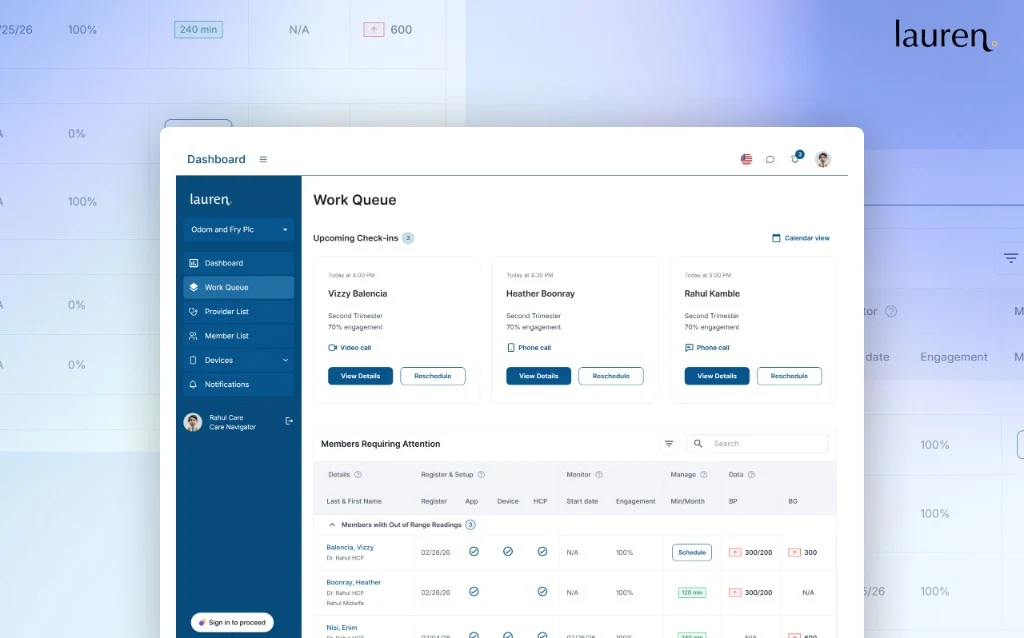
A HIPAA-ready maternal health platform enabling remote patient monitoring, care coordination, and personalized engagement from pre-pregnancy through postpartum.
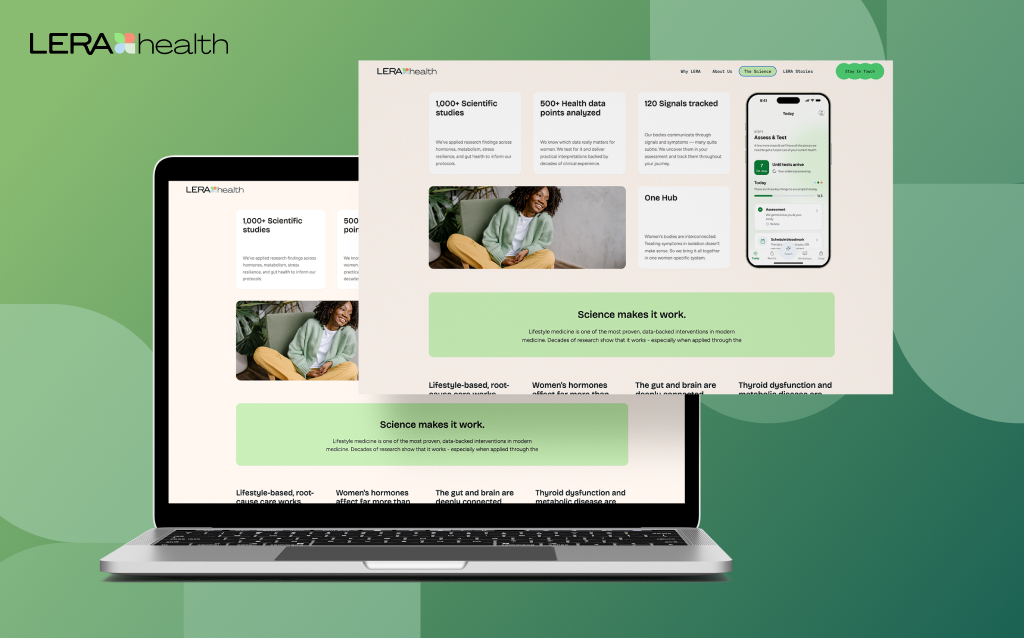
A women’s health product experience focused on guided care journeys, education, and compliance-aware workflows to support long-term engagement.
Common pilots from health-system innovation teams and the digital health startups that partner with them.
Symptom check-ins and escalation rules for one condition cohort after discharge.
Home readings for a small group, with a nurse worklist and clear escalation.
Admission, education or discharge tasks handled by a remote nurse with a shared worklist.
Patient navigators coordinating referrals, transport and follow-up from one view.
A CDS Hooks prompt at order entry, measured by how often it changes the decision.
AI drafting of notes or messages with clinician review, evaluated on edits and time saved.
A pilot touches fewer systems than a production service, but the ones it touches must be done properly.
Our pilot-to-production checklist. Tick what is already true; the result shows which area needs work before the switch.
We build secure, scalable products designed for privacy, interoperability, and regulatory readiness from day one across every sector we serve.

Protect PHI with privacy-first architecture, encrypted storage and transmission, and strict access controls.

Enabling standardized health data exchange through standards-based API mappings.
We combine deep technical expertise with industry-specific knowledge to deliver solutions that aren't just functional, but transformational.
We implement rigorous security protocols and compliance standards (HIPAA, GDPR, SOC2) across all industrial solutions to protect sensitive data.
Our architectures are built to handle massive data loads and user bases, keeping performance steady whether you're serving ten or ten million.
Using our suite of internal tools and proven frameworks, we reduce development cycles and get your product to market 40% faster.
Beyond simple wrappers, we build deep-learning integrations and predictive analytics directly into the core of your industry-specific workflows.
Timing depends on the care model, the EHR access path and the governance steps your organisation requires. We agree the first pilot's scope and timeline on the scoping call.
We agree the care model, the cohort, the measures and the EHR access path for the pilot.
Clinicians test the workflow on synthetic data and the SMART on FHIR sandbox while privacy review runs.
One unit or cohort, with controls, evaluation capture and named support in place from the first patient.
Results against the pre-agreed measures, reviewed with clinical, research and operational leads.
Hardening, interface approvals, runbooks and training, then rollout to the next units.
Short facts we design pilots around, each linked to its primary source.
The SMART App Launch implementation guide uses OAuth 2.0 and OpenID Connect so that apps can launch from an EHR with the user's and patient's context and only the access scopes they were granted.
Source: HL7 International (SMART App Launch)ONC certification criterion 170.315(g)(10) requires certified EHRs to offer a standardized API for patient and population services based on HL7 FHIR.
Source: 45 CFR 170.315 (eCFR)The HIPAA Privacy Rule lets covered entities use or disclose health information for research with a waiver of authorization approved by an IRB or privacy board.
Source: 45 CFR 164.512(i) (eCFR)HIPAA allows two ways to de-identify health data: expert determination, or the safe harbor method, which removes 18 categories of identifiers.
Source: 45 CFR 164.514(b) (eCFR)A HIPAA covered entity may share protected health information with a business associate, such as a software vendor, only under a business associate agreement that commits the vendor to safeguard it.
Source: 45 CFR 164.502(e) and 164.504(e) (eCFR)We don't just build products; we forge lasting partnerships. See how we've helped industry leaders transform their vision into technical reality.
“I can clearly see how Agnotic has a unique way of handling end-to-end development. They are always active on quick chat and provide support quickly.”

Aaron Phelan
Founder, Benchmark
“Agnotic combines deep technical expertise with strong domain knowledge. They understand the business context, anticipate challenges, and make collaboration smooth and effective.”

John Pasmore
Founder, Latimer
“Agnotic is the best technical team we evaluated. Their engineering excellence made our work dramatically easier and allowed us to stay focused on what matters most for maternal care outcomes. They took full ownership of the technical execution, and we are always happy to continue working together.”

Kim Smith
Founder, My Lauren
Detailed pages for the services most clinical innovation pilots draw on.
SMART apps, FHIR APIs and CDS Hooks services that launch inside the EHR.
A fixed-scope first release to test the idea with real users before scaling.
The interfaces a pilot needs when it moves from sandbox to production.
The safeguards a pilot must meet before the first real patient.
Explore other production-grade engineering platforms we deliver across healthcare.
The technical patterns behind this platform translate naturally into adjacent verticals.