




Challenge
Plausible codes the note does not support
Agnotic approach
Every suggestion must cite supporting text. Codes with no citation are shown as questions for the coder, not as suggestions.



Coders spend their day finding the diagnosis and procedure codes that the documentation supports, and every miss becomes a denial or an audit finding. Agnotic Technologies builds AI medical coding software for RCM products and billing teams: code suggestions with the evidence behind them, a coder review queue, and an audit trail on every decision.
Trusted by global innovators











AI medical coding software reads clinical documentation and suggests ICD-10-CM, ICD-10-PCS, CPT and HCPCS codes with the evidence behind each one, then routes every chart to a certified coder for review. Agnotic Technologies develops this computer assisted coding software for RCM products and billing teams, integrated with the EHR and billing system over FHIR, HL7 v2 and X12 837.
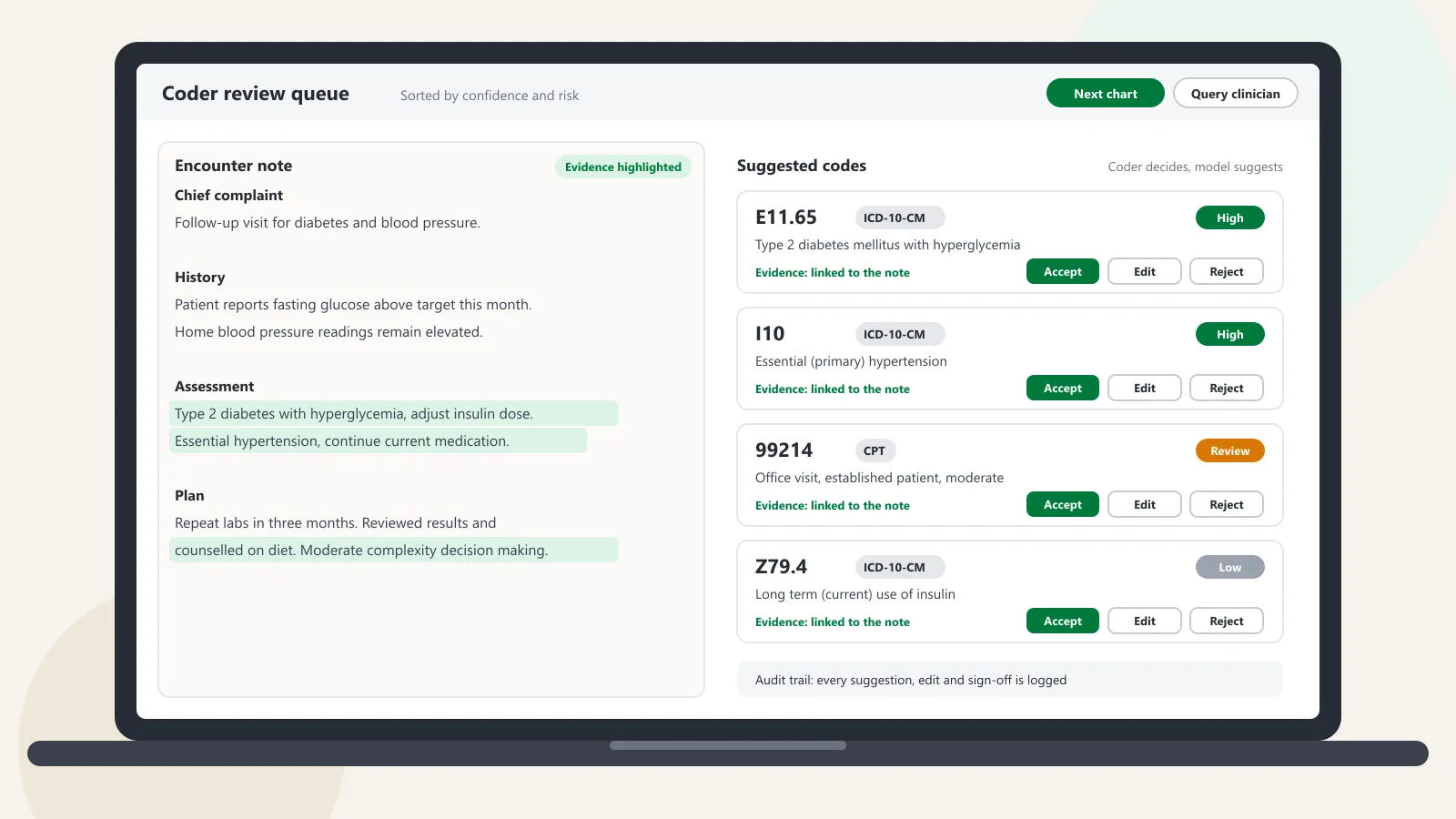
The model does not decide the code. It reads the note, proposes codes with the sentences that support them, and flags what it cannot support. The coder accepts, edits or rejects, and the final code set goes to the claim.
Older computer assisted coding relied on term matching. Current language models read context, which raises recall on specificity and laterality, and also raises the risk of plausible codes that the note does not support. The product design has to handle both.
A split view: the note on one side, suggested codes on the other, each code linked to the sentence that supports it, with accept, edit and reject actions and a queue sorted by confidence.
Four stages from documentation to claim, with a person at the gate that matters.
Encounter notes, orders and results arrive from the EHR as FHIR DocumentReference and Encounter resources or HL7 v2 MDM messages, and are linked to the account.
The model proposes ICD-10-CM, ICD-10-PCS, CPT and HCPCS codes, each with the supporting text, a confidence label and a note on missing specificity.
Charts are sorted by confidence and dollar risk. The coder accepts, edits or rejects each code, or sends a query to the clinician. Nothing is coded without a person.
Final codes go to the billing system and the X12 837 claim. Every suggestion, decision and edit is logged, and agreement rates feed the next model review.
Each capability is a module we scope on its own, so a first release can be narrow and still useful.
Diagnosis codes to full specificity, with laterality, encounter type and combination codes, and inpatient procedure codes where the documentation supports them.
Procedure and E/M code suggestions with modifiers, bundling checks and the documentation elements that justify the level.
Every code links to the sentences that support it, so a coder can verify in seconds and an auditor can see why a code was chosen.
Work queues by specialty, confidence and risk, with accept, edit, reject and clinician query actions, and keyboard-first design for speed.
Who saw what, which codes the model proposed, what the coder changed and when the claim went out, kept for the retention period you set.
Documentation in over FHIR or HL7 v2, final codes out to the billing system and the 837 claim, remittance back from the 835 for outcome tracking.
Code sets and transactions
The standards a coding assistant has to speak, and what each one is used for in the pipeline.
| Code | Name | Typical use |
|---|---|---|
| ICD-10-CM | Diagnosis codes | Suggested from assessment and problem list text; updated yearly, so the code set is versioned by date of service. |
| ICD-10-PCS | Inpatient procedure codes | Suggested from operative notes for hospital inpatient accounts. |
| CPT | Physician services and procedures | Procedure and E/M suggestions with modifiers; licensed from the AMA by the product owner. |
| HCPCS Level II | Supplies, drugs and services not in CPT | Suggested alongside CPT where the documentation names supplies or drugs. |
| X12 837 | Health care claim | Receives the final code set after coder sign-off. |
| X12 835 | Remittance advice | Denials and adjustments tied back to the codes that caused them. |
| FHIR R4 | Clinical documentation and encounters | DocumentReference, Encounter and Condition resources from the EHR. |
| HL7 v2 | Legacy document and ADT feeds | MDM and ADT messages where the EHR does not expose FHIR. |
Measurement
An accuracy number without a method is marketing. These are the measures we build into the product from the first release, reported per specialty and per code set.
Failure points
These failures are predictable, and the product has to be designed around them rather than patched after launch.
Challenge
Plausible codes the note does not support
Agnotic approach
Every suggestion must cite supporting text. Codes with no citation are shown as questions for the coder, not as suggestions.
Challenge
Drift toward higher-paying codes
Agnotic approach
Agreement and edit metrics are tracked by code and by direction, and a systematic shift toward higher levels triggers a review.
Challenge
Annual code set updates
Agnotic approach
Code sets are versioned by date of service, and the model is re-evaluated against the new set before it is used.
Challenge
Copy-forward and template text
Agnotic approach
Repeated text across visits is detected and down-weighted, so a stale problem list does not become a current diagnosis.
Challenge
Coders trusting the queue blindly
Agnotic approach
Sampling of accepted codes for second review, and no auto-accept mode, however high the confidence.
Challenge
PHI in prompts and logs
Agnotic approach
Models run inside your HIPAA-ready environment under a BAA, logs are scrubbed, and no PHI is used to train shared models.
A coding assistant touches PHI and the claim. We treat the controls as product decisions, not a policy document.
Documentation and claim data stay in HIPAA-ready, encrypted infrastructure under a signed BAA, with least-privilege access per coder and per client.
A certified coder signs off every code set. The model suggests, the person decides, and that boundary is enforced in the product, not in a policy.
Each code carries its evidence, and every suggestion, edit and sign-off is logged, so a payer audit or an internal compliance review can replay the decision.
We map, measure and manage model risks using the NIST AI Risk Management Framework, with a model card and monitoring plan per deployment.

Health Insurance Portability and Accountability Act
Protect PHI with privacy-first architecture, encrypted storage and transmission, strict access controls, and traceable audit logs.

General Data Protection Regulation
Implement lawful consent flows, data minimization, retention controls, and secure processing for sensitive health data.

Fast Healthcare Interoperability Resources
Enable standardized health data exchange across apps, care teams, and systems through standards-based FHIR APIs.

Health Level Seven International
Support enterprise-grade interoperability with HL7-based integrations for records, events, and clinical messaging workflows.

Health Information Trust Alliance
Align security programs to healthcare-specific control and risk management practices trusted by providers and ecosystem partners.

Health Information Technology for Economic and Clinical Health Act
Design with breach notification readiness, digital record safeguards, and operational controls that support regulated care programs.

FDA Software as a Medical Device
Plan software quality, traceability, and documentation pathways for products that may require SaMD review and submission.

Medical Device Regulation (European Union)
Prepare EU market-ready processes for risk classification, evidence tracking, and lifecycle governance under MDR expectations.

Substance Abuse and Mental Health Services Administration
Apply confidentiality controls and consent-aware sharing models for behavioral and mental health data experiences.
Decision table
For an RCM product founder or a billing company the question is whether coding AI is your product or a tool you use. This table is how we talk it through.
| Your situation | Buy a coding vendor | Build with Agnotic |
|---|---|---|
| Coding AI is a feature inside your RCM product | Vendor branding and margins inside your product | Your model, your data, your margin; built to your workflow |
| You code for many clients with different specialties | Vendor coverage decides which specialties you can serve | Specialty by specialty, in the order your clients need |
| You need evidence and audit trails your clients can inspect | Depends on the vendor's export and audit features | Designed in: evidence, logs and metrics are yours to show |
| You have no engineering team for ML operations | Vendor runs the models | We build the pipeline and hand over, or run it with you |
| You need something live quickly for one specialty | Fast if the vendor covers it | A fixed-scope first release for one specialty, then expand |
Both paths need a certified coder in the loop and a compliance program around them. Neither removes that.
Who builds it
The same pipeline, aimed at different coding workloads.
Coding assistance as a feature of a billing or revenue cycle platform sold to practices and hospitals.
Internal tooling that raises coder throughput across many clients while keeping sign-off with the coder.
Inpatient ICD-10-PCS and outpatient CPT work queues integrated with the existing encoder and EHR.
E/M level and procedure suggestions tuned to one specialty's documentation patterns.
A first product built on one specialty and one EHR, with the data model designed alongside.
Specificity gaps and query suggestions fed back to clinicians before the chart is coded.
Standards it speaks
Short facts we design around, each linked to its primary source.
HIPAA adopts ICD-10-CM, including its Official Guidelines for Coding and Reporting, for diagnoses, ICD-10-PCS for hospital inpatient procedures, and CPT-4 together with HCPCS for physician and other health care services as the standard medical code sets.
Source: 45 CFR 162.1002 (eCFR)CPT codes describe medical services and procedures performed by physicians and other qualified health care professionals, and the code set is maintained and distributed by the American Medical Association through its CPT Editorial Panel.
Source: American Medical Association, CPTHIPAA adopts ASC X12 standards for electronic transactions, including health care claims (837), payment and remittance advice (835), eligibility inquiries (270/271) and prior authorization requests (278).
Source: 45 CFR Part 162 (eCFR)The NIST AI Risk Management Framework is a voluntary framework that organizes AI risk work into four functions: Govern, Map, Measure and Manage.
Source: NIST AI 100-1A HIPAA covered entity may share protected health information with a business associate, such as a software vendor, only under a business associate agreement that commits the vendor to safeguard it.
Source: 45 CFR 164.502(e) and 164.504(e) (eCFR)