RPA in healthcare is the use of software robots that operate existing applications the way a person would: logging in, reading screens, typing, clicking and moving data between systems that have no shared interface. It is fast to deploy and fragile to run, and the right question is rarely whether to use it but where it belongs next to APIs and standard transactions.
This RPA in healthcare guide covers what RPA is, why the bot or API choice matters now, where RPA fits, how to decide, how to build it, best practices, common mistakes and your build plan.
What is RPA in healthcare?
Deciding where automation belongs in your operations?
Agnotic's fractional CTO service for healthcare helps leaders choose between bots, APIs and rebuilt workflows, then builds what you decide.
RPA in healthcare is robotic process automation applied to administrative and clinical support work: software bots that use the user interfaces of EHRs, payer portals and billing systems to perform repetitive, rule-based tasks such as checking eligibility, posting payments or re-keying data. The bot acts as a user, so it needs credentials, permissions, audit logging and a plan for when the screen it depends on changes.
Common uses
- Eligibility and benefits: Checking coverage in payer portals before visits.
- Prior authorization: Submitting requests and polling status on portals that offer no API.
- Claims and payments: Claim status checks, payment posting and denial worklist updates.
- Document handling: Moving faxes, referrals and results into the right record.
- Scheduling and registration: Filling cancellations, confirming appointments and updating demographics.
- Reporting: Pulling data from systems that offer no export into reports.
Why does the bot or API choice matter now?
- Standard transactions exist: HIPAA Administrative Simplification adopts ASC X12 standards for eligibility (270 and 271), claim status (276 and 277), prior authorization (278), claims (837) and remittance (835), with operating rules authored by CAQH CORE. Much of what bots re-key already has a standard transaction.
- Prior authorization is getting an API: Under CMS-0057-F, impacted payers must offer a Prior Authorization FHIR API by January 1, 2027 and, from 2026, decide standard requests within seven days and expedited requests within 72 hours.
- Bots are users under HIPAA: The HIPAA Security Rule's access control standard at 45 CFR 164.312(a) requires unique user identification and the audit controls standard at 164.312(b) requires recording activity in systems containing ePHI, which applies to every bot account.
- Credentials have rules: NIST SP 800-63B-4 (July 2025) sets authenticator requirements, including blocklist checks and no forced periodic rotation, which bot credentials and their vaults should follow.
- EHR APIs are mandatory: Under ONC criterion 170.315(g)(10), certified EHRs expose a FHIR API with SMART App Launch and Bulk Data Access, so screen scraping an EHR is rarely necessary.
- Vendors need agreements: Under 45 CFR 164.502(e), an RPA vendor whose bots handle PHI is a business associate and needs a Business Associate Agreement.
When should you use RPA, and when an API?
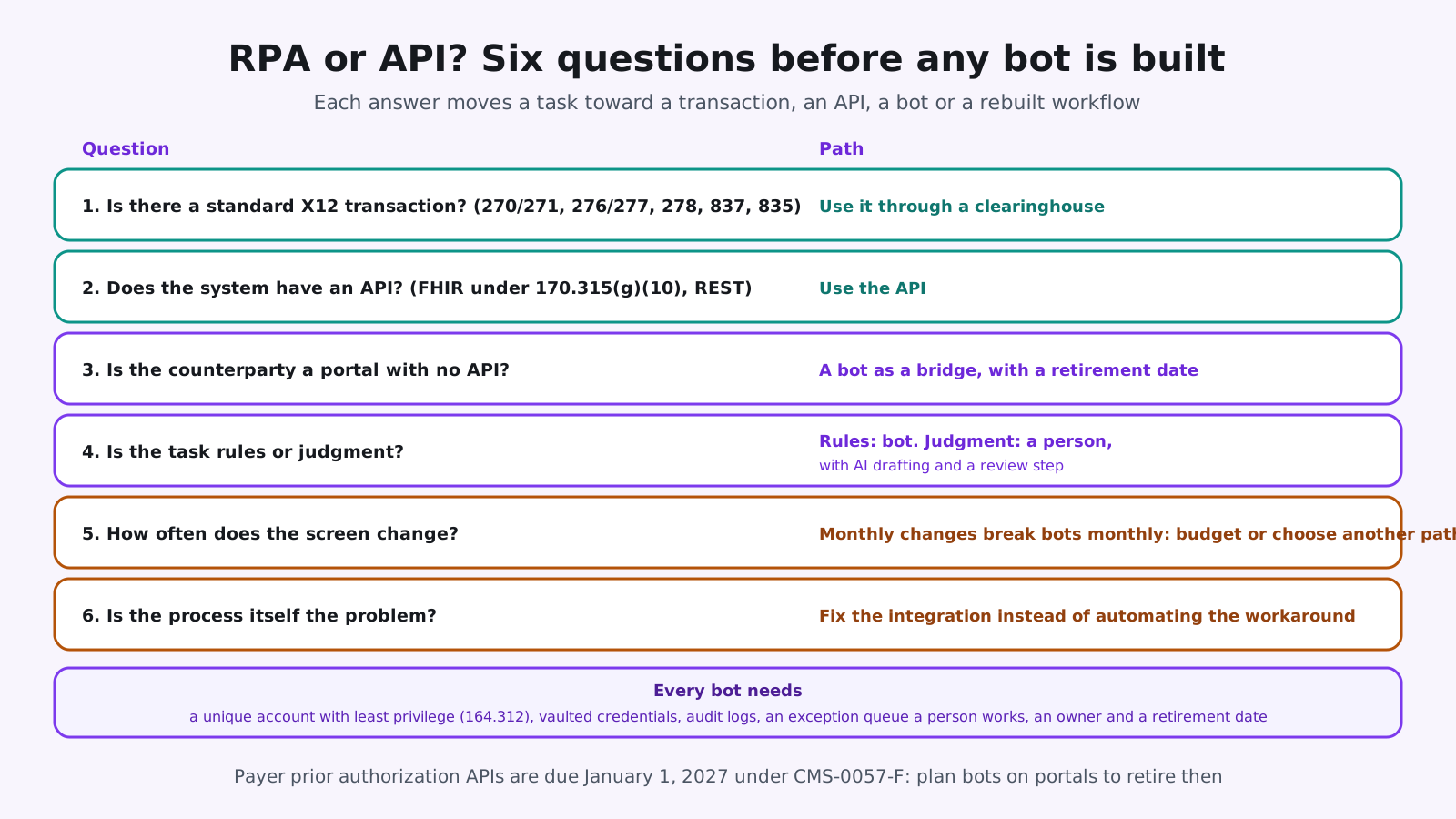
The diagram is the decision list we use before any bot is built. Each question moves a task toward an API, a standard transaction, a bot or a rebuilt workflow.
- Is there a standard transaction? Eligibility, claim status, prior authorization, claims and remittance should run as X12 transactions through a clearinghouse, not as a bot on a portal.
- Does the system have an API? EHRs expose FHIR; many practice management and billing systems expose REST. Use it.
- Is the counterparty a portal with no API? A bot is the practical bridge, with a plan to replace it when the API arrives, such as the payer APIs due in 2027.
- Is the task judgment or rules? Rules suit bots; judgment needs a person, possibly with AI drafting and a review step.
- How often does the screen change? Portals that change monthly will break bots monthly. Budget for maintenance or choose another path.
- Is the process itself the problem? If a task exists only because two systems do not talk, fixing the integration beats automating the workaround.
RPA as a bridge, not a destination
The strongest case for RPA in healthcare is time: a bot can be running in weeks while an integration or a payer API takes months or years. Treat each bot as a bridge with an owner, a cost and a retirement date tied to the API or transaction that will replace it, and review the list every quarter.
Where AI changes the picture
Intelligent document processing and language models now read faxes, letters and portal pages that older bots could not parse, which widens what automation can touch. It also raises the stakes: extracted data should be validated against the source, and anything that changes a claim, a record or a care decision goes through a human review step before it is committed.
Governing bots as users
A bot that logs into an EHR or payer portal is a user under the HIPAA Security Rule. Give it a unique account, the minimum permissions the task needs, credentials held in a vault rather than in a script, and audit logging that records what it read and changed. When a bot is retired, its account is disabled the same day.
Measuring what a bot is worth
Report net savings: staff time saved minus the time spent maintaining the bot, handling its exceptions and reworking its errors. Track run success rates, exception volumes and screen-change failures per month. A bot whose maintenance cost approaches the time it saves is a signal to build the API or fix the process.
How do teams approach RPA in healthcare step by step?
- 1. Inventory the manual work: Tasks, volumes, systems touched, error rates and who does them today.
- 2. Run the decision list: API, transaction, bot or rebuild, per task, with a retirement date for each bot.
- 3. Govern the bots: Named service accounts, least privilege, credential vaulting, logging and an owner per bot.
- 4. Build the first bot narrowly: One task, one system, with exception handling that routes failures to a person.
- 5. Validate outputs: Sample results against the source until error rates are known and acceptable.
- 6. Monitor: Run success, exceptions, screen-change failures and time saved, on a dashboard someone reads.
- 7. Scale by task, not by tool: Add bots where the decision list says bot; build APIs where it says API.
- 8. Retire on schedule: When the API or transaction arrives, switch and decommission the bot.
What are RPA in healthcare best practices?
- Transactions before bots: If an X12 transaction exists, use it through a clearinghouse.
- Bots are users: Unique accounts, least privilege, vaulted credentials and audit logs, like any staff member.
- Exceptions go to people: Every bot has a queue for what it could not do, and someone works it.
- Minimize PHI in flight: Bots handle only the fields the task needs, and logs never capture full screens with PHI.
- Version and test: Bot logic in version control, tested against screen changes before release.
- Measure honestly: Time saved net of maintenance and exception handling.
- Plan the exit: Each bot has a replacement path and a date.
The practices above keep bots useful and under control. The mistakes below are why many RPA programs quietly become a second maintenance burden.
What are the common mistakes with RPA in healthcare?
- Automating the workaround: Bots that re-key data between two systems that could be integrated.
- Shared credentials: One account for many bots, or a staff member's login, with no audit trail.
- Silent failures: A bot stops after a portal update and nobody notices until claims age out.
- Screens with PHI in logs: Screenshots and logs that become an unmanaged PHI store.
- No exception path: Failed cases disappear instead of reaching a person.
- Counting gross savings: Time saved reported without the maintenance and rework cost.
What does RPA in healthcare mean for your build plan?
- Task inventory: Volumes, systems and error rates decide the order of work.
- Mix of bots, APIs and transactions: Each path has different build, run and maintenance costs.
- Governance: Service accounts, vaults, logging and an owner per bot.
- Exception handling: Queues and staff time for what automation cannot finish.
- Monitoring: Dashboards and alerts for bot health and portal changes.
- Retirement plan: Dates tied to payer APIs and integrations that replace bots.
For the bigger program around automation, our digital transformation guide covers the organization side, and our healthcare software development guide covers how to scope and staff the build.
How Agnotic can help
Agnotic Technologies is a software development services company. We help healthcare organizations decide where automation belongs and then build it: X12 transaction integrations through clearinghouses, FHIR and REST integrations with EHRs and practice systems, governed bots where portals offer no API, review steps for anything AI drafts, and the monitoring that keeps all of it honest. Our fractional CTO service leads the decision; our engineers deliver it.
Plan your automation with Agnotic
Explore our fractional CTO service for healthcare or browse more guides in our Guides and Playbooks hub.
Related reading on Agnotic
Go deeper on the automation, revenue cycle and AI topics covered in this guide.
Sources
- CMS: HIPAA Administrative Simplification, adopted standards and operating rules
- CMS: Interoperability and Prior Authorization final rule (CMS-0057-F)
- 45 CFR 164.312: HIPAA Security Rule technical safeguards
- NIST SP 800-63B-4: Digital Identity Guidelines, Authentication and Authenticator Management
- ASTP/ONC: Standardized API for patient and population services, 170.315(g)(10)
- 45 CFR 164.502: Uses and disclosures of PHI, including business associates
- CAQH CORE: Operating rules
- NIST: AI Risk Management Framework (AI 100-1)