

Manufacturer brand and market access teams
Fund the program, set its rules and need aggregate reporting on access barriers without seeing more patient detail than the program design allows.



Patients wait for therapy while hub teams chase faxes, benefit checks and prior authorizations across disconnected tools. Agnotic Technologies builds patient support program software that moves each case from enrollment to first fill, and sends every reported adverse event to your safety team on time.
Trusted by global innovators











Patient support services are the hub programs a drug manufacturer funds to help patients start and stay on therapy: enrollment and consent, benefits investigation, prior authorization help, copay assistance, nurse education and adherence calls. Agnotic Technologies builds the software behind these programs, from case records and payer checks to adverse event hand-off.
Several teams share one patient's case. The software has to give each of them the view and permissions they need, and no more.
Fund the program, set its rules and need aggregate reporting on access barriers without seeing more patient detail than the program design allows.
Run the case work day to day: intake, benefits investigation, prior authorization follow-up and outreach calls, often for several brands at once.
Receive triaged referrals, confirm benefits, dispense and report ship and refill status back to the hub.
Train patients on administration, support prescriber offices with coverage questions and log every contact in the case record.
Most hub problems are hand-off problems. These are the failure points we look for first when we review an existing program.
Consent arrives on a faxed form and is keyed in days later, so outreach and data sharing start before the authorization is on file.
Benefits investigation results are typed into free text, so nobody can report which plans or benefit types cause delays.
Prior authorization status lives in spreadsheets, and the hub and the prescriber's office disagree on what was sent and when.
An adverse event mentioned on an adherence call is noted but not flagged, so the safety team hears about it late.
Copay program eligibility is checked once at enrollment and never again when the patient's coverage changes.
Specialty pharmacy referrals go out before benefits are confirmed, so the prescription waits in a queue.
Three decisions on the scoping call shape the build. We make them with your privacy, safety and market access leads in the room.
Decide which parties are HIPAA covered entities, which act as business associates, and which data flows need a patient authorization. We build to the model your privacy counsel sets.
No call, text or data share starts until the right authorization and program consent are on file, and the software enforces that rule instead of relying on training.
Every contact screen offers an adverse event flag, and every flagged event reaches your pharmacovigilance intake with the time of first receipt attached.
How to build patient support services that hold up in daily use: modules that follow the case journey, built for your program and connected to the systems your partners already run.
Web and mobile enrollment forms for prescribers and patients, with electronic signature, identity checks and the HIPAA authorization stored against the case.
One case record per patient and therapy, with tasks, due dates, call notes and role-based views for hub agents, nurses and supervisors.
Electronic eligibility checks where payers support them, structured capture where they don't, and coverage results stored as data, not free text.
Status, documents and payer references for each request and appeal, shared with the prescriber's office so both sides see the same timeline.
Program rules in versioned configuration, eligibility screening and re-checks when coverage changes, with each decision recorded.
Refill reminders and nurse check-ins by call, SMS or app, sent only to patients whose consent covers that channel.
A flag on every contact screen, a minimum data form, routing to your safety team and reconciliation reports between the hub and the safety database.
Aggregate dashboards on time to therapy and access barriers for brand teams, built from data the program design lets them see.
Adverse events surface on enrollment calls, adherence calls and nurse visits. This is the path we build so none of them stalls in a call note.
Agents and nurses see an adverse event and product complaint flag on every contact screen, and call scripts prompt the question at set points.
A short form records the reporter, the patient, the product and the event, and stamps the time the hub first received it.
The case is sent to the manufacturer's safety intake through the agreed channel, such as a secure API, an SFTP drop or the safety team's portal.
Follow-up questions from the safety team come back to the hub as tasks, and every answer is linked to the original report.
Scheduled reconciliation compares hub reports with safety database receipts, and an audit log shows who saw and sent each report.
Chosen to fit your safety database, your hub partners and the payers your patients use.
This is the case map we use on scoping calls. Each stage has its own data, its own owner and its own hand-off, and the software has to track all three.
| Stage | What the hub does | Data the software captures | Hand-off |
|---|---|---|---|
| Enrollment and consent | Receives the enrollment form, confirms the patient and prescriber, records consent | Signed HIPAA authorization, program terms, prescriber and patient details | Case opens for benefits investigation |
| Benefits investigation | Confirms coverage and whether the drug falls under the pharmacy or medical benefit | Eligibility response, plan details, coverage notes | Prior authorization or affordability path |
| Prior authorization support | Helps the prescriber's office assemble, submit and track the request and any appeal | Status, payer reference, documents sent, denial reasons | Prescriber office and specialty pharmacy |
| Copay and affordability | Screens for copay support, foundation referral or a free drug program | Eligibility answers, program rules version, enrollment status | Pharmacy claim and program administrator |
| Specialty pharmacy triage | Routes the prescription to an in-network specialty pharmacy | Network match, referral record, ship confirmation | Dispensing pharmacy |
| Nurse education and adherence | Runs onboarding and training calls, refill reminders and check-ins | Call notes, refill dates, patient-reported issues | Nurse escalation or safety team |
| Adverse event capture | Flags any adverse event or product complaint raised on any contact | Reporter, patient, product, event and first receipt time | Manufacturer pharmacovigilance intake |
Measures we build dashboards around and review with your market access and safety leads.
How long patients wait at each stage, and which stage holds them longest.
Denials, missing documents and benefit types that slow cases, by plan and region.
The stage where patients stop responding or abandon therapy.
Hub adverse event reports matched against safety database receipts.
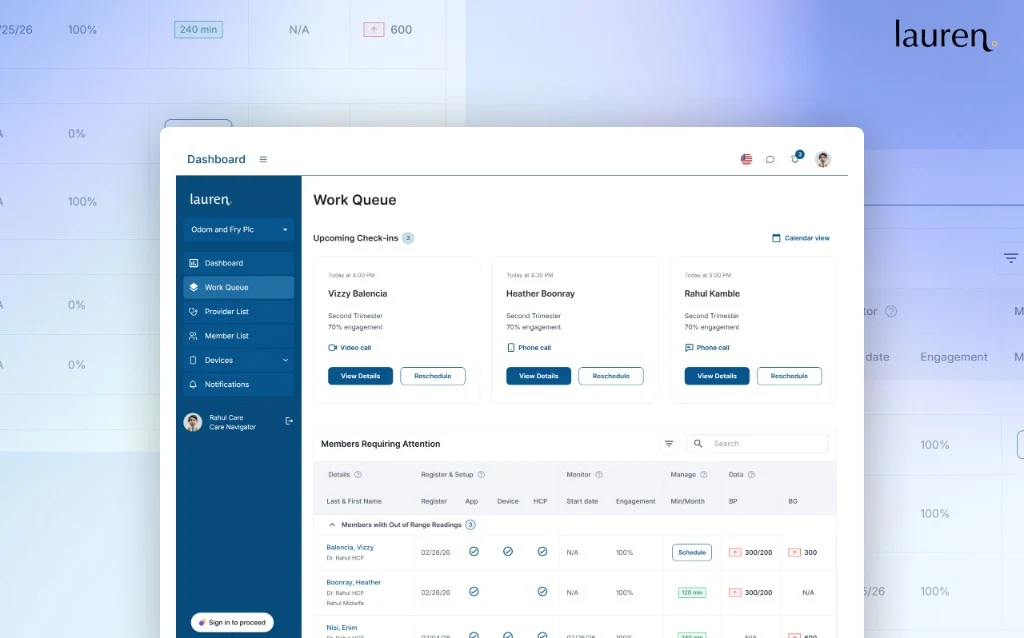
A HIPAA-ready maternal health platform enabling remote patient monitoring, care coordination, and personalized engagement from pre-pregnancy through postpartum.
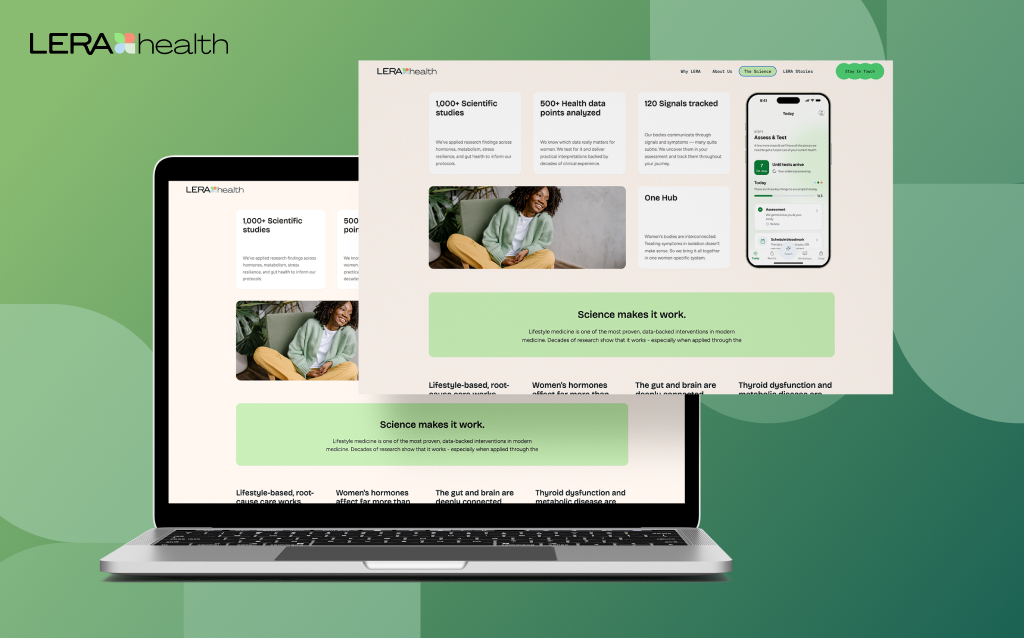
A women’s health product experience focused on guided care journeys, education, and compliance-aware workflows to support long-term engagement.
Common first releases, each scoped to one brand or one stage of the case journey.
Replacing faxed enrollment forms with e-forms and electronic signature.
Electronic eligibility checks with structured results for one brand's payer mix.
A shared status view for hub agents and prescriber offices.
Eligibility screening and enrollment with program rules held as configuration.
Booking and logging onboarding and injection training visits.
Matching hub reports with safety database receipts every day.
The systems a patient support program reads from and writes to.
We build secure, scalable products designed for privacy, interoperability, and regulatory readiness from day one across every sector we serve.

Protect PHI with privacy-first architecture, encrypted storage and transmission, and strict access controls.

Enabling standardized health data exchange through standards-based API mappings.
We combine deep technical expertise with industry-specific knowledge to deliver solutions that aren't just functional, but transformational.
We implement rigorous security protocols and compliance standards (HIPAA, GDPR, SOC2) across all industrial solutions to protect sensitive data.
Our architectures are built to handle massive data loads and user bases, keeping performance steady whether you're serving ten or ten million.
Using our suite of internal tools and proven frameworks, we reduce development cycles and get your product to market 40% faster.
Beyond simple wrappers, we build deep-learning integrations and predictive analytics directly into the core of your industry-specific workflows.
We start with one brand or one stage of the case journey. Timing depends on scope; we agree a fixed first release on the scoping call.
We map the case journey, the parties, the data flows and the first stage to rebuild.
Consent model, authorization text handling, access roles and the adverse event route are agreed with your counsel and safety team.
One stage, such as enrollment or benefits investigation, working end to end with audit logging.
More stages, brands and partner interfaces added on the same case platform.
Program rule changes, payer interface updates and reconciliation monitoring under agreed change control.
Short facts we design around, each linked to its primary source.
The holder of an approved drug application must report each adverse drug experience that is both serious and unexpected to FDA as soon as possible, and no later than 15 calendar days from first receiving the information.
Source: 21 CFR 314.80(c)(1) (eCFR)FDA requires drug applicants to promptly review adverse drug experience information from any source, including information derived from commercial marketing experience.
Source: 21 CFR 314.80(b) (eCFR)For licensed biological products, the applicant must report each serious and unexpected adverse experience to FDA as a 15-day Alert report, no later than 15 calendar days from initial receipt of the information.
Source: 21 CFR 600.80(c)(1) (eCFR)A HIPAA covered entity must obtain the patient's authorization for any use or disclosure of protected health information for marketing, and the authorization must say so when a third party pays the covered entity for the communication.
Source: 45 CFR 164.508(a)(3) (eCFR)A valid HIPAA authorization must describe the information, name who may disclose and receive it, state each purpose, give an expiration date or event, and carry the individual's signature and date.
Source: 45 CFR 164.508(c)(1) (eCFR)We don't just build products; we forge lasting partnerships. See how we've helped industry leaders transform their vision into technical reality.
“I can clearly see how Agnotic has a unique way of handling end-to-end development. They are always active on quick chat and provide support quickly.”

Aaron Phelan
Founder, Benchmark
“Agnotic combines deep technical expertise with strong domain knowledge. They understand the business context, anticipate challenges, and make collaboration smooth and effective.”

John Pasmore
Founder, Latimer
“Agnotic is the best technical team we evaluated. Their engineering excellence made our work dramatically easier and allowed us to stay focused on what matters most for maternal care outcomes. They took full ownership of the technical execution, and we are always happy to continue working together.”

Kim Smith
Founder, My Lauren
This page covers hub program software. These pages cover the wider pharma and pharmacy work around it.
Software for drug manufacturers across commercial, medical and regulatory teams.
Dispensing, inventory and claims software for retail and specialty pharmacies.
Eligibility, prior authorization and claims transactions with payers and clearinghouses.
Digital intake and onboarding flows that capture identity and consent up front.
The safeguards we build into every system that handles patient data.
Explore other production-grade engineering platforms we deliver across healthcare.
The technical patterns behind this platform translate naturally into adjacent verticals.