

Definition
- Plain-language meaning
- Formula and filters
- Grain: per order, per customer or per day
- Known exclusions


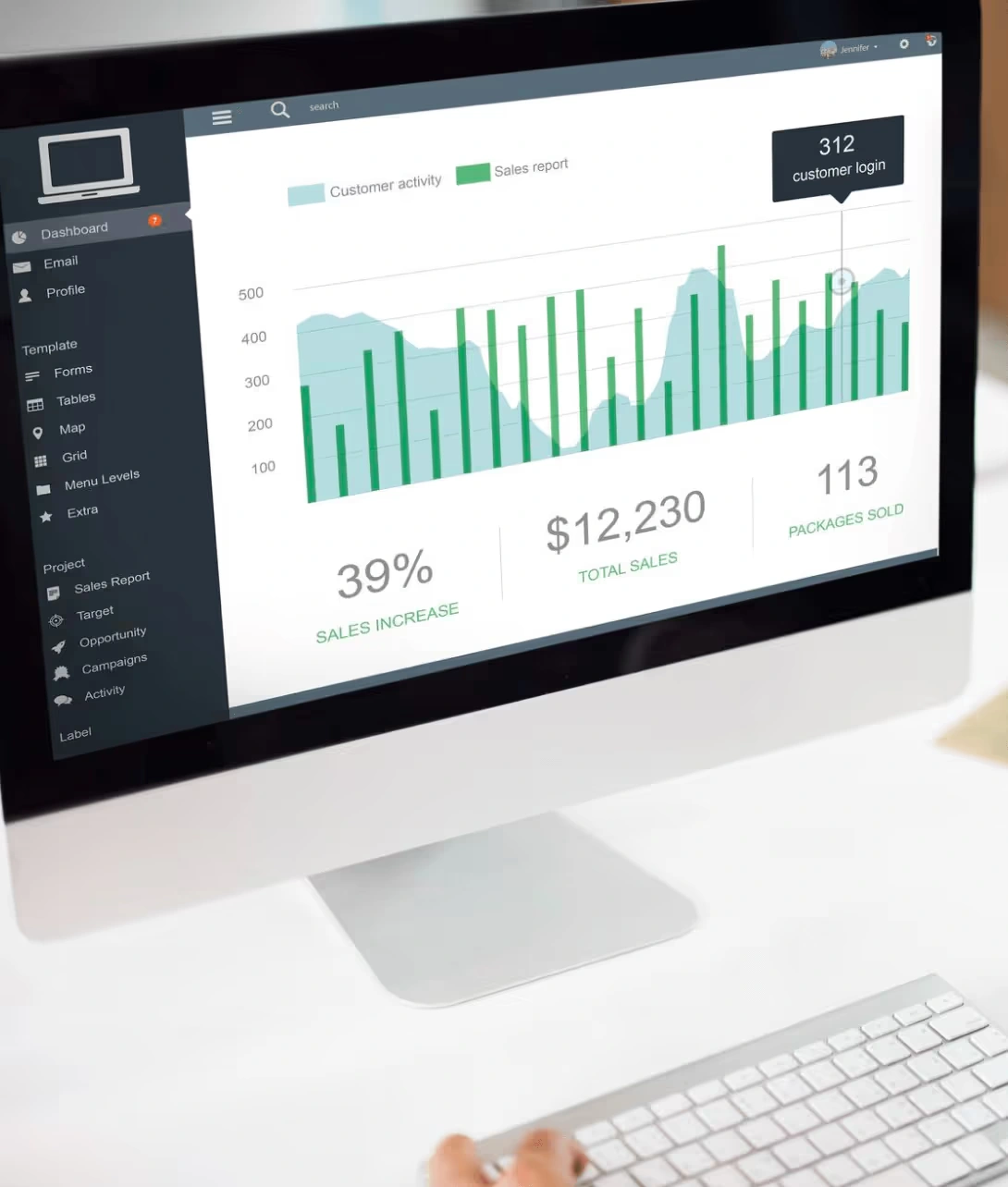
When finance, sales and operations bring different numbers to the same meeting, the problem is not the charts. Agnotic Technologies implements business intelligence with one governed definition per metric and security built into the model, so every report agrees.
Trusted by global innovators











Business intelligence
Business intelligence implementation is setting up reporting so every team gets the same number for the same question. Agnotic Technologies builds a governed semantic layer with one definition per metric, row-level security, the right deployment model and a migration of legacy reports, on the BI tool you have chosen.
Dashboard screens and chart design are covered by our dashboard development service, and the pipelines and warehouse underneath by data engineering. This page is the layer between them, where numbers are defined and protected.
We work in Power BI, Tableau, Looker and other tools. We do not resell licences or rank vendors.
Decision table
Most organizations mix two of these. The choice decides who owns definitions and where security is enforced.
| Deployment model | Who owns metric definitions | Security model | Licensing driver | Typical failure |
|---|---|---|---|---|
| Central governed | A BI team builds and publishes every report | Roles managed by the BI team in the semantic model | Viewer licences for most users, a few authors | The backlog grows and teams build shadow spreadsheets |
| Governed self-service | The BI team owns certified metrics; analysts build reports on top | Row-level security in the shared model, workspace roles for authors | More author licences across departments | Analysts redefine metrics in their own reports and numbers drift |
| Embedded analytics in your product | Your product team, per customer-facing metric | Tenant isolation enforced on every query, often through embed tokens | Capacity or usage-based pricing for embedding | One tenant sees another's data because a filter was applied only in the front end |
Metric register
Every certified metric gets an entry before it appears on a report.
Security
Report migration
Example: Hundreds of reports on an old reporting server and in shared spreadsheets
Approach: Collect usage logs and owners. Reports nobody opens are retired, not rebuilt.
Example: Revenue calculated three ways in finance, sales and operations
Approach: Agree one definition per metric with its owner and record it in the metric register.
Example: A monthly pack assembled by hand from exports
Approach: Rebuild it on shared measures so it refreshes on schedule.
Example: The new dashboard shows a different total from the old report
Approach: Compare old and new numbers for the same periods and explain every difference before sign-off.
Example: Old and new reports both in use with no end date
Approach: Set a date, redirect links and archive the old reports once owners sign off.
Analytics consulting
Before building anything, we find out what people need to decide and whether the data can support it.
Systems, owners, refresh frequency and known data quality problems.
Every metric defined differently across teams, with the reports that use each version.
The decisions people want to make, ranked by value and by how ready the data is.
Whether your BI tool and deployment model fit, judged on security model, embedding, governance, skills and licence structure, without ranking vendors.
The order for the semantic layer, migrations and new reports, with the first release defined.
Monthly packs and KPIs that come from one model instead of spreadsheets.
Customer-facing reports with tenant isolation enforced on every query.
Reporting on PHI with role-based views built around minimum necessary access.
Two reporting stacks and two sets of definitions brought into one.
Legacy reports moved to a current BI tool with reconciled numbers.
References
Vendor documentation and one regulation that shape how we build semantic layers and security.
Power BI row-level security restricts data only for users with Viewer permissions; it does not apply to workspace Admin, Member or Contributor roles.
Source: Microsoft Learn: row-level security with Power BILookML is the language Looker uses to create semantic data models that describe dimensions, aggregates, calculations and relationships, and Looker writes its SQL queries from that model.
Source: Google Cloud: What is LookML?Tableau supports several row-level security methods inside and outside Tableau, the simplest being a user filter that maps users to values manually.
Source: Tableau Help: overview of row-level security optionsWhen using or disclosing protected health information, a HIPAA covered entity or business associate must make reasonable efforts to limit it to the minimum necessary for the intended purpose.
Source: 45 CFR 164.502(b) (eCFR)Scope and cost
We do not publish prices. These factors decide the size of the work.
How many certified metrics and source systems the first release covers.
The count left after unused reports are retired.
Row-level and column-level rules, and how many roles they cover.
Central, self-service, embedded, or a mix.
Working within your current tool, or moving to a new one.
Whether the warehouse already holds clean, modelled data.