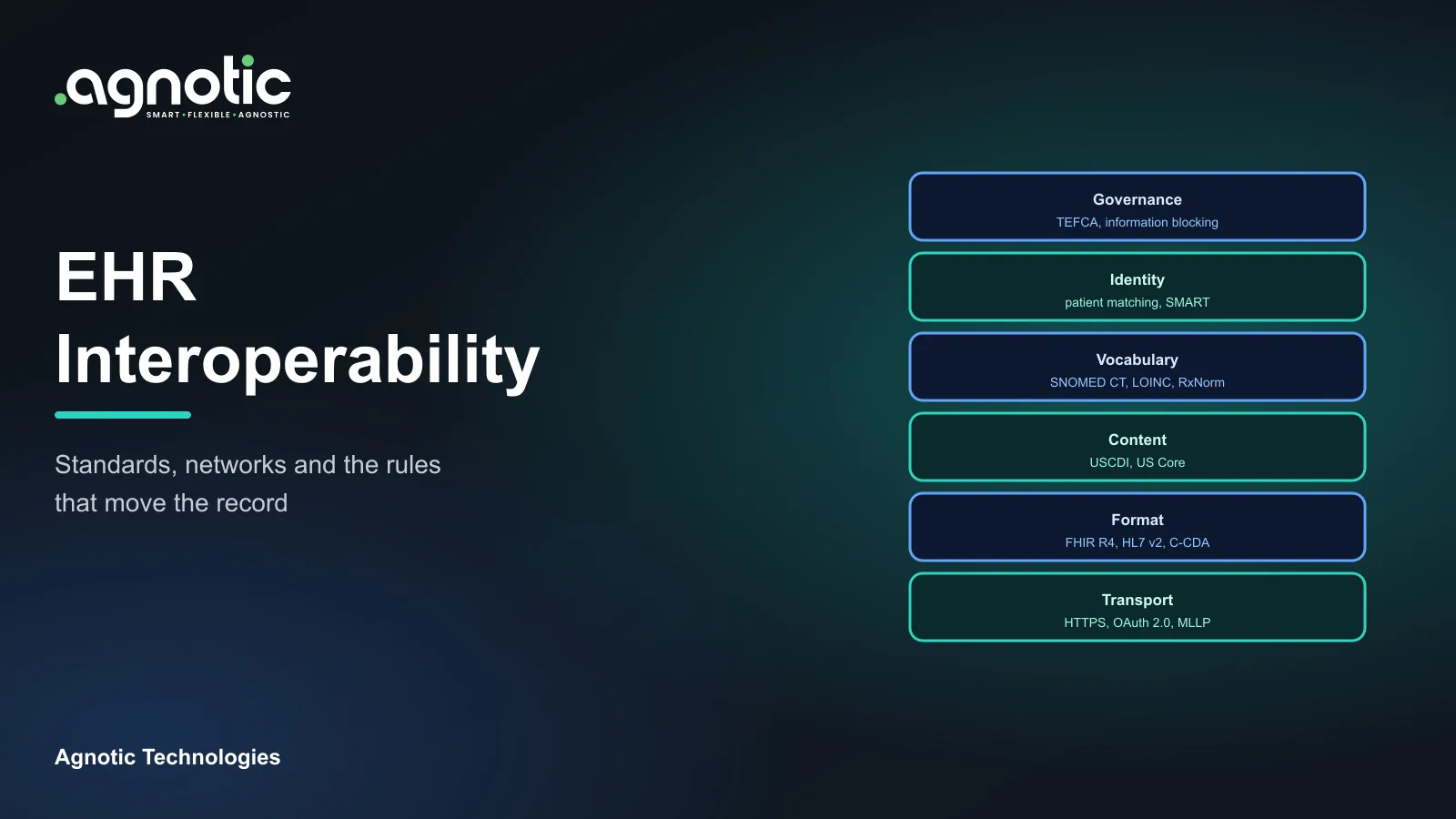
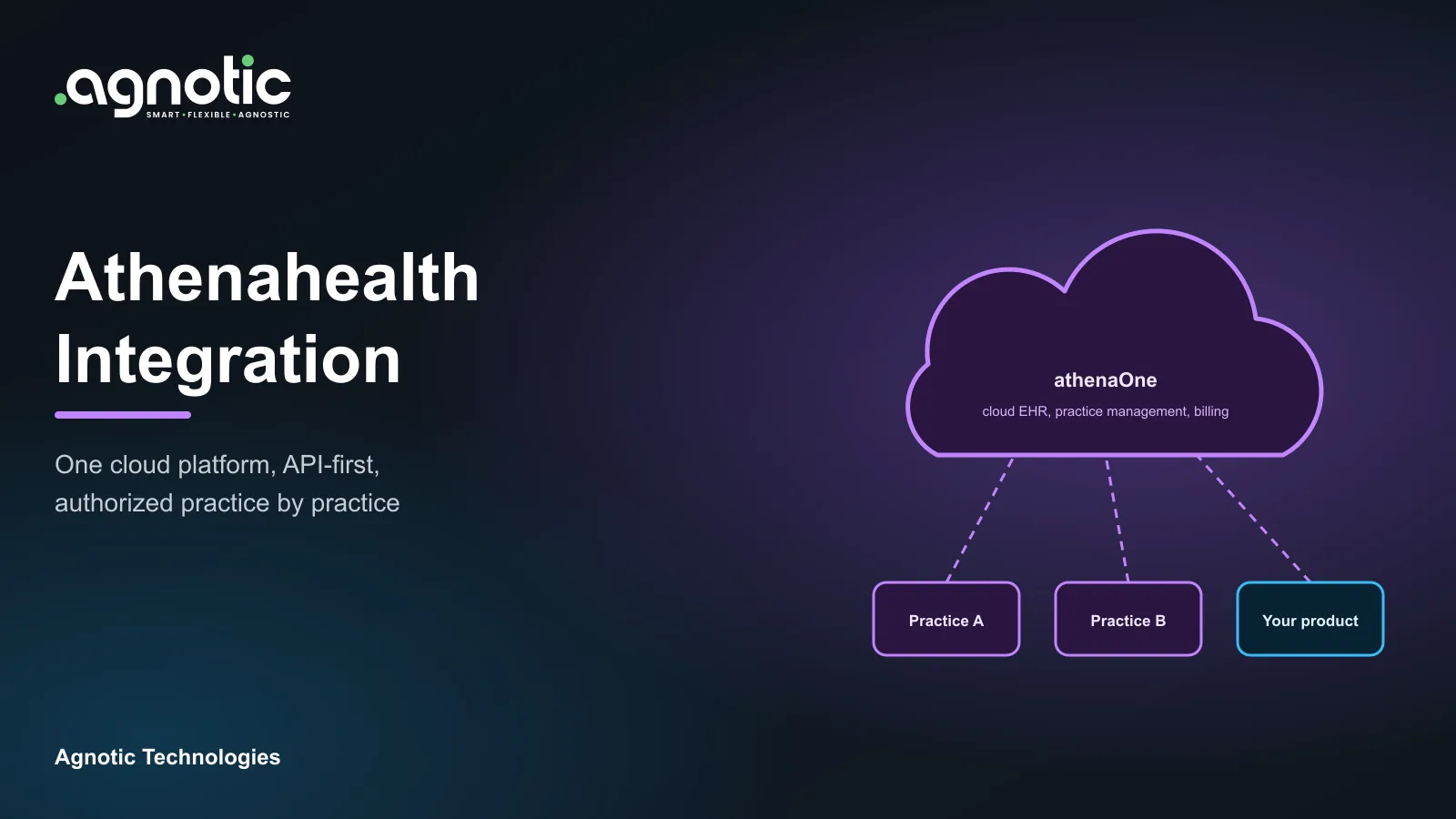
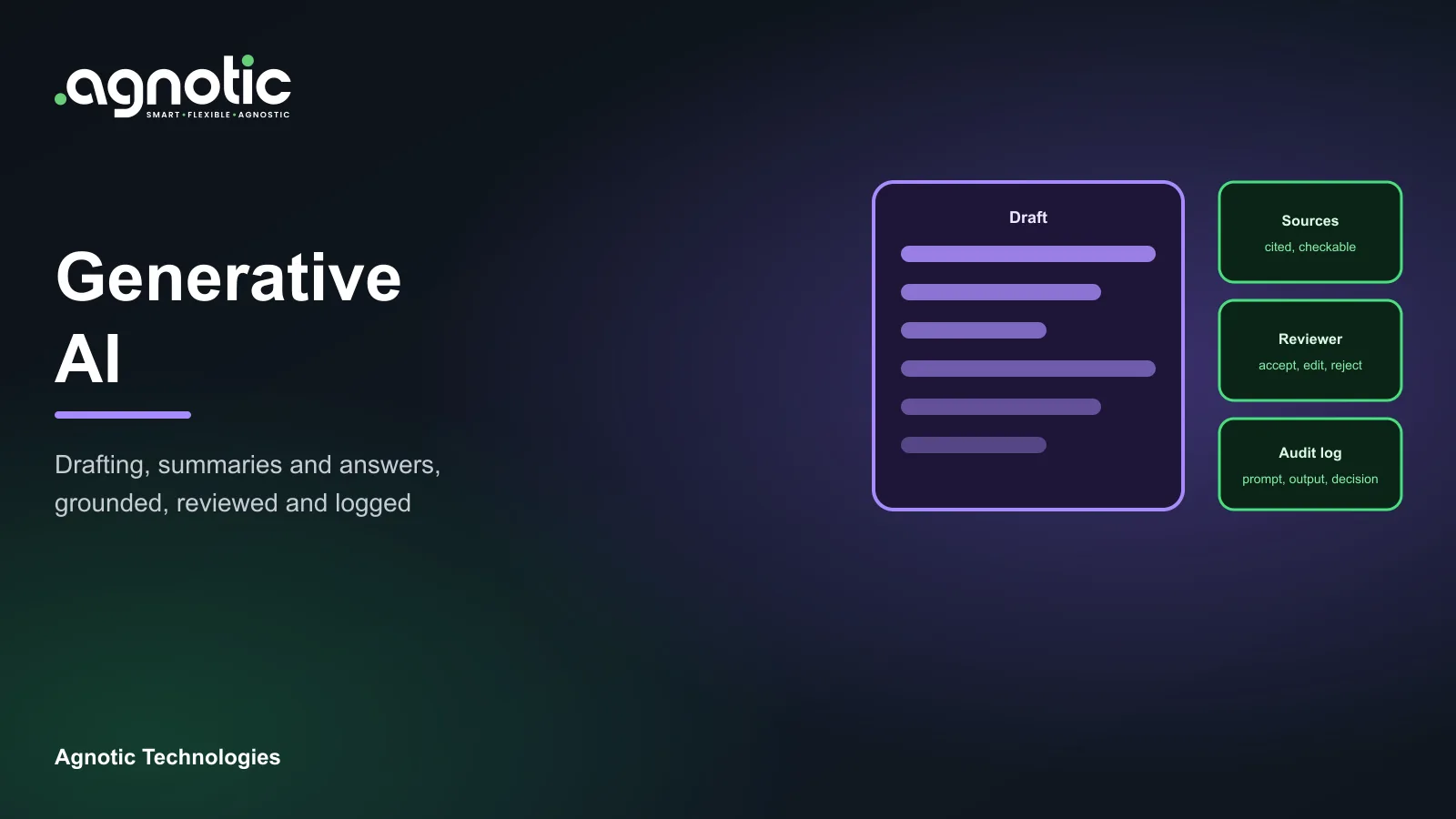
EHR development is the engineering work of building an electronic health record: the clinical features clinicians use, the data model and FHIR API underneath, security and audit controls, integrations with labs, pharmacies and payers, and, when customers need it, ONC certification. It differs from EMR development mainly in how much data it shares beyond one practice.
This EHR development guide walks through the core features, the architecture, the certification touchpoints, a step by step approach, testing, best practices and what drives cost.
What is EHR development?
Building or extending an EHR?
Our engineers build EHR platforms, modules and integrations, from the FHIR API to clinical workflows.
What is EHR development, as distinct from choosing an EHR? It is the engineering behind the record: designing a data model that can hold a patient's whole history, building screens that clinicians can use under time pressure, exposing data through standard APIs, and proving that every access is controlled and logged. Whether you are building a full EHR, a specialty EMR or modules that extend an existing system, the same foundations apply.
EHR or EMR?
The terms are often used interchangeably. In common usage, an EMR is the digital chart used within one practice, while an EHR is designed to share information with other providers, labs, pharmacies, payers and patients. For this EMR software development guide, the practical difference is integration: an EHR needs standard APIs, document exchange and patient access from the start.
Core features of an EHR
- Patient chart: Demographics, problems, medications, allergies, immunizations, results and notes.
- Documentation: Templates, smart text and structured fields for each specialty.
- Orders and results: Lab and imaging orders, results review and acknowledgment.
- e-Prescribing: Prescriptions to pharmacies, with drug interaction and allergy checks.
- Scheduling and tasks: Appointments, inbox, messages and care team tasks.
- Billing data: Charges, codes and claims data for the revenue cycle.
- Patient access: A portal and API access for patients and the apps they choose.
Why does EHR development matter now?
- Standard APIs: Under the ASTP/ONC HTI-1 rule, from January 1, 2026, certified FHIR APIs under 45 CFR 170.315(g)(10) must support USCDI v3, US Core 6.1.0 and SMART App Launch 2.0, plus the Bulk Data Access standard for population level access.
- Data sets keep growing: USCDI is maintained by ASTP/ONC. Version 3 is the certification baseline, and the most recent published version is v7 (July 2026), so data models must be ready to grow.
- Full export: ONC Health IT Certification criterion 170.315(b)(10) requires certified health IT to export all electronic health information for one patient or a whole population in a documented, computable format.
- Incentive programs: Hospitals in the Medicare Promoting Interoperability Program and MIPS clinicians reporting that category must use certified EHR technology (42 CFR 495.4), a CMS requirement that shapes what customers expect.
- Safety self-assessment: ONC released eight updated SAFER Guides in 2025, and from the 2026 reporting period hospitals in the Promoting Interoperability Program must attest to an annual self-assessment using all eight.
- e-Prescribing standards: Medicare Part D allows NCPDP SCRIPT version 2017071 or 2023011 today, and from January 1, 2028 only version 2023011 may be used.
What does an EHR architecture look like?
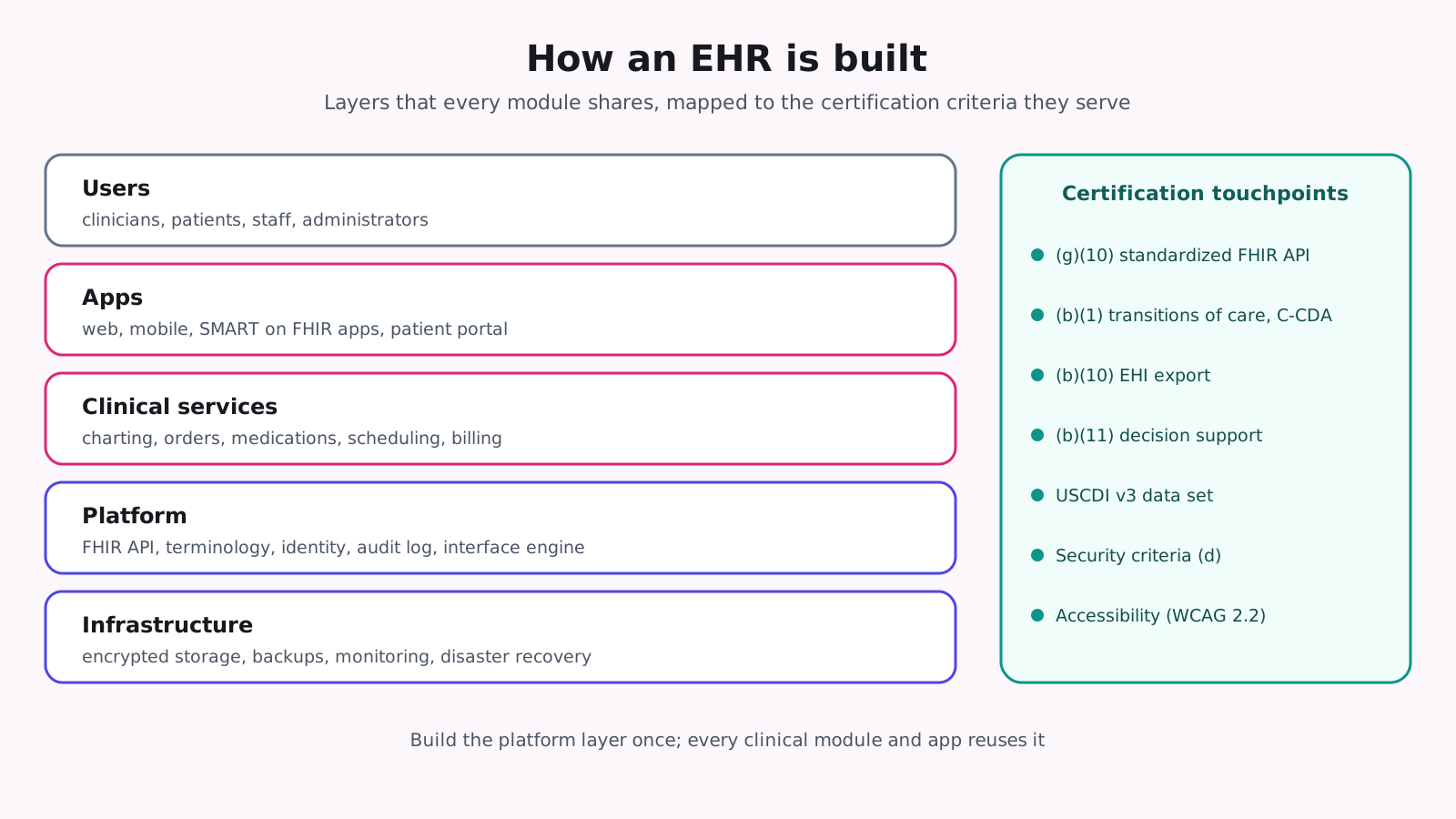
- Apps layer: Web and mobile apps for clinicians and patients, plus SMART on FHIR apps from third parties.
- Clinical services: Charting, orders, medications, scheduling and billing as separate services with clear ownership.
- Platform: The FHIR API, terminology services, identity and access, the audit log and an interface engine for HL7 v2 feeds. Build it once and share it.
- Infrastructure: Encrypted storage, tested backups, monitoring and disaster recovery, hosted with a provider that signs a Business Associate Agreement.
FHIR native or a FHIR facade?
Some teams store data directly as FHIR resources. Others keep a relational model tuned for their workflows and expose it through a FHIR facade. A FHIR native store makes the API simple but can make complex clinical queries harder. A facade gives more freedom in the core model but needs careful mapping and testing to stay conformant with US Core. Either works if the choice is made early and the mapping is versioned and tested.
Terminology and the data model
An EHR is only as useful as its codes. Store problems with SNOMED CT and ICD-10-CM, results with LOINC, medications with RxNorm and immunizations with CVX, and keep the original text alongside the code. A terminology service that handles code lookups, value sets and version updates saves every module from doing it separately.
Performance and reliability
Clinicians notice every second. Set response time targets for the common tasks, such as opening a chart, signing a note or placing an order, and test them with realistic data volumes. Design for high availability, plan maintenance windows with clinical leaders, and keep a read-only fallback for downtime.
Choosing a technology stack
Pick technologies your team can support for a decade. Mature languages and frameworks, a relational database with strong transaction support, a proven FHIR server or library, and a managed cloud platform that signs a BAA are safer choices than the newest tools. The stack matters less than clean module boundaries and good tests.
How do teams approach EHR development step by step?
- 1. Define users and scope: Specialties, care settings, user roles and the modules the first release needs.
- 2. Set the compliance scope: Decide on ONC certification, EPCS, payer transactions, accessibility targets and any FDA questions for decision support.
- 3. Design the platform: Data model, FHIR strategy, identity, audit logging, terminology and integration engine.
- 4. Build the chart first: Patient chart and documentation are the core every other module depends on.
- 5. Add orders, results and prescribing: Connect labs and pharmacy networks early, because partner testing takes time.
- 6. Add scheduling, billing and patient access: Portal, messaging and API access for patient apps.
- 7. Test continuously: Clinical safety review, security testing, accessibility testing to WCAG 2.2 and conformance testing.
- 8. Launch and improve: Pilot with one site, measure, fix and expand.
Testing and certification
Plan certification testing as part of the build, not after it. ONC's Inferno test kit checks FHIR API conformance with US Core and SMART App Launch, and certified products are listed on ONC's Certified Health IT Product List. Run the SAFER Guides self-assessment with your first hospital customers, and test the privacy and security criteria, such as authentication, audit logging and encryption, as early as the clinical features.
What are EHR development best practices?
- Clinicians in every sprint: Review real screens with real users throughout the build.
- Standards first: HL7 International's FHIR, C-CDA and HL7 v2 standards, US Core and X12 instead of custom formats.
- Audit everything: Log every view and change of PHI from the first release.
- Synthetic data in development: Keep real PHI out of development and test environments.
- Configuration over code: Keep templates, order sets and rules editable without releases.
- Performance budgets: Set and test response time targets for common clinical tasks.
- Accessible by default: Design to WCAG 2.2 so every clinician and patient can use the system.
- Upgrade path: Plan how code sets, USCDI versions and certification updates are released without downtime.
What are the common mistakes in EHR development?
- Copying a mature EHR feature for feature: The first release tries to do everything and finishes nothing.
- Late integration: Lab, pharmacy and payer connections tested only at the end.
- Weak terminology handling: Free text where codes are needed, or codes without the original text.
- Security bolted on: Access control and audit logs added after the clinical features.
- Ignoring certification until a customer asks: Retrofitting certification is slower than designing for it.
- No plan for upgrades: Code sets, USCDI versions and regulations change every year.
- No downtime design: No read-only fallback or recovery plan when the system is unavailable.
What does EHR development mean for your build plan?
As an EHR software development ultimate guide in one list, these are the drivers of cost and timeline:
- Modules and specialties: How many modules, templates and order sets the first release needs.
- Certification: Which ONC criteria, EPCS audit and other approvals are in scope.
- Integrations: Labs, pharmacy networks, payers, HIEs, devices and existing systems.
- Data model and FHIR strategy: FHIR native or facade, and the mapping and testing work.
- Data migration: Moving records from the system being replaced.
- Compliance and security: The HIPAA safeguards HHS requires, BAAs, penetration testing and accessibility.
- Operations: Hosting, monitoring, support and yearly regulatory updates.
If you are still deciding whether to build an EHR at all, or to extend a certified one with apps, start with that decision. Our custom EHR software development guide covers it in detail.
How Agnotic can help
Agnotic Technologies is a software development services company. We build EHR platforms and modules: data models and FHIR APIs, clinical workflows, terminology services, HL7 and X12 integrations, audit logging and HIPAA safeguards, and the testing that certification requires. You own the code; we build it around your clinicians.
Build your EHR with Agnotic
Explore our EHR integration services or browse more articles in our EHR integration hub.
Related reading on Agnotic
Go deeper on EHR software, implementation and data covered in this guide.
Sources
- ASTP/ONC: HTI-1 final rule
- ASTP/ONC: Standardized API for patient and population services, 170.315(g)(10)
- ASTP/ONC: Electronic health information export, 170.315(b)(10)
- ASTP/ONC: United States Core Data for Interoperability (USCDI)
- 42 CFR 495.4: Definitions, including certified EHR technology
- ASTP/ONC: SAFER Guides
- CMS: Electronic prescribing
- 45 CFR Part 164, Subpart C: HIPAA Security Rule