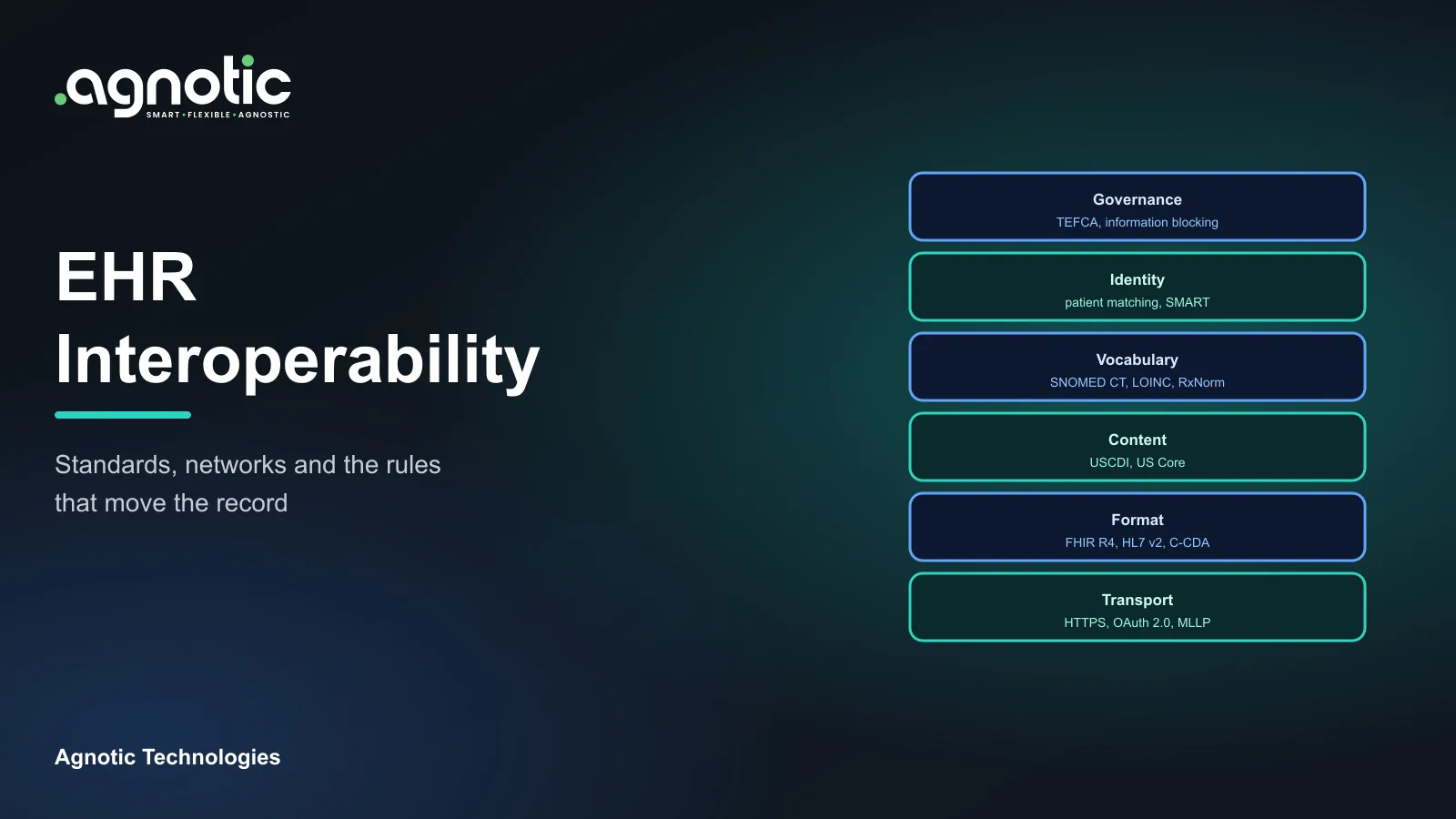
EHR implementation is the project of selecting, configuring and launching an electronic health record in a practice or hospital. It covers planning and governance, workflow design, system build, data migration, integrations, testing, training and go-live support, and it succeeds or fails on clinician adoption as much as on the technology.
This EHR implementation guide walks through the stages of EHR implementation, vendor selection, what drives the timeline and cost, the most common mistakes and the best practices that protect a go-live.
What is EHR implementation?
Implementing a new EHR?
We build the integrations, data migration and custom apps an EHR implementation needs.
What is EHR implementation, beyond installing software? It is an organizational change project. Every clinician, nurse, front desk and billing team changes how they work, often at once. The EHR vendor configures the product; the organization owns the decisions, the workflows, the data, the training and the outcome.
Who should be involved
- Executive sponsor: Owns the budget and settles disputes between departments.
- Physician and nursing leads: Make clinical build decisions and champion adoption.
- Project manager: Runs the plan, the vendor relationship and the issue list.
- Analysts and super users: Configure workflows and support colleagues at go-live.
- IT and integration team: Interfaces, devices, security and data migration.
- Revenue cycle and compliance: Billing workflows, privacy and security reviews.
Why does EHR implementation matter now?
- Certified technology: Hospitals in CMS's Medicare Promoting Interoperability Program and MIPS clinicians reporting that category must use certified EHR technology (42 CFR 495.4). ONC's Certified Health IT Product List shows which products and versions are certified under the ONC Health IT Certification Program.
- Safety self-assessment: ONC released eight updated SAFER Guides in 2025, and from the 2026 reporting period hospitals in the Promoting Interoperability Program must attest to an annual self-assessment using all eight.
- Standard APIs: From January 1, 2026, certified FHIR APIs must support USCDI v3, US Core 6.1.0 and SMART App Launch 2.0, built on HL7 International's FHIR standard, which matters for the apps and integrations around the new EHR.
- Data export: ONC criterion 170.315(b)(10) requires certified health IT to export all electronic health information in a documented format, which helps when leaving the old system.
- Security: The HIPAA Security Rule requires administrative, physical and technical safeguards for electronic PHI (45 CFR Part 164, Subpart C), enforced by HHS.
- Accessibility: HHS's Section 504 rule requires WCAG 2.1 Level AA for the web content and mobile apps of HHS funding recipients, and a 2026 interim final rule extended the compliance dates. Many teams design to WCAG 2.2.
What are the stages of EHR implementation?
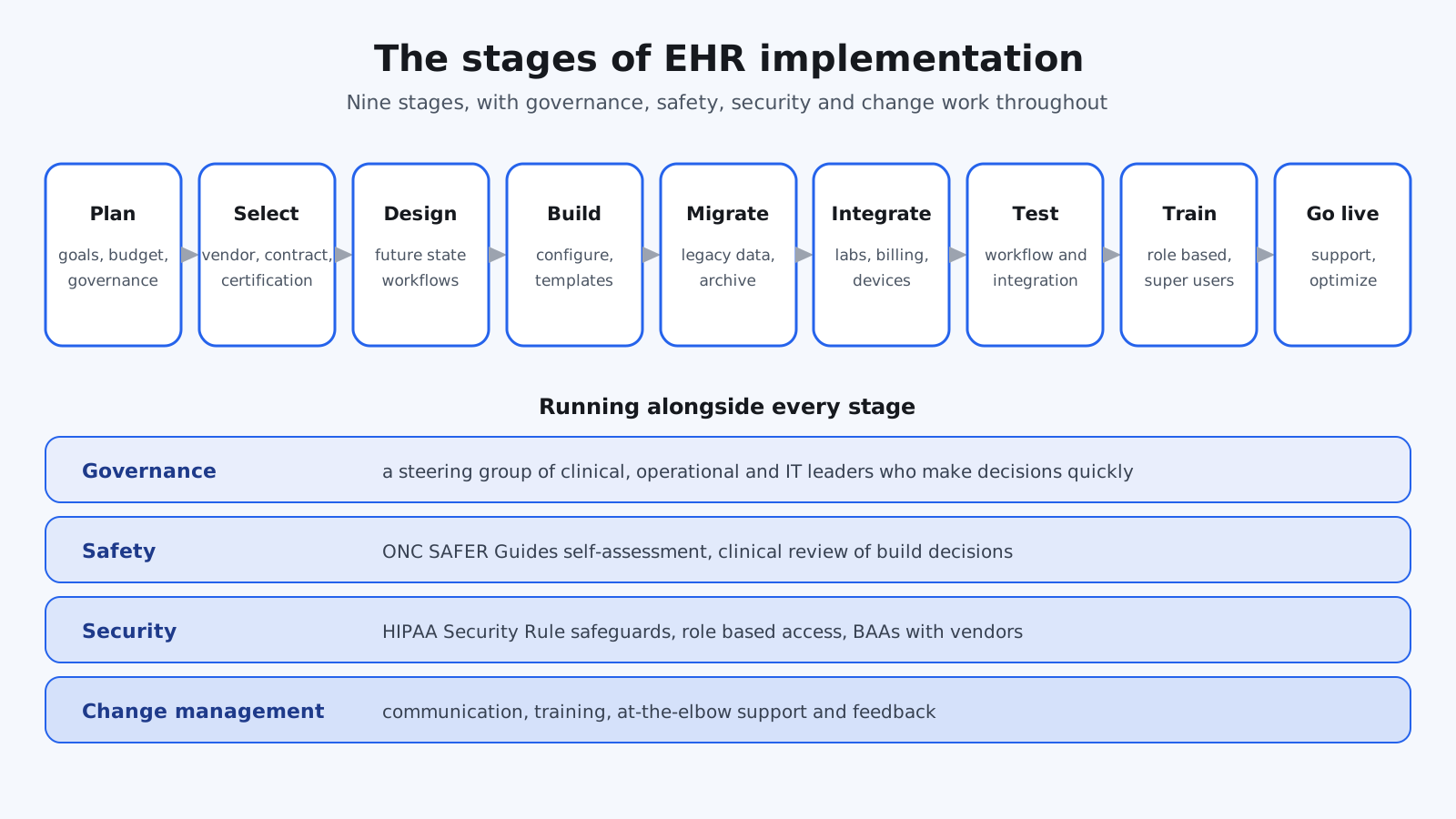
- 1. Plan: Set goals, budget, scope and governance, and name the people who will decide.
- 2. Select: Compare vendors on workflow fit, certification, APIs, data export, support and total cost.
- 3. Design: Map future state workflows for each role and department.
- 4. Build: Configure templates, order sets, security roles, schedules and billing rules.
- 5. Migrate: Decide what history moves, convert and validate it, and archive the rest.
- 6. Integrate: Connect labs, imaging, pharmacy, billing, devices and other systems.
- 7. Test: Run unit, integrated workflow and end to end tests, including downtime procedures.
- 8. Train: Role based training close to go-live, with super users in every team.
- 9. Go live and optimize: Provide at-the-elbow support, fix issues fast, then tune workflows over the following months.
Selecting the EHR vendor
- Workflow fit: Scripted demonstrations of your real workflows, not the vendor's standard demo.
- Certification: The product and version listed on ONC's Certified Health IT Product List.
- APIs and integration: FHIR API coverage, HL7 v2 interfaces and any API fees.
- Data rights: Export formats, data access during and after the contract, and transition support.
- Support and roadmap: Response times, upgrade schedule and customer references.
Downtime planning
Every EHR is sometimes unavailable, for upgrades or outages. Before go-live, agree on downtime procedures: read-only access to recent records, paper or offline forms for orders and notes, and a process to enter that information once the system returns. Test the procedure, not just the document.
Practice versus hospital implementations
A small practice implementation is shorter and simpler, but staff have less time to spare and often no in-house IT team, so vendor support and training matter most. A hospital implementation involves many departments, interfaces and devices, so governance, testing and command center support at go-live become the critical pieces.
What drives the EHR implementation timeline?
The EHR implementation timeline depends more on the organization than on the software. Size and number of sites, specialties with unique workflows, the number of interfaces, the amount of data to migrate, staff availability for design and training, and the vendor's own implementation method all set the pace. Plan design and testing generously, avoid go-live during known peak periods, and freeze changes to other systems around go-live. Phased go-lives by site or department lower risk but stretch the timeline, while a single go-live is shorter but needs more support at once.
Training that sticks
Train each role on the workflows it will actually use, as close to go-live as possible, in a practice environment with realistic patients. Give super users extra training and time to help colleagues, and provide short tip sheets for the first weeks. Check proficiency before go-live rather than counting attendance.
What is the cost of EHR implementation?
An EHR implementation cost guide should cover more than the license. These are the main cost categories:
- Software: Licenses or subscriptions, and modules priced separately.
- Implementation services: Vendor or consultant time for build, testing and go-live.
- Hardware and devices: Workstations, scanners, printers and mobile devices.
- Interfaces: Labs, imaging, pharmacy, billing and other connections.
- Data migration and archive: Conversion, validation and a read-only archive for legacy data.
- Training and backfill: Staff time in training and reduced schedules around go-live.
- Ongoing optimization: Analysts, upgrades and continued training after launch.
What are the common EHR implementation mistakes?
- Replicating old workflows: Rebuilding paper or legacy processes in a new system instead of improving them.
- Too little clinician involvement: Build decisions made without the people who will use them.
- Training too early or too generic: Staff forget training given months before go-live, or training that is not role specific.
- Underestimating interfaces and data: Integrations and migration started late and tested lightly.
- No downtime plan: No tested procedure for when the EHR is unavailable.
- Stopping at go-live: No budget or team for optimization afterwards.
- Ignoring revenue cycle: Billing workflows tested late, causing claim delays after go-live.
- Too many customizations: Heavy changes to the standard product that make every upgrade harder.
- Weak issue tracking: Problems reported in hallways and email instead of one list with owners and priorities.
What are EHR implementation best practices?
- Strong governance: A steering group that meets often and decides quickly.
- Future state design: Redesign workflows before configuring them.
- Super users: Trained champions in every department.
- Thorough testing: Integrated tests with real workflows and realistic data.
- Safety review: Use the SAFER Guides and clinical review of build decisions.
- Go-live support: Extra staff and fast issue resolution in the first weeks.
- Measure adoption: Track usage, documentation time and user feedback after launch.
- Keep the build standard: Prefer the vendor's standard content and change it only where the workflow truly needs it.
After go-live: optimization
The first months after go-live decide whether the EHR helps or hinders. Collect issues in one place, fix the most disruptive first, review documentation time and in-basket load by role, and schedule optimization sessions with each department. Plan budget and analyst time for this phase before go-live, not after.
Measuring success
Agree before go-live how success will be judged, and take a baseline. Useful measures include documentation time per visit, in-basket volume, charge lag and claim denials, patient wait times, portal adoption and user satisfaction by role. Review them at 30, 60 and 90 days, and use them to prioritize optimization work.
Communicating with patients
Patients notice an EHR change through new portals, new statements and longer visits in the first weeks. Tell them what will change and when, explain how to move to the new portal, and consider lighter schedules around go-live so clinicians have time to learn without long waits for patients.
Where does custom software fit in an EHR implementation?
Even a well chosen EHR rarely covers everything. Most implementations need custom work around it: interfaces to labs, devices and billing systems that the vendor does not provide, data migration and archives, patient or clinician apps built on the EHR's FHIR APIs, and analytics on the new data. Plan this work in the same schedule as the EHR build, because it often sits on the critical path.
How Agnotic can help
Agnotic Technologies is a software development services company. We support EHR implementations with the work around the EHR: interfaces and FHIR integrations, data migration and archives, apps that extend the EHR, and analytics, with HIPAA safeguards built in. We do not resell EHRs; we build the software that connects them. You own the code.
Support your EHR implementation with Agnotic
Explore our EHR integration services or browse more articles in our EHR integration hub.
Related reading on Agnotic
Go deeper on migration, integration and data topics covered in this guide.
Sources
- 42 CFR 495.4: Definitions, including certified EHR technology
- ASTP/ONC: Certified Health IT Product List (CHPL)
- ASTP/ONC: SAFER Guides
- Federal Register: FY 2026 IPPS final rule (Promoting Interoperability)
- ASTP/ONC: Standardized API for patient and population services, 170.315(g)(10)
- ASTP/ONC: Electronic health information export, 170.315(b)(10)
- 45 CFR Part 164, Subpart C: HIPAA Security Rule
- Federal Register: Extension of Section 504 web and mobile accessibility compliance dates (2026)