AI in telemedicine is the use of machine learning and language models inside remote care: triaging intake, drafting the visit note, translating in real time, flagging device readings, suggesting next steps and routing follow-up. Most of it is administrative help around the visit. Some of it is a medical device, and that line is where the risk sits.
This AI in telemedicine guide covers the uses, why the rules matter now, where AI sits in a remote visit, which uses are devices, how to add AI to a platform, best practices, common mistakes and your build plan.
What is AI in telemedicine?
Adding AI to a telemedicine platform?
Agnotic builds telemedicine platforms with AI where it helps: intake, ambient documentation, translation and device monitoring, with the FDA and HIPAA groundwork done first.
AI in telemedicine is artificial intelligence applied to remote care delivery: models that structure patient intake and suggest urgency, assistants that draft documentation from the visit audio, translation and captioning, anomaly detection on remote monitoring data, decision support shown to the clinician and automation of scheduling and follow-up. Artificial intelligence in telehealth works best when it removes work from the clinician without taking the decision away.
Common uses
- Intake and triage: Structured symptom capture and urgency suggestions before the visit.
- Ambient documentation: Draft notes from the visit audio, reviewed and signed by the clinician.
- Language access: Real-time translation and captions for patients and clinicians.
- Remote monitoring: Flags on device readings that cross thresholds or change trend.
- Decision support: Guideline prompts and risk scores shown during the visit.
- Operations: No-show prediction, slot filling, follow-up reminders and inbox triage.
Why does AI in telemedicine matter now?
- Telehealth coverage runs to 2027: The Consolidated Appropriations Act, 2026 extended most Medicare telehealth flexibilities, including home as an originating site and audio-only services, through December 31, 2027.
- FDA drew the line: FDA's Clinical Decision Support Software guidance, dated January 2026, explains when software is not a device under section 520(o)(1)(E) of the FD&C Act. Tools for time-critical decisions and tools that advise patients directly are treated as devices, and the guidance adds examples on clinical documentation tools.
- Device software has its own policy: FDA's Policy for Device Software Functions and Mobile Medical Applications explains which software functions FDA regulates and which fall under enforcement discretion.
- Discrimination must be checked: Under 45 CFR 92.210, from May 1, 2025 covered entities must make reasonable efforts to identify patient care decision support tools that use protected characteristics and mitigate the risk of discrimination.
- Vendors are business associates: Under 45 CFR 164.502(e), an AI vendor that receives visit audio, transcripts or readings containing PHI needs a Business Associate Agreement.
- A framework exists: The NIST AI Risk Management Framework (AI 100-1, January 2023) and its Generative AI Profile (AI 600-1, July 2024) give a voluntary structure to govern, map, measure and manage AI risk.
Where does AI sit in a telemedicine visit?
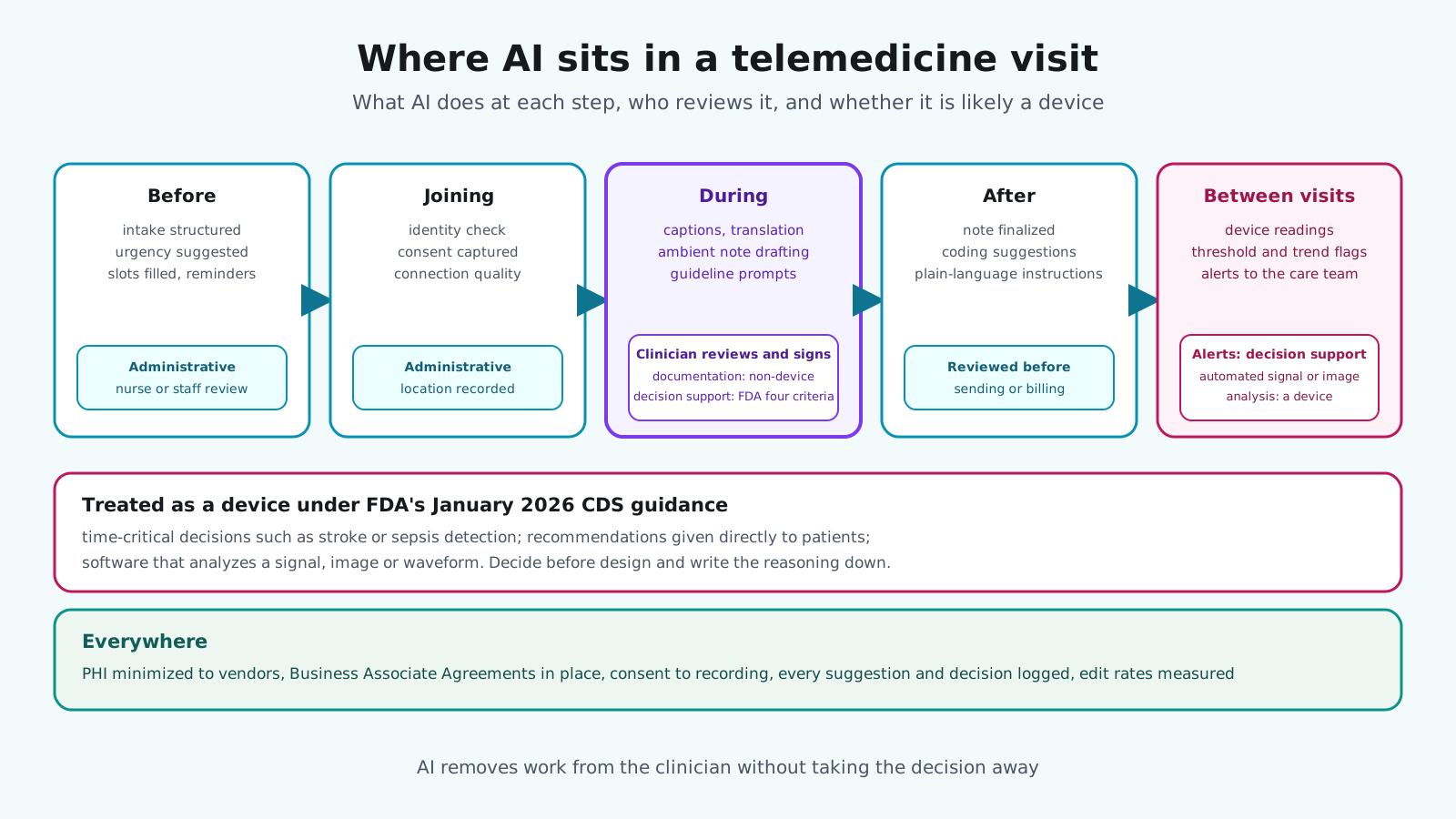
The diagram follows one remote visit from booking to follow-up and marks where AI helps, who reviews it and whether the use is likely a device. Most value sits before and after the visit, where the clinician is not present.
- Before: Intake questionnaires structured by AI, urgency suggestions routed to a nurse, slot filling and reminders. Administrative, reviewed by staff.
- Joining: Identity checks, consent capture and connection quality. Administrative.
- During: Captions and translation, ambient documentation drafting, guideline prompts for the clinician. Documentation is non-device when the clinician reviews it; decision support depends on the four FDA criteria.
- After: Note finalization, coding suggestions, patient instructions drafted in plain language, follow-up booking. Reviewed before anything is sent or billed.
- Between visits: Device readings monitored for threshold and trend changes. Alerts to a care team are decision support; automated analysis of signals or images is device territory.
- Everywhere: PHI minimized, BAAs in place, every suggestion and decision logged.
Which uses are medical devices?
Software that analyzes a signal, image or waveform, that supports a time-critical decision such as stroke or sepsis detection, or that gives a diagnosis or treatment recommendation directly to a patient is treated as a device under FDA's January 2026 guidance. Software that drafts documentation, structures intake, translates or shows a clinician a recommendation they can independently review usually is not. Decide before design, and write the reasoning down.
Ambient documentation in practice
Ambient scribes are the most adopted AI in telemedicine because the visit is already recorded as audio. The platform needs patient consent to recording, a vendor under a BAA, a draft that the clinician edits and signs before it reaches the record, and a way to measure edit rates. Drafts that are rarely edited deserve the same scrutiny as drafts that are always edited.
Consent and recording
Ambient documentation and translation need the visit audio, which means the patient must know it is being processed and by whom. Capture consent at the start of the visit, record it, let the patient decline and still receive care, and say how long audio and transcripts are kept. Consent rules for recording vary by state, so make the workflow configurable.
Measuring whether AI helps
Track edit rates on drafted notes, acceptance and override rates on triage suggestions, time per visit before and after, and error reports from clinicians and patients, broken down by language and age group. A feature that saves no time, or that clinicians override silently, is not helping, whatever the adoption number says.
How do teams add AI to a telemedicine platform step by step?
- 1. Pick one task: Intake structuring, note drafting or reading alerts, with a measurable outcome.
- 2. Classify it: Device or not under the FDA criteria, patient care decision support under 45 CFR 92.210 or administrative.
- 3. Choose the vendor or model: BAA, data retention terms, where processing happens and whether PHI trains the model.
- 4. Design the review step: Who sees the output, what evidence they see and how they accept, edit or reject.
- 5. Build the integration: Visit audio, intake data or device readings in; drafts and flags out to the EHR through FHIR after review.
- 6. Run in shadow mode: Outputs logged but not shown until accuracy and edit rates are known.
- 7. Launch with monitoring: Acceptance, edits, latency, errors and fairness across patient groups.
- 8. Govern: A committee that reviews performance and decides what expands, changes or stops.
What are AI in telemedicine best practices?
- Clinician review before the record: Drafts and suggestions become documentation only after a person signs.
- Consent for recording: Explicit, recorded and revocable, with the visit still possible without it.
- Minimize PHI to vendors: Send what the task needs and nothing more, under a BAA.
- Audio-only parity: Intake and documentation support work for phone visits too.
- Measure edits and overrides: They are the quality signal for drafting and triage.
- Check fairness: Compare triage and alert rates across language, age and other groups.
- Keep the device question open: Re-check classification when features change.
The practices above keep AI in the assistant's seat. The mistakes below are how it ends up making decisions nobody meant to delegate.
What are the common mistakes with AI in telemedicine?
- Triage that decides: Urgency scores that route patients without a nurse in the loop.
- Unsigned drafts: AI notes written to the record before the clinician reads them.
- No recording consent: Ambient tools switched on without telling the patient.
- Consumer AI tools: Transcription or translation services with no BAA.
- Device by accident: A monitoring feature that starts analyzing waveforms without a regulatory plan.
- Measuring adoption only: Usage celebrated while edit rates and errors go unread.
What does AI in telemedicine mean for your build plan?
- Use cases and classification: Each task is administrative, decision support or device, with different work.
- Vendors and BAAs: Models, transcription and translation services under agreement.
- Review interfaces: Screens for clinicians and staff to accept, edit or reject.
- Integration: Audio, intake and device data in, reviewed outputs to the EHR over FHIR.
- Monitoring and governance: Edit rates, fairness checks and a committee.
- Operations: Model and vendor changes, consent management and the regulatory calendar.
For the platform underneath, our telemedicine software guide covers choosing and integrating products, and our human in the loop AI guide covers the review design in depth.
How Agnotic can help
Agnotic Technologies is a software development services company. We build telemedicine platforms with AI features that help without deciding: structured intake and triage with nurse review, ambient documentation with clinician sign-off, translation and captions, device monitoring alerts, and the FHIR integration, audit logging and vendor agreements around them, with the FDA classification settled before design. Your clinicians keep the decisions. The platform does the work around them.
Add AI to your telemedicine platform with Agnotic
Explore our telemedicine platform development services or browse more articles in our HL7 hub.
Related reading on Agnotic
Go deeper on the telemedicine, AI and compliance topics covered in this guide.
Sources
- Congress.gov: Consolidated Appropriations Act, 2026 (H.R. 7148)
- FDA: Clinical Decision Support Software guidance (January 2026)
- FDA: Policy for Device Software Functions and Mobile Medical Applications
- 45 CFR 92.210: Nondiscrimination in the use of patient care decision support tools
- 45 CFR 164.502: Uses and disclosures of PHI, including business associates
- NIST: AI Risk Management Framework (AI 100-1)
- NIST AI 600-1: Generative AI Profile
- HHS OCR: HIPAA and telehealth