Clinical decision support (CDS) is software that gives clinicians, staff or patients knowledge and person-specific information at the point of decision: alerts, reminders, order sets, guideline summaries, risk scores and, increasingly, AI generated suggestions. Most of it lives inside or next to the EHR, and the useful kind stays quiet until it has something worth saying.
This clinical decision support guide covers the types, the role of the EHR, how a CDS Hooks service works, FDA regulation, where CDS helps most, whether it pays off, best practices, common mistakes and a buyer's checklist.
What is clinical decision support?
Adding AI decision support to an EHR workflow?
Agnotic builds clinical decision support that runs inside the EHR: CDS Hooks services, SMART on FHIR apps and the models behind them.
Clinical decision support is health IT that delivers knowledge and patient-specific information to clinicians, staff or patients at the moment a decision is made, so the decision is safer and more consistent. It includes alerts, reminders, order sets, documentation templates, diagnostic suggestions and predictive models, delivered inside the EHR or through connected apps.
Types of clinical decision support
- Alerts and interruptions: Drug interaction, allergy, dose range and duplicate order checks.
- Reminders: Overdue screenings, immunizations and follow-ups, shown in the chart or a worklist.
- Order sets and pathways: Pre-built orders for a condition or procedure that encode a protocol.
- Documentation support: Templates and prompts that capture the data a guideline needs.
- Reference and guidance: Guideline summaries and calculators available in context.
- Diagnostic and predictive tools: Risk scores, early warning systems, imaging triage and AI suggestions.
The five rights of CDS
ASTP/ONC describes effective CDS as delivering the right information, to the right person, in the right format, through the right channel, at the right time in the workflow. Most failed CDS breaks one of these, usually format or time.
Why does clinical decision support matter now?
- FDA guidance was revised: The FDA's Clinical Decision Support Software guidance dated January 2026 replaces the September 2022 version. It explains how FDA applies the four non-device criteria in section 520(o)(1)(E) of the FD&C Act and extends enforcement discretion to some tools that give a single recommendation.
- Certification moved to DSIs: Since January 1, 2025, ONC certification criterion 170.315(b)(11), decision support interventions, has replaced the older clinical decision support criterion and requires source attribute transparency for predictive DSIs. ASTP/ONC's HTI-5 proposed rule (January 2026) would remove parts of that requirement. It was not final as of October 2026.
- The integration standard matured: HL7 CDS Hooks 2.0.1 is the current published version of the specification for calling external decision support from inside the EHR, with hooks such as patient-view, order-select and order-sign.
- Imaging mandates were rescinded: CMS rescinded the Appropriate Use Criteria program regulations for advanced diagnostic imaging effective January 1, 2024, so radiology CDS is now driven by quality and workflow rather than a Medicare claims requirement.
- Safety is assessed: ONC's SAFER Guides include a Clinical Decision Support guide, and hospitals in the Medicare Promoting Interoperability Program attest to an annual SAFER self-assessment.
What is the role of the EHR in clinical decision support?
The EHR is where the decision happens, so it is where CDS must appear. It holds the data, the workflow events and the screen the clinician is looking at. EHR clinical decision support benefits come from that position: the data is already there and the suggestion lands where the order is placed.
- Native rules: Vendor-supplied and locally configured alerts, order sets and reminders, maintained by the clinical informatics team.
- CDS Hooks: The EHR calls an external service at a workflow event and shows the returned cards.
- SMART on FHIR apps: Clinical decision support apps with EHR integration launch in context with the patient's data and show richer interfaces.
- Bulk data: Population-level FHIR exports feed risk models and worklists outside the chart.
- Write-back: Suggested orders or documentation returned as FHIR resources the clinician can accept.
How does a CDS Hooks service work?
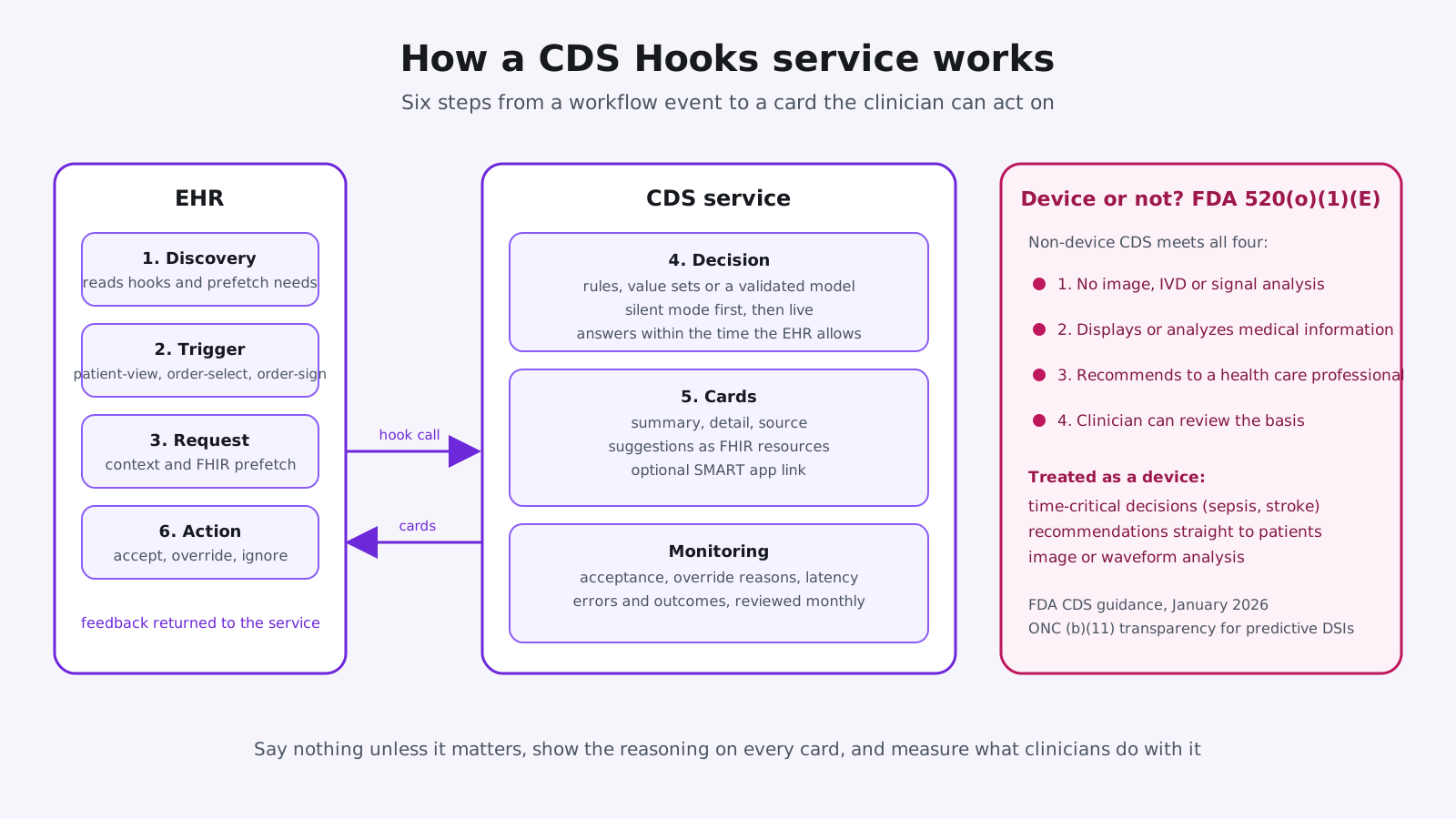
- 1. Discovery: The EHR reads the service's discovery endpoint to learn which hooks it supports and what prefetch data it wants.
- 2. Trigger: A clinician opens a chart (patient-view), selects an order (order-select) or signs orders (order-sign).
- 3. Request: The EHR sends context and prefetched FHIR resources, or a token the service uses to fetch more.
- 4. Decision: The service runs its rules or model and decides whether to say anything at all.
- 5. Cards: It returns zero or more cards with a summary, detail, source, and optional suggestions or a SMART app link.
- 6. Action and feedback: The clinician accepts, overrides or ignores. The EHR can send feedback so the service learns its override rate.
What do FDA clinical decision support regulations require?
FDA clinical decision support regulations turn on whether the software is a device. Under section 520(o)(1)(E) of the FD&C Act, software is not a device when it meets all four criteria:
- 1. It does not acquire, process or analyze a medical image, a signal from an in vitro diagnostic device, or a pattern or signal from a signal acquisition system.
- 2. It displays, analyzes or prints medical information about a patient or other medical information, such as clinical guidelines.
- 3. It supports or provides recommendations to a health care professional about prevention, diagnosis or treatment.
- 4. It lets the professional independently review the basis for the recommendation, so they do not rely primarily on it.
The January 2026 guidance treats software for time-critical decisions, such as real-time sepsis or stroke detection, as a device, and treats recommendations given directly to patients as a device. It extends enforcement discretion to tools that give a single recommendation when only one is clinically appropriate and the other criteria are met.
Advanced clinical decision support that reads images or waveforms, or that hides its reasoning, is a device and needs a regulatory plan from day one. Deciding this before design is cheaper than discovering it before launch.
Where does clinical decision support help most?
Clinical decision support helps most where a decision is frequent, the evidence is clear and the data is already structured. Three settings come up in almost every scoping call.
Radiology clinical decision support
Radiology CDS checks an imaging order against appropriateness guidance and protocol rules, and increasingly triages images for urgent findings. Order-time CDS runs on the order-select hook and can be non-device software. Image triage reads DICOM studies and is device software.
Clinical decision support for nursing
Nursing CDS includes early warning scores, fall and pressure injury risk, sepsis screening and medication administration checks. It must fit the nursing workflow, which is more mobile and more interrupted than physician ordering, so worklists and mobile cards often work better than pop-ups.
AI clinical decision support tools and agents
AI clinical decision support tools range from predictive risk models to language model assistants that draft summaries or answer guideline questions. AI agents for clinical decision support go further and chain steps, such as gathering data, checking a guideline and proposing an order set. Keep a clinician in the loop, log every suggestion and its outcome, and treat anything that reads images or signals, or acts under time pressure, as a device.
Are clinical decision support systems worth it?
The benefits of clinical decision support systems are real when the five rights are met: fewer prescribing errors, better guideline adherence and less variation. The costs are real too, and the answer depends on measuring both.
- Where value shows: Medication safety, closing care gaps, consistent protocols and fewer unnecessary orders.
- Where it fails: High interruption rates that clinicians override by habit, and tools nobody measures.
- What it costs: Rule authoring and maintenance, integration, clinician review time, monitoring and, for device software, regulatory work.
- How to judge: Acceptance rate, override reasons, outcome changes and time added to the workflow. Retire what does not move them.
What are clinical decision support best practices?
- Interrupt rarely: Reserve pop-ups for high-severity, high-specificity checks and put everything else in worklists or passive cards.
- Show the reasoning: Every suggestion carries its source, the data it used and a way to read more.
- Start silent: Run new logic in production without showing it, compare against outcomes, then switch cards on.
- Version everything: Rules, value sets, models and thresholds, with a changelog clinicians can read.
- Measure acceptance: Track accepts, overrides and override reasons per intervention and review them monthly.
- Keep latency low: Cache prefetch data and answer within the time the EHR allows, or the hook gets disabled.
- Govern as a committee: Clinical, informatics and engineering owners who can retire an intervention.
How do teams build clinical decision support step by step?
- 1. Pick one decision: A specific clinical question with a measurable outcome and a clinical owner.
- 2. Classify it: Run the four FDA criteria and the time-critical test. Decide device or non-device before design.
- 3. Choose the delivery: Native rule, CDS Hooks service or SMART app, based on the data and interface needed.
- 4. Define the logic: Rules, value sets and thresholds with clinicians, or a validated model with documented performance.
- 5. Build and test: Against sandbox data, then a test tenant, with a silent mode in production before any card is shown.
- 6. Design for transparency: Every card shows its source, its reasoning and the data it used.
- 7. Launch with monitoring: Acceptance, overrides, latency, errors and outcomes from day one.
- 8. Govern: A CDS committee that reviews performance and retires or tunes interventions.
What are the common mistakes with clinical decision support?
- Alert fatigue by design: Too many interruptive alerts with low specificity, so clinicians override everything.
- No silent mode: Cards shown to clinicians before the logic was validated on real data.
- Hard-coded value sets: Codes that drift as terminologies update, so rules silently stop firing.
- Ignoring latency: A hook that takes seconds blocks ordering and gets switched off.
- No feedback loop: No record of what was accepted or overridden, so nothing improves.
- Scope creep into device territory: A non-device tool that starts reading signals without a regulatory plan.
- No owner: Rules written by a vendor or a departed informaticist that nobody maintains.
A clinical decision support software buyer's checklist
Whether you are buying a CDS product or commissioning one, this clinical decision support software buyers guide is the list we run before we recommend a tool to a client.
- Evidence and logic: Can you read the rules, or the model's documented performance, population and limitations?
- Regulatory status: Device or non-device, with the reasoning and any FDA clearance in writing.
- Integration: CDS Hooks and SMART on FHIR support, FHIR R4 and US Core data, and write-back options.
- Transparency: ONC (b)(11) source attribute information for predictive tools.
- Workflow fit: Which hook, which screen, which role, and how often it will interrupt.
- Measurement: Built-in acceptance and override reporting.
- Maintenance: Who updates value sets, guidelines and models, and how often.
- Data handling: Where PHI goes, who signs the BAA and how long data is kept.
How Agnotic can help
Agnotic Technologies is a software development services company. We build clinical decision support that fits the EHR: CDS Hooks services, SMART on FHIR apps, rule and model services with silent mode and monitoring, and the FHIR integration underneath, with the FDA classification and HIPAA safeguards worked out before the build. Your clinicians own the logic. We make it run reliably.
Build your clinical decision support with Agnotic
Explore our clinical decision support AI work or browse more articles in our EHR integration hub.
Related reading on Agnotic
Go deeper on the EHR integrations, data and AI covered in this guide.