The healthcare AI trends that matter in 2026 are AI agents moving into administrative workflows, generative and multimodal models entering clinical documentation and imaging, and a sharp rise in governance obligations. For buyers and builders, the trend is less about smarter models and more about connecting AI safely to EHR data, payer rules and HIPAA controls.
This guide explains each trend, why the timing matters, and how to turn it into a practical build plan.
What are the main healthcare AI trends right now?
Planning a healthcare AI build?
Our AI and ML development for healthcare team works through these same questions with founders and hospital technology leaders before any code is written.
Artificial intelligence in healthcare has moved past the question of whether models are capable. The open questions now are where AI fits into real workflows, which data it can reach, and who is accountable for its output. Seven trends define the current market.
1. AI agents for administrative work
AI agents in healthcare are software that plans and completes multi-step tasks: checking eligibility, assembling a prior authorization packet, drafting an appeal for a denied claim, or rescheduling an appointment. Administrative work is where most production deployments start, because the inputs are structured, the outcomes are measurable, and a human can review the result before it reaches a patient or payer. Examples include prior authorization and claims denial management.
2. Agentic AI with human checkpoints
Agentic AI in healthcare goes a step further: the system decides which tools to call and in what order. That flexibility is useful for messy work such as reconciling records across systems, but it raises the stakes on permissions and logging. The pattern that holds up in regulated settings is narrow scope, explicit approval steps for anything that changes a record or reaches a patient, and a full audit trail of every action the agent took.
3. Generative AI for documentation
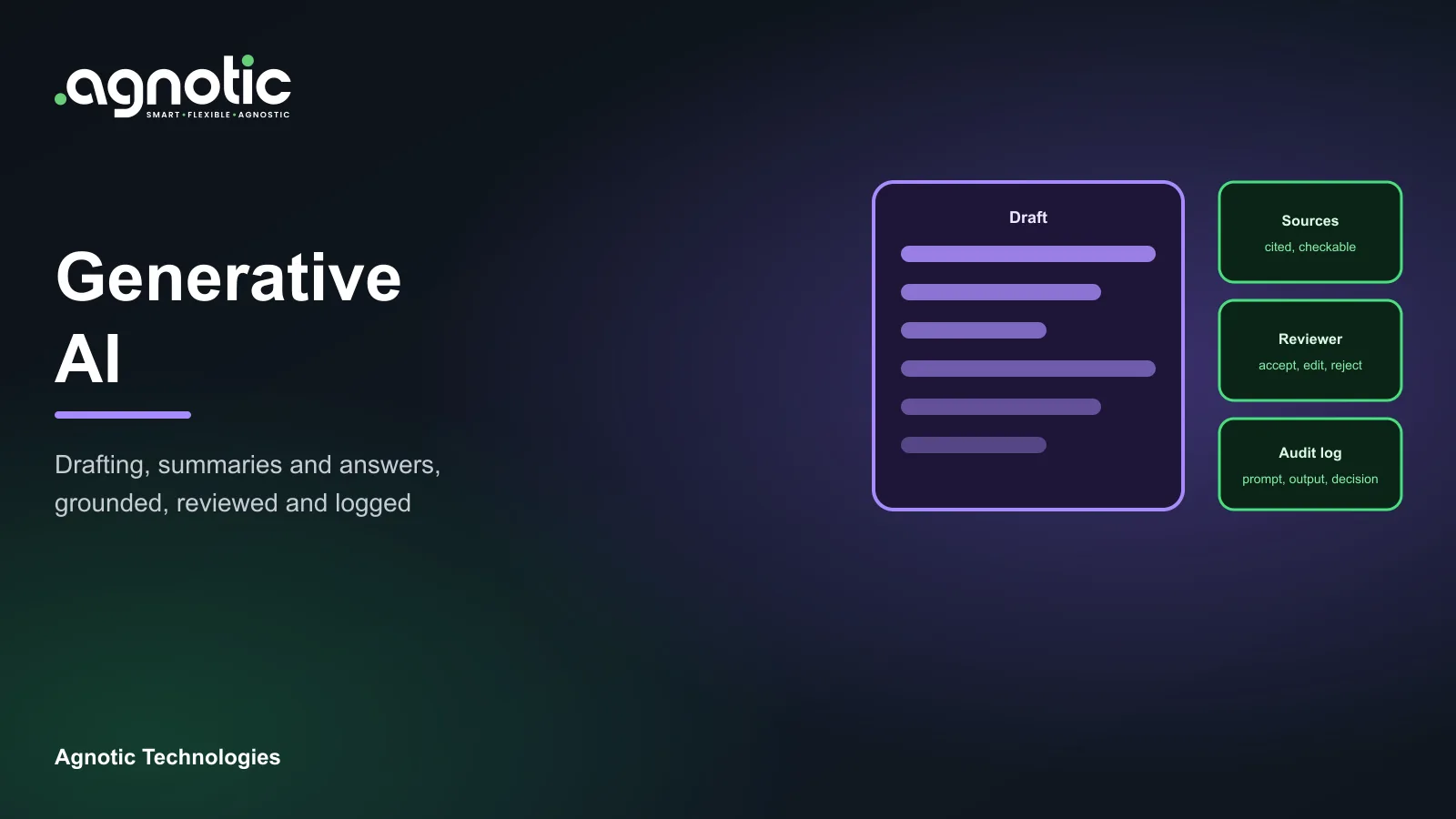
Generative AI in healthcare is most visible in clinical documentation: drafting visit notes from ambient audio, summarizing long charts, and preparing patient-friendly discharge instructions. The value is time returned to clinicians. The risk is fluent text that is wrong. NIST published a Generative AI Profile (NIST AI 600-1, July 2024) that lists risks specific to these models, including confabulation and data privacy, and maps them to controls.
4. Multimodal AI across images, notes and device data
Multimodal AI in healthcare combines more than one data type, for example an imaging study, the radiology report, lab trends and wearable readings. Clinical questions rarely live in one data type, so multimodal models can give more complete context. They also cross regulatory lines more easily: FDA's clinical decision support guidance, revised in January 2026, keeps software that analyzes medical images to produce diagnostic output under device oversight.
5. AI in personalized healthcare
AI in personalized healthcare uses a patient's history, risk factors and response data to tailor outreach, care plans or follow-up intensity. Readmission risk scoring and chronic care management are common starting points. Personalization depends on the inputs a model uses, which is why fairness rules now apply directly to these tools (covered below).
6. AI for cybersecurity in healthcare
AI for cybersecurity in healthcare works in two directions. Security teams use machine learning to spot unusual access to records and suspicious network behavior. At the same time, every new AI system is a new place where protected health information (PHI) is stored, sent to a model, or written to a log. Securing the AI pipeline itself, including prompts, outputs and vendor connections, is now part of AI data security work.
7. Governance and the healthcare AI paradox
The healthcare AI paradox is the gap between better models and measurable results. Models keep improving, yet many deployments struggle to show value, usually because the model lacks context: the relevant facts are split across EHR records, payer policies and free-text notes. The response is a governance layer that decides which use cases go forward, how each is measured, and when a model is retired. The NIST AI Risk Management Framework (NIST AI 100-1, January 2023) organizes this work into four functions: Govern, Map, Measure and Manage.
Why do these healthcare AI trends matter now?
Several rules with fixed dates now shape how AI gets built and bought. These are the ones most relevant to digital health founders and hospital CTOs and CIOs.
- Prior authorization timelines: The CMS Interoperability and Prior Authorization Final Rule (CMS-0057-F) requires impacted payers, such as Medicare Advantage organizations and Medicaid and CHIP programs, to decide standard prior authorization requests within 7 calendar days and expedited requests within 72 hours starting in 2026. FHIR-based APIs, including a Prior Authorization API, follow from January 2027. Faster clocks create direct demand for automation on both the payer and provider side.
- Transparency for AI inside certified health IT: The ONC (now ASTP/ONC) HTI-1 Final Rule added decision support intervention requirements to the certification program, including source attribute information for predictive models. The HTI-5 proposed rule, published in December 2025, proposes revisions to that criterion, so teams should track the final text.
- Nondiscrimination for decision support tools: Under 45 CFR 92.210, covered entities must not discriminate on the basis of race, color, national origin, sex, age or disability through patient care decision support tools, must make reasonable efforts to identify tools that use those factors as inputs, and must make reasonable efforts to mitigate the resulting risk.
- Device boundaries: FDA's revised clinical decision support guidance (January 2026) sets which software functions fall outside device oversight. Image analysis that produces diagnostic output remains a device function.
- HIPAA still applies to every AI vendor: A covered entity may let a business associate handle PHI only with satisfactory assurances documented in a written agreement (45 CFR 164.502(e) and 164.504(e)), which in practice means a Business Associate Agreement with each AI vendor that touches PHI. The HIPAA Security Rule requires administrative, physical and technical safeguards for electronic PHI (45 CFR Part 164, Subpart C). HHS proposed significant Security Rule changes in January 2025; until a final rule is published, the current rule applies.
How do teams approach a healthcare AI project step by step?
The future of AI in healthcare will be decided by delivery discipline more than by model choice. A sequence that works for most teams:
- 1. Pick one workflow and one owner: Choose a task with a clear before and after, such as hours spent on prior authorization packets, and name the clinical or operational owner who will judge success.
- 2. Map the data path: List every system the AI reads from and writes to, every place PHI travels, and every vendor in the chain. Confirm a BAA exists for each vendor that touches PHI.
- 3. Classify the risk: Decide whether the function could be a medical device, whether it is a decision support tool under Section 1557, and whether it will sit inside certified health IT. This decides how much documentation and validation you need.
- 4. Build on standards: Use HL7 FHIR APIs for data access and, where the AI surfaces advice inside the EHR, CDS Hooks for delivering that advice at the right point in the workflow. Standards keep the project portable across EHR vendors.
- 5. Design the human checkpoint: Define what the AI may do on its own, what needs approval, and how a reviewer sees the evidence behind an output.
- 6. Measure before scaling: Agree on two or three metrics before launch, such as turnaround time, rework rate and override rate, and track them per site.
- 7. Plan for change: Models drift and rules change. Version every model and prompt, keep evaluation data, and schedule reviews.
What are the common mistakes with AI in healthcare?
- Starting with the model instead of the workflow: A strong demo on clean data says little about performance on real charts with missing fields and inconsistent coding.
- Treating the BAA as the whole compliance plan: A signed agreement does not cover logging, access control, retention of prompts and outputs, or de-identification of training data.
- No plan for wrong answers: Every AI output in a clinical or payer workflow needs a visible source, a way to correct it, and a record of the correction.
- Ignoring inputs that create bias: If a model uses age, sex or other protected characteristics, Section 1557 expects reasonable efforts to identify and mitigate discrimination risk.
- Building one-off integrations: Custom point-to-point connections to a single EHR make the next site expensive. Standards-based integration keeps the second deployment cheaper than the first.
- Measuring usage instead of outcomes: Logins and generated notes are activity. Time saved, denials avoided and errors caught are results.
What do these trends mean for your build plan?
Infusing AI in healthcare products works best when each trend is tied to a concrete engineering decision. Use this list as a starting checklist: the trend, the build decision, and the standard or rule to check.
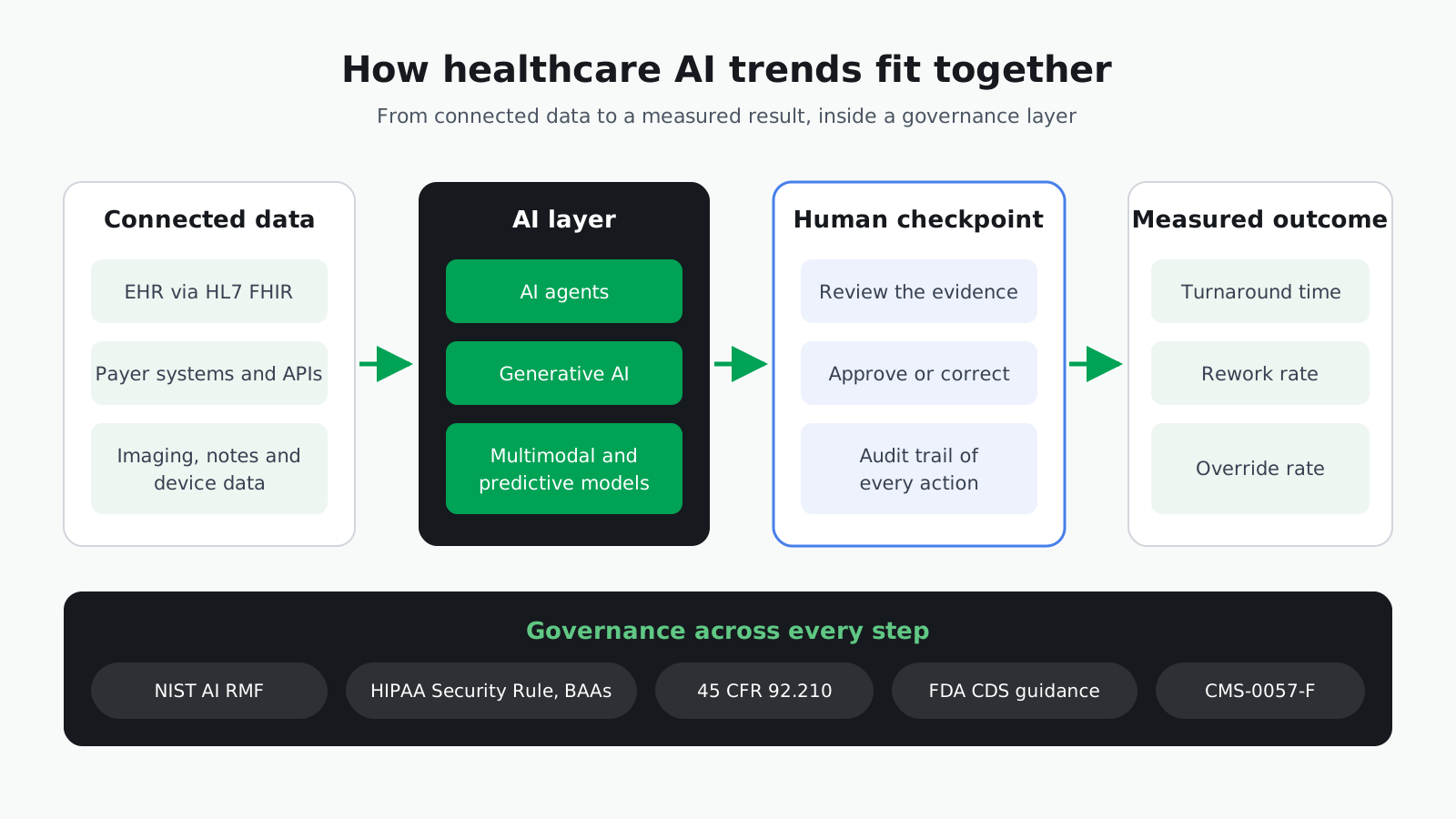
- AI agents for admin work: Scope tools and permissions per task and log every action. Check CMS-0057-F timelines and payer API specs.
- Agentic AI: Add an approval step before any write to a record. Check HIPAA Security Rule audit controls.
- Generative AI: Show sources for generated text and require human sign-off. Check NIST AI 600-1.
- Multimodal AI: Confirm device status early. Check FDA CDS guidance (2026).
- Personalized care models: Review input variables for protected characteristics. Check 45 CFR 92.210.
- AI for cybersecurity: Treat prompts, outputs and logs as PHI stores. Check 45 CFR Part 164, Subpart C.
- Governance: Define use case intake, metrics and retirement criteria. Check the NIST AI RMF (AI 100-1).
Two practical notes. First, if your product already runs on older architecture, modernization often comes before AI. Second, if the AI will handle PHI in a patient-facing app, read our guide to building a HIPAA compliant AI app before choosing vendors.
Related reading on Agnotic
Go deeper on the workflows, standards and safeguards covered in this guide.
How Agnotic can help
Agnotic Technologies is a software development services company. We design and build healthcare AI for your team: scoping the workflow, integrating with EHR and payer systems over FHIR, putting HIPAA safeguards in place, and setting up the measurement that shows whether the system is working. You own the product; we build it with you.
Build healthcare AI with Agnotic
Explore our AI and ML development for healthcare service, browse more articles in our healthcare AI agents hub, or review our approach to HIPAA compliance.
Sources
- NIST AI Risk Management Framework (AI 100-1) and Generative AI Profile (AI 600-1)
- CMS Interoperability and Prior Authorization Final Rule (CMS-0057-F)
- ASTP/ONC Health IT Certification Program (HTI-1)
- ASTP/ONC HTI-5 Proposed Rule
- FDA Clinical Decision Support Software Guidance
- 45 CFR 92.210: Nondiscrimination in the use of patient care decision support tools
- 45 CFR 164.502: Uses and disclosures of protected health information