Epic implementation is the program a health system runs to replace its clinical, operational and billing systems with Epic: configuring the record, converting data, connecting interfaces and third-party systems, training every user and going live without interrupting care. For software vendors, it is also the window in which your product gets connected, or gets left out.
This Epic implementation guide covers what the program involves, why it matters to builders now, the steps for Epic implementation, the integration workstream that vendors join, best practices, common mistakes and what it means for your build plan.
What is Epic implementation?
Connecting your product during an Epic go-live?
Agnotic builds Epic integrations that fit an implementation timeline: Epic on FHIR apps, HL7 v2 interfaces, data conversions and the testing that go-live demands.
Epic implementation is the multi-phase program through which a hospital, health system or large practice adopts the Epic electronic health record: planning and governance, workflow design and system build, data conversion, interface and third-party integration, testing, training and go-live, followed by optimization. It replaces many systems at once, which is why it is run as an organization-wide program rather than an IT project.
Who is involved
- Executive sponsors and governance: Decide scope, standard workflows and what stays local.
- Epic's implementation team: Guides configuration, tooling and the go-live plan.
- Analysts: The organization's certified application analysts who build and maintain each module.
- Clinical and operational leads: Define workflows and validate the build.
- Interface and integration teams: Connect labs, devices, payers, state registries and third-party software.
- Trainers and super users: Credentialed trainers deliver role-based training and support go-live on the floors.
- Vendors: Every third-party system that must exchange data with Epic, on the program's timeline.
Why does Epic implementation matter for builders now?
- The integration surface is standard: Epic on FHIR describes itself as a free resource for developers who create apps for use by patients and healthcare organizations, with resources across FHIR DSTU2, STU3 and R4, OAuth 2.0 for apps and backend clients and a FHIR Bulk Data Access tutorial.
- The catalog is large: open.epic states that over 750 no-cost APIs and interfaces are available, and that USCDI v3 support is available to app developers for free.
- Certification sets the baseline: Under ONC criterion 170.315(g)(10) and the HTI-1 rule, certified EHRs expose a FHIR API supporting USCDI v3, US Core 6.1.0, SMART App Launch 2.0 and Bulk Data Access from January 1, 2026.
- Data must keep moving: The information blocking rules at 45 CFR Part 171 restrict practices that interfere with access, exchange or use of electronic health information, which applies during and after a migration.
- Safety is assessed: ONC's SAFER Guides provide EHR safety self-assessments, and hospitals in the Medicare Promoting Interoperability Program attest to an annual assessment, so safety configuration is part of the build.
- Security is required: The HIPAA Security Rule requires a risk analysis and risk management process at 45 CFR 164.308(a)(1), and a Business Associate Agreement under 164.502(e) with every vendor that handles PHI.
What are the steps for Epic implementation?
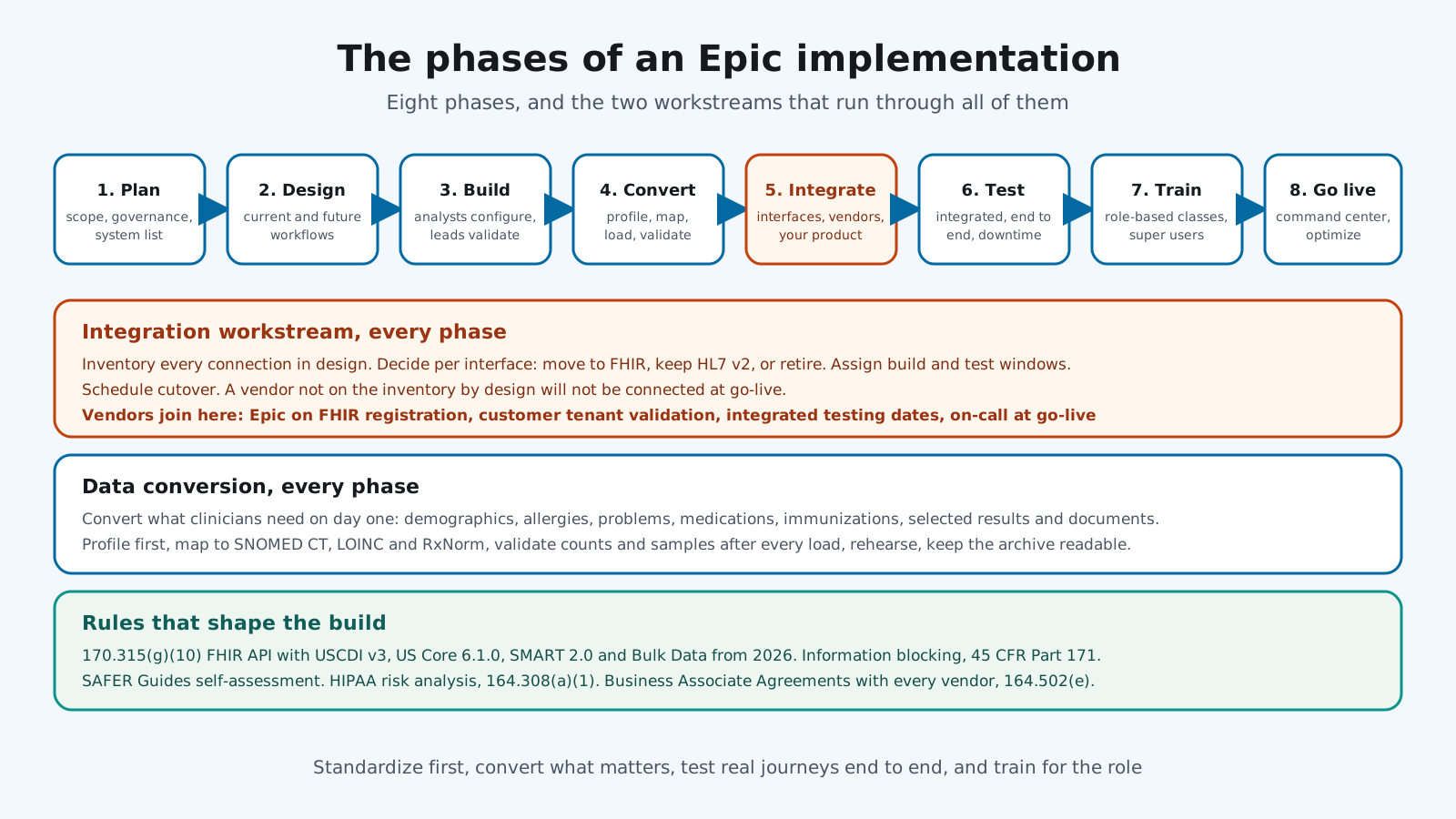
The steps for Epic implementation follow the same shape in most organizations, even though names and durations differ. The diagram shows the phases and, underneath them, the integration workstream that third-party vendors join.
- 1. Plan and govern: Scope, timeline, decision rights, standard workflows and the list of systems to replace, keep or connect.
- 2. Discover and design: Current workflows mapped, future workflows agreed, module by module.
- 3. Build and validate: Analysts configure Epic; clinical and operational leads review the build in validation sessions.
- 4. Convert data: Patient, provider, schedule, problem, medication and document data profiled, mapped and loaded, with legacy archives kept readable.
- 5. Integrate: Interfaces and third-party systems connected and tested, from lab analyzers to payers to your product.
- 6. Test: Unit, integrated and end-to-end testing, including downtime procedures.
- 7. Train: Role-based classes, practice environments and super users ready before go-live.
- 8. Go live and stabilize: Command center, elbow support, issue triage and rapid fixes, then optimization.
The integration workstream
Integration runs alongside every phase, and it is where vendors live or die. The team inventories every connection, decides whether each one moves to FHIR, stays on HL7 v2 or is retired, assigns build and test windows, and schedules cutover. A vendor that is not on that inventory by the design phase will not be connected at go-live.
Data conversion is not optional
Conversion decides what clinicians see on day one. Most programs convert demographics, allergies, problems, medications, immunizations, selected results and documents, and leave the rest in a read-only archive. Profile the legacy data before mapping it, map codes to standard terminologies, validate counts and samples after every load, and rehearse the final load more than once.
Testing that finds the real problems
Unit tests prove a build matches its design. Integrated testing proves that a referral placed in one module reaches the lab, the claim and the patient's portal. End-to-end scripts that follow real patients through admission, orders, results, discharge and billing, across every interface, are where most go-live defects are found, and they need vendor systems connected to be meaningful.
Training and super users
Clinicians learn Epic in role-based classes delivered by credentialed trainers, then rely on super users on the floors at go-live. Vendors whose products appear in those workflows should supply tip sheets in the same format the training team uses, and should be reachable during go-live hours, because a confused clinician calls the command center, not the vendor.
How should a vendor prepare for an Epic implementation?
- Get on the inventory early: Ask the integration lead for the system list and confirm your product is on it with an owner and a date.
- Choose the surface: FHIR and SMART on FHIR through Epic on FHIR where possible; HL7 v2 through the interface engine where events or legacy formats require it.
- Register and test: Epic on FHIR app registration, sandbox tests and least-privilege scopes before the customer's build environment opens.
- Plan for the customer's tenant: Validate in their test environment with their configuration, and expect a security review.
- Fit the go-live window: Integrated testing dates, cutover sequence and who is on call for your side during command center hours.
- Document for trainers: Tip sheets that match the workflows the health system is teaching.
What are Epic implementation best practices?
- Standardize first: Adopt standard workflows and keep local variation for real clinical differences.
- Decide interface by interface: Move to FHIR where the data model allows, keep HL7 v2 where the partner needs it, retire what nobody uses.
- Convert what clinicians need on day one: Everything else goes to a searchable archive.
- Test with real scenarios: End-to-end patient journeys across modules and interfaces, including downtime.
- Train for the role, not the module: Clinicians learn their workflow, with super users close by at go-live.
- Run the SAFER Guides: Before go-live and again in optimization.
- Keep the archive and the audit trail: Legacy records stay accessible for the retention period, and every conversion load is logged.
The practices above are what keeps an implementation on schedule. The mistakes below are what vendors and health systems tell us went wrong on the ones that slipped.
What are the common mistakes with Epic implementation?
- Late vendors: Third-party systems discovered during testing, with no build window left.
- Converting everything: Years of unstructured data loaded into the new record, slowing clinicians on day one.
- Custom build everywhere: Local variation that makes upgrades and training harder for years.
- Interfaces tested in isolation: Each feed works alone, and the end-to-end journey fails at go-live.
- No downtime drill: Procedures written but never practiced before the first outage.
- Optimization skipped: The program ends at go-live and the issues list is never worked.
What does Epic implementation mean for your build plan?
- Scope and modules: How many care settings and modules go live, and in how many waves.
- Interfaces and vendors: Each connection is a build, test and cutover item with an owner.
- Data conversion: Profiling, mapping, validation, rehearsal loads and the archive.
- Testing and training: Integrated test cycles and role-based training for every user.
- Go-live support: Command center, super users and vendor on-call coverage.
- Optimization: Issues, enhancements and the SAFER review after stabilization.
For the EHR side of the same program, our EHR implementation guide covers vendor-neutral stages and cost drivers, and our EHR data migration guide covers conversion in depth.
How Agnotic can help
Agnotic Technologies is a software development services company. During Epic implementations we build the integration work that health systems and vendors need on the program's timeline: Epic on FHIR apps and SMART launches, HL7 v2 interfaces through the interface engine, data conversion pipelines with validation, and the test automation and monitoring that carry a connection through go-live. Your program sets the dates. We meet them.
Get your integration ready for an Epic go-live with Agnotic
Explore our Epic integration services or browse more articles in our EHR integration hub.
Related reading on Agnotic
Go deeper on the Epic, implementation and data topics covered in this guide.
Sources
- Epic: Epic on FHIR developer resources
- Epic: open.epic
- ASTP/ONC: Standardized API for patient and population services, 170.315(g)(10)
- ASTP/ONC: HTI-1 final rule
- 45 CFR Part 171: Information blocking
- ASTP/ONC: SAFER Guides
- 45 CFR 164.308: HIPAA Security Rule administrative safeguards
- 45 CFR 164.502: Uses and disclosures of PHI, including business associates