Healthcare apps are mobile and web applications that help patients manage their health or help clinicians and staff deliver care: patient portals, telehealth, remote monitoring, medication tools, scheduling and clinical apps that extend an EHR. Which rules apply depends on who the app serves, who pays for it and what the software claims to do.
This healthcare apps guide covers the types and features, the rules that apply, how to build and test a healthcare app, where good app ideas come from, the common challenges, when to modernize an existing app and what drives cost.
What are healthcare apps?
Modernizing a healthcare app that has outgrown its first build?
Agnotic rebuilds and extends healthcare apps and the systems behind them, from architecture and integrations to the compliance work.
Healthcare apps are software applications used by patients, clinicians or health organizations to manage health and deliver care. They range from consumer wellness and symptom tools to patient portals, telehealth, remote monitoring and clinical apps that read and write EHR data. The data they hold and the claims they make decide which regulations apply.
Types of healthcare apps
- Patient-facing apps: Portals, appointment booking, intake forms, bill pay, medication reminders and condition management.
- Telehealth apps: Video visits, asynchronous messaging and e-prescribing, usually connected to scheduling and the EHR.
- Remote monitoring apps: Collect readings from Bluetooth devices or wearables and route them to care teams.
- Clinician apps: Mobile charting, secure messaging, results review and SMART on FHIR apps launched inside the EHR.
- Operational apps: Staff scheduling, referral management, prior authorization and revenue cycle tools.
- Wellness apps: Fitness, sleep, nutrition and habit tools that make no disease claims.
Healthcare app features that matter
- Identity and consent: Strong login, multi-factor options, proxy access for caregivers and clear consent records.
- Data from the source: FHIR connections to the EHR so medications, results and appointments are real, not re-typed.
- Notifications that respect privacy: Push and SMS that never carry PHI in the message body.
- Offline tolerance: The app behaves sensibly when the network drops mid-visit or mid-reading.
- Accessibility: Screen reader labels, contrast, text scaling and plain language, tested with real users.
- Audit and export: Every PHI access logged, and patients able to download their data.
Why do healthcare apps matter now?
- Patient access by API: Under ONC certification criterion 170.315(g)(10), certified EHRs expose a standardized FHIR API that patient apps use with SMART App Launch, so an app can read a patient's record with the patient's permission.
- HIPAA reaches the vendor: HHS OCR guidance says an app developer is likely a business associate when a covered entity hires it or pays for the app and directs how it handles PHI, and likely not one when the patient independently chooses the app.
- The FTC covers the rest: The FTC's amended Health Breach Notification Rule, in effect since July 29, 2024, applies to health apps and similar services not covered by HIPAA and treats unauthorized disclosures as breaches.
- Some apps are medical devices: FDA's Policy for Device Software Functions and Mobile Medical Applications (September 2022) explains which software functions are devices and which fall under enforcement discretion. Software that only stores, transfers or displays data is excluded by section 520(o)(1)(D) of the FD&C Act.
- Wellness has a lane: In January 2026 the FDA revised its General Wellness guidance, clarifying that some non-invasive wearables that estimate physiologic values can be low risk wellness products if they make no disease claims.
- Europe is stricter by default: GDPR Article 9 treats health data as a special category that may be processed only under a listed condition, such as explicit consent or the provision of health care.
Which rules apply to your healthcare app?
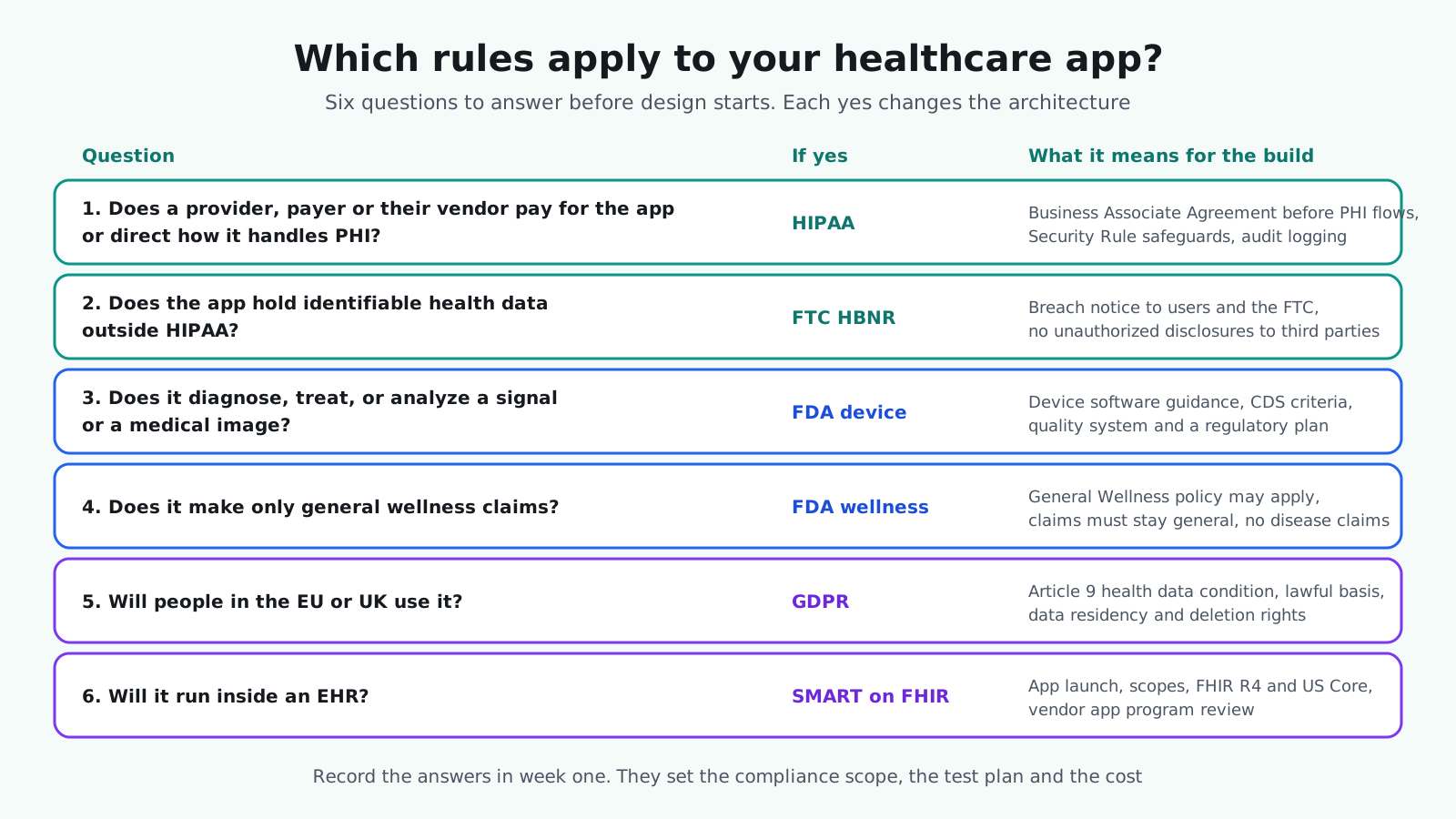
The diagram is the decision list we run at the start of every healthcare app project. Work through it before design starts, because each yes changes the architecture.
- Does a provider, payer or their vendor pay for the app or direct how it handles PHI? Yes means HIPAA applies and a Business Associate Agreement is needed before PHI flows.
- Does the app hold identifiable health data outside HIPAA? Yes means the FTC Health Breach Notification Rule applies, with notice to users and the FTC after a breach.
- Does the app diagnose, treat or analyze a signal or image? Yes means it may be a device under the FD&C Act, so check FDA's software guidance and the clinical decision support criteria.
- Does it make only general wellness claims? Then the FDA General Wellness policy may apply, and the claims must stay general.
- Will people in the EU or UK use it? Yes means GDPR Article 9 and a lawful basis for health data.
- Will it run inside an EHR? Yes means SMART on FHIR, scopes and the vendor's app program requirements.
How do you build a healthcare app step by step?
- 1. Define the user and the moment: Who uses the app, where, and what they must finish in under a minute.
- 2. Classify the app: Run the rules list above and record the answers. They set the compliance scope.
- 3. Map the data: Which EHR, device or payer systems the app reads and writes, and through which standard.
- 4. Prototype: Clickable screens tested with patients or clinicians before a line of production code.
- 5. Design the platform: Identity, consent, audit logging, encryption and a FHIR integration layer.
- 6. Build in slices: Ship one complete journey, such as book and attend a visit, then widen.
- 7. Test like a hospital: Security, accessibility, device matrix, integration and clinical safety testing.
- 8. Release and watch: Monitor crashes, API errors and PHI access patterns from day one.
Healthcare app prototyping
Prototyping saves the most money in healthcare because clinicians have no patience for a second try. Put a clickable prototype in front of five users per role, watch them without helping, and fix the flow before engineering starts. Keep the prototype free of real PHI. Synthetic patients are enough.
Testing healthcare applications
- Functional and integration: Every FHIR call against a sandbox and then a test tenant of the real EHR.
- Security: Authentication, session handling, encryption in transit and at rest, dependency scanning and a penetration test before launch.
- Accessibility: WCAG 2.2 checks with assistive technology, not only automated scans.
- Devices and networks: Low-end phones, old OS versions and poor connectivity, because clinics have all three.
- Privacy: Confirm no PHI reaches analytics, crash reporting or push notification payloads.
- Clinical safety: Walk through what happens when a reading is wrong, late or missing.
Which healthcare app ideas are worth building?
The best healthcare app ideas come from a measurable gap in an existing workflow, not from a feature list. These patterns keep coming up in scoping calls.
- Pre-visit intake: Forms that write structured data to the EHR instead of PDFs.
- Care gap closure: Tools that read quality measures and nudge patients to book.
- Medication adherence: Condition-specific support connected to the pharmacy and the care team.
- Post-discharge check-ins: Short surveys that escalate to a nurse only when answers cross a threshold.
- Caregiver apps: Proxy access for parents and adult children, with consent handled properly.
- Specialty tools: Wound photo tracking or symptom diaries that feed a clinician dashboard.
What are healthcare app best practices?
Healthcare app best practices are the habits that keep an app safe, adopted and maintainable after launch. These are the ones we hold every project to.
- Classify before you design: Settle HIPAA, FTC, FDA and GDPR status in week one and write it down.
- Keep PHI out of third parties: Review every SDK and tag, and send identifiers nowhere they are not needed.
- Use the standards: FHIR R4 and SMART on FHIR for EHR data, so the app survives vendor upgrades.
- Design for the worst phone: Old devices, small screens and weak signal are the normal case in clinics and homes.
- Test with assistive technology: Screen readers and switch access, not only an automated scan.
- Plan the operations: Store releases, OS updates, API versions and security patches have a named owner and a budget.
What are the common healthcare app challenges?
- Integration takes longer than the app: EHR sandbox access, app program review and tenant configuration take months, not weeks.
- PHI leaks through third parties: Analytics SDKs, crash tools and marketing pixels receive identifiers nobody reviewed.
- Consent is an afterthought: No record of who agreed to what, so data cannot be shared or deleted correctly.
- Low adoption: Patients download once and never return, because the app does not save them a call or a trip.
- Device sprawl: Supporting every wearable instead of a short, tested list.
- No owner after launch: OS updates, API version changes and vulnerability fixes with nobody assigned.
When should you modernize an existing healthcare app?
Healthcare application modernization is due when the app blocks the business: a new EHR or payer integration cannot be added, a security review fails, an OS update breaks it, or releases take months. Modernization does not mean a rewrite. It means replacing the parts that hurt while the app keeps running.
- Strangle, do not rewrite: Put a new API layer in front, move one journey at a time and retire old screens as new ones land.
- Fix the data model first: Map legacy fields to FHIR resources so every new feature speaks the standard.
- Rebuild identity and audit: Modern login, multi-factor options and complete access logs are usually the first win.
- Automate testing and release: A pipeline with security scans and device tests turns months into days.
- Measure before and after: Crash rate, time to complete the key task and support tickets.
What do healthcare apps mean for your build plan?
- Regulatory class: A wellness app, a HIPAA business associate app and an FDA device carry very different test and documentation loads.
- Integrations: Each EHR, device type and payer connection is its own workstream.
- Platforms: iOS, Android and web, or one cross-platform codebase with native modules where needed.
- Identity and consent: Proxy access, multi-factor options and consent management.
- Accessibility and languages: WCAG 2.2 conformance and translations.
- Operations: Monitoring, store releases, API version upgrades and security patching for years.
If you are deciding what to build first, our healthcare software development guide covers the planning side, and our digital transformation guide shows where apps fit in a wider program.
How Agnotic can help
Agnotic Technologies is a software development services company. We design, build and modernize healthcare apps for digital health companies and hospital teams: patient and clinician apps, the FHIR integration layer behind them, identity and consent, device connectivity, and the security, accessibility and testing work that healthcare demands. Your team owns the product and the code.
Modernize or build your healthcare app with Agnotic
Explore our healthcare software modernization services or browse more guides in our Guides and Playbooks hub.
Related reading on Agnotic
Go deeper on the planning, platforms and integrations behind healthcare apps.
Sources
- ASTP/ONC: Standardized API for patient and population services, 170.315(g)(10)
- HHS OCR: Health apps and HIPAA
- FTC: Health Breach Notification Rule
- FDA: Policy for Device Software Functions and Mobile Medical Applications
- FDA: General Wellness: Policy for Low Risk Devices
- Regulation (EU) 2016/679 (GDPR), Article 9
- 45 CFR Part 164, Subpart C: HIPAA Security Rule
- W3C: Web Content Accessibility Guidelines (WCAG) 2.2