Healthcare software modernization is the work of bringing an existing clinical, administrative or patient-facing system up to current standards without stopping the care that depends on it: new architecture, standard APIs, current security controls and, increasingly, AI features. It is driven as much by regulation as by technology.
This healthcare software modernization guide covers what modernization means, why the pressure is rising, the patterns teams use, how AI changes the work, a step by step approach, best practices, common mistakes and what it means for your build plan.
What is healthcare software modernization?
Modernizing a system that cannot go offline?
Agnotic modernizes healthcare software in place: new architecture, FHIR APIs, security controls and AI features, delivered while the old system keeps running.
Healthcare software modernization is the planned replacement or re-engineering of legacy healthcare systems so they meet current standards for interoperability, security, usability and operations. It covers architecture, data models, integrations, hosting and the delivery pipeline, and it is done in slices so clinical and billing work continues throughout.
Signs a system is due
- Integrations stall: A new EHR, payer or device connection cannot be added without months of custom work.
- Audits fail: Encryption, access control or audit logging does not meet the HIPAA Security Rule or a customer's security review.
- Releases are rare: Changes take months because testing is manual and the codebase is fragile.
- Knowledge is leaving: The people who understand the system are retiring or gone.
- Costs climb: Hosting, licenses and support grow while the product stands still.
- Standards moved: The system cannot speak FHIR R4, US Core or the current USCDI version.
Why does healthcare software modernization matter now?
- APIs are mandated: Under the ASTP/ONC HTI-1 rule, from January 1, 2026 certified FHIR APIs under 170.315(g)(10) must support USCDI v3, US Core 6.1.0, SMART App Launch 2.0 and the FHIR Bulk Data Access standard.
- Data must flow: The information blocking rules at 45 CFR Part 171 restrict practices that interfere with access, exchange or use of electronic health information, which legacy systems that cannot export data make hard to honor.
- Security rules are tightening: HHS published a proposed update to the HIPAA Security Rule on January 6, 2025 that would make encryption and multi-factor authentication mandatory with limited exceptions. It had not been finalized as of October 2026, but it signals the direction.
- Sector goals exist: HHS published Healthcare and Public Health Cybersecurity Performance Goals in January 2024, with ten essential and ten enhanced goals that assume patchable, inventoried systems.
- AI needs a framework: The NIST AI Risk Management Framework (AI 100-1, January 2023) gives organizations a voluntary structure to govern, map, measure and manage AI risk, which applies as soon as AI features are added to a modernized system.
- Vendors are business associates: Under 45 CFR 164.502(e), any vendor that creates, receives, maintains or transmits PHI for a covered entity needs a Business Associate Agreement, including the cloud and AI vendors a modernization introduces.
Which modernization patterns work for legacy healthcare software?
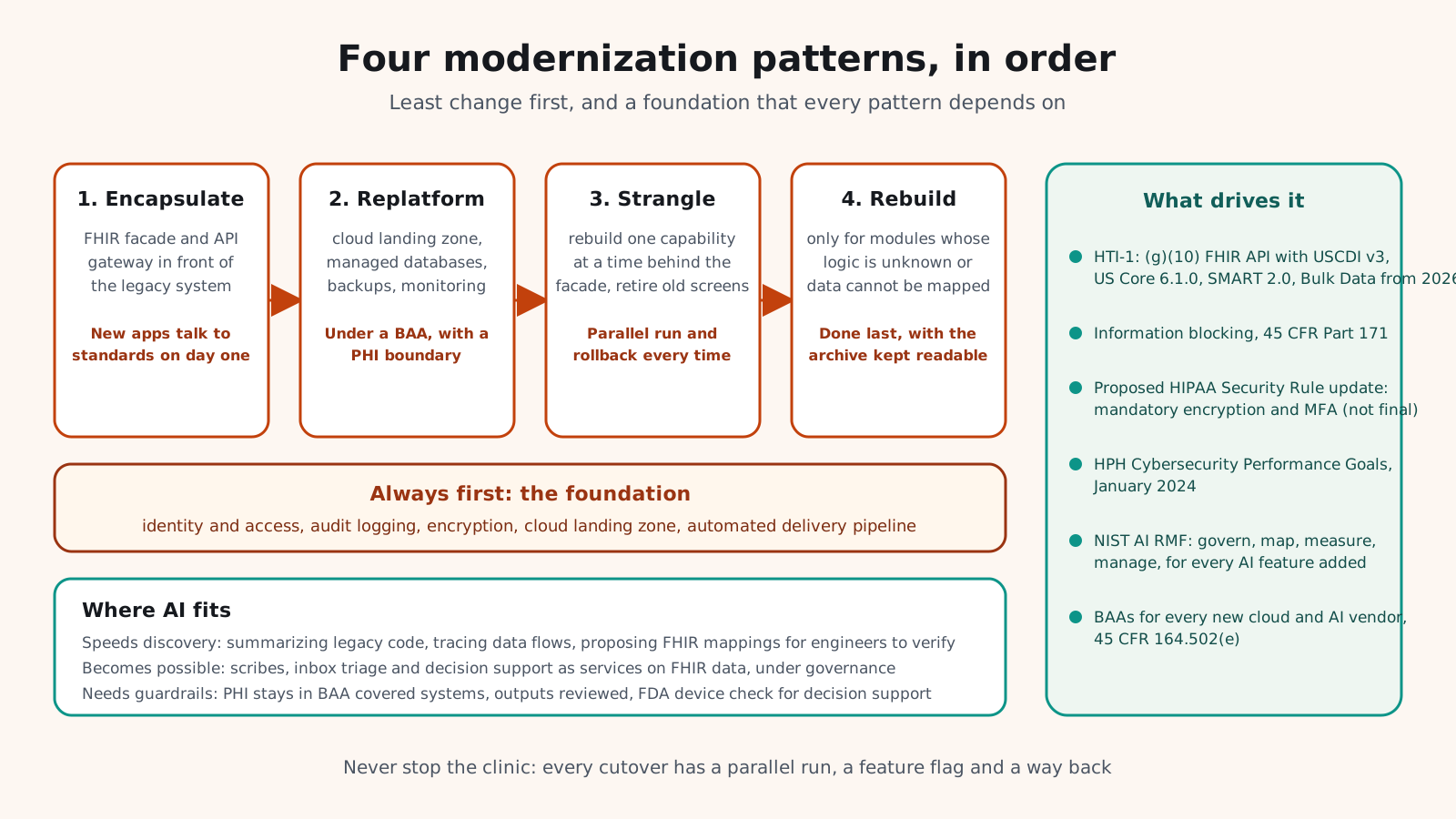
Legacy healthcare software modernization almost never means a big-bang rewrite. The diagram shows the four patterns we use, from least to most change, and the order in which the pieces usually move.
- Encapsulate: Put a FHIR facade and an API gateway in front of the legacy system so new apps talk to standards while the core stays put.
- Rehost and replatform: Move the system to a cloud landing zone with managed databases, backups and monitoring, under a BAA.
- Strangle: Rebuild one capability at a time behind the facade, route traffic to the new service and retire the old screen when the new one is proven.
- Rebuild: Reserved for modules whose logic is unknown or whose data model cannot be mapped, and done last.
- Always first: Identity, audit logging, encryption and a delivery pipeline, because every later step depends on them.
How does AI change healthcare software modernization?
AI driven software modernization for healthcare works in two directions. AI tools speed up the modernization itself, and modernization makes AI features possible. Both need the same guardrails.
- Understanding legacy code: Language models summarize undocumented modules, trace data flows and draft tests, which shortens discovery on systems nobody fully knows.
- Mapping data: Models propose mappings from legacy fields to FHIR resources and code systems, which engineers then verify.
- Adding features: Once data is in FHIR and APIs exist, AI scribes, inbox triage and decision support can be added as services rather than bolted into the legacy core.
- Guardrails: PHI never leaves BAA covered systems, outputs are reviewed before they change records, and the NIST AI RMF functions give the governance structure.
- Regulatory check: Decision support that analyzes signals or images, or acts under time pressure, is likely a device under the FDA's January 2026 CDS guidance and needs a regulatory plan.
Choosing the first module
The first module to modernize should be the one that blocks the business most and risks patients least. Interfaces, reporting and scheduling are common first choices because they sit at the edge of the system and have clear inputs and outputs. Medication and order workflows come later, once the foundation, the facade and the team's confidence are in place.
Data migration inside modernization
Every modernized module moves data, and the data is rarely as clean as the schema suggests. Profile the real records first, map codes to standard terminologies such as SNOMED CT, LOINC and RxNorm, validate counts and samples after each load, and keep the legacy store readable for the retention period. Our EHR data migration guide covers the method in detail.
How do teams approach healthcare software modernization step by step?
- 1. Inventory and classify: Every system, its PHI, its integrations, its owners and its risk.
- 2. Pick the business reason: An integration you cannot ship, an audit you failed or a cost you cannot carry. It sets the order.
- 3. Build the foundation: Identity, audit, encryption, a cloud landing zone and an automated pipeline.
- 4. Put a facade in front: FHIR and REST APIs over the legacy data so new work starts immediately.
- 5. Move one capability: The most painful or most valuable module first, with a parallel run and a rollback.
- 6. Migrate data deliberately: Profile, map to standard codes, validate and keep the legacy archive readable.
- 7. Add AI where the data is ready: Scribes, triage and analytics on FHIR data, under the governance you set up.
- 8. Retire and repeat: Decommission old components, measure, and move the next module.
What are healthcare software modernization best practices?
- Never stop the clinic: Parallel runs, feature flags and rollbacks for every cutover.
- Standards at every new boundary: FHIR R4, US Core, HL7 v2 only where the partner offers nothing else.
- Security before features: Access control and audit logs are the first release, not the last.
- Keep the archive: Legacy data stays queryable for the retention period even after the system is gone.
- Measure the pain you set out to fix: Integration lead time, release frequency, audit findings and cost per month.
- Bring clinicians along: Every rebuilt screen is tested with the people who use it under time pressure.
- Document as you go: The modernized system should not become the next undocumented legacy.
The best practices above separate modernizations that finish from those that stall. The mistakes below are the ones that stall them.
What are the common mistakes with healthcare software modernization?
- The big bang: A multi-year rewrite with nothing shipped until the end, and nothing left when funding changes.
- Lift and shift as the goal: Servers moved to the cloud with the same fragility and a higher bill.
- Mapping by assumption: Legacy fields translated without profiling the real data in them.
- New vendors, no BAAs: Cloud, monitoring and AI services added without agreements.
- AI before the foundation: Models bolted onto a system with no audit trail or standard data.
- Forgetting the archive: Old records inaccessible when a patient, auditor or court asks.
What does healthcare software modernization mean for your build plan?
- Scope: Which systems, which modules first, and what stays as is.
- Foundation: Identity, audit, encryption, landing zone and pipeline before the first module moves.
- Facade and integrations: FHIR and API layers over legacy data, and the partners that connect to them.
- Data migration: Profiling, mapping, validation and the archive.
- AI features: Governance, vendor BAAs and the regulatory check for decision support.
- Operations: Monitoring, cost management, patching and the yearly standards updates.
If the modernization is driven by AI ambitions, our healthcare AI trends guide covers what is practical now, and our HIPAA compliant AI app guide covers the compliance work around it.
How Agnotic can help
Agnotic Technologies is a software development services company. We modernize healthcare software in place: discovery of legacy systems, FHIR facades and API layers, cloud landing zones with HIPAA safeguards, module by module rebuilds, data migration and the AI features that become possible afterwards. The system keeps running while it changes, and your team owns every line.
Modernize your healthcare software with Agnotic
Explore our healthcare software modernization services or browse more articles in our Healthcare AI Agents hub.
Related reading on Agnotic
Go deeper on the AI, compliance, cloud and integration topics covered in this guide.
Sources
- ASTP/ONC: HTI-1 final rule
- ASTP/ONC: Standardized API for patient and population services, 170.315(g)(10)
- 45 CFR Part 171: Information blocking
- HHS OCR: HIPAA Security Rule notice of proposed rulemaking
- HHS: Healthcare and Public Health Cybersecurity Performance Goals
- NIST: AI Risk Management Framework (AI 100-1)
- 45 CFR 164.502: Uses and disclosures of PHI, including business associates
- FDA: Clinical Decision Support Software guidance (January 2026)