A medicine delivery service is judged at the front door. The order can be verified, packed and paid for perfectly, and still fail if the rider hands it to the wrong person, leaves an insulin pen in a hot van, or cannot show later that the bag arrived.
This post covers the last mile only: how dispatch groups and assigns orders, what the rider app should show, how identity and signature checks work at the door, what proof of delivery needs to hold, and how cold items are handled. Ordering, payment and the pharmacy system itself are separate topics.
What is medicine delivery app development?
Planning a medicine delivery service?
Our medicine delivery app page covers the patient, pharmacy and rider apps we build and how they connect.
Medicine delivery app development is building the dispatch service, rider app and door-step checks that move a verified prescription from a pharmacy to the right patient, with a record of each handover. Agnotic Technologies designs the last mile around three risks: the wrong recipient, a broken cold chain and missing proof.
Speed matters, but a fast delivery to the wrong person is a safety event, not a success.
Which apps make up a medicine delivery system?
A medicine delivery system usually has four parts: the pharmacy system that releases orders, a dispatch service, a rider app and patient notifications. Each has a different user and a different view of the order.
- Pharmacy console: marks orders ready, flags cold and controlled items, and receives proof of delivery.
- Dispatch service: groups orders, plans routes and assigns riders and vehicles.
- Rider app: pickup, navigation, door-step checks and exceptions.
- Patient notifications: time window, rider on the way, delivered or missed.
How does an order move from pharmacy shelf to front door?
An order moves through four handovers: the pharmacy seals and releases it, dispatch assigns it, the rider scans it at pickup, and the patient or an allowed recipient receives it at the door. Each handover should leave a timestamped record.
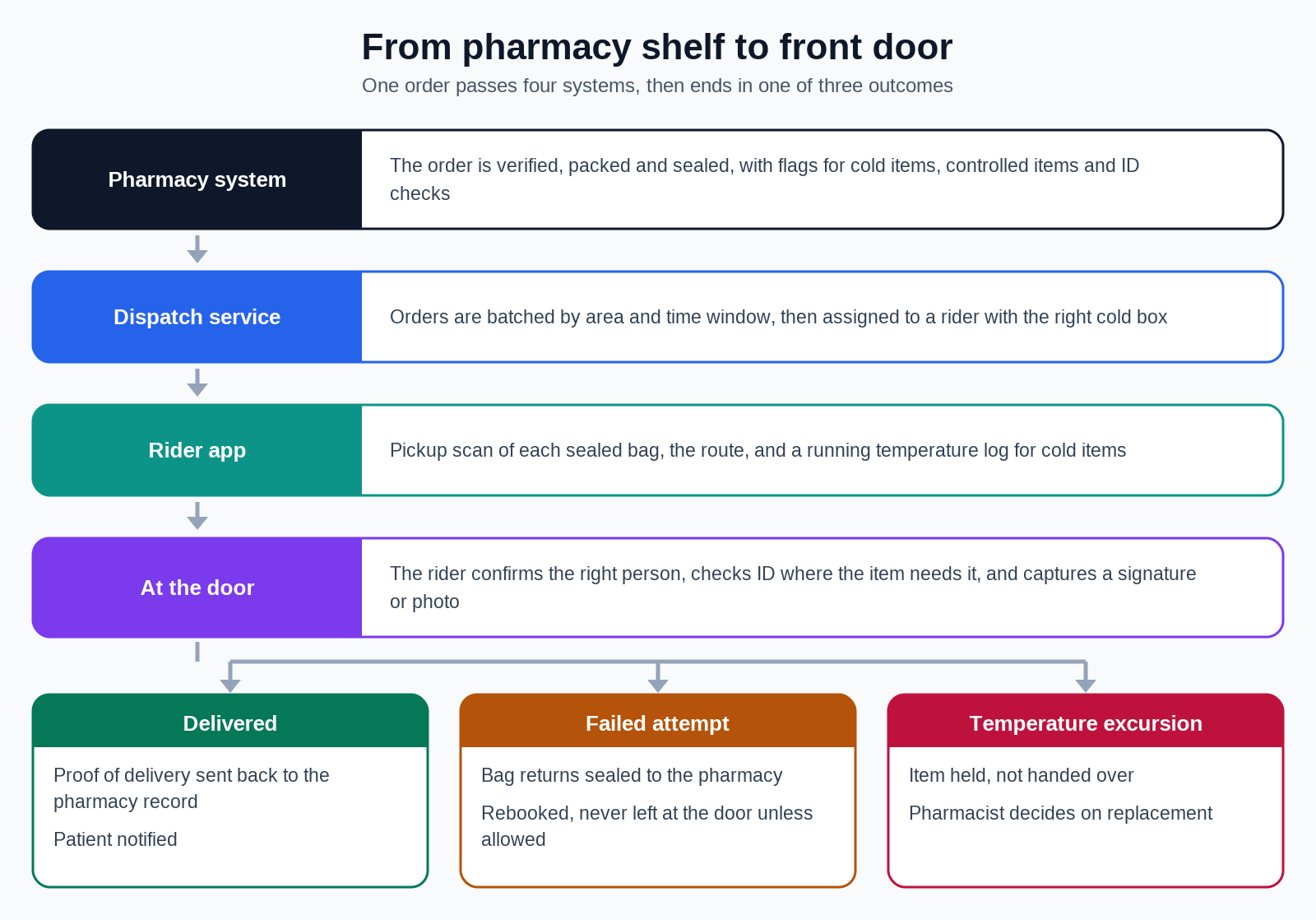
The record should end in one of three states: delivered with proof, returned after a failed attempt, or held because something went wrong in transit. An order with no end state is the one that turns into a complaint.
How should dispatch group and assign orders?
Dispatch should group orders by area and delivery window first, then assign them to riders who have the right equipment. A cold item cannot go to a rider without a cold box, however short the route.
- Windows: offer the patient a window the route can keep, and recalculate when a rider falls behind.
- Capacity: cap the number of cold items per rider to what their boxes hold.
- Priority: same-day discharge medicines and urgent items go first.
- Reassignment: when a rider drops out, move their sealed bags as a group, with a new pickup scan.
What should the rider app show, and hide?
The rider app should show what the rider needs to deliver the bag and nothing about why the patient needs it. A name, an address, a window, a bag number and any door-step check are usually enough.
The HIPAA Privacy Rule's minimum necessary standard requires covered entities to limit uses and disclosures of protected health information to the minimum needed for the purpose.
In practice, drug names, diagnoses and prescriber details stay off the rider screen and off the bag label. Delivery notes from the patient, such as a gate code, are shown only during that delivery and cleared afterwards.
ID and signature at the door
The door-step check depends on the item. Many orders need only confirmation of the address and a name; controlled or high-risk items may need a photo ID check and a signature from the patient or a named adult.
- Recipient rules: the pharmacy sets who may receive each order, such as the patient only or any adult at the address.
- ID check: the rider confirms the name and date of birth match, without photographing the ID document.
- Signature: captured on the rider's screen and stored with the delivery record, not in the phone gallery.
- Refusal path: if the check fails, the rider keeps the bag sealed and the app starts a return.
What counts as proof of delivery?
Proof of delivery is the record that shows which sealed bag reached which person, at what time and place, after which checks. A photo of a doorstep alone is weak proof for medicines.
Store the bag scan, the time, the location reported by the phone, the check performed and the signature or reason for no signature. Send it back to the pharmacy record automatically, so the pharmacist can answer a patient call without asking the delivery team.
How do you handle temperature-sensitive items?
Handle them as a separate class of order with its own packing, equipment and checks. The app should know an item is cold from the pharmacy flag, not from the rider remembering.
- Packing: the pharmacy records the packing method and the time the bag left the fridge.
- Monitoring: a temperature logger in the box, read at pickup and at the door, or a connected sensor that reports during the route.
- Excursion: if the reading is outside the range the pharmacy set, the rider does not hand over the item and the app alerts the pharmacist.
- Route limits: cold items get shorter routes and are delivered before warm items on the same run.
Failed deliveries and returns
A failed delivery is normal and should be a clean path in the app, not an exception the rider handles by phone. Nobody home, wrong address, refused check and temperature excursion each need a reason code.
The bag returns sealed to the pharmacy with a return scan, the patient gets a message with a rebooking option, and the pharmacist decides whether a cold or time-critical item needs a new supply.
What goes wrong in medicine delivery builds?
Most failures come from treating medicines like parcels. These are the problems we see most often in delivery apps that grew out of general courier software.
- Drug names on screen: riders see full prescription details they do not need.
- Leave at door by default: settings copied from food or parcel delivery.
- No end state: orders stuck as out for delivery when a rider's shift ends.
- Proof in the gallery: signatures and photos saved to the phone's photo library.
- Cold flag lost: the cold label exists in the pharmacy system but never reaches dispatch.
A worked example: an outpatient pharmacy adds home delivery
A hospital outpatient pharmacy wants to deliver discharge medicines and repeat prescriptions within the city. Some orders are refrigerated and a few contain controlled medicines that need an adult signature.
The build adds a release step in the pharmacy system that seals each order with a bag number and flags. Dispatch plans two runs a day and assigns cold items only to riders with logged cool boxes.
The rider app shows name, address, window and checks. Proof of delivery and any excursion alert flow back to the pharmacy record, and failed deliveries return to the pharmacy the same day.
Who owns what in a delivery service?
Ownership splits between the pharmacy, which owns the medicine and the rules, and operations, which owns the vehicles and riders. The software has to reflect that split.
- Pharmacist in charge: recipient rules, cold ranges and decisions after an excursion or failed delivery.
- Operations lead: rider onboarding, equipment, windows and route capacity.
- Engineering owner: the apps, the pharmacy integration and the proof record.
- Security owner: rider device policy, sign-in and remote wipe for lost phones.
The HIPAA Security Rule requires administrative, physical and technical safeguards for electronic protected health information.
How do you test a delivery app before launch?
Test it with real routes, real bags and staff playing patients, not only in a simulator. The door step is where most defects appear.
- Pilot routes: run a week of deliveries to staff addresses with dummy bags.
- Checks: try each recipient rule, including a refused ID check and a wrong person at the door.
- Cold chain: send a logger on a long route and confirm the app catches an excursion.
- Offline: drop the phone's signal at the door and confirm the proof uploads later in order.
- Lost phone: remove a device and confirm access is revoked and data is wiped.
What are medicine delivery app development best practices?
Show riders only what they need, set recipient rules per order, make cold handling a flag that travels with the order, and give every order an end state. Keep proof of delivery in your system, linked to the pharmacy record.
Start with one area and one pharmacy, learn from failed deliveries, then widen the service.
How Agnotic can help
Agnotic builds medicine delivery systems for pharmacies and health systems: the pharmacy release step, dispatch logic, rider app, door-step checks, cold chain monitoring and the proof record that flows back to the pharmacy.
Build your medicine delivery service with Agnotic
We connect dispatch, riders and cold chain checks to your pharmacy system.
Related reading on Agnotic
Pharmacy systems, prescriptions and dispatch software.