Patient engagement tools are the digital services that let patients find care, book it, prepare for it, take part in it and follow up afterwards: portals, scheduling, intake, reminders, messaging, education, payments and the apps that connect to the record. Together they make up what health systems call the digital front door.
This patient engagement tools guide covers what the tools are, why they matter now, which ones belong in a digital front door, how to build or buy them step by step, best practices, common mistakes and what they mean for your build plan.
What are patient engagement tools?
Building a digital front door for patients?
Agnotic builds patient engagement software and digital front door patient experience platforms for health systems and digital health companies, connected to the EHR through FHIR.
Patient engagement tools are digital health tools that help patients take an active part in their care: finding a clinician, booking and checking in, completing intake, receiving reminders, messaging the care team, reading results and education, paying bills and sharing data from devices. They connect to the EHR so the information patients see and enter is the same information clinicians use.
The main categories
- Access: Provider search, online scheduling, waitlists and virtual visit booking.
- Preparation: Digital intake, consent, insurance capture and pre-visit instructions.
- Communication: Secure messaging, appointment reminders by SMS and push, and after-visit summaries.
- Record access: Portals and apps showing results, notes, medications and visit history.
- Care participation: Care plans, questionnaires, remote monitoring readings and education.
- Financial: Estimates, statements, payment plans and price transparency.
Why do patient engagement tools matter now?
- Access is a right: Under the HIPAA Privacy Rule at 45 CFR 164.524, covered entities must give patients access to their records as soon as practicable and no later than 30 days after a request, with one 30 day extension allowed.
- Apps can connect: Under ONC certification criterion 170.315(g)(10), certified EHRs expose a standardized FHIR API that patient-chosen apps use with SMART App Launch, so a patient can bring their record into an app you build.
- Payers join in: Under CMS-0057-F, impacted payers must add prior authorization information to their Patient Access API by January 1, 2027.
- Consumer apps are covered too: The FTC's amended Health Breach Notification Rule, in effect since July 29, 2024, applies to health apps that are not covered by HIPAA.
- Accessibility has deadlines: The HHS Section 504 rule adopts WCAG 2.1 Level AA for the web content and mobile apps of recipients of HHS funding, with compliance dates of May 11, 2027 for larger recipients and May 10, 2028 for smaller ones.
- Texting has rules: The FCC's 2015 TCPA ruling exempts healthcare treatment messages such as appointment reminders from prior express consent when they go to the number the patient gave, offer an easy opt-out and carry no billing or marketing content.
Which tools belong in a digital front door?
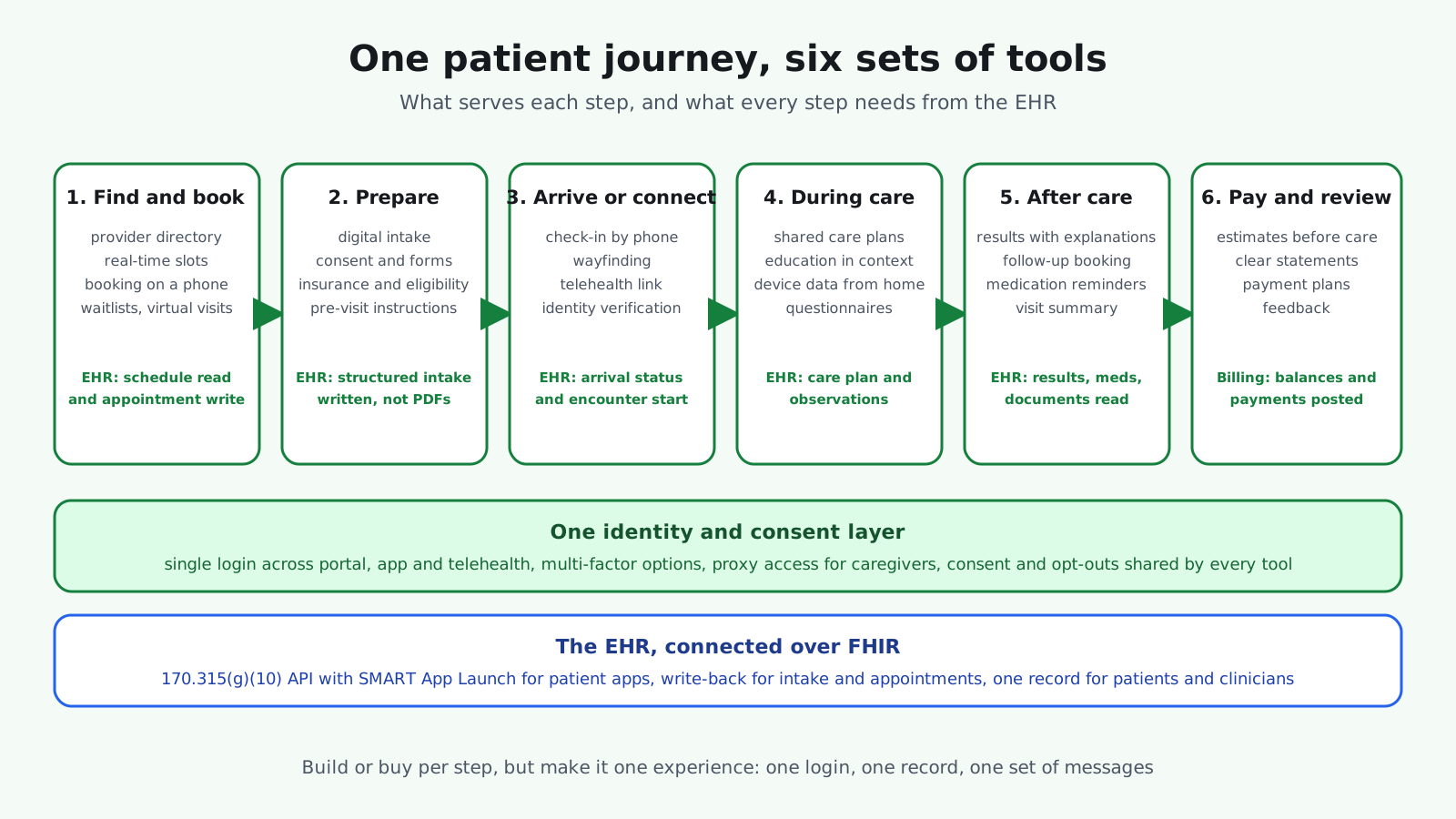
The diagram follows one patient journey and shows which digital patient engagement tools serve each step, and what each needs from the EHR. Most organizations have pieces of every step from different vendors. The work is making them one experience.
- Find and book: Provider directory with structured data, real-time slot availability from the scheduling system and a booking flow that works on a phone.
- Prepare: Intake and consent that write structured data to the EHR, insurance capture with eligibility checks and clear pre-visit instructions.
- Arrive or connect: Check-in by phone, wayfinding or a telehealth link, with identity verification.
- During care: Shared screens for care plans and education, and device data flowing in from home.
- After care: Results with explanations, follow-up booking, medication reminders and a summary the patient can read.
- Pay and review: Estimates before care, clear statements after, payment plans and feedback.
Should you build or buy patient engagement tools?
Most health systems buy the portal that comes with their EHR and build around its gaps. Digital health companies usually build, because the engagement experience is their product. The decision is per capability, not for the whole front door.
- Buy when the EHR vendor's tool already does it well and patients already use it, such as basic results and messaging.
- Build when the experience is the differentiator, such as a specialty intake flow, a condition program or a caregiver app.
- Integrate either way: Every tool reads and writes the EHR through FHIR, so patients see one record.
- Watch the identity layer: One login across tools, with proxy access for caregivers, is the hardest and most valuable piece.
Identity and proxy access
The identity layer decides whether the front door feels like one place or six. A single account across portal, app and telehealth, with multi-factor options, lets patients move between tools without logging in again. Proxy access for parents, adult children and caregivers needs its own rules: who may see what, for how long, and how a teenager's record changes at the age state law sets.
Messaging patients without breaking rules
Appointment reminders, pre-visit instructions and results notifications by text are allowed under the FCC's healthcare treatment exemption when they go to the number the patient provided, carry no billing or marketing content and offer a simple way to stop. Keep PHI out of the message body, link to the authenticated portal for details, and log consent and opt-outs where every tool can see them.
How do teams approach patient engagement tools step by step?
- 1. Map the journeys: Pick two or three patient journeys, such as new patient visit or chronic care follow-up, and list every step and every tool touched.
- 2. Measure the gaps: Where patients call instead of click, abandon a form or miss a visit.
- 3. Decide build or buy per capability: Keep what works, replace what does not.
- 4. Design the identity and consent layer: Single login, proxy access and consent records shared by every tool.
- 5. Connect the EHR: Scheduling, demographics, results, medications and documents through FHIR, with write-back where needed.
- 6. Build the first journey end to end: One complete flow before adding another.
- 7. Test with patients: Including older patients, screen reader users and people on slow phones.
- 8. Launch, measure and iterate: Portal activation, online booking share, no-show rate, form completion and satisfaction.
What are patient engagement tools best practices?
- One identity: A single account across portal, app and telehealth, with proxy access for caregivers handled properly.
- Structured data in, structured data out: Intake and questionnaires land in the EHR as coded data, not PDFs.
- Plain language: Results explained, instructions short, and translations for the languages your patients speak.
- Accessible by default: WCAG 2.2 as the engineering target, tested with assistive technology.
- Respectful messaging: Treatment messages only to the number the patient gave, with an easy opt-out, and no PHI in the message body.
- Fast on a phone: Server-rendered pages, few scripts and booking that completes on a weak connection.
- Measure engagement, not downloads: Activation, completion and show rates, reviewed monthly.
These practices are the difference between tools patients tolerate and tools they return to. The mistakes below are why most portals are the former.
What are the common mistakes with patient engagement tools?
- Tool sprawl: Six vendors, six logins and six places to update a phone number.
- Portal as an afterthought: Features turned on by the vendor but never designed for the patient population.
- Marketing tags on authenticated pages: Identifiers sent to ad platforms from inside the portal.
- Forms that go nowhere: Intake collected as PDFs that staff re-type into the EHR.
- No proxy access: Parents and adult children locked out, so they call instead.
- Ignoring accessibility and language: Tools that exclude the patients who need them most.
- Measuring the wrong thing: App downloads celebrated while no-shows stay the same.
What do patient engagement tools mean for your build plan?
- Journeys in scope: Each journey adds screens, integrations and content.
- Identity and consent: Single sign-on, proxy access and consent management are the foundation.
- EHR integration: FHIR read and write for scheduling, demographics, results, medications and documents.
- Build or buy mix: Vendor tools to configure and connect, custom tools to design and build.
- Accessibility and languages: WCAG conformance, translations and testing with real patients.
- Operations: Messaging costs, vendor updates, analytics and the regulatory calendar.
If the front door is part of a wider program, our digital transformation guide covers the organization side, and our healthcare apps guide covers the rules that apply to the apps themselves.
How Agnotic can help
Agnotic Technologies is a software development services company. We build patient engagement tools for health systems and digital health companies: scheduling and intake, portals and mobile apps, messaging and reminders, caregiver access and the FHIR integration that keeps everything in step with the EHR, designed to accessibility standards from the first screen. Your patients get one front door. Your team owns it.
Build your patient engagement tools with Agnotic
Explore our patient engagement software development or browse more guides in our Guides and Playbooks hub.
Related reading on Agnotic
Go deeper on the apps, portals and programs covered in this guide.
Sources
- 45 CFR 164.524: Access of individuals to protected health information
- ASTP/ONC: Standardized API for patient and population services, 170.315(g)(10)
- CMS: Interoperability and Prior Authorization final rule (CMS-0057-F)
- FTC: Health Breach Notification Rule
- HHS: Section 504 final rule (45 CFR Part 84) fact sheet
- FCC: TCPA Omnibus Declaratory Ruling and Order (2015)
- W3C: Web Content Accessibility Guidelines (WCAG) 2.2
- HL7: SMART App Launch