


Genomic analysis is the computational work that turns raw DNA sequencing output into variants a laboratory can interpret and report. For a clinical test it runs as a fixed, validated pipeline: reads come off the sequencer as FASTQ files, are aligned to a reference genome, called as variants and annotated before a qualified reviewer classifies them.
This guide walks that pipeline stage by stage, names the file formats and standards at each handoff, sets out the CLIA and HIPAA duties that apply once results reach patients, and lists the failure points that make a pipeline hard to validate or rerun.
What is genomic analysis?
Building a genomics pipeline or reporting tool?
Agnotic builds genomic data platforms for laboratories and precision medicine teams, from pipeline orchestration and provenance tracking to report delivery into the EHR.
Genomic analysis is the bioinformatics process that converts sequencing reads into interpreted variants: quality control, alignment to a reference genome, variant calling, annotation and classification. In a clinical laboratory, each step runs in a validated, versioned pipeline, and a qualified reviewer signs the final report before it reaches the ordering clinician.
The scope varies by test. A targeted panel looks at a set of genes, an exome covers the protein-coding regions, and a genome covers nearly all of the DNA. Larger scopes produce more variants, more compute and more uncertain findings, but the stages stay the same.
Research analysis and clinical analysis share tools but not obligations. A research group can change a parameter and rerun. A clinical laboratory has to validate the change, document it and be able to explain any report it has already issued.
Which file formats carry data between stages?
Four formats carry most of the data, and each one marks the boundary between two stages. Knowing them helps a team plan storage, retention and the points where a run can be restarted.
- FASTQ: Text records holding each read's sequence and a per-base quality score. It is the output of demultiplexing and the input to alignment.
- SAM and BAM: SAM is the text Sequence Alignment/Map format, and BAM is its compressed binary form. Both record where each read sits on the reference and how well it matches, as defined in the SAM specification in the hts-specs repository.
- CRAM: A reference-based compressed alternative to BAM. It saves storage but can only be decoded with the exact reference sequence used to write it.
- VCF and BCF: The Variant Call Format lists positions where the sample differs from the reference, with genotype and quality fields. BCF is its binary encoding. The format is versioned, so record which version each tool writes and reads.
- gVCF: A genome VCF also records reference-confidence blocks for positions with no variant. Joint calling across a cohort needs it, and it lets a reviewer tell no variant apart from no data.
Raw files are large. Teams often keep FASTQ or CRAM as the long-term record and regenerate intermediate BAMs only when needed, which works only if the pipeline version and reference build are recorded with each sample.
How does a sample move from FASTQ to a clinical report?
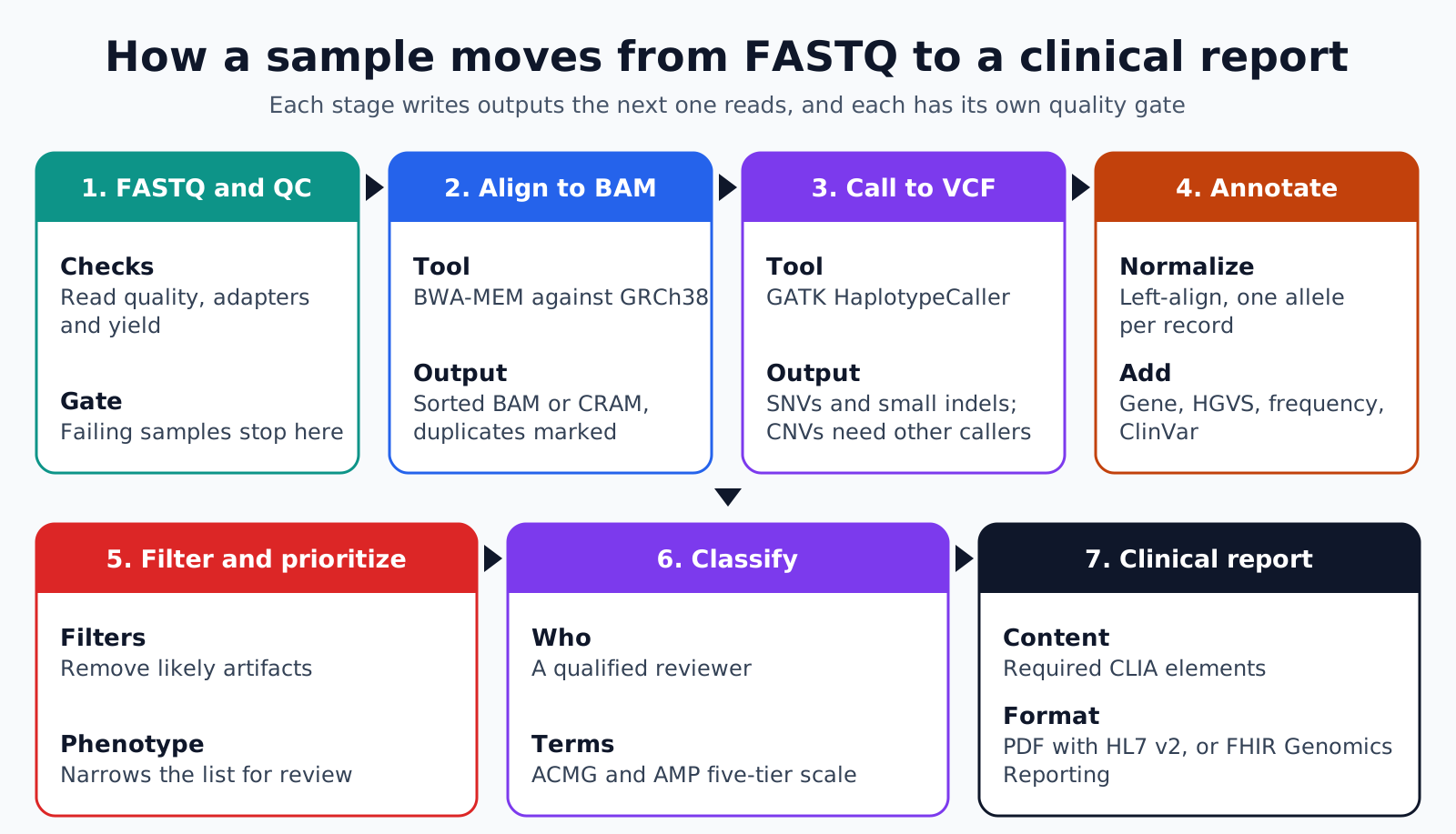
A clinical sample passes through seven stages, from raw reads to a signed report in the patient record. Each stage writes outputs that the next one reads, and each has its own quality gate.
- 1. FASTQ and quality control: The sequencer's output is demultiplexed into FASTQ files per sample. QC checks read quality, adapter content and yield, and failing samples stop here.
- 2. Alignment to BAM: An aligner such as BWA-MEM maps reads to a reference build, usually GRCh38. The output is sorted and indexed into BAM or CRAM, with duplicates marked and coverage measured across the target regions.
- 3. Variant calling to VCF: A caller such as GATK HaplotypeCaller compares aligned reads with the reference and writes single nucleotide variants and small insertions and deletions to VCF. Copy number and structural variants usually need separate callers.
- 4. Normalization and annotation: Variants are left-aligned and split to one allele per record, then annotated with gene, transcript, HGVS description, population frequency and existing assertions from databases such as ClinVar.
- 5. Filtering and prioritization: Quality filters remove likely artifacts, and the patient's phenotype narrows the list to variants worth a reviewer's time.
- 6. Classification: A qualified reviewer applies the ACMG and AMP criteria and assigns one of five terms: pathogenic, likely pathogenic, uncertain significance, likely benign or benign.
- 7. Clinical report: The laboratory issues a report with the required CLIA elements to the ordering clinician, as a PDF with an HL7 v2 result message or as structured data using the HL7 FHIR Genomics Reporting Implementation Guide.
Two records run beside every stage rather than in sequence. The provenance log captures software versions, the reference build and the databases used. The audit trail captures who viewed or changed each result.
What does the ACMG and AMP framework ask of software?
The ACMG and AMP standards ask software to present evidence, not to make the call. The 2015 joint recommendation in Genetics in Medicine defines the five-term classification and groups evidence into types such as population, computational, functional and segregation data.
- Evidence view: Show population frequency, prior assertions, predicted effect and family data side by side for each variant, with the source and version of every database.
- Criteria capture: Record which criteria the reviewer applied and why, so a second reviewer can check the reasoning.
- Nomenclature: Describe variants in HGVS form against a complete reference sequence from NCBI RefSeq or LRG, as the ACMG and AMP standards recommend.
- Reclassification history: Store each classification with its date, so a later change in evidence can be traced to every report it affects.
The same standards strongly recommend that clinical molecular genetic testing take place in a CLIA-approved laboratory, with results interpreted by a board-certified clinical molecular geneticist, molecular genetic pathologist or equivalent.
Which rules apply once results reach patients?
Once a laboratory reports patient-specific results for diagnosis or treatment, CLIA and HIPAA both apply. These facts set the main software requirements.
- CLIA report contents: 42 CFR 493.1291(c) lists what every test report must carry: who the patient is, the name and address of the laboratory that ran the test, when the report was issued, which test was run, the specimen source where relevant, and the result with its units or interpretation.
- Genetic data is PHI: 45 CFR 160.103 counts genetic information as health information, so sequence files and variant results held by a covered entity or business associate are protected health information.
- Validation before reporting: The laboratory has to show the pipeline performs as claimed for each test before results go out, so benchmark runs, sign-offs and change records belong in the software, not in a spreadsheet.
- Access by role: Bioinformaticians need raw files, reviewers need variants and evidence, and clinicians need the signed report. Give each role only the layer it needs and log every view.
- The signed report stays the record: Structured variant data can flow to the EHR where it is supported, but the signed report remains the version the laboratory stands behind, so keep the two in step.
Validation and reproducibility
A clinical pipeline is reproducible when the same input, run months later, produces the same calls and the laboratory can prove it. This checklist covers what the software has to support.
- Pinned versions: Every tool, container image, reference build and annotation database has a version recorded in the run's provenance log.
- Workflow definition: The pipeline is written in a workflow language such as WDL or Nextflow, so each stage, input and parameter is explicit.
- Truth-set benchmarks: Each release is compared against public benchmark samples such as NIST's Genome in a Bottle truth sets, with precision and recall tracked separately for SNVs and indels.
- Sample identity checks: Sex checks and fingerprint SNPs compared with an independent assay catch sample swaps before classification.
- Change control: A new tool version, reference or database release is a change that needs revalidation before it reaches clinical reports.
- Retention plan: Raw data, final VCFs and reports are kept for the period the laboratory's records policy sets, with intermediate files regenerated on demand.
Where the pipeline runs matters less than how it is controlled. On premises or in a cloud account under a business associate agreement, each run should start from a tagged release, write its outputs to storage the pipeline cannot overwrite later, and refuse to start if a required reference or database file is missing or has the wrong checksum.
Where genomic pipelines fail
Most pipeline failures are silent: the run completes and the output looks normal. This failure-point list covers the ones that reach reports.
- Mixed reference builds: GRCh37 annotations applied to GRCh38 coordinates place variants in the wrong gene or miss them.
- Transcript drift: An HGVS description written against one transcript version no longer matches after the annotation source changes its default transcript.
- Unnormalized indels: The same deletion written two ways fails to match its ClinVar entry, so a known pathogenic variant looks novel.
- Missed contamination: A sample mixed with another person's DNA produces extra heterozygous calls that look like real findings unless a contamination estimate gates the run.
- Coverage gaps: Regions with low depth are reported as negative instead of as not tested.
- Silent database updates: A new population frequency release changes filtering results with no record of why.
- No reanalysis path: A variant of uncertain significance is reclassified, but nothing links it back to the patients who received it.
- Missing decode reference: CRAM files written years ago cannot be read because the exact reference file was never archived.
How Agnotic can help
Genomic analysis software has to make every result traceable to its inputs, versions and reviewer. Agnotic Technologies builds that software for laboratories, precision medicine programs and genomics startups: pipeline orchestration, provenance and audit logging, reviewer screens for ACMG and AMP evidence, and report delivery to the EHR.
The laboratory director and geneticists own validation and sign-off. Agnotic builds the workflow definitions, benchmark runs, change records and interfaces that give them the evidence to do it.
Plan your genomic analysis platform with Agnotic
Explore healthcare software development services, or read more articles in the Data Engineering hub.
Related reading on Agnotic
Continue with AI in genomics, clinical data integration, healthcare data management and HL7 results messaging.


