IoT for industrial asset tracking means tagging tools, totes, pallets, carts and machines so a plant or warehouse knows where each one is and when it moved. The radios get the attention, but the value sits in the event record behind them: which asset, which place, what time and what it means for the work.
This guide covers how to pick a radio for each asset class, which identifier and event standards to follow, how a raw read becomes a trusted location event, where accuracy is lost and how to pilot before buying tags for the whole site.
What is IoT for industrial asset tracking?
Need plant or warehouse assets on a live map?
Agnotic builds industrial IoT data platforms that turn RFID, BLE and GPS reads into location events your operations systems can use.
IoT for industrial asset tracking is the use of tags, readers and gateways, such as RFID, Bluetooth Low Energy, ultra-wideband and GPS, to record where plant and warehouse assets are. Each read is filtered, resolved to a zone and stored as a time-stamped event that joins work orders, inventory or maintenance records.
The question it answers is narrow: where is this asset, and when did it move? Process data from machines, such as temperatures, cycle counts and quality holds, is a separate problem with a separate data path, even when both run on the same plant network.
Which radio fits which asset?
No single radio fits every asset. Match the radio to the question being asked and to the asset's size, value and surroundings.
- Passive UHF RFID: Cheap tags with no battery, read when the asset passes a portal or dock reader. It answers "did it pass this point?" and suits totes, pallets, returnable containers and tools. Metal and liquids weaken reads, so metal assets need on-metal tags.
- BLE beacons: Battery tags heard by fixed gateways. They answer "is it in this zone?" and suit carts, kits and mobile equipment where zone-level location is enough.
- BLE direction finding: Added in Bluetooth Core Specification 5.1, angle-of-arrival locators can place a tag more precisely than signal strength alone, at a higher cost per locator.
- Ultra-wideband: Battery tags and anchors for fine positioning, for example forklifts or high-value fixtures on a busy floor. Anchor density drives the cost.
- GPS with cellular: Trailers, yard equipment and assets that leave the site. Battery life depends on how often the tracker reports.
- Barcode and scan: Still the baseline for items handled by people at fixed steps. A tracking plan should say where a scan is enough.
Three questions that narrow the choice
- What decision does the location drive? Passing a dock door calls for a portal read. Finding a cart on a large floor calls for zone presence. Collision avoidance or fixture placement calls for fine positioning.
- How often does the asset move, and how far? Assets that stay inside one building rarely need GPS, while trailers and loaners that leave the site cannot be tracked by indoor readers alone.
- What does a tag cost compared with the asset? Passive tags suit high-volume, low-value items. Battery tags and their replacement cycle make sense for equipment that is expensive to lose or slow to find.
Which standards should a tracking system follow?
Follow open identifier and event standards, plus current IoT and OT security guidance. Standards make the data portable between readers, platforms and trading partners.
- Asset identifiers: The GS1 EPC Tag Data Standard defines how GS1 keys, including the Global Individual Asset Identifier (GIAI) and the Global Returnable Asset Identifier (GRAI), are encoded on RFID tags.
- Air interface: The GS1 EPC UHF Gen2 air interface protocol, aligned with ISO/IEC 18000-63, defines how passive UHF readers and tags talk to each other.
- Event data: GS1 EPCIS 2.0, published in June 2022, records what, when, where and why for each event, and added sensor data, a JSON-LD syntax and a REST interface for capture and query.
- Device security: NIST IR 8259 Revision 1, published in April 2026, sets foundational cybersecurity activities for IoT product manufacturers, which buyers can use when assessing tags, readers and gateways.
- OT security: NIST SP 800-82 Revision 3 is the current guide to operational technology security, and covers gateways that share a network with plant control systems.
For the tracking network as a whole, the NIST Cybersecurity Framework 2.0 adds a Govern function to Identify, Protect, Detect, Respond and Recover. It gives operations, IT and security teams a shared way to assign ownership of tags, readers and the platform.
How does a raw read become a location event?
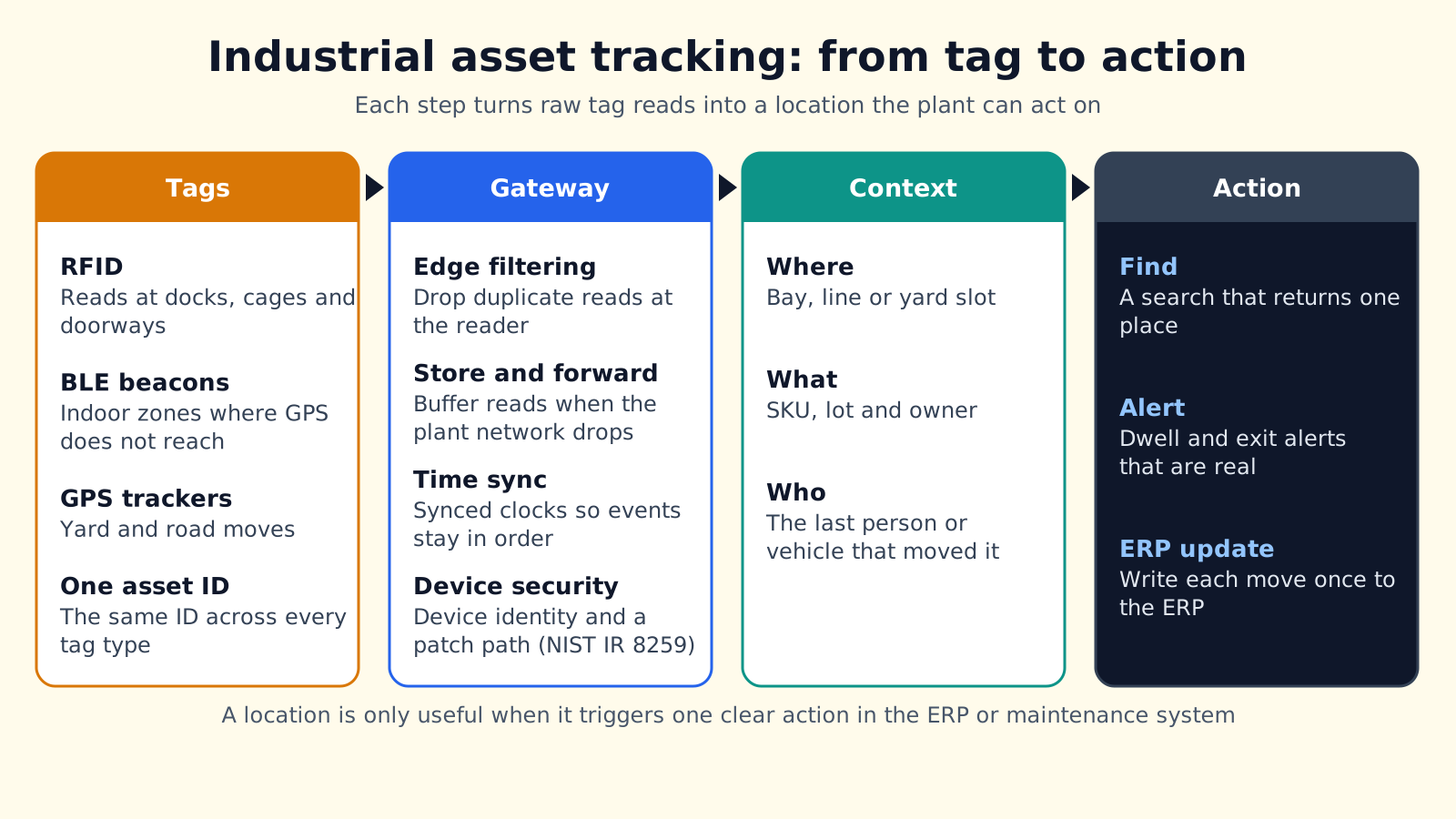
A raw read becomes a location event in five steps. Readers produce many reads per second, and most of them repeat what the platform already knows.
- 1. Read: A reader or gateway reports the tag ID, its own ID, signal strength and time. The gateway authenticates to the platform with its own credential and buffers reads when the link drops.
- 2. Filter: The edge or platform drops duplicate reads inside a short window and discards reads below a signal threshold, so a tag sitting next to a portal is not counted as passing it.
- 3. Resolve: Reads are turned into a zone or point, using reader location for RFID or signal and angle data for BLE and UWB.
- 4. Record: The platform writes an event only when something changes: arrival, departure, dwell past a limit or a missing tag.
- 5. Join: Each event links to the business record, such as a work order, an inventory location or a maintenance due date, so it triggers a decision instead of a dot on a map.
Filtering at the edge or on the platform
Filtering at the gateway cuts network traffic and keeps working when the uplink fails, but every gateway then needs the same rules and updates. Filtering on the platform keeps rules in one place and preserves raw reads for diagnosis. A common split is duplicate removal at the edge and zone logic on the platform, with raw reads sampled upstream for troubleshooting.
Designing the asset event model
The event model decides what questions the system can answer later. Define it before the tag purchase, and keep it close to EPCIS so partners and future systems can read it.
- Asset ID: The GIAI, GRAI or internal ID, with the asset class and the tracking grain (item, tote, pallet, cage or machine).
- Location: Site, area and zone, with the reader or locator that produced the event.
- Times: Read time from the device and receipt time at the platform, so late uploads from a buffered gateway are placed correctly.
- Event type: Arrive, depart, dwell or missing, with the business step it represents, such as receiving, staging or repair.
- Confidence: A field that records whether the location came from a portal read, a zone estimate or a manual scan.
- Lineage: The raw reads behind each event, kept for a defined period so disputed moves can be traced.
Where asset tracking loses accuracy
These failure points make the map disagree with the floor. Each one can be found in a site walk before the full rollout.
- Stray reads: A portal reader picks up tags on a nearby rack and records moves that never happened.
- Metal and liquid: Standard UHF tags on steel bins or near fluids read poorly, so the asset appears missing.
- Mixed grains: Some pallets are tagged and others carry tagged items, so counts disagree between systems.
- No departure events: The system records arrivals only, and an asset taken off site still shows in its last zone.
- Dead beacons: BLE and UWB tag batteries run out without an alert, and assets disappear from the map one by one.
- Shared gateway credentials: One password for every reader means one compromised device can feed false events for the whole site.
- Tags without owners: Nobody is assigned to re-tag damaged assets or retire tags from scrapped ones, so the asset register and the tag list drift apart over time.
How should a tracking pilot be run?
Run a pilot on one asset class in one area, and measure it against a manual count. Use this checklist.
- Scope: One asset class, one radio, one area and a named business question, such as finding tool carts within five minutes.
- Baseline: A manual count and a record of current search and loss events before tags go on.
- Site survey: Reader and anchor placement tested with tagged assets in real positions, including on metal and near racking.
- Ground truth walks: Scheduled walks that compare the platform's view with the floor and record every mismatch and its cause.
- Security: Unique gateway credentials, a segmented network reviewed against SP 800-82, and the vendor's answers on IR 8259 activities.
- Exit criteria: The accuracy level and support effort that justify scaling, agreed with operations before the pilot starts.
- Integration test: At least one live link into a work order, inventory or maintenance record, so the pilot proves a decision changes and not only that the map fills up.
How Agnotic can help
Tags are the cheap part of asset tracking; the event platform is the part that has to be right. Agnotic Technologies builds industrial IoT data platforms for plants and warehouses: gateway ingestion, read filtering, zone resolution, an EPCIS-style event store and the links into work orders, inventory and maintenance systems.
Agnotic works with the client's chosen readers and tags, or helps compare radio options during the pilot, and builds the platform so a second asset class or a second site uses the same event model.
Plan an industrial tracking platform with Agnotic
Explore the industrial IoT data platform, or browse more articles in the Industry Insights hub.
Related reading on Agnotic
Continue with IoT in manufacturing, asset tracking software, smart inventory and supply chain tracking,, IoT product development and IoT development.
Sources
- GS1: EPC Tag Data Standard (GIAI and GRAI encoding)
- GS1: EPC UHF Gen2 Air Interface Protocol
- GS1: EPCIS and Core Business Vocabulary
- NIST CSRC: IR 8259 Rev. 1, Foundational Cybersecurity Activities for IoT Product Manufacturers
- NIST CSRC: SP 800-82 Rev. 3, Guide to Operational Technology (OT) Security
- NIST CSRC: CSWP 29, The NIST Cybersecurity Framework (CSF) 2.0