

01
Health system informatics teams
CMIO and CIO teams adding chart summaries and inbox triage to their EHR.


Clinicians lose time reading long charts and working full inboxes, and an AI tool that sits outside the EHR adds one more window. Agnotic Technologies builds clinical copilots that open inside the EHR, summarise the record, triage messages and draft work for the clinician to review and sign.
Trusted by global innovators











A clinical copilot is AI software that works inside the clinician's EHR to summarise the chart, triage the inbox and draft notes, messages and orders that the clinician reviews and signs. Agnotic Technologies builds clinical copilots that launch through SMART on FHIR or CDS Hooks, ground each suggestion in the patient record and log what was shown and accepted.
Most failures are about workflow and trust, not the language model.
Outside the chart: a separate tab or app means copying text in and out, so clinicians stop using it within weeks.
Ungrounded answers: a summary that cannot show where a statement came from in the record is a summary nobody can sign.
Silent writes: a tool that files text or orders without an explicit clinician action breaks the chain of responsibility.
No record of use: without a log of what was suggested, edited and accepted, quality and safety reviews have nothing to work from.
Three kinds of clinical AI that buyers often mix up. They start from different inputs and carry different risks, and many health systems end up running all three.
| Question | Clinical copilot | Ambient scribe | Rule-based decision support |
|---|---|---|---|
| What does it start from? | The patient record and the clinician's inbox | The audio of the visit | Coded data and configured rules |
| What does it produce? | Summaries, triage, draft notes, messages and orders | A draft visit note | Alerts and reminders |
| Where does it run? | Inside the EHR, launched in patient context | On a device in the room, note sent to the EHR | In the EHR at defined workflow points |
| Who acts on the output? | The clinician, who edits and signs | The clinician, who reviews the note | The clinician, who accepts or overrides |
| Typical standards | SMART on FHIR, CDS Hooks, FHIR R4 | FHIR or the EHR's note APIs | CDS Hooks or native EHR rules |
| Main design risk | Statements not grounded in the record | Transcription and attribution errors | Alert fatigue |
| Where we cover it | This page | AI medical scribe page | Clinical decision support page |
A copilot is only as good as what it is allowed to read and how clearly it shows its sources. These are the design choices we make first.
The copilot reads FHIR R4 resources within the scopes granted at SMART on FHIR launch, for the patient in context, and nothing else.
Every statement in a summary links to the note, result or medication it came from, so the clinician can check it in one click.
Orders, notes and replies arrive as drafts or CDS Hooks suggestions. The clinician accepts, edits or rejects each one in the EHR.
What was shown, to whom, from which sources, and what the clinician did with it is recorded for review.
Copilot functions we build, alone or together, for the workflows your clinicians name first.
A short pre-visit summary of problems, recent results, medications and open items, each linked to its source.
Summaries for shift handoff, transfer or discharge planning, drafted from the record for the clinician to finish.
Patient messages and results sorted by urgency and type, with a suggested reply or routing for each.
Order suggestions offered at order-select or order-sign through CDS Hooks, for the clinician to accept or discard.
Referral letters, patient instructions and note sections drafted from the chart, never filed without a signature.
Answers to a clinician's question about this patient, quoted from the record with links, or a clear statement that the record does not say.
The request path we build, from the clinician's click to a signed result. Every step is logged.
The EHR launches the copilot through SMART on FHIR, or calls it through a CDS Hooks hook such as patient-view or order-select.
The service reads only the FHIR R4 resources the launch scopes allow, for the patient and user in context.
Relevant record extracts are selected and tagged with their source so the output can cite them.
The model runs in your cloud account or a covered model service under a BAA, with no training on your data.
Outputs without a source, or outside the agreed task, are blocked or flagged before the clinician sees them.
Results appear as a CDS Hooks card or in the SMART app panel, clearly marked as AI drafted.
The clinician accepts, edits or rejects. Only accepted content is written back, through the EHR's own order or note workflow.
The launch standards, data access and model hosting behind the clinical copilots we build.
Measures we build reporting around, agreed with your clinical leads before launch.
Tracked by task, so weak functions are fixed or retired.
A signal of whether drafts save time or create work.
Measured before and after the copilot, per clinician group.
Each one reviewed and fed into the test set.
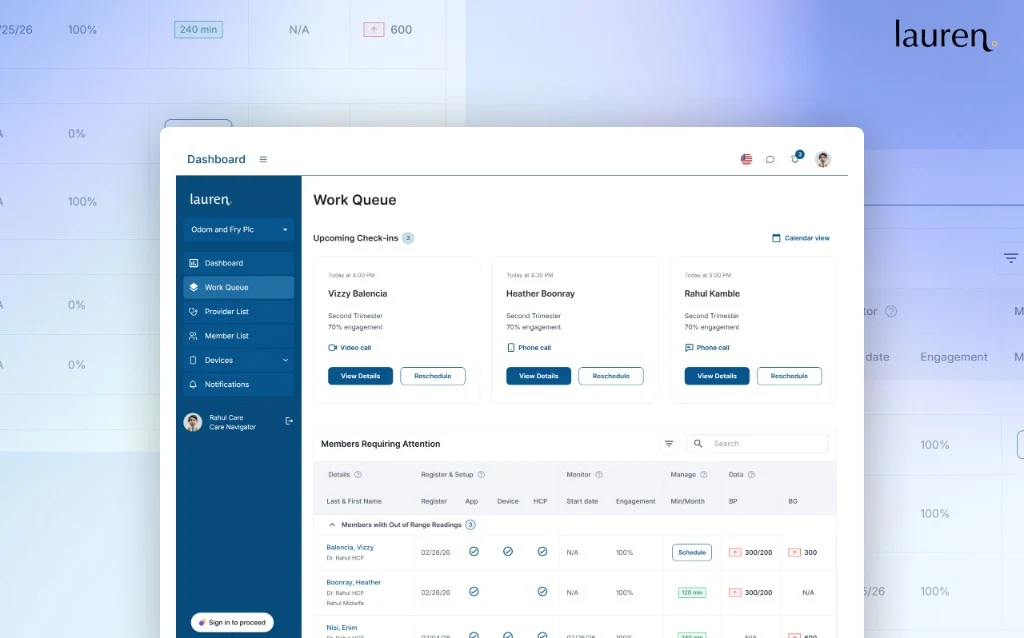
A HIPAA-ready maternal health platform enabling remote patient monitoring, care coordination, and personalized engagement from pre-pregnancy through postpartum.
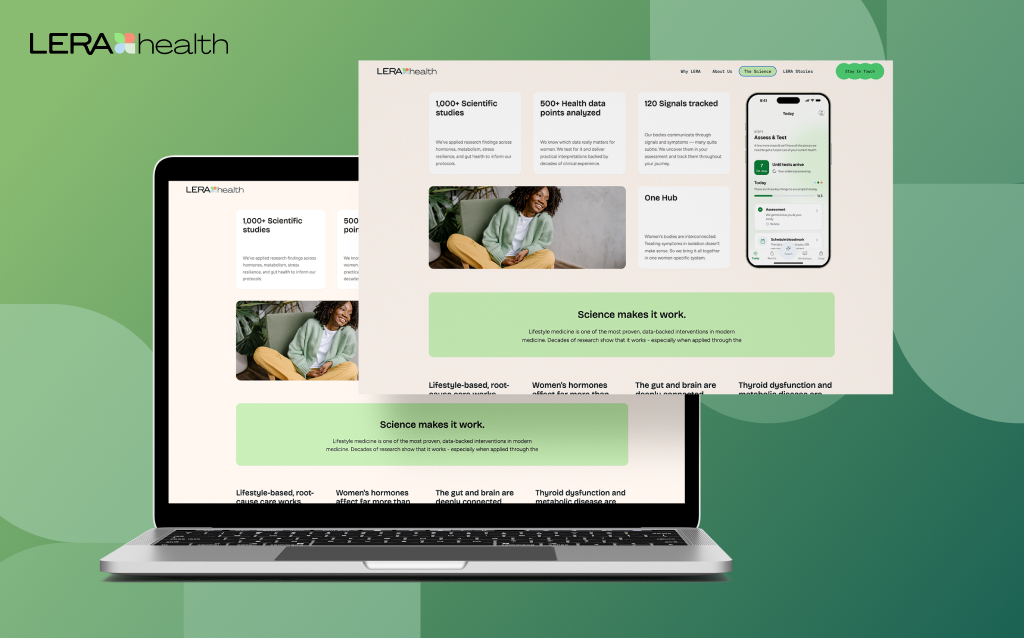
A women’s health product experience focused on guided care journeys, education, and compliance-aware workflows to support long-term engagement.
Teams that want AI inside the clinician's workflow, not next to it.
CMIO and CIO teams adding chart summaries and inbox triage to their EHR.
Clinical copilots for startups selling into health systems, built as SMART on FHIR apps from the first release.
Copilots tuned to one specialty's chart, such as oncology, cardiology or behavioral health.
Message triage and visit summaries for clinicians who work mostly in the inbox.
Pre-visit summaries and referral letters across many clinics on one EHR.
Teams adding copilot functions to an existing SMART on FHIR app.
The systems a copilot reads from and writes through.
The checklist we work through with your clinical and informatics leads before a copilot reaches a single clinician.
We build secure, scalable products designed for privacy, interoperability, and regulatory readiness from day one across every sector we serve.

Protect PHI with privacy-first architecture, encrypted storage and transmission, and strict access controls.

Enabling standardized health data exchange through standards-based API mappings.
We combine deep technical expertise with industry-specific knowledge to deliver solutions that aren't just functional, but transformational.
We implement rigorous security protocols and compliance standards (HIPAA, GDPR, SOC2) across all industrial solutions to protect sensitive data.
Our architectures are built to handle massive data loads and user bases, keeping performance steady whether you're serving ten or ten million.
Using our suite of internal tools and proven frameworks, we reduce development cycles and get your product to market 40% faster.
Beyond simple wrappers, we build deep-learning integrations and predictive analytics directly into the core of your industry-specific workflows.
How to build clinical copilots one task at a time, with clinicians involved from the first week. Timing depends on scope, and we agree a fixed first release on the scoping call.
We agree the first task, the EHR and launch method, and who on your side reviews outputs.
Clinicians define what a good output looks like and we build a test set from de-identified or synthetic cases.
One copilot task in an EHR sandbox, launched in context, with grounding, logging and the guardrails checklist in place.
A small clinician group uses it in production, and acceptance, edits and flags are reviewed each week.
More tasks and clinician groups, with regression tests on every change, under agreed support terms.
Short facts behind copilots that run inside the EHR, each linked to its primary source.
The SMART App Launch implementation guide uses OAuth 2.0 and OpenID Connect so that apps can launch from an EHR with the user's and patient's context and only the access scopes they were granted.
Source: HL7 International (SMART App Launch)CDS Hooks is an HL7 specification that lets an EHR call an external decision support service at points in the clinician's workflow, such as opening a chart or signing an order.
Source: HL7 International (CDS Hooks)FDA's Clinical Decision Support Software guidance explains which decision support functions meet the non-device criteria in section 520(o)(1)(E) of the FD&C Act and which remain device software functions.
Source: FDA guidance, Clinical Decision Support SoftwareThe NIST AI Risk Management Framework is a voluntary framework that organizes AI risk work into four functions: Govern, Map, Measure and Manage.
Source: NIST AI 100-1We don't just build products; we forge lasting partnerships. See how we've helped industry leaders transform their vision into technical reality.
“I can clearly see how Agnotic has a unique way of handling end-to-end development. They are always active on quick chat and provide support quickly.”

Aaron Phelan
Founder, Benchmark
“Agnotic combines deep technical expertise with strong domain knowledge. They understand the business context, anticipate challenges, and make collaboration smooth and effective.”

John Pasmore
Founder, Latimer
“Agnotic is the best technical team we evaluated. Their engineering excellence made our work dramatically easier and allowed us to stay focused on what matters most for maternal care outcomes. They took full ownership of the technical execution, and we are always happy to continue working together.”

Kim Smith
Founder, My Lauren
Pages for the clinical AI that a copilot complements rather than replaces.
Generative AI products beyond the EHR workflow, from patient tools to internal assistants.
Rule-based and model-based alerts at defined points in the workflow.
Visit notes drafted from the conversation, the other half of documentation work.
Retrieval over clinical documents, the pattern behind chart questions.
The launch framework that puts a copilot inside the EHR.
The safeguards we build into every system that holds patient data.
Explore other production-grade engineering platforms we deliver across healthcare.
The technical patterns behind this platform translate naturally into adjacent verticals.