

01
Cash-pay store with an Rx gate
Adding prescription-only devices to an existing supply store without letting them ship unchecked.



A box of gauze, a prescription-only device and a Medicare-billed CPAP mask cannot share one checkout. Agnotic Technologies builds medical supply ecommerce where each product class carries its own order, document and delivery rules, so nothing ships before the paperwork it needs.
Trusted by global innovators











Selling medical supplies and equipment online means the order flow changes with the product: over-the-counter supplies sell like retail items, prescription-only devices need a practitioner's order, and Medicare-billed equipment needs a written order, proof of delivery and refill records. Agnotic Technologies builds healthcare ecommerce websites that enforce each rule per product.
Most problems start when a general retail store adds medical products without changing how orders are released. These are the gaps we look for first.
One checkout serves every product, so a prescription-only device ships on a card payment with no practitioner's order on file.
Product class lives in a spreadsheet instead of on the SKU, so the store cannot tell a CPAP mask from a box of gauze.
Auto-ship for Medicare supplies runs on a fixed calendar, although Medicare refills need the customer's own request close to the end of the current supply.
Proof of delivery sits in a carrier portal and cannot be produced, per item, when an auditor asks.
Lot and serial numbers are not recorded when orders are picked, so a recall notice turns into a manual search through shipments.
Outbound sales calls reach Medicare customers who never gave the written permission the supplier standards require.
This is the table we fill in on the scoping call. Your regulatory and billing leads confirm it for your catalog; the software then reads the class from each SKU.
| Product class | Rule that applies | Checkout control | Fulfilment control |
|---|---|---|---|
| Over-the-counter supply sold for cash | No practitioner order; card payment rules apply | Standard checkout, with the product class still stored on the SKU | Normal pick and ship; lot recorded where the label carries one |
| Prescription-only device | Sold only to or on the order of a licensed practitioner (21 CFR 801.109) | Order upload or prescriber request before the line can be approved | Line held in review; ships only after a reviewer approves the order |
| Equipment billed to Medicare | Written order elements (42 CFR 410.38) and DMEPOS supplier standards (42 CFR 424.57) | Written order checked for every required element; items on the prior-to-delivery list wait for it | Proof of delivery and use instructions stored against each item |
| Recurring Medicare supplies | Refill request within 30 days of the supply's expected end; ship no earlier than 10 days before it (42 CFR 410.38) | Refill reminder asks the customer to confirm need; no silent auto-ship | Ship date held inside the allowed window and recorded |
| Clinic or practitioner order | Prescription-only devices may go to practitioners for professional use (21 CFR 801.109(a)) | Buyer account verified as a licensed practitioner or facility before Rx-only items appear | Device identifier and lot recorded per unit for recall lookups |
Three design decisions keep the store simple for customers and safe for the business.
Each item carries its product class, an Rx-only flag, Medicare coverage and whether a lot or serial number must be captured. Checkout and the warehouse read those attributes, never a page template.
Lines move through not needed, requested, received and approved. One order can mix a cash supply that ships today with a device still waiting for its order.
Billing Medicare as a DMEPOS supplier adds written orders, proof of delivery, refill records and claims. Many sellers launch cash-only and add billing once the catalog rules work.
How to build healthcare ecommerce website development work that holds up: modules for the parts a general store does not have. The storefront itself can be a platform you already run.
Class, Rx-only, coverage and capture rules stored as SKU attributes, with a review screen for regulatory staff when new items are added.
Customers upload an order or name their prescriber; the store sends a signature request and matches the returned document to the order line.
Staff check practitioner, item, quantity and date against each document, then approve or reject with a reason that is logged.
Written order elements, face-to-face notes where required, proof of delivery and use instructions stored together for each item billed.
Reminders sent near the end of the current supply, the customer's confirmation recorded with its date, and shipment held to the allowed window.
Warehouse staff scan the GS1 barcode on each unit; the device identifier, lot, serial and expiry are parsed and stored on the shipment line.
Search shipments by device identifier or lot and get the customers and addresses affected, ready for the recall notice.
Return requests with a reason code, so substandard or unsuitable equipment can be taken back and tracked as the supplier standards expect.
The path we build for any line that needs a practitioner's order. Cash supplies in the same order ship on their own.
The SKU's Rx-only flag tells checkout to ask for an order upload or the prescriber's details before the order is placed.
An uploaded order, or one returned by the prescriber after a signature request, is matched to the customer and the line.
Staff confirm the practitioner, item, quantity and date. The decision, the reviewer and the time are logged.
Only approved lines reach the warehouse. The picker scans the unit's UDI, and its lot and serial are saved to the shipment.
Carrier delivery confirmation is stored with the line; for Medicare items, the record of use instructions is stored beside it.
Chosen to fit the storefront, warehouse and billing setup you already have.
Measures we build into the operations dashboard and review with your billing and compliance leads.
Order lines held for a practitioner's order, and how long each has waited.
Missing signatures, wrong items or expired orders, by prescriber and product.
Billed items with stored proof of delivery and use instructions.
Time from a recall notice to a complete list of affected customers.
A HIPAA-ready maternal health platform enabling remote patient monitoring, care coordination, and personalized engagement from pre-pregnancy through postpartum.
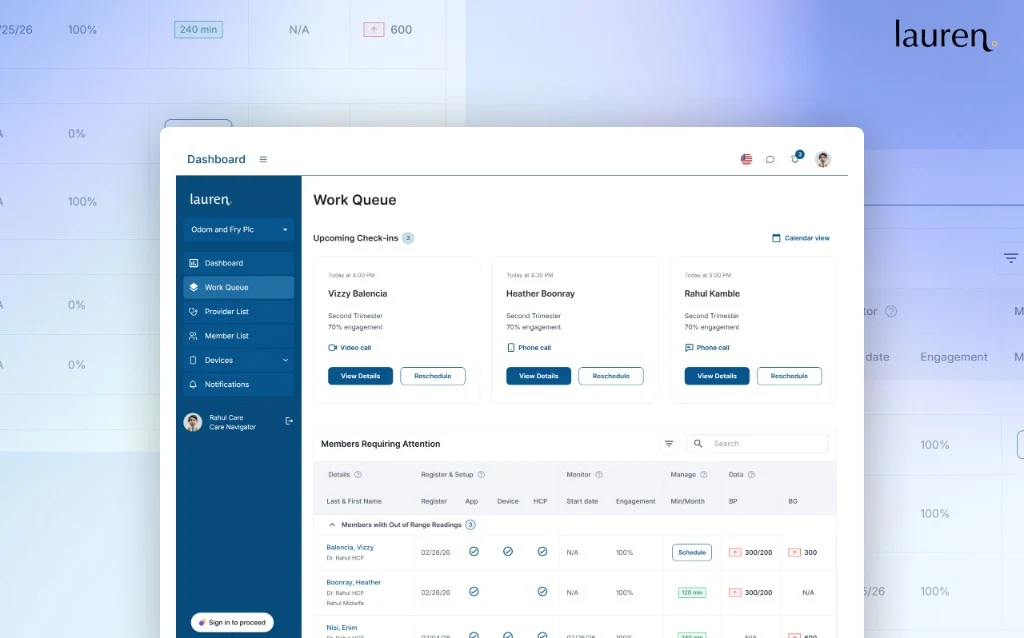

A women’s health product experience focused on guided care journeys, education, and compliance-aware workflows to support long-term engagement.
Common first releases, each scoped to one product class or one channel.
Adding prescription-only devices to an existing supply store without letting them ship unchecked.
Written order checks, proof of delivery and claims for a store that sold cash only.
Refill reminders and confirmations that follow Medicare timing instead of a fixed calendar.
Wheelchairs and aids delivered with instructions recorded at the door.
Verified practitioner accounts that can order prescription-only devices for their practice.
Lot and UDI capture added to an existing warehouse flow.
The systems the order flow reads from and writes to.
We build secure, scalable products designed for privacy, interoperability, and regulatory readiness from day one across every sector we serve.

Protect PHI with privacy-first architecture, encrypted storage and transmission, and strict access controls.
We combine deep technical expertise with industry-specific knowledge to deliver solutions that aren't just functional, but transformational.
We implement rigorous security protocols and compliance standards (HIPAA, GDPR, SOC2) across all industrial solutions to protect sensitive data.
Our architectures are built to handle massive data loads and user bases, keeping performance steady whether you're serving ten or ten million.
Using our suite of internal tools and proven frameworks, we cut setup work so your first release reaches users sooner.
Beyond simple wrappers, we build deep-learning integrations and predictive analytics directly into the core of your industry-specific workflows.
We start with one product class end to end. Timing depends on scope; we agree a fixed first release on the scoping call.
We list your product classes, sales channels and whether Medicare billing is in scope.
Every SKU is tagged with its class and capture rules, and your regulatory lead signs off the table.
One class, such as prescription-only devices, working from cart to delivery proof.
Medicare documentation and claims, or verified practitioner ordering, on the same order model.
Catalog rule changes, new product lines and payer updates under agreed change control.
Short facts we design around, each linked to its primary source.
A prescription device must be sold only to, or on the prescription or other order of, a practitioner licensed by law to use or order its use, and its label bears the statement "Rx only" or an equivalent caution.
Source: 21 CFR 801.109 (eCFR)Medicare pays for DMEPOS items only with a written order that names the beneficiary, describes the item, states the quantity, the order date, the treating practitioner and carries the practitioner's signature; for items on the Written Order Prior to Delivery List, the supplier must have it before delivery.
Source: 42 CFR 410.38(d)(1) (eCFR)For Medicare supplies shipped on a recurring basis, the supplier needs the beneficiary's affirmative request for a refill, made within 30 calendar days of the expected end of the current supply, and the date of service can be no earlier than 10 calendar days before that supply runs out.
Source: 42 CFR 410.38 (eCFR)A Medicare DMEPOS supplier must be responsible for delivering Medicare-covered items, keep proof of delivery, and document that beneficiaries received instructions on using the items safely and effectively.
Source: 42 CFR 424.57(c)(12) (eCFR)A unique device identifier has a fixed device identifier for the model and labeler, and a production identifier that can carry the lot or batch, serial number, expiration date and manufacturing date.
Source: 21 CFR 830.3 (eCFR)We don't just build products; we forge lasting partnerships. See how we've helped industry leaders transform their vision into technical reality.
“I can clearly see how Agnotic has a unique way of handling end-to-end development. They are always active on quick chat and provide support quickly.”

Aaron Phelan
Founder, Benchmark
“Agnotic combines deep technical expertise with strong domain knowledge. They understand the business context, anticipate challenges, and make collaboration smooth and effective.”

John Pasmore
Founder, Latimer
“Agnotic is the best technical team we evaluated. Their engineering excellence made our work dramatically easier and allowed us to stay focused on what matters most for maternal care outcomes. They took full ownership of the technical execution, and we are always happy to continue working together.”

Kim Smith
Founder, My Lauren
This page covers how product class changes the order flow. These pages cover the rest of the store and its neighbours.
Prescription drugs sold online, with e-prescription intake and pharmacist verification.
Storefront, catalog, subscriptions and loyalty for health retail brands.
Card, HSA and FSA payments connected to your checkout.
Claims and remittance transactions for sellers that bill Medicare.
Software for the device makers whose products the store sells.
Explore other production-grade engineering platforms we deliver across healthcare.
The technical patterns behind this platform translate naturally into adjacent verticals.